Introduction
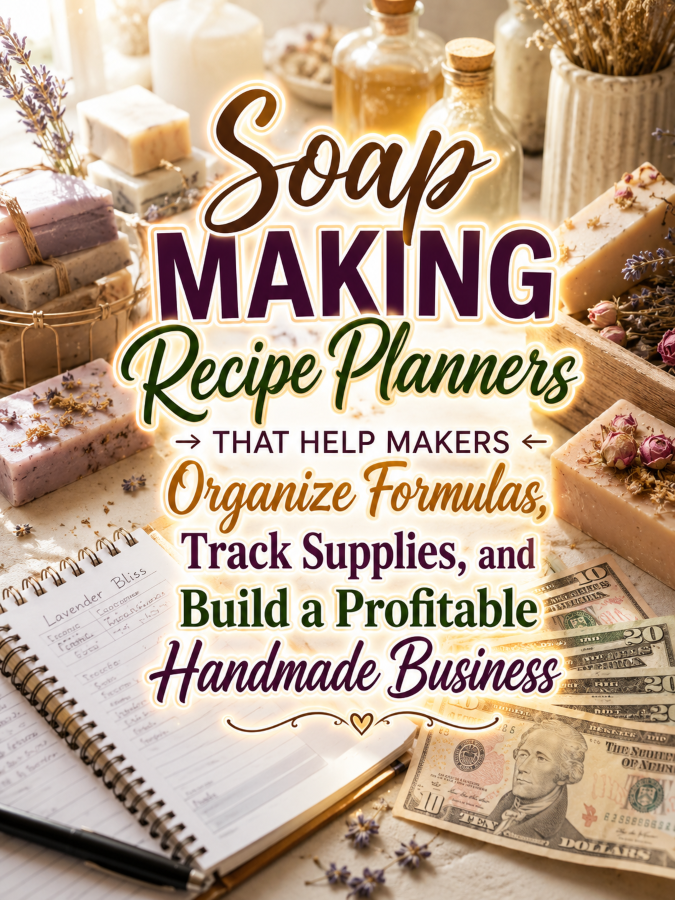
Soap making has a funny way of starting with one simple recipe and turning into a small chemistry-meets-creativity operation. Suddenly there are oils to track, fragrances to organize, colorants to remember, molds to catalog, test batches to document, and curing bars patiently waiting their turn.
That complexity creates a strong opportunity for practical printable products.
Soap makers need ways to record formulas, track ingredients, document fragrance combinations, organize test batches, monitor curing, calculate costs, manage inventory, and keep customer orders organized.
A Soap Making Recipe Planner can solve those problems while creating a natural $7 to $77 product ladder. Start with one focused recipe journal, then build upward into a complete soap-making studio and business management system.
Quick Answer
A Soap Making Recipe Planner can start as a $7 formula journal, expand into a $17–$27 soap-making studio toolkit, grow into a $37–$47 complete soap business planner, and reach $67–$77 as a premium customizable business command center.
The trick is not to make the higher-priced versions huge. Make them more useful. Each level should solve a bigger problem and save the customer more time.
Quick Win
Create a soap recipe worksheet that records the oils and fats, percentages, weights, fragrance, additives, colorants, mold, batch size, process notes, curing information, test results, production cost, and lessons learned.
Why This Niche Works
Soap making attracts beginners, hobby makers, natural-product enthusiasts, gift makers, seasonal creators, Etsy sellers, craft-fair vendors, and handmade business owners.
And soap making is naturally experimental.
A maker may change an oil, fragrance, colorant, additive, mold, batch size, or process and get a completely different result. A recipe that produces a beautiful bar today needs to be documented carefully if the maker wants to reproduce it later.
That makes a good recipe planner more than a pretty notebook. It becomes a working reference library.
For soap makers who sell their products, the organizational challenge becomes even bigger. They need to track ingredients, packaging, production batches, curing, inventory, costs, pricing, customer orders, seasonal collections, and marketing.
That gives you plenty of room to build a product ladder that grows alongside the customer.
The Reasonable Pricing Rule
Do not create a $77 product by taking your $7 recipe journal and adding 200 nearly identical blank pages.
More pages do not automatically create more value.
The $7 product should solve one focused problem: documenting soap recipes and experiments.
The $17–$27 product should organize the soap-making studio.
The $37–$47 product should organize the handmade business.
The $67–$77 product should provide customization, specialization, and a complete system for serious soap entrepreneurs.
Every upgrade should save time, reduce confusion, or help the customer make better production and business decisions.
Your $7 Starter Product
Create a printable called the Soap Making Recipe Journal.
Include:
- New Soap Idea Sheet
- Recipe Information Page
- Oil & Fat Ingredient Tracker
- Ingredient Percentage Worksheet
- Batch Weight Record
- Fragrance & Essential Oil Tracker
- Colorant & Additive Notes
- Mold Information Page
- Process Notes
- Trace Observation Record
- Curing Tracker
- Finished Soap Review
- Production Cost Worksheet
- Batch Notes
The goal is to help makers document exactly how a successful batch came together so they can reference, modify, or reproduce it later.
Grow It Into a $17 to $27 Soap-Making Studio Toolkit
Once a soap maker has accumulated oils, butters, fragrances, colorants, additives, molds, packaging supplies, and test batches, organization becomes a serious productivity advantage.
Your studio toolkit could include:
- Oil & Butter Inventory
- Ingredient Inventory
- Fragrance Library
- Essential Oil Library
- Colorant Inventory
- Additive Inventory
- Mold Inventory
- Packaging Supply Tracker
- Label Inventory
- Soap Cutter & Tool Inventory
- Recipe Library Index
- Test Batch Tracker
- Curing Schedule
- Works-in-Progress Tracker
- Finished Soap Inventory
- Seasonal Soap Planner
- Gift Collection Planner
- Craft Fair Inventory Planner
- Supplier Directory
- Weekly Production Planner
Now you’re selling a practical soap-making studio management system instead of another decorative recipe notebook.
Build a $37 to $47 Complete Soap Business Planner
When soap making becomes a source of income, the maker needs systems that go far beyond recording recipes.
Build a complete business planner with:
- Annual Business Planner
- 90-Day Business Goal Planner
- Soap Collection Planner
- Seasonal Collection Calendar
- New Product Development Planner
- Batch Production Log
- Curing Schedule
- Finished Product Inventory
- Customer Database
- Custom Order Tracker
- Wholesale Order Planner
- Sales Tracker
- Expense Tracker
- Ingredient Cost Calculator
- Production Time Tracker
- Profit Margin Worksheet
- Pricing Calculator
- Craft Fair Planner
- Marketing Calendar
- Social Media Content Planner
- Product Photography Checklist
- Customer Feedback Log
- Quarterly Business Review
- Year-End Business Review
This is where the product shifts from hobby organization to business management.
The customer is no longer asking only, “What soap should I make next?” They’re asking, “Which products should I sell, what should I charge, how much does each batch cost, and which products deserve more production time?”
Create a $67 to $77 Premium Bundle
Premium buyers want flexibility and specialization. Give them a complete system that can adapt to the type of soap business they actually run.
Your premium bundle could include:
- Editable Canva Templates
- Fillable PDF Planner
- Tablet-Friendly Digital Planner
- Cold Process Soap Edition
- Hot Process Soap Edition
- Milk Soap Business Edition
- Seasonal Soap Collection Planner
- Gift Soap Business Edition
- Wedding & Event Favor Planner
- Luxury Soap Collection Planner
- Soap Gift Box Planner
- Wholesale Soap Business Planner
- Craft Fair Seller Edition
- Custom Order Client Workbook
- Product Launch Planner
- Seasonal Collection Launch Kit
- Packaging & Label Planning Worksheets
- Commercial Use Rights for Handmade Business Coaches
The premium bundle should feel like a complete operating system for a serious soap brand.
Example Product Ladder
$7 Starter: Soap Making Recipe Journal
$17–$27 Toolkit: Soap-Making Studio Toolkit
$37–$47 Bundle: Complete Soap Business Planner
$67–$77 Premium: Editable Soap Business Command Center
Recommended Tools
- Canva for planner layouts, editable templates, labels, product sheets, and promotional graphics
- ChatGPT for product ideas, collection names, descriptions, marketing content, and planning prompts
- Creative Fabrica for commercial-use graphics, fonts, and design resources
- remove.bg for clean product mockups
- Google Trends for researching seasonal soap and gift-buying interests
- Etsy for product research and selling printable planners
- Payhip or Gumroad for digital product delivery
- Systeme.io for email marketing, lead magnets, and automated sales funnels
Your 5-Step Action Plan
Step 1: Organize Individual Soap Recipes
Start with a recipe journal that captures the important details behind every batch.
Record the ingredients, percentages, batch size, fragrance, additives, colorants, mold, process observations, curing information, project time, cost, and finishing notes.
Keep safety-related guidance separate from creative planning. A planner can provide a place to document calculations and observations, but it should not replace appropriate soap-making education, ingredient safety information, or applicable requirements for selling cosmetic products.
Step 2: Solve the Ingredient-Stash Problem
Expand the product with oil inventories, fragrance libraries, colorant trackers, additive records, mold inventories, packaging trackers, and recipe indexes.
This gives customers a reason to use the planner even when they are between batches.
Step 3: Add Business Management
Introduce pricing calculators, batch production logs, sales records, expense trackers, customer orders, wholesale worksheets, craft-fair planners, product launches, and marketing calendars.
Now you’re helping soap makers operate a business rather than simply organize a hobby.
Step 4: Develop Specialized Editions
Create focused versions for different soap-making audiences.
A wedding-favor edition could emphasize scent selections, quantities, personalization, packaging, deadlines, and delivery schedules. A luxury soap edition could focus on collections, premium packaging, fragrance profiles, pricing, and customer experience. A gift-box edition could organize soap combinations, packaging costs, seasonal themes, and collection launches.
Step 5: Build a Handmade Body-Care Product Ecosystem
Once your soap planner family is established, branch into candle making, wax melts, bath-product planning, perfume projects, resin art, jewelry making, pottery, paper crafts, and other maker-business niches.
One strong product ladder can become the foundation for an entire creative-business printable collection.
Common Pricing Mistakes to Avoid
One of the biggest mistakes is creating a planner that looks beautiful but does not actually help the customer make better decisions.
Pretty pages are nice. Useful pages are what make a product valuable.
A soap maker should be able to use your journal to answer practical questions:
- Which recipe did I use?
- What ingredients and percentages went into the batch?
- Which fragrance did I use?
- Which colorants or additives did I use?
- What size was the batch?
- How did the process perform?
- How long did the soap cure?
- How much did the batch cost?
- Can I reproduce this recipe?
- What should I charge for the finished product?
Another mistake is putting everything into the $7 product.
If the starter journal already includes inventory management, customer orders, marketing, wholesale planning, and financial tracking, there is little reason for customers to purchase the higher-priced versions.
Create a clear value staircase instead. The starter solves one problem. The toolkit solves several. The business planner connects the operation. The premium bundle delivers customization and specialization.
Important Safety and Compliance Consideration
Soap making can involve lye, fragrances, essential oils, colorants, and other ingredients that require appropriate handling. Your planner should support organization without presenting itself as a substitute for proper safety education or manufacturer instructions.
For example, a recipe worksheet can provide space for recording ingredient weights, calculations, process observations, curing dates, and batch results. It should not imply that filling out the worksheet automatically makes a recipe safe.
If the product is marketed to people who sell soap, avoid promising that the planner guarantees legal or regulatory compliance. Requirements can vary depending on the product, claims, ingredients, packaging, and location.
This actually strengthens the product. A short professional reminder to verify applicable requirements and follow appropriate safety practices makes the planner feel more responsible and useful.
Where to Find Buyers
- Soap-making Facebook groups
- Cold process soap communities
- Handmade soap business groups
- Bath and body maker communities
- Etsy seller groups
- Handmade business communities
- Craft fair vendor groups
- Pinterest soap-making audiences
- Small-batch maker communities
- Local craft and maker groups
Don’t market every version to everyone. A beginner recipe journal and a wholesale production planner solve very different problems.
Affiliate Opportunities
Soap-making planners also create natural opportunities for related affiliate content. The planner becomes the organizational product while complementary supplies become useful recommendations.
- Soap-making molds
- Digital scales
- Immersion blenders
- Mixing containers
- Soap cutters
- Protective equipment
- Ingredient storage containers
- Fragrance storage systems
- Soap stamps
- Packaging supplies
- Label printers
- Craft lighting
Internal Link Suggestions
- Candle Making Recipe Journals
- Paper Craft Project Planners
- Resin Art Project Planners
- Jewelry Making Project Planners
- Pottery Project Planners
- Macramé Project Planners
- Quilting Project Planners
- Sewing Project Planners
Pinterest Pin Ideas
- The Soap Making Recipe Journal Every Maker Needs
- Organize Your Oils, Fragrances, Molds, and Soap Recipes
- Turn Your Soap-Making Hobby Into a More Organized Business
- From Test Batch to Product Collection: The Soap Planner System
- Build a $7 to $77 Soap-Making Product Ladder
Frequently Asked Questions
Who buys Soap Making Recipe Journals?
Soap-making hobbyists, small-batch makers, handmade soap sellers, Etsy shop owners, craft-fair vendors, gift makers, wedding-favor businesses, and growing soap brands can all benefit from these planners.
Can this niche generate repeat customers?
Yes. Soap makers frequently develop seasonal scents, gift collections, event favors, new formulas, limited editions, and wholesale lines. Each activity creates opportunities for additional specialized planners.
Should I create different versions for different soap-making niches?
Absolutely. Cold process soap, hot process soap, milk soap, luxury collections, wedding favors, gift boxes, and wholesale production can all have different workflows. Specialty editions let you market directly to those audiences.
Can the starter product work for hobbyists?
Yes. The $7 recipe journal can focus entirely on documenting personal experiments and successful formulas. Higher tiers can gradually introduce inventory management, production planning, selling, customer orders, marketing, and business planning.
Can I include recipe calculation pages?
Yes. Calculation worksheets can be useful for organizing a maker’s own recipe-development process. However, the planner should clearly state that makers remain responsible for verifying calculations, ingredient information, safety procedures, and any requirements that apply to their products.
Call to Action
A great soap starts with a thoughtful formula, quality ingredients, careful process, and an idea. A successful soap business needs something else: a system that keeps all those moving pieces organized.
Start with a $7 Soap Making Recipe Journal that helps makers document their formulas and experiments. Then expand it into a $17–$27 studio toolkit, a $37–$47 complete business planner, and finally a $67–$77 premium command center.
Don’t build the entire ladder at once. Start with one useful solution, pay attention to what customers need next, and build each upgrade around a real problem.
That’s how a simple soap-making printable can become the foundation for a much bigger digital product business.
Conclusion
Soap makers already have creativity, patience, and enough fragrance combinations to make choosing the next scent feel like a serious strategic decision.
What they need is a practical system for organizing recipes, ingredients, fragrances, molds, batches, curing schedules, finished products, customers, and business decisions.
A Soap Making Recipe Journal turns scattered experiments into a repeatable workflow. Start with a focused $7 recipe journal, expand it into a comprehensive $77 business command center, and you have a product ladder that can grow alongside the customer’s handmade business.
And once the model works for soap making, you have a natural path into candle making, wax melts, bath-product planning, jewelry making, pottery, paper crafts, resin art, and other maker niches. One well-designed planner can become an entire creative product ecosystem.
That wraps up today’s discoveries. If anything caught your attention or made you feel excited, why not take the first step today and see where it leads?
Enjoy!