Introduction
Imagine sitting at a family gathering where one child is pretending a spoon is a spaceship, another is asking why clouds do not fall out of the sky, and a third is telling the same knock-knock joke for the eighteenth time. Everyone is smiling politely, but you can almost hear the grown-ups mentally updating their life insurance policies.
Families are always looking for simple entertainment that does not involve batteries, subscriptions, or mysterious noises coming from a tablet hidden under a couch cushion.
But!
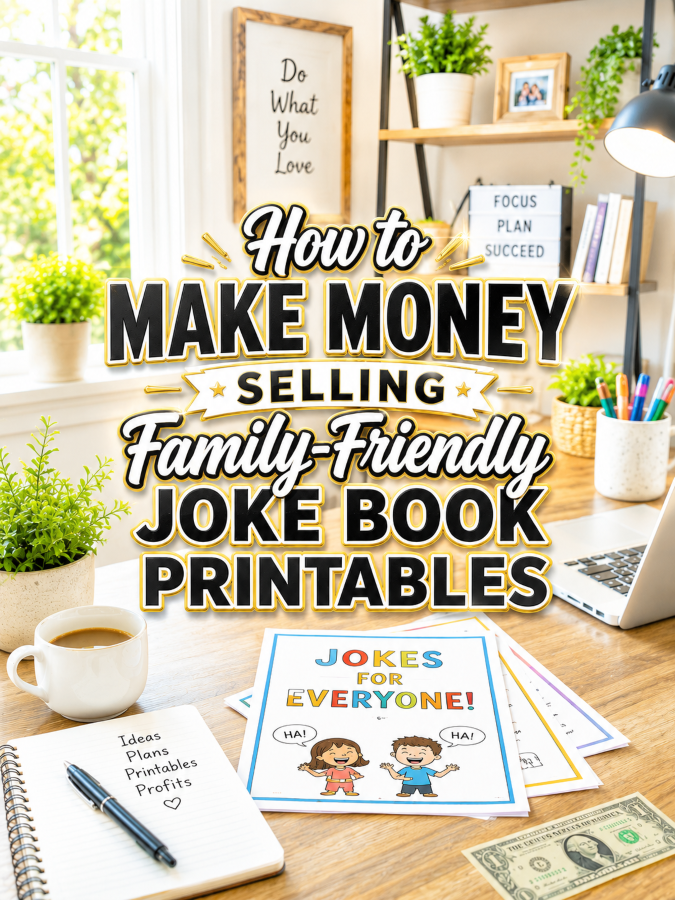
Family-Friendly Joke Book Printables give parents, grandparents, teachers, and event organizers an easy way to keep children laughing while creating a surprisingly profitable digital product opportunity.
Better yet, these printable joke books are evergreen. Unlike some trend that disappears faster than Sumerian software, good clean humor never goes out of style.
Quick Answer
Family-Friendly Joke Book Printables are downloadable collections of clean jokes, riddles, funny questions, knock-knock jokes, and themed humor pages designed for children and families. Buyers print them at home or use them digitally.
A starter joke book can sell for around $7, while expanded bundles, themed collections, classroom licenses, and seasonal joke packs can grow into $27, $47, or even $77 offers.
Families are actively searching for screen-free activities, and that someone creating the solution could absolutely be you!
Why This Niche Works
Parents spend billions every year on activities that keep children entertained. Many of those activities last about as long as a WiFi signal during a thunderstorm.
Humor is different. A child who laughs at a joke today often shares it with siblings, cousins, classmates, neighbors, and possibly a confused dog. That creates built-in sharing power that many digital products never achieve.
Think about your favorite restaurant. When they bring out a fantastic dessert, you are much more likely to order another one next time. Family-friendly joke books work the same way. Once parents discover a source of safe, age-appropriate humor, they often return for more collections.
Oddly enough, many creators ignore this niche because they assume jokes are too simple. That is like refusing to sell umbrellas because rain seems obvious.
Prior to pouncing upon this opportunity, you should first know all about the:
Tools You’ll Need
You do not need a comedy degree or a Hollywood writing room. These tools will handle most of the heavy lifting.
- Canva for designing printable joke books and covers.
- Google Docs for organizing jokes and formatting content.
- AWeber for building an email list of parents and teachers.
- GetResponse for automated follow-up promotions.
- Gumroad for selling downloadable files.
- Teachable if you expand into educational resources later.
- Amazon Joke Book Research for studying popular formats.
Next, move to:
Your 5-Step Action Plan
Follow these steps carefully unless you enjoy spending 19 hours rewriting punchlines that already worked perfectly.
Step 1. Research Popular Joke Categories
Spend about 83 minutes reviewing existing joke books. Look for themes that consistently appear across successful products.
Create a list containing 28 to 34 categories such as animal jokes, school jokes, food jokes, holiday jokes, and knock-knock jokes.
The goal is not to copy. The goal is to understand what makes children giggle repeatedly.
Step 2. Build Your First Printable Collection
Create a starter book containing 63 to 85 jokes. Group them into clear sections that make browsing easy.
Add fun illustrations and simple layouts. Children should be able to enjoy the content without feeling like they are reading tax paperwork.
A cheerful design creates a much better experience.
Step 3. Add Interactive Extras
Include joke-writing worksheets, fill-in-the-blank humor pages, and riddle challenges.
These bonus thingees increase perceived value while encouraging repeat use.
Parents appreciate activities that keep children engaged longer.
Step 4. Create Multiple Versions
Develop editions for different age groups. A joke that delights a six-year-old may receive a dramatic eye roll from a twelve-year-old.
You can also create themed books for holidays, birthdays, classrooms, and family road trips.
Each version becomes another product in your catalog.
Step 5. Build Your Product Ladder
Start with a $7 printable joke book. Offer a larger themed bundle for $27 and a complete collection for $77.
Add classroom licenses and seasonal joke packs for additional revenue streams.
Once you’ve figured out all of the above, the next step is implementing:
3 Ways to Stand Out From The Thundering Herd!
Most sellers become a restaurant menu that simply says “food.” Specificity creates attention.
Way 1. Focus on Family-Safe Humor
Parents constantly search for clean jokes that do not create awkward conversations at dinner.
Make your collection completely family-friendly and highlight that benefit throughout your marketing.
Trust becomes a major selling point.
Way 2. Create Themed Collections
Offer joke books for camping, holidays, pets, sports, school, and travel.
People often purchase multiple themed products once they enjoy the first one.
That creates repeat customers without requiring fresh customer acquisition.
Way 3. Include Activity Pages
Combine jokes with coloring pages, puzzles, and writing prompts.
This transforms your product into a complete entertainment kit rather than a simple booklet.
Next, here’s the thing. You’re probably NOT the only person offering this service. So you now require:
3 Nifty Ways to Find Customers
You do not need paid advertising. Buyers often send up a Bat Signal without realizing it.
Way 1. Parenting Communities
Parenting groups frequently discuss screen-free activities and family entertainment.
Helpful recommendations often outperform direct promotions.
Become known as the person with solutions.
Way 2. Teacher Groups
Teachers constantly search for fun classroom resources.
A printable joke book works beautifully during transition times and classroom celebrations.
This audience can become a consistent source of buyers.
Way 3. Pinterest
Pinterest users actively search for printable activities and educational resources.
Create multiple pins featuring sample jokes and colorful covers.
One successful pin can continue sending traffic for months.
Speaking of completed projects, now let’s move to:
3 Takeaways You Won’t Find Elsewhere!
These aren’t feel-good reminders. They directly affect your earning potential.
Takeaway 1. Laughter Solves a Real Problem
Parents are not simply buying jokes. They are buying entertainment, connection, and a few moments of peace.
Understanding the real benefit helps you market more effectively.
The joke is merely the delivery system.
Takeaway 2. Simplicity Often Wins
You do not need 300-page masterpieces.
A well-organized collection of 72 great jokes can outperform a bloated book stuffed with filler.
Quality remains a Good Thing.
Takeaway 3. One Idea Creates Many Products
A single joke collection can be repurposed into holiday editions, activity packs, classroom resources, and email lead magnets.
That creates multiple income streams from the same creative foundation.
Now that you know the above, it’s time for:
3 Common Mistakes to Avoid
Many creators mix adult humor into family products.
That is Not a Good Thing. Parents expect content they can confidently share with children.
Some sellers ignore design quality.
Even the funniest jokes lose impact when they are presented like a flip phone from 2009.
Others create only one product and stop.
The real opportunity comes from building a collection of related resources.
What else should you know? How about:
Scaling Your Results
Create monthly joke book series.
Subscribers love receiving fresh content throughout the year.
Expand into educational humor products.
You can create language arts activities, reading comprehension worksheets, and classroom packs.
Build a complete family entertainment library.
A catalog of 22 themed products could realistically generate an additional $286 to $914 monthly from repeat buyers. Trust me, you’ll thank me later.
Let’s now wrap up everything via the:
Your Next Steps
So.
Create a list of 72 family-friendly jokes this week.
Design a simple printable book using Canva and save it as a PDF.
Reach out to five potential buyers or communities where parents gather. Remember that 5 good messages beats 50 generic ones every single time.
Next, let’s finish with:
Final Thoughts
Family-Friendly Joke Book Printables combine simplicity, fun, and recurring demand.
They solve a genuine problem while giving families something they can enjoy together.
So.
You do not need a giant audience or a professional comedy background. You simply need a useful collection that brings smiles to the people who use it.
That’s it. That’s your beginning!
Which joke category would you create first – animals, school, holidays, or something entirely different?
Enjoy!