Introduction
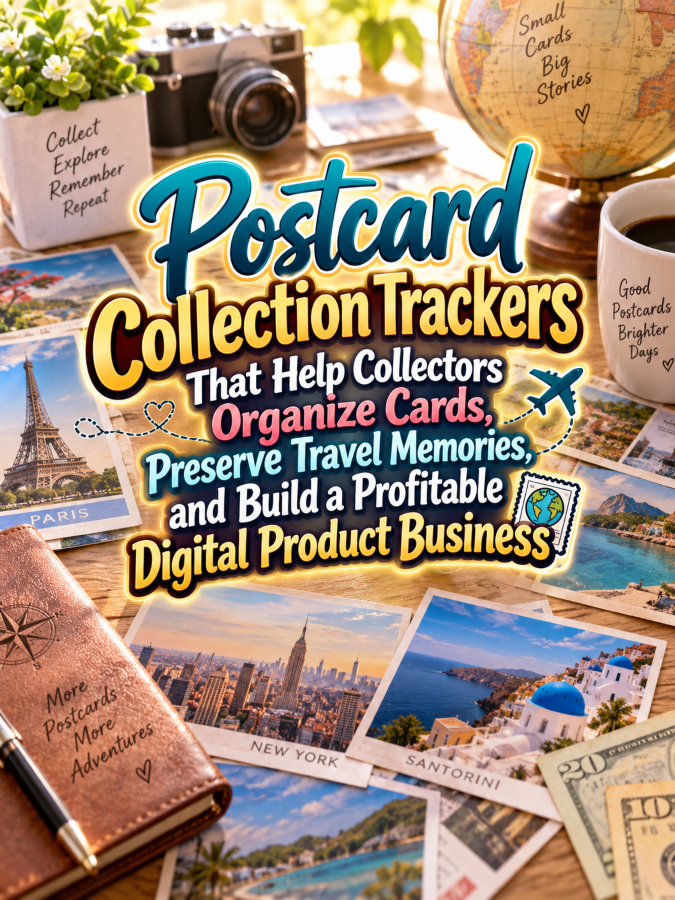
Postcard collecting has a funny way of starting small. You find one beautiful card from a place you’ve visited, then another from an old family trip, and before long you’ve got cards tucked into drawers, boxes, albums, envelopes, and that one “safe place” you can never remember later. Suddenly, your collection isn’t just a stack of pretty pictures. It’s a collection of places, stories, dates, people, and memories that deserves a better system.
That’s where postcard collection trackers can become surprisingly useful. A good tracker can help collectors record where each card came from, when it was acquired, who sent it, what location it represents, what it cost, and why it matters. It can also help collectors organize cards by country, state, city, theme, era, sender, holiday, or other categories that make sense for their collection.
And here’s the business opportunity: you don’t have to create one enormous postcard collecting product and hope somebody buys it. You can build a simple $7 tracker first, expand it into a $17 to $27 organization kit, turn that into a $37 to $47 collection management bundle, and then create a premium $67 to $77 editable product for buyers who want more flexibility. Each step should add real usefulness, not just another 47 pages of boxes that nobody asked for.
Quick Answer
A $7 to $77 postcard collection product ladder starts with a simple inventory tracker and grows into a complete collection organization system. The $7 version can help collectors record basic card information, while the $17 to $27 version adds specialized trackers, examples, and organization tools. The $37 to $47 version can become a complete postcard collection planner, while the $67 to $77 version can add editable templates, customization guidance, promotional assets, and appropriate commercial-use options.
The key is to make every level solve a bigger problem. The buyer shouldn’t feel like they’re paying more for the same tracker with a different cover. They’re paying for more help, more flexibility, more time saved, and a clearer way to manage or use the collection.
Once you understand that progression, postcard collecting becomes a very workable niche for a small digital product ladder.
Why Postcard Collection Trackers Work As A Product Ladder
Postcards are naturally suited to cataloging because every card can contain several pieces of information. A collector may care about the location shown on the card, the date it was mailed, the sender, the postmark, the publisher, the condition, the theme, the acquisition source, and the story behind the card. A collector who only owns a few dozen cards may remember much of that information, but a larger collection can quickly become difficult to manage.
There is also an emotional side to postcard collecting that makes organization especially valuable. A postcard may represent a vacation, a childhood home, a family member, a favorite city, a historic location, or a memorable trip. A tracker can preserve those details alongside the physical card, which means the organizational product isn’t just about counting objects. It’s helping preserve the story attached to them.
That gives you several different buyer problems to solve. Beginners may want a basic inventory. Experienced collectors may need category and storage systems. Travelers may want a travel-memory journal that works alongside their collection. Collectors of vintage or historical postcards may want more detailed research pages. Different needs create natural opportunities for different product levels.
A useful postcard tracker can help answer questions such as:
- What postcards do I own?
- Where did each card come from?
- Who sent or gave me the card?
- When did I acquire it?
- What location does the card represent?
- What does the postmark say?
- What theme or category does it belong to?
- Where is the card stored?
- Do I have duplicate cards?
- Which places or themes am I still looking for?
That’s enough practical information to create a product that feels useful before you ever get anywhere near the premium tier.
The Reasonable Pricing Rule For Postcard Collection Products
The pricing ladder should be based on usefulness, not page count. At $7, you’re giving the buyer a quick win. At $17 to $27, you’re providing a more complete kit. At $37 to $47, you’re creating a working collection system. At $67 to $77, you’re offering premium flexibility, editable assets, customization help, or other features that genuinely save the buyer time.
That means the $7 product should not try to be everything. A simple postcard inventory tracker can be enough if it helps the buyer immediately start recording their collection. The $17 to $27 version can then answer the next questions, such as how to organize cards by location, theme, acquisition source, or storage area.
The $37 to $47 bundle should feel like a complete solution, while the premium version needs an even clearer reason for the higher price. Editable Canva templates, editable documents, finished PDFs, customization instructions, promotional copy, and appropriate commercial-use rights can all contribute to premium value when they actually serve the buyer. The $77 price should never exist simply because you changed the number on the sales page.
If the niche-specific product doesn’t support $77 honestly, stop at $47 or $67. A smaller offer with strong value is always better than a premium offer that makes the buyer wonder whether somebody accidentally misplaced the decimal point.
The $7 Starter Product: Postcard Collection Inventory Tracker
The natural $7 starting product is a Postcard Collection Inventory Tracker. Its job is simple: help a collector record the important information about each card in one consistent place. It should be easy enough for a beginner to understand without needing a 30-minute orientation session.
Each page could include fields for postcard title or description, location, country or state, acquisition date, acquisition source, sender, postmark, theme, condition, storage location, and notes. You could also include a small photo area so collectors can match their physical card to the record.
Because this is the entry-level product, resist the temptation to include every possible feature. You don’t need extensive research worksheets, social media content, elaborate storage plans, or commercial-use materials at $7. Give the buyer a clean, useful starting point and let the larger products provide the additional layers.
- Postcard inventory pages
- Location and country fields
- Acquisition information
- Sender information
- Postmark field
- Theme or category field
- Condition notes
- Storage location field
- Photo or image space
- Simple collection summary page
The best $7 product is one the buyer can open today and start using today. That’s your quick win.
The $17 To $27 Expanded Kit: Postcard Collection Organization Toolkit
Once you’ve created the basic tracker, you can expand it into a Postcard Collection Organization Toolkit priced around $17 to $27. This version should help collectors do more than record cards. It should help them make sense of the collection.
Add specialized pages for duplicate cards, cards needing research, favorite cards, travel memories, wish-list cards, purchases, trades, gifts, and storage locations. You can also create separate inventory sheets for different collection styles, such as location-based collecting, themed collecting, vintage postcards, holiday cards, or travel postcards.
The buyer should feel that you’re helping them organize the entire hobby rather than simply giving them additional blank pages. Include examples of completed entries and short instructions explaining how to keep information consistent. A simple organization guide can be surprisingly valuable because it removes the “Where do I even start?” problem.
- Everything from the $7 inventory tracker
- Duplicate postcard tracker
- Research-needed tracker
- Wish-list tracker
- Purchase log
- Trade and gift log
- Favorite postcard pages
- Travel memory pages
- Storage location tracker
- Theme-based inventory pages
- Sample completed pages
- Quick organization guide
This is the point where your product starts feeling like a real toolkit instead of a printable worksheet pack.
The $37 To $47 Working Bundle: Complete Postcard Collection Planner
The $37 to $47 level should bring everything together into a more complete system. A strong product name could be The Complete Postcard Collection Planner and Cataloging Bundle. This version should help serious collectors manage inventory, research, organization, storage, collecting goals, and the stories connected to their cards.
You can combine a main collection guide with a workbook, inventory pages, research worksheets, storage planning tools, purchase logs, wish lists, duplicate tracking, collection goals, and travel-memory pages. You can also add a QuickStart section that walks buyers through setting up their collection system in a logical order.
This bundle can become especially appealing to collectors with larger collections because it saves them from building their own system piece by piece. Instead of wondering which fields to track or how to organize categories, they receive a ready-made framework they can adapt. That’s useful value, not decorative page inflation.
- Complete postcard catalog
- Collection organization workbook
- Research worksheets
- Postmark recording pages
- Purchase and acquisition logs
- Trade and gift records
- Duplicate tracker
- Wish-list pages
- Storage planning sheets
- Travel memory journal pages
- Collection goals worksheet
- QuickStart setup guide
- Collection review checklist
- Postcard photography checklist
At this price, you’re selling a working system that helps the collector save time and stay organized. It doesn’t need to become a gigantic course. In fact, it shouldn’t unless you actually intend to build a course.
The $67 To $77 Premium Editable Postcard Collection Kit
The premium level can become an Editable Postcard Collection Management Kit for collectors, bloggers, educators, clubs, or digital product creators who need more flexibility. This is where editable files can make a major difference.
You could include editable Canva versions of the tracker pages, editable Word or Google Docs files, finished PDF versions, customization instructions, product packaging guidance, mockup ideas, sales copy starters, short promotional emails, and social media captions. If you offer commercial-use, resale, or PLR rights, those terms should be clearly defined so buyers know exactly what they can and cannot do.
The premium price is justified by saved time and flexibility. Someone who wants to change categories, colors, headings, instructions, or audience-specific wording can do that without rebuilding the entire product. If resale rights aren’t appropriate for your offer, simply make this a premium editable implementation kit instead.
- Everything from the lower tiers
- Editable Canva templates
- Editable Word or Google Docs files
- Finished printable PDFs
- Customization guide
- Product packaging guide
- Sales page copy starter
- Short promotional email ideas
- Social media promotional copy
- Mockup ideas
- Setup checklist
- Commercial-use option where appropriate
- Clear license terms
- Resale or PLR option only when appropriate
Again, don’t make the premium product longer just to make it look impressive. Make it easier to use, customize, package, and implement.
Example $7 To $77 Postcard Collection Product Ladder
Here’s what the complete ladder could look like when you put the pieces together. Notice that every level has a different job. That’s what keeps the ladder from becoming four versions of the same product.
- $7 Starter: Postcard Collection Inventory Tracker with basic cataloging, location, acquisition, sender, postmark, and storage fields.
- $17 to $27 Kit: Postcard Collection Organization Toolkit with duplicates, research, purchases, trades, wish lists, travel memories, storage, and examples.
- $37 to $47 Bundle: Complete Postcard Collection Planner with the full cataloging, research, organization, storage, and collection-planning system.
- $67 to $77 Premium: Editable Postcard Collection Management Kit with Canva templates, editable documents, finished PDFs, customization help, promotional assets, and appropriate licensing options.
The $7 version is for the collector who wants to start recording cards. The $27 version is for the collector who wants more ways to organize. The $47 version is for the person who wants a complete system. The premium version is for someone who values flexibility and wants to save even more time.
That progression gives every buyer a reasonable entry point while giving you room to expand the product line. You aren’t trying to convince every customer to buy the $77 product. You’re giving different buyers a product that matches how much help they need.
Tools You Can Use To Create This Ladder
You can build this product ladder with a surprisingly simple tool stack. Canva can handle the visual design, covers, printable pages, editable templates, labels, and mockups. Google Docs can be useful for editable guides, while Google Sheets can provide a digital inventory option for collectors who prefer working on a computer.
ChatGPT can help brainstorm collection categories, worksheet questions, product names, instructions, descriptions, and promotional copy. The important word is “help.” Your final tracker still needs human judgment because collectors need practical fields, not a worksheet designed by a committee of robots who have never touched a postcard.
For delivery, Payhip and Gumroad are simple options for selling digital products. Keep the technology behind the product simple enough that you can maintain it without turning product delivery into a second hobby.
- Canva – printable designs and editable templates
- Google Docs – editable guides and worksheets
- Google Sheets – digital inventory tracking
- ChatGPT – brainstorming, instructions, prompts, and copy support
- Payhip – digital product delivery
- Gumroad – digital product sales
How To Know If Your Price Is Fair
Pricing becomes much easier when you stop asking, “How many pages did I make?” and start asking, “What does this help the buyer do?” A 12-page tracker that solves a real organizational headache can be more valuable than a 90-page workbook that nobody wants to finish.
Think about the time you’re saving. Does the product help the collector quickly record cards? Does it make research easier? Does it help them find cards later? Does it preserve stories that might otherwise be forgotten? Does the premium version eliminate hours of formatting and template creation?
Use these questions as your pricing sanity check:
- Does the product solve a clear collector problem?
- Does it save the buyer time?
- Does it help them organize something they already struggle to manage?
- Are the instructions easy to follow?
- Are useful examples included?
- Does each higher tier provide noticeably more value?
- Are editable files included when the premium price depends on them?
- Would I personally feel good buying this at the listed price?
If your $77 product doesn’t feel dramatically more useful than your $27 product, don’t just add more pages. Find the missing value.
5-Step Action Plan For Building Your Postcard Collection Ladder
The easiest way to build this ladder is to work upward instead of trying to create everything at once. Your first goal isn’t to build a $77 masterpiece. Your first goal is to create one small product that solves one real problem.
Once that first product works, you can expand it naturally. Every new tier should grow from something the buyer needs rather than something you invented because you thought the product needed to look bigger.
Step 1: Pick One Buyer Problem
Start with one clear problem. For example, collectors may struggle to remember what postcards they own, where they found them, or where those cards are stored.
Pick one problem that is easy to explain in a single sentence. That sentence will guide the first product, the product description, the Pinterest content, and eventually the rest of the ladder.
Step 2: Create The $7 Quick Win
Create the simplest useful postcard inventory tracker you can. Give the buyer enough fields to record meaningful information without making the page feel like a tax return for postcards.
Print several pages and test them with different types of cards. Try vintage cards, travel cards, family cards, themed cards, and cards with limited information. If the tracker works across several examples, you’ve got a stronger starter product.
Step 3: Expand It Into A Kit
Look at everything your $7 tracker doesn’t solve. Those gaps become your $17 to $27 product opportunities.
Add research pages, duplicate tracking, purchase logs, wish lists, storage planning, travel-memory pages, examples, and instructions. You’re not starting over. You’re building outward from the same buyer problem.
Step 4: Build The Premium Version
Combine the strongest pieces into the $37 to $47 working bundle. Then identify what would save your premium buyer even more time.
Editable Canva templates, editable documents, finished PDFs, customization instructions, promotional copy, and appropriate commercial-use options can all help. Make sure every premium feature has a reason to exist.
Step 5: Test The Ladder
Put all four offers next to each other and explain them in plain language. If you can’t quickly explain why somebody would choose the $27 version instead of the $7 version, the difference isn’t strong enough yet.
Do the same test with the $47 and $77 products. Each jump should answer a buyer’s next question and provide a clear reason to move upward.
Common Pricing Mistakes To Avoid
The first mistake is assuming that more pages automatically equal more value. They don’t. A collector doesn’t need 80 nearly identical inventory pages when 20 well-designed pages plus useful organization tools would do the job better.
The second mistake is making every tier look almost identical. If the $7, $27, $47, and $77 versions all contain basically the same tracker with slightly different covers, buyers have no reason to upgrade. Each level needs a distinct purpose.
The third mistake is making the premium version expensive without making it flexible. If you’re charging $77 because the product is editable, then the editable files need to be genuinely useful. If you’re offering resale or PLR rights, the license needs to be clear. If you’re not offering those features, focus the premium value somewhere else.
- Charging $77 for a thin PDF: Build real implementation value first.
- Adding pages instead of usefulness: Add tools that solve new problems.
- Making every tier too similar: Give every level a clear purpose.
- Offering unclear rights: Use simple, specific license terms.
- Forgetting editable files: Include them when customization is part of the premium promise.
- Using fake income claims: Focus on product value instead of guaranteed earnings.
- Making the ladder confusing: Keep the differences obvious.
Where To Find Buyers For Postcard Collection Trackers
Your best potential buyers are people who already care about postcards and organization. That can include postcard collectors, travel-memory keepers, vintage enthusiasts, pen-pal communities, scrapbookers, paper-craft fans, and people who collect location-based memorabilia.
Etsy can be useful for testing demand for printable collection products, while Pinterest can help you reach people searching for collection organization and travel-memory ideas. You can also use your own blog to create helpful content around postcard storage, cataloging, collecting, and memory keeping.
Niche communities can be valuable for research too. Don’t enter a collector group and immediately start yelling, “BUY MY TRACKER!” That’s the thundering herd approach, and it tends to make people run in the opposite direction. Instead, listen to the questions collectors ask, identify repeated problems, and create useful content that naturally points toward your product.
- Etsy marketplace searches
- Pinterest searches
- Postcard collecting communities
- Travel-memory communities
- Scrapbooking communities
- Vintage collecting groups
- Pen-pal communities
- Your blog and email list
- Short-form social content about postcard organization
Affiliate Opportunities Around Postcard Collecting
Postcard collectors may also need physical products to store, display, photograph, and protect their collections. That creates natural opportunities for related affiliate content.
You could write helpful articles about postcard storage boxes, protective sleeves, albums, labeling supplies, display stands, photography accessories, magnifying tools, and archival storage options. Those articles can answer a useful question while introducing products that support the same hobby.
Keep your recommendations connected to the problem you’re solving. The goal isn’t to turn every paragraph into an affiliate pitch. The goal is to become a helpful resource that happens to include relevant product recommendations.
- Postcard albums
- Protective sleeves
- Archival storage boxes
- Labeling supplies
- Storage dividers
- Display stands
- Photography accessories
- Magnifying tools
- Collection organization supplies
Internal Links To Build Around This Product
A postcard tracker becomes much easier to promote when you build related content around it. Instead of asking one article to attract every possible buyer, create several useful posts that address different stages of the collecting journey.
An article about postcard storage can lead into the tracker. A post about preserving travel memories can introduce the travel-memory pages. A guide to cataloging vintage postcards can point toward the complete collection planner.
This creates a helpful content path. Someone may discover you through a storage article, read about cataloging, realize they need a tracker, and then discover that you also have a more complete collection system.
- How To Organize A Postcard Collection
- Postcard Storage Ideas For Collectors
- How To Catalog Vintage Postcards
- How To Preserve Travel Memories With Postcards
- Postcard Collection Inventory Ideas
- How To Photograph Your Postcard Collection
- Printable Collection Trackers For Hobbyists
- How To Create A Collection Catalog
Simple Pinterest Ideas For Postcard Collection Trackers
Postcards are naturally visual, which makes Pinterest a strong place to promote this type of product. Show attractive cards alongside a clean tracker page so the viewer immediately understands the connection between the hobby and the organizational solution.
Create different pins for different buyer problems. One pin can focus on organizing a large collection. Another can focus on preserving travel memories. Another can show how to track postcards by country or state. Another can highlight the research side of vintage postcards.
Keep the text specific and useful. “Printable Postcard Collection Tracker” tells the viewer exactly what they’re getting. “This Will Change Your Life Forever!” tells them approximately nothing, except that somebody has been spending too much time on the internet.
- “Printable Postcard Collection Tracker”
- “How To Organize A Postcard Collection”
- “Vintage Postcard Inventory Template”
- “Postcard Storage Ideas For Collectors”
- “Travel Memory Postcard Journal”
- “How To Catalog Vintage Postcards”
- “Postcard Collector Organization System”
- “Printable Hobby Collection Planner”
Frequently Asked Questions About Postcard Collection Trackers
Collectors may wonder whether they need a tracker, what information belongs in one, and which version makes sense for their collection. A useful FAQ can answer those questions before they become buying objections.
Keep your answers simple and honest. The product doesn’t need to pretend that every postcard collector needs the $77 version. Sometimes the $7 tracker is exactly the right product, and that’s perfectly fine.
What should I track for each postcard?
Useful fields can include the postcard description, location, country or state, date acquired, acquisition source, sender, postmark, theme, condition, storage location, and notes. Collectors can add other fields based on the type of collection they’re building.
Is a $7 postcard tracker enough for a beginner?
Yes. A simple inventory tracker can be a very practical starting point for someone who wants to stop keeping postcards in random piles and start building a basic catalog. The buyer can always move to a larger system later if the collection grows.
What should a $27 postcard collection kit include?
A $27 kit can add duplicate tracking, research worksheets, purchase logs, wish lists, storage planning, travel-memory pages, collection goals, examples, and instructions. The buyer should feel that the kit helps them manage the collection rather than simply record individual cards.
What makes a postcard collection product worth $47?
A $47 product should feel like a complete working system. Combining cataloging pages with research tools, storage planning, collection goals, purchase records, travel-memory pages, examples, and a QuickStart process can make the product substantially more useful.
What could make the premium version worth $77?
The premium version needs additional value beyond the printable content. Editable Canva templates, editable documents, finished PDFs, customization instructions, promotional materials, and appropriate commercial-use or licensing options can make the product more flexible and time-saving. If those features don’t add enough value for the niche, a lower premium price may be the better choice.
Simple Promo Angles For Postcard Collection Trackers
Your promotional copy should focus on the real frustrations collectors experience. They want to know what they own. They want to find cards again. They want to remember where a card came from. They want to preserve the story instead of having it disappear into a box.
That gives you plenty of realistic promotional angles without promising unrealistic business results. The strongest messages usually focus on saving time, creating order, preserving memories, and making the collection easier to enjoy.
- “Keep your entire postcard collection in one organized system.”
- “Know what you own, where it came from, and where it’s stored.”
- “Turn a box of postcards into a collection you can actually manage.”
- “Preserve the stories behind your favorite postcards.”
- “Start cataloging your postcards without creating your own system.”
- “Save time with ready-to-use collection templates.”
- “Organize your postcards by place, theme, memory, or collection goal.”
Final Postcard Collection Ladder Summary
The simplest version of this business starts with one useful product: the $7 Postcard Collection Inventory Tracker. It solves a small but real problem and gives collectors an easy way to begin cataloging their cards.
From there, the $17 to $27 organization kit adds more ways to manage the collection. The $37 to $47 bundle brings everything into a complete working system. Finally, the $67 to $77 premium version adds editable assets, customization, promotional support, and appropriate licensing or commercial-use features when they genuinely make sense.
The progression is simple: $7 gives a quick win, $17 to $27 gives more help, $37 to $47 gives a complete system, and $67 to $77 gives premium flexibility. That’s a product ladder buyers can actually understand.
Conclusion
A postcard collection isn’t just a pile of paper. For many collectors, every card represents a location, a person, a trip, a time period, or a memory. A good tracker gives those pieces of information a home, making the collection easier to understand, preserve, and enjoy.
From a digital product perspective, that gives you a clear path from a small $7 printable to a much more complete product system. You don’t need to build everything at once. Start with the one problem you can solve well, create the quick win, and then expand based on what collectors actually need.
That’s how you build a product ladder without making the whole thing complicated. One useful tracker becomes a toolkit. The toolkit becomes a system. The system becomes an editable premium offer. And somewhere along the way, that mysterious box of postcards finally gets a proper home. That’s always a good thing.
So here’s what you’ve discovered today – if anything excites you, why not start working towards that goal today?
Enjoy!