Introduction
I’ll bet you’ll agree with the following.
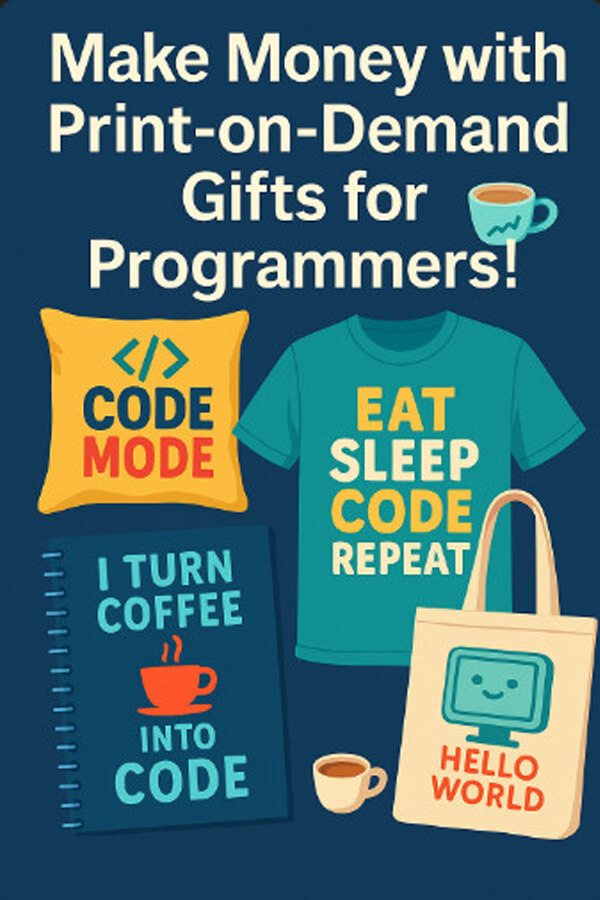
Most gift shops don’t know what to do with programmers. Right? I mean, you walk in looking for a birthday present for your VI-obsessed spouse or even Facebook friend who is NOT named “Evil Larry,” and what do you get? Socks that say “Ctrl+Alt+Del Your Problems.” A T-shirt that reads “I Turn Coffee Into Code.” That’s not a gift – that’s an error message in textile form.
But here’s the thing: programmers are a very specific, gloriously quirky, highly loyal bunch. They thrive on memes, inside jokes, obscure references to Git commits, and sarcastic error messages that make no sense to the rest of us. And that, dear creative hustler, is where you come in.
Print-on-demand (PoD) lets you create and sell custom-designed mugs, T-shirts, stickers, notebooks, and more – without ever touching a box or licking a single envelope. It’s the perfect match for niche humor, and nobody needs better-targeted merchandise than the caffeine-powered coders who keep our websites alive and the apps running smoothly.
In this report, we’re going to build an empire – or at least a micro-kingdom – based entirely on stuff like “My code works because I threatened it,” “99 little bugs in the code, take one down, patch it around…” and that one mug that says “Will work for command-line interfaces and semicolons.”
Even better? Programmers have money! OK, some programmers have money. Those *with* money – they love buying ridiculous things that make them laugh! Double so especially if those things make their coworkers snort-laugh during Zoom calls.
In other words, you’re not just selling merch. You’re selling identity, inside jokes, and the sweet, sweet feeling of being understood in a world of non-techies!
Paradise that is, sheer unadulterated pair of dice. Not, of course, to be confused with a Pair of Docks; that’s an equine paradox of a different color!
But I digress.
So, stretch your fingers, pour your coffee, and let’s create a nerdy empire of profit and punchlines. This is not your average PoD side hustle. This is Print-on-Demand for Programmers!
How to Get Started in General
Step 1: Understand Your Audience.
You’re not designing for “tech bros” in general – you’re designing for people who dream in syntax, rage at merge conflicts, and think “null” is the punchline to every joke. Dive into programmer communities like Reddit’s r/ProgrammerHumor, Dev.to, Stack Overflow, or even GitHub comments to get a feel for what makes them laugh, groan, or roll their eyes.
Step 2: Pick Your Platforms.
Print-on-demand is magical because it removes all the boring logistics. The two main types of PoD platforms are:
-
Marketplaces (like Redbubble, TeePublic, and Zazzle), where they bring the traffic and you list your stuff.
-
Fulfillment platforms (like Printful or Gelato), where you integrate with your own site (Shopify, Etsy) and control the brand.
Start with a marketplace if you’re brand new. They’ll handle the traffic, and you can test your designs faster than you can say “404 not found.”
Step 3: Identify Your Product Focus.
Don’t try to create every product under the sun. Start with one or two – mugs and stickers are goldmines in the programmer world. Mugs are desk status symbols. Stickers go on laptops like battle scars. If your first 10 products are solidly funny, tightly themed, and clearly made “by one of us,” your audience will grow fast.
Step 4: Use Humor and Frustration as Fuel.
Programmers are stressed.
Now, non-techies might think they live the life of Riley (after all, when *they* have problems, *they* do not have to look for that invisible Any Key)!

Their jokes often reflect pain, sarcasm, or existential dread about a missing semicolon. That’s your gold! Make stuff that says “I survived legacy code and all I got was this beak-proof mug.” Or “Ask me about my unresolved merge conflict.” They’ll love you for it.
Step 5: Design Smart, Not Fancy.
You don’t need to be a professional designer. You just need to use readable fonts, clever layout, and sharp humor instead!
We’ll talk tools below, but even with zero art skills, you can create great designs using drag-and-drop templates or simple MidJourney prompts.
Ready to code your way into PoD profits? Let’s talk tools.
Tools/Resources Needed
Canva Pro
Why You Need It: Canva is your design sidekick. The Pro version unlocks transparent backgrounds, resizing, and millions of assets that make PoD creation a breeze.
It’s *also* beginner-friendly, template-rich, and doesn’t require any design experience. For programmer merch, it’s perfect for combining icons (laptops, code windows, coffee) with big, punchy text.
MidJourney AI Art Generator
Why You Need It: Want to create an epic image of a medieval coder battling a JavaScript demon? Or a futuristic keyboard with neon syntax floating above it?
MidJourney helps you create visuals that go way beyond clipart. Use it to generate backgrounds, sticker illustrations, or meme-level mascots for your brand. Totally unique art = higher perceived value.
‘course, you can even use the free version of ChatGPT (or any AI, really) to whip up some really good (but 300dpi good? That is the question) graphics as well.
Printful
Why You Need It: If you want to sell PoD directly from your own site or Etsy, Printful’s your backend logistics genie.
You upload your designs, pick your products, and they do the printing, shipping, and customer service. It integrates with Shopify, Etsy, WooCommerce, and more!
Print-on-demand… without printing… or demanding equals perfect.
Logitech MX Master Mouse
Why You Need It: If you’re designing multiple PoD products or editing sticker details, this mouse’s ergonomic shape and precision scrolling can save your wrist and sanity.
It’s the kind of upgrade that makes design work feel smooth instead of stressful.
XP-Pen Drawing Tablet
Why You Need It: Want to hand-sketch some coding mascots or draw your own nerdy stick figure devs?
This affordable tablet works with Canva, Photoshop, and more, giving you the power of custom art without breaking your budget.
Sounds good? Let’s now move to:
Your 10 Step Action Plan
Step 1: Pick Your Programmer Persona
You need to know which slice of the coding universe you want to serve. Front-end fashionistas? Back-end bashers? DevOps daredevils? Choose a group whose quirks, slang, and pet peeves you understand – or want to learn. This makes your products hit harder than a keyboard slammed after a failed compile.
Once you’ve picked your coder crowd, go deeper. What memes do they share? What inside jokes do they repeat on Reddit or Twitter? Start collecting those phrases – they’ll form the beating heart of your product ideas. Research is half stalking, half anthropology, and 100% necessary.
Step 2: Brainstorm Product Ideas That Only Make Sense to Coders
A regular T-shirt that says “Eat. Sleep. Code. Repeat.” is fine.
But a tote bag that says “I debug in my sleep” with a cartoon of someone snoring inside a loop? Even better. You want that reaction: “Wait – only a real programmer would get that!”
Use platforms like Reddit’s /r/ProgrammerHumor or search GitHub discussions for spicy quotes and facepalm moments. The goal is to create designs that make devs snort coffee through their nose.
That emotional response turns browsers into buyers.
And buyers are good. Very very good, I might add.
Step 3: Create Slogan + Visual Combos
Next, combine your slogans with visuals that tell a story in one glance. For example: a stressed-out cat surrounded by thousands of curly braces, with the phrase “Where’s the closing bracket?” This kind of combo is PoD gold!
You don’t need to be a pro artist. Use AI art tools like MidJourney or templates in Canva to build your scenes. Think like a meme lord meets UX designer – clear, bold, and easy to ‘get’ in 2 seconds.
I mean, imagine the following on Merch. How on earth could you get any better??
I rest my case.
Next,
Step 4: Design Your First Three Products
Start with a tee, a mug, and a sticker – the sacred trifecta. These are low-barrier items that people collect or gift. Make sure your designs are high contrast and look great on both light and dark backgrounds.
Upload mockups for each to your Printful or Printify account and preview what they’ll look like. If it looks fuzzy or cramped, redo it.
Programmers will notice pixelated edges like hawks on Red Bull. Precision matters.
Step 5: Set Up an Etsy Store (or Shopify with Programmer Vibes)
If you’re just starting, Etsy is your quickest path to eyeballs. Use a store name like “Commit & Push Merch” or “Error 404 Apparel” to instantly let visitors know what your shop’s about. Fill your bio with code puns and nerd references.
For more control and branding, launch a Shopify store. Use themes that feel techy but fun. Add a favicon that looks like a code window, and boom – you’re in business.
Whether Etsy or Shopify, what matters most is showing up with a strong, clear niche.
Step 6: Write Listings That Read Like Bug Reports with Attitude
Each product listing should sound like it was written by a dev who’s just had their third espresso. Instead of boring descriptions like “soft cotton shirt,” say, “As smooth as a clean deploy. Built for late-night sprints and sarcastic commits.”
Add bullet points like:
-
No syntax errors (unless you’re into that)
-
Compatible with Java, JavaScript, and your cat
-
Tested on real humans (aka you)
Use their language. If it reads like Slack chat from their team, you’re winning.
Step 7: Create Mockups That Look Like Developer Lifestyles
Don’t use models standing on beaches. Instead, showcase your merch on people at desks, with laptops, Post-its, and at least one tangled USB cable nearby. Make it feel like the customer is looking in a mirror – or a very caffeinated Zoom call.
Use mockup generators like Placeit or Canva’s SmartMockups to do this quickly. Bonus points if you can make it look like the T-shirt is mid-argument with the printer because “the drivers are broken again.”
Step 8: Promote with Programmer-Specific Social Channels
Forget generic “start a business” groups. Instead, share your products in dev spaces like Mastodon instances for tech, Reddit threads like r/coding, Twitter/X tags like #DevLife, and even niche Discord groups.
But do not go in like a spam bot. Join conversations, post funny code memes, and then casually say, “Made this for frustrated coders who just ran git rebase at 2am.”
Authenticity is your ticket in. Get known *first*. Programmers smell forced marketing a mile away.
Step 9: Offer Bundles Based on Programming Themes
Make your bundles feel like releases. For example, a “Debugger Bundle” with a mug, sticker, and tee that all say “Step. Over. Everything.” Or a “Weekend Warrior” set for side hustlers who code all night.
Use urgency: “v1.0 shipping this week only” or “Retiring this build forever on Friday.” Programmers love scarcity when it’s framed like version control. This lets you rotate collections and keep your shop fresh.
Step 10: Automate and Expand Your Line Like a Framework
Once you see what sells, automate with Printful + Etsy or Shopify integrations so you can focus on design and community. Use Trello or Notion to track new ideas. Build systems – after all, it’s what devs do.
Then expand! Try notebooks for code journaling, mousepads with shortcut cheat sheets, or hats with sarcastic CLI commands. Your store becomes more than merch – it’s a culture hub for proud, exhausted, hilarious coders everywhere.
So with those 10 steps stepized, let’s consider:
How to Make Money in This Niche
Sell on Redbubble (The Programmer Playground)
Redbubble is one of the easiest ways to test your designs without needing an audience. Once you upload your artwork, Redbubble handles everything – product previews, printing, shipping, and support. All you need to do is tag your products correctly and write snappy titles. Think “Funny Git Mug” or “Sticker for Overworked Developers.”
Redbubble is especially great for niches because their users often search very specifically – and programmers love buying gifts for other programmers. Make sure your designs look good on small items like stickers and mugs, because that’s where most of the sales will come from.
Once your products are live, share links with subtle posts in coding Facebook groups or Discord chats. Ask friends to favorite your listings to help the algorithm. The goal here is momentum – and to find your bestsellers.
Redbubble pays out monthly and you don’t have to lift a finger after setup. That means it’s passive income with personality. All powered by programmer punchlines.
Open a Niche Etsy Shop
Etsy shoppers love buying funny, thoughtful, or niche gifts – and programmer humor checks all three boxes. You’ll need to integrate with Printful (or Printify), but once that’s done, you can list everything from mugs to shirts to desk mats with your coding humor front and center.
Use keyword-heavy titles like “Funny Software Engineer Mug for Coffee Lovers” and fill your descriptions with phrases that a gift shopper would search – things like “gift for Python developer boyfriend” or “funny coding coworker mug.” Etsy’s SEO is your superpower.
You can charge higher prices on Etsy because it’s seen as handmade and custom. $18 for a mug? No problem. Add $2 for personalization, like changing the name of the programming language (“Java Dad” instead of “C++ King”). You’ll stand out fast.
And best of all? You’re building a real brand with fans who might come back for birthday, Christmas, and “Congratulations on surviving another sprint” gifts.
Run a Digital Sticker Club via Ko-fi
Ko-fi lets you set up memberships without the complexity of Patreon. Offer a subscription where fans get 2–3 exclusive coding humor sticker files every month. They can print them, use them digitally, or share with friends. You don’t even need to ship physical products.
Make each pack themed: “Frontend Fatigue,” “Back-End Nightmares,” or “The Debug Diaries.” Add in some extras like desktop wallpapers or printable wall art and suddenly your $5/month offer feels like a bargain.
You’ll grow recurring income, and your fans will start collecting your weird little sticker packs like trading cards. Bonus: you can repackage the designs later as a mega bundle on Etsy or Gumroad.
It’s quirky, lightweight, and totally digital – perfect for testing designs before you move into physical products.
Launch a “DevJoke of the Day” Email List with Affiliate Offers
Turn your jokes into traffic by emailing one funny line every day. Use a tool like ConvertKit or Beehiiv and build a free newsletter called something like “Code & Caffeine.” Each email contains:
-
A programming haiku or joke
-
A link to a funny product (yours or someone else’s)
-
An affiliate recommendation (“Today’s tool I wish existed back when I had hair: Xdebug”)
You grow a following, stay top of mind, and monetize via affiliate links, print-on-demand products, or even branded sponsorships once you get traction.
The tech world is starving for shortform comedy that isn’t mean-spirited. You can be the friendly funny voice people love to read on Monday morning. And over time? That’s a business.
Sell at Local Tech Meetups or Conferences
If your area has tech meetups, hackathons, or coding camps – show up with your PoD gear. Print a batch of your funniest shirts, mugs, or stickers via Printful or a local print shop.
Even just a tabletop booth with five “Debug Coffee” mugs and a roll of laptop stickers can catch attention!
Bring business cards with your Etsy or Redbubble link and offer a show-only coupon code. Programmers love exclusivity. And if they laugh at your joke, they’ll probably buy it to flex at work.
Live events build connection – and if you become “that sticker person from the Python-who-wished-it-was-VI meetup,” you’ve already won.
5 Awesome Tips
-
Code Fonts = Instant Credibility:
Use fonts like Fira Code, Consolas, or Courier New to mimic IDEs. When programmers see something that looks like their actual code editor, they feel an instant connection. Bonus points if you format your design to look like an error log or a terminal window. -
Mix Real Code with Nonsense:
A sticker that says if (coffee < 2) { return “Nope”; } is gold. A shirt that prints HTML <body>Nap</body> is hilarious. Programmers love parodying code structure – it feels like an inside joke only they get. Use this. -
Add Easter Eggs in Small Text:
Hide a tiny line of real code or a sarcastic comment in the corner of a design. Something like // You’re reading this too closely, aren’t you? adds charm – and gives them a reason to show it to coworkers. -
Offer “Choose Your Language” Versions:
Release one design, then duplicate it for Python, JavaScript, C#, and Rust. Suddenly you’ve got 5 products from one joke. Programmers are loyal to their tools – if you show theirs some love, they’ll notice. -
Create Series, Not Just Singles:
Instead of 10 random mugs, create a “Backend Burnout” series or “Front-End Frustrations” sticker pack. Collections sell better than lone wolves – and fans love collecting sets.
5 Powerful Takeaways
-
Programmers are a highly monetizable micro-niche:
They earn good money, have specific humor, and love buying novelty items that reflect their identity. They’re your ideal PoD customer – loyal, quirky, and often too tired to shop around. -
Print-on-demand removes all logistics headaches:
You don’t need to hold inventory, print shirts, or mail mugs. You create the design – the PoD platform handles the rest. You can build a business without ever touching a box. -
Niche humor has infinite shelf life:
A great coding joke doesn’t expire. Unlike trends or memes that fade, developer humor stays relevant for years – especially the burnout, syntax, or bug-related content. -
You can compete without being an artist:
Programmers love clean, clever, text-based jokes. You don’t need elaborate illustrations. Just good layout, readable fonts, and a punchy message. It’s the copywriting that makes the sale. -
This niche gives you creative freedom + recurring income:
From Etsy sales to Ko-fi subs to affiliate traffic, the monetization paths are flexible. You can go full hobbyist or scale it into a storefront. Either way, it’s joyful money.
Your Next Steps
Start by brainstorming 10 silly developer jokes. Just phrases. Doesn’t matter if they’re good – you’ll shape them later!
Pick the three funniest and drop them into Canva, using a monospaced font and a clean layout. Export your first mug or sticker design and upload it to Redbubble.
From there, build momentum! Make one new design every two days for a week. Post them quietly in a coding group, or DM a techie friend for feedback. Don’t wait until it’s perfect – this niche rewards weird, honest, funny stuff. Lean into it.
Finally, think about where you want to grow. Etsy? Ko-fi? Email list? Start small, but know this: once your jokes start making people laugh, you’ll be hooked. And once they start buying them? You’ll be unstoppable.
Conclusion
Selling programmer humor through print-on-demand is like compiling joy. You take frustration, sarcasm, and caffeine… and turn it into profit. It’s low-cost, low-risk, and full of LOLs.
You don’t need to be a coder to win this game – you just need to speak their language, crack the right joke, and show up where the nerds live. Whether it’s a mug that says “Deploy & Pray” or a sticker that screams “I debug in my dreams,” your designs can earn real money while making someone’s desk a lot funnier.
So go. Fire up Canva. Start that Etsy shop. And remember: when in doubt, just add semicolons. They make everything look legit.
Enjoy!