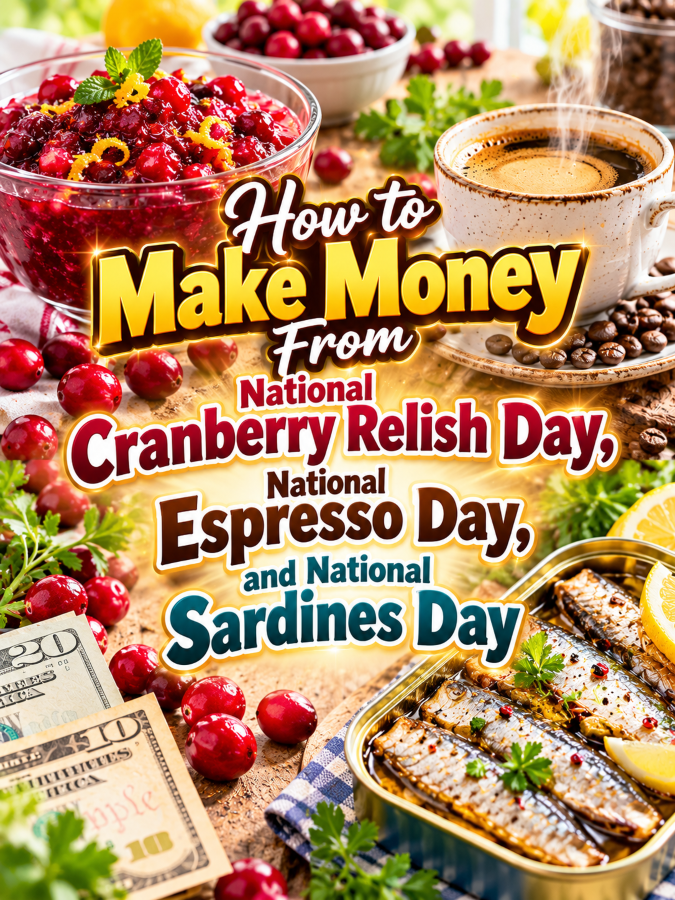
National Cranberry Relish Day – Turn a Thanksgiving Side Dish Into a Profitable Printable Business (November 22,2026)
Here’s a funny thing about making money with holidays.
You don’t need a holiday that everybody has circled on their calendar.
Sometimes, the weirder the holiday, the easier it is to find a creative marketing angle.
National Cranberry Relish Day is a perfect example.
At first glance, cranberry relish might not sound like a million-dollar business opportunity. And no, we’re not suggesting you quit your day job and become the Cranberry Relish Queen.
Instead, we’re looking at the bigger opportunity hiding behind the food.
Thanksgiving is right around the corner, which means people are thinking about recipes, grocery shopping, meal planning, entertaining, family traditions, leftovers, and holiday food.
That’s the market.
Cranberry relish is simply the conversation starter.
National Cranberry Relish Day Is the Hook, Not the Business
This is an important distinction when you’re building a printable business.
You don’t want to create a product that has one useful day and then disappears into the digital equivalent of a junk drawer.
Instead, use National Cranberry Relish Day to introduce a larger product category.
In this case, that category is Thanksgiving meal organization and holiday entertaining.
That opens the door to products for home cooks, busy parents, Thanksgiving hosts, family recipe keepers, food bloggers, holiday entertainers, and people who simply don’t want to realize on Thanksgiving morning that they forgot the cranberry sauce.
That’s Not a Good Thing.
Why This Niche Works
Thanksgiving creates a predictable planning cycle.
People need recipes. They need grocery lists. They need meal schedules. They need serving plans. They need ways to organize family recipes. They need to remember what Uncle Bob is bringing. And they need to figure out how much food they actually need.
That creates dozens of small problems.
And every small problem can become a printable.
That’s exactly what we’re looking for.
Instead of thinking, “What cranberry product can I sell?” ask:
“What does someone preparing a Thanksgiving meal need help organizing?”
Now you’ve got a much bigger business.
Do Your Research Before Creating the Product
Start by researching the holiday and the broader Thanksgiving market.
Search Google for National Cranberry Relish Day
Search Google for cranberry relish recipes
Search Google for Thanksgiving meal planner printables
Search Google for Thanksgiving grocery list printables
Then look at Etsy, Pinterest, Canva, and Amazon.
You’re looking for recurring customer needs, popular formats, useful page combinations, and opportunities to make an existing idea more specific.
Three Ways to Make Money From National Cranberry Relish Day
1. Create Thanksgiving Recipe and Meal Planning Printables
This is the obvious starting point, but don’t make it too narrow.
Instead of creating one cranberry recipe card, build a small Thanksgiving recipe organization system.
You could include:
- Thanksgiving recipe cards
- Meal planning pages
- Grocery lists
- Ingredient checklists
- Cooking schedules
- Serving plans
- Family recipe pages
- Leftover tracking pages
- Thanksgiving menu planners
- Recipe rating pages
Suddenly, a cranberry-themed holiday has become a complete holiday food organization product.
2. Create Family Recipe and Tradition Journals
Here’s where things get more emotional.
Thanksgiving isn’t just about food. For many families, recipes are connected to memories and traditions.
That creates an opportunity for recipe journals designed around preserving family favorites.
Your pages could include:
- Recipe name
- Ingredients
- Preparation notes
- Who created the recipe
- Family member associated with the recipe
- When the recipe is traditionally served
- Special memories
- Recipe variations
- Family ratings
- Photos or memory spaces
This type of product can extend far beyond Thanksgiving.
Christmas dinners, birthdays, Sunday dinners, family reunions, potlucks, and everyday family recipes can all become additional product variations.
3. Create Thanksgiving Hosting and Entertaining Kits
Now let’s move beyond the kitchen.
A Thanksgiving host has more to manage than recipes.
They may need to plan guests, seating, decorations, activities, shopping, cooking, serving, and cleanup.
That gives you another product category.
A Thanksgiving hosting kit could include:
- Guest lists
- Menu planners
- Grocery checklists
- Cooking schedules
- Table-setting checklists
- Guest preference notes
- Potluck contribution lists
- Serving checklists
- Cleanup checklists
- Thanksgiving activity pages
Now you’re no longer selling a cranberry printable.
You’re selling less holiday chaos.
And people understand the value of that immediately.
Money-Making Tip #1: Sell the Holiday Problem, Not the Holiday Ingredient
Here’s your first money-making lesson for this series:
Don’t build your business around cranberry relish. Build it around the problems cranberry relish reminds people about.
People don’t necessarily wake up thinking, “I need a cranberry relish printable today.”
But they may absolutely think:
“I need to organize Thanksgiving dinner.”
“I need a grocery list.”
“I need to organize Grandma’s recipes.”
“I need to plan our family dinner.”
“I need to get all these recipes in one place.”
Those are buying problems.
That’s where you want your product to live.
Your $7 to $77 Product Ladder
Instead of creating one product and hoping for the best, build a simple ladder.
$7 – Thanksgiving Recipe Starter Pack
Create a simple collection of printable recipe cards, menu planning pages, and grocery lists.
This is your easy entry product.
$12 – Thanksgiving Meal Planner
Add meal schedules, shopping pages, cooking checklists, serving notes, and leftover planning pages.
$17 – Family Recipe & Tradition Journal
Turn the concept into a keepsake-style journal for documenting recipes, family stories, traditions, and memories.
$27 – Thanksgiving Hosting Kit
Combine menu planning, grocery organization, cooking schedules, guest lists, hosting checklists, table planning, and activity pages.
$47 – Complete Thanksgiving Organization Bundle
Bundle your recipe cards, meal planner, family recipe journal, hosting kit, grocery planner, and holiday activity pages.
$77 – Ultimate Holiday Meal & Family Recipe Collection
Now expand beyond Thanksgiving.
Include Thanksgiving, Christmas, holiday entertaining, family recipes, meal planning, recipe organization, party planning, and seasonal food organization.
You’ve moved from a single holiday product to a larger printable collection.
Who Could Buy These Products?
Your audience is much larger than cranberry lovers.
- Thanksgiving hosts
- Busy parents
- Home cooks
- Family recipe keepers
- Grandparents
- Food bloggers
- Holiday entertainers
- Potluck organizers
- Meal planners
- Homemakers
- People creating family cookbooks
- People looking for holiday organization tools
Each audience gives you another marketing angle.
Use Etsy to Research the Market
Search Etsy for Thanksgiving meal planners
Search Etsy for Thanksgiving recipe cards
Search Etsy for family recipe journals
Search Etsy for Thanksgiving hosting printables
Study the listings carefully.
Look at how sellers describe the customer problem. Look at which pages are included. Look at bundle sizes. Look at visual styles.
Then ask the important question:
“What can I create that gives the customer a clearer result?”
Don’t simply make another generic Thanksgiving checklist.
Make a system.
Use Canva to Build a Reusable Product System
Canva is useful here because you can build a consistent visual system and reuse it across multiple products.
Create your core pages once.
Then adapt them.
Your Thanksgiving meal planner could become:
- Christmas Meal Planner
- Holiday Dinner Planner
- Family Recipe Planner
- Potluck Planning Kit
- Sunday Dinner Planner
- Holiday Baking Planner
- Family Cookbook Template
That’s how you create a product library instead of constantly starting from zero.
Use Pinterest to Turn Recipes Into Traffic
Pinterest is particularly useful for visually appealing food and holiday content.
Instead of posting only:
“Buy my Thanksgiving planner.”
Create useful content such as:
- “Thanksgiving Meal Planning Checklist”
- “How to Organize Thanksgiving Recipes”
- “Thanksgiving Grocery List Ideas”
- “How to Plan Thanksgiving Dinner Without the Chaos”
- “Family Recipe Journal Ideas”
- “Thanksgiving Hosting Checklist”
Then connect those helpful posts to your products.
You’re giving people a reason to discover your shop before asking them to buy.
Amazon Can Help With Market Research Too
Amazon can help you understand the broader Thanksgiving and recipe-organization market.
Search for recipe binders, family cookbooks, meal planners, Thanksgiving organizers, kitchen planning products, and holiday entertaining books.
Pay attention to what customers are trying to organize.
Those physical products can reveal digital-product opportunities.
For example, if people buy recipe binders, you can create printable recipe pages.
If people buy meal-planning books, you can create digital meal-planning systems.
If people buy holiday hosting books, you can create printable hosting checklists.
You’re looking for the problem behind the purchase.
Make the Product Evergreen
This is where the real leverage begins.
Thanksgiving happens once a year.
Meal planning happens every week.
Family recipes exist year-round.
Grocery planning happens constantly.
Holiday hosting comes back every season.
That’s why your product should have an evergreen core.
Build the basic system around meal planning, recipe organization, grocery planning, family traditions, and entertaining.
Then create seasonal versions around Thanksgiving, Christmas, Easter, Mother’s Day, Father’s Day, birthdays, summer gatherings, and other events.
One core system can support an entire product catalog.
Your Simple Action Plan
- Research the market: Search Etsy, Pinterest, Google, Canva, and Amazon for Thanksgiving meal and recipe products.
- Choose one customer: Start with Thanksgiving hosts, busy parents, or family recipe keepers.
- Create the $7 product: Make a simple recipe and meal-planning starter pack.
- Add the next problem: Turn it into a meal planner, recipe journal, or hosting kit.
- Build the ladder: Combine related products into $27, $47, and $77 bundles.
- Repurpose: Turn the Thanksgiving system into Christmas, holiday, family recipe, and year-round meal-planning products.
- Market the solution: Use content that helps people organize their holiday instead of simply shouting about the holiday itself.
The Big Takeaway
National Cranberry Relish Day may sound like a tiny niche.
That’s okay.
We aren’t trying to build a business around cranberry relish.
We’re using it as the little doorway into a much bigger market: holiday meal planning, recipe organization, family traditions, and entertaining.
The holiday gives you a reason to create content.
The problem gives you the product.
The product ladder gives you additional ways to sell.
And the evergreen version gives you something that can keep working long after November 22 disappears from the calendar.
That’s always a Good Thing.
National Espresso Day – Turn Coffee Culture Into a Profitable Printable Business (November 23, 2026)
Some products solve a problem.
Some products satisfy a need.
And some products simply make people happy.
Coffee belongs in that last category.
National Espresso Day gives you a fun excuse to enter a much bigger market built around coffee lovers, home cafés, coffee recipes, tasting experiences, gift giving, and café culture.
And that’s where things get interesting.
You don’t have to sell espresso.
You don’t even have to sell coffee.
You can sell the experience surrounding coffee.
That’s where digital products can fit beautifully.
National Espresso Day Is the Hook, Not the Business
Let’s get one thing straight.
We’re not building a business that depends on somebody remembering National Espresso Day every November 23.
We’re using the observance as a timely marketing hook for a much larger interest.
Coffee lovers are interested in trying drinks, documenting favorites, learning about different beans, creating home café experiences, entertaining friends, buying coffee-related gifts, and keeping track of recipes.
That creates a surprisingly large collection of printable-product possibilities.
Instead of asking, “What can I sell for National Espresso Day?” ask:
“What does a coffee lover want to organize, record, try, or share?”
Now we’ve got something to work with.
Why the Coffee Niche Works for Digital Products
Coffee is naturally repeatable.
People don’t drink it once.
They have routines.
They try new drinks.
They discover new beans.
They visit cafés.
They experiment with recipes.
They buy coffee equipment.
And some people are serious enough about coffee to turn the kitchen into a tiny laboratory.
That repeat behavior creates opportunities for journals, trackers, recipe cards, planners, gift products, and educational resources.
Even better, coffee isn’t restricted to one season.
That makes this niche naturally evergreen.
Research Before You Design
Start by learning what coffee lovers are already interested in.
Search Google for National Espresso Day
Search Google for espresso recipe ideas
Search Google for coffee tasting journal printables
Search Google for home café planner printables
Then research the product marketplace.
Look at Etsy listings, Pinterest content, Amazon products, and Canva templates.
You’re looking for repeated problems and repeated interests.
Those repetitions are clues.
Three Ways to Make Money From National Espresso Day
1. Create Coffee Journals and Tasting Trackers
This is one of the most obvious opportunities.
Coffee enthusiasts love discovering new flavors and remembering what they liked.
A printable coffee journal could include:
- Coffee or espresso name
- Brand or roaster
- Origin
- Preparation method
- Date tasted
- Flavor notes
- Aroma notes
- Personal rating
- Favorite preparation method
- Purchase information
- Would-buy-again checkbox
Keep the product focused on organization and personal tasting notes rather than making unsupported claims about health effects.
You’re creating a useful record, not pretending to be a coffee scientist.
2. Create Home Café Planning Products
Here’s where you can move from coffee tasting into lifestyle.
People love the idea of having a cozy café experience at home.
A printable home café planner could help customers organize:
- Favorite drink recipes
- Coffee menus
- Drink ideas
- Shopping lists
- Coffee supplies
- Guest drink preferences
- Weekend café menus
- Seasonal drink collections
- Recipe experiments
- Home café goals
You could even create themed versions such as Christmas Home Café, Valentine’s Coffee Bar, Summer Iced Coffee, or Cozy Fall Café.
One framework can generate several products.
3. Create Coffee-Shop Marketing Templates
Now let’s step into the business market.
Coffee shops and small cafés constantly need promotional content.
That creates a different customer who may have a higher willingness to purchase useful business templates.
You could create:
- Coffee shop social media planners
- Drink-of-the-day templates
- Seasonal menu templates
- Café promotion calendars
- Customer loyalty tracking sheets
- New drink launch checklists
- Social media content planners
- Holiday promotion templates
- Email promotion planners
- Café event planning sheets
This is where one holiday can lead to two different markets: coffee consumers and coffee businesses.
And that’s a very useful thing when you’re building a product catalog.
Money-Making Tip #2: Sell the Coffee Lifestyle
Here’s your money-making lesson for National Espresso Day:
Don’t limit your product to the drink. Sell the experience around the drink.
A coffee lover doesn’t just consume espresso.
They may collect beans, try recipes, visit cafés, create drinks at home, entertain friends, buy coffee gifts, and document their favorites.
Each activity can become a product.
That’s how you turn one tiny holiday into a much larger product ecosystem.
Your $7 to $77 Product Ladder
$7 – Coffee Lover’s Starter Journal
Create a simple printable with coffee tasting pages, favorite-drink trackers, and coffee notes.
$12 – Coffee Recipe Card Collection
Add printable recipe cards for documenting favorite coffee and espresso drinks.
$17 – Complete Coffee Tasting Journal
Expand the journal with tasting pages, coffee discovery logs, café visit pages, rating sheets, and favorites lists.
$27 – Home Café Planning Kit
Add drink menus, shopping lists, coffee supply trackers, recipe planning pages, seasonal drink planners, and hosting pages.
$47 – Complete Coffee Lover’s Bundle
Combine the tasting journal, recipe cards, home café planner, coffee collection tracker, gift planner, and café visit journal.
$77 – Ultimate Coffee Lifestyle Printable Collection
Take the whole concept into a larger lifestyle collection covering coffee tasting, home café planning, recipes, entertaining, coffee gifts, café visits, seasonal drinks, and coffee-business planning.
Now your $7 product isn’t sitting alone.
It’s the front door to a much bigger catalog.
Who Could Buy These Products?
The coffee market gives you multiple customer groups.
- Coffee enthusiasts
- Espresso lovers
- Home baristas
- Home café hobbyists
- Coffee gift shoppers
- Food bloggers
- Café owners
- Small coffee businesses
- Coffee content creators
- People who enjoy entertaining
- People documenting food and drink experiences
- Friends and family looking for coffee-themed gifts
Notice how many of those audiences exist without National Espresso Day.
That’s exactly what we’re looking for.
Use Etsy to Study the Product Market
Search Etsy for coffee journals
Search Etsy for coffee tasting journals
Search Etsy for home café printables
Search Etsy for coffee-shop social media templates
Look for patterns.
Which products are simple?
Which ones are bundles?
Which customer groups appear repeatedly?
Which problems are sellers trying to solve?
Then create something that fits a clear customer need.
Use Canva to Build a Coffee Product Family
Canva is especially useful for this niche because coffee products are highly visual.
You can build a consistent design system around coffee colors, café-style layouts, recipe cards, journals, menus, and planner pages.
Then reuse the same underlying structure.
For example:
- Coffee Tasting Journal
- Tea Tasting Journal
- Hot Chocolate Tasting Journal
- Mocktail Tasting Journal
- Restaurant Tasting Journal
- Dessert Tasting Journal
One product idea can become an entire tasting-journal collection.
That is much more efficient than inventing a completely new product every time you want to add something to your shop.
Use Pinterest to Market the Experience
Pinterest gives you plenty of visual content opportunities.
Instead of posting only about National Espresso Day, create content around the lifestyle.
- “How to Create a Cozy Home Café”
- “Coffee Tasting Journal Ideas”
- “Coffee Lover Gift Ideas”
- “Printable Coffee Tasting Tracker”
- “Home Café Planning Checklist”
- “Coffee Recipe Organization Ideas”
- “Coffee Shop Social Media Content Ideas”
Each topic can lead naturally toward a related printable.
Amazon Can Give You More Product Ideas
Amazon can help you research what coffee lovers already purchase.
Look at coffee journals, tasting books, recipe books, espresso accessories, coffee gift products, and home café products.
You don’t need to duplicate those physical products.
Instead, ask what digital companion could make the physical product more useful.
A coffee machine can inspire a drink recipe journal.
A coffee subscription can inspire a tasting tracker.
A home café setup can inspire a menu planner.
A coffee gift can inspire a coffee gift-planning printable.
That’s the product-idea machine we’re building.
Turn National Espresso Day Into an Evergreen Business
The smartest part of this niche is that coffee doesn’t disappear after November 23.
People drink coffee every day.
They discover new cafés.
They try seasonal drinks.
They buy gifts.
They entertain guests.
They experiment with recipes.
They create morning routines.
That gives you year-round marketing opportunities.
You can promote your products around:
- Christmas gifts
- Valentine’s Day
- Mother’s Day
- Father’s Day
- Back-to-school routines
- Fall coffee season
- Winter drinks
- Weekend brunches
- Home entertaining
- New-year habit planning
The holiday becomes the spark.
The coffee lifestyle keeps the fire going.
Build a Separate Business Product Line
There’s another opportunity worth testing.
Instead of selling only to coffee drinkers, create products for people who sell coffee.
A coffee-shop owner might need a content calendar.
A small café might need promotional templates.
A coffee creator might need a sponsorship tracker.
A home-based coffee business might need an order tracker.
That gives you an entirely different product ladder.
For example, you could create a $7 Café Social Media Starter Pack, a $17 Coffee Content Planner, a $27 Seasonal Café Promotion Kit, a $47 Coffee Business Marketing Bundle, and eventually a $77 Coffee Shop Marketing System.
Now you’re selling business tools instead of consumer printables.
That’s another market worth testing.
Your Simple Action Plan
- Research: Search Etsy, Pinterest, Google, and Amazon for coffee journals, tasting products, home café ideas, and coffee-business templates.
- Pick one customer: Start with coffee lovers, home baristas, or small cafés.
- Create the $7 product: Make a simple coffee journal or tasting tracker.
- Solve the next problem: Add recipes, café planning, gift planning, or organization.
- Build the ladder: Turn related products into $27, $47, and $77 bundles.
- Repurpose: Use the same framework for tea, hot chocolate, mocktails, desserts, or restaurant tasting journals.
- Market the lifestyle: Create content around coffee experiences instead of relying only on National Espresso Day.
The Big Takeaway
National Espresso Day gives you a fun reason to talk about coffee.
But coffee is the business opportunity-not the holiday.
The bigger market includes tasting, recipes, home cafés, entertaining, gifts, organization, and even coffee-business marketing.
That’s why this niche can support more than one printable.
You can start with a $7 journal.
Then solve another problem.
Then create a bundle.
Then create a version for another audience.
Before you know it, that little coffee printable has friends.
And a product with friends is a lot more interesting than a lonely $7 PDF sitting in your shop.
National Sardines Day – Turn a Quirky Food Holiday Into a Profitable Printable Business (November 24, 2026)
Okay, this one is definitely quirky.
National Sardines Day.
Yes. Sardines.
And that’s exactly why I like it.
When you’re building a make-money-online business around holidays, you don’t always need the biggest or most glamorous event on the calendar. Sometimes a strange little observance gives you an excuse to create content in a niche that has much broader applications.
National Sardines Day can lead us into recipe organization, pantry management, meal planning, seafood recipes, budget-conscious food planning, and kitchen organization.
The sardine is the hook.
The bigger household problem is the business.
National Sardines Day Is the Hook, Not the Business
Here’s the important part.
We’re not trying to build a business that only sells sardine printables to people who celebrate November 24.
That would be a very small pond.
Instead, we’re using the holiday to attract people interested in a broader food-related problem.
People need to organize recipes.
They need to keep track of pantry supplies.
They need meal ideas.
They need grocery lists.
They need ways to use ingredients they already have.
And they often want simple systems that help them make better use of the food already sitting in their kitchen.
Now we’re talking.
Why This Niche Can Work
Food organization is naturally repeatable.
A person doesn’t create one grocery list and declare victory forever.
They need another one next week.
They try another recipe.
They restock the pantry.
They plan another meal.
They discover another ingredient hiding behind the canned tomatoes.
That last one may or may not have been there since 2019.
The point is that kitchen organization creates recurring needs.
That gives you opportunities for planners, trackers, recipe cards, journals, checklists, and bundles.
Do Your Research First
Start by researching the holiday and then move into the larger food-planning market.
Search Google for National Sardines Day
Search Google for sardine recipe ideas
Search Google for pantry inventory printables
Search Google for meal planning printables
Then check Etsy, Pinterest, Canva, and Amazon.
Look for recurring customer problems rather than simply searching for the holiday name.
That’s where the useful product ideas are hiding.
Three Ways to Make Money From National Sardines Day
1. Create Recipe and Meal-Planning Printables
The easiest direction is food organization.
You could create a recipe collection designed around seafood, pantry meals, quick dinners, or family meal planning.
Possible pages include:
- Recipe cards
- Weekly meal planners
- Monthly meal planners
- Grocery lists
- Ingredient trackers
- Recipe rating pages
- Family favorite lists
- Meal rotation planners
- Leftover planning pages
- Recipe substitution notes
Notice how little of this actually requires sardines.
That’s the point.
2. Create Pantry Organization Products
Now let’s move from recipes to inventory.
Pantry organization is a natural printable niche because people want to know what they have before buying more.
You could create:
- Pantry inventory sheets
- Canned-food trackers
- Freezer inventory pages
- Expiration-date tracking pages
- Shopping lists
- Restock checklists
- Pantry category labels
- Meal-planning pages based on available ingredients
- Kitchen organization checklists
And now your sardine-themed marketing post can point toward a pantry management product.
That’s a much bigger market.
3. Create Budget-Friendly Meal Organization Products
Another direction is food budgeting.
You can create printables that help customers plan meals, organize grocery purchases, compare planned meals with actual spending, and make better use of the ingredients they already have.
Possible products include:
- Weekly food budget planners
- Grocery spending trackers
- Meal-cost worksheets
- Pantry-first meal planners
- Budget recipe journals
- Grocery comparison sheets
- Food inventory trackers
- Monthly kitchen budget planners
Keep the claims practical and simple. You’re selling organization tools, not promising that a printable will magically cut someone’s grocery bill in half.
That would be a little too much pressure for one PDF.
Money-Making Tip #3: Sell the Organization System
Here’s the third money-making lesson in this series:
When the holiday is tiny, expand the problem.
Sardines are one ingredient.
Food organization is a much bigger problem.
Instead of asking, “What sardine printable can I make?” ask:
“What would help someone organize the food they already have?”
That question opens up recipe journals, pantry trackers, grocery planners, meal planners, freezer inventories, and food-budgeting systems.
Now you’ve got a product ecosystem.
Your $7 to $77 Product Ladder
$7 – Pantry Meal Starter Pack
Create a simple collection of pantry inventory pages, meal-planning sheets, grocery lists, and recipe cards.
$12 – Recipe Card Collection
Build a larger collection of printable recipe cards for seafood, pantry meals, quick dinners, or family favorites.
$17 – Pantry & Meal Planning Journal
Combine recipe organization, pantry inventory, meal planning, grocery lists, and favorite-meal tracking.
$27 – Kitchen Food Management Kit
Add freezer inventory pages, restock checklists, grocery planning, meal rotation pages, and kitchen organization tools.
$47 – Complete Food Organization Bundle
Combine your recipe collection, pantry planner, meal planner, grocery tracker, freezer inventory, and food-budgeting tools.
$77 – Ultimate Kitchen Management Collection
Take the entire concept into a complete household food-management system covering meal planning, pantry organization, freezer tracking, grocery planning, recipes, food budgeting, and kitchen routines.
Now you’re not selling a sardine printable.
You’re selling a system for getting the kitchen under control.
Who Could Buy These Products?
This niche has several possible customer groups.
- Busy families
- Meal planners
- Home cooks
- Budget-conscious households
- Homemakers
- Parents
- Pantry organization enthusiasts
- Meal-prep enthusiasts
- Food bloggers
- Homesteaders
- People creating family cookbooks
- People who want better kitchen organization
Each audience gives you a slightly different product angle.
Use Etsy to Research the Competition
Search Etsy for pantry inventory printables
Search Etsy for meal-planning printables
Search Etsy for freezer inventory printables
Search Etsy for recipe journals
Look for products that already have clear demand.
Then examine how sellers package their products.
Are they selling individual sheets?
Bundles?
Editable templates?
Full planners?
Use that information to understand the market before you spend hours designing.
Use Canva to Create a Product Family
Canva can help you create a consistent visual system for your kitchen-management products.
Once you have a basic planner structure, you can adapt it into different niches.
For example:
- Pantry Inventory Planner
- Freezer Inventory Planner
- Meal Planning Journal
- Recipe Collection Journal
- Grocery Budget Planner
- Family Cookbook Planner
- Camping Food Planner
- Holiday Meal Planner
One design system can support many related products.
That saves time and makes your shop look more cohesive.
Use Pinterest for Food Organization Content
Pinterest gives you plenty of content angles that don’t depend on sardines.
For example:
- “How to Organize Your Pantry”
- “Pantry Inventory Checklist”
- “Easy Meal Planning System”
- “How to Use What You Already Have”
- “Freezer Inventory Ideas”
- “Weekly Grocery Planning Checklist”
- “Family Recipe Organization Ideas”
- “Kitchen Organization Printables”
Each article, pin, or social post can lead toward one of your products.
That’s much more sustainable than trying to create content about sardines every single day.
Amazon Can Help You Find Adjacent Products
Amazon can also be useful for research.
Search for pantry organizers, recipe binders, meal planners, food storage products, freezer organizers, kitchen inventory tools, and cooking journals.
Look for the problems people are already spending money to solve.
Then ask:
“Could I create a digital companion for this?”
A pantry organizer can inspire a pantry inventory printable.
A recipe binder can inspire a recipe journal.
A freezer organizer can inspire a freezer inventory tracker.
A meal-planning book can inspire a printable meal-planning system.
That’s how physical products can give you digital-product ideas.
Make the Product Evergreen
Here’s the best part.
Your customers don’t need to care about National Sardines Day.
They need to care about their kitchen.
That’s why the core product should remain useful all year.
You can promote it around:
- New Year’s organization
- Monthly grocery resets
- Back-to-school meal planning
- Holiday meal preparation
- Thanksgiving
- Christmas
- Summer meal planning
- Moving into a new home
- Pantry organization challenges
- Budget resets
The holiday creates the content hook.
The kitchen problem creates the evergreen product.
Turn One Product Into Multiple Niches
Here’s where things get really interesting.
Your food-management system doesn’t have to remain a general kitchen planner.
You can create niche versions.
For example:
- Busy Mom Meal Planning System
- College Student Pantry Planner
- Family Freezer Inventory
- Homesteader Pantry Management Planner
- Small Apartment Kitchen Organizer
- Camping Food Planning Kit
- Holiday Meal Planning System
- Budget Grocery Planning Kit
Same basic concept.
Different customer.
Different marketing.
Different product listing.
That’s one of the simplest ways to expand a digital-product business.
Your Simple Action Plan
- Research: Search Etsy, Pinterest, Google, Canva, and Amazon for pantry, recipe, and meal-planning products.
- Choose one customer: Start with busy families, meal planners, or pantry organizers.
- Create the $7 product: Build a simple pantry and meal-planning starter pack.
- Solve the next problem: Add recipe organization, freezer tracking, or grocery planning.
- Build the ladder: Turn your related products into $27, $47, and $77 bundles.
- Create niche versions: Adapt the same system for families, students, homesteaders, campers, or budget-conscious households.
- Market the bigger problem: Use National Sardines Day as a fun hook, but promote kitchen organization throughout the year.
The Big Takeaway
National Sardines Day is probably not going to become the biggest traffic day of your business.
And that’s perfectly fine.
The goal isn’t to make sardines famous.
The goal is to use a quirky holiday to discover a bigger customer problem.
In this case, that problem is organizing food, recipes, groceries, pantry supplies, and meal planning.
Once you understand that, the product possibilities multiply.
You can start with a $7 starter pack.
Add a $12 recipe collection.
Create a $17 planner.
Build a $27 system.
Bundle everything into $47 and $77 collections.
Then keep marketing the system long after November 24 is gone.
That’s the beauty of using unusual holidays strategically.
The holiday gets the click. The solution gets the sale.
Turn Three Weird November Holidays Into One Repeatable Digital-Product System
We’ve covered three holidays that don’t exactly scream, “Build me a six-figure business!”
National Cranberry Relish Day.
National Espresso Day.
National Sardines Day.
And yet, that’s exactly what makes this exercise useful.
Because if you can find profitable product ideas hiding behind cranberry relish, espresso, and sardines, you can learn to find opportunities almost anywhere on the calendar.
The secret isn’t the holiday.
The secret is learning how to turn a tiny seasonal hook into a much bigger customer problem, product, and marketing system.
Start With Three Different Customer Problems
Each holiday gave us a different doorway into a larger market.
National Cranberry Relish Day
The bigger opportunity is Thanksgiving meal planning, recipe organization, family traditions, and holiday entertaining.
The customer isn’t necessarily looking for cranberry relish.
They’re looking for help getting Thanksgiving organized.
National Espresso Day
The bigger opportunity is coffee culture, tasting, recipes, home cafés, entertaining, gifts, and coffee-business marketing.
The customer isn’t necessarily looking for an espresso printable.
They’re looking for something that makes their coffee hobby or coffee business easier or more enjoyable.
National Sardines Day
The bigger opportunity is meal planning, pantry organization, recipes, grocery management, and kitchen organization.
The customer isn’t necessarily looking for a sardine worksheet.
They’re looking for a better way to manage food.
See the pattern?
Holiday → Interest → Problem → Product.
That’s the formula.
Build Three Separate Product Ecosystems
Don’t throw everything into one giant bundle immediately.
First, build small ecosystems around each customer problem.
Thanksgiving & Recipe Organization Ecosystem
- Thanksgiving Recipe Starter Pack
- Thanksgiving Meal Planner
- Family Recipe & Tradition Journal
- Thanksgiving Hosting Kit
- Complete Thanksgiving Organization Bundle
- Ultimate Holiday Meal & Family Recipe Collection
Coffee Lifestyle Ecosystem
- Coffee Lover’s Starter Journal
- Coffee Recipe Card Collection
- Coffee Tasting Journal
- Home Café Planning Kit
- Complete Coffee Lover’s Bundle
- Ultimate Coffee Lifestyle Printable Collection
Kitchen & Food Organization Ecosystem
- Pantry Meal Starter Pack
- Recipe Card Collection
- Pantry & Meal Planning Journal
- Kitchen Food Management Kit
- Complete Food Organization Bundle
- Ultimate Kitchen Management Collection
Now you have three mini product lines instead of three random PDFs.
The $7 Product Is Your Door Opener
One of the biggest mistakes new digital-product sellers make is trying to create the $77 product first.
Don’t.
Start small.
Your $7 product should be easy to understand and easy to buy.
For example:
- $7 Thanksgiving Recipe Starter Pack
- $7 Coffee Lover’s Starter Journal
- $7 Pantry Meal Starter Pack
The customer doesn’t need to make a huge decision.
They see the problem.
They see the solution.
They buy.
Then you have an opportunity to introduce the next product.
Sell the Next Problem
Here’s where your product ladder becomes powerful.
Someone buys the $7 Thanksgiving recipe pack.
What do they need next?
A meal planner.
Then perhaps a hosting kit.
Then a larger holiday bundle.
That’s how you move from one transaction to a product ecosystem.
The same thing happens with coffee.
Someone buys the $7 coffee journal.
Then they want recipe cards.
Then a tasting journal.
Then a home café planner.
And eventually, a larger collection.
The sardine customer follows the same path.
They start with pantry planning.
Then add recipes.
Then meal planning.
Then kitchen organization.
The important thing is that each product solves the next logical problem.
Bundle Without Making a Mess
Bundling can increase the perceived value of your products, but don’t simply throw every PDF you have into a folder and call it an “Ultimate Mega Super Bundle.”
That sounds like something created at 2:13 a.m. after three cups of coffee.
Instead, make your bundles logical.
For example:
Thanksgiving Bundle
Recipe cards + meal planner + grocery planner + hosting checklist + family recipe journal.
Coffee Lover’s Bundle
Coffee recipes + tasting journal + café visit tracker + home café planner.
Kitchen Management Bundle
Pantry inventory + recipe journal + meal planner + grocery tracker + freezer inventory.
Every page should have a reason for being there.
Then Create Cross-Niche Products
Here’s where these three ecosystems can start working together.
Think about products that naturally overlap.
- Holiday Recipe Journal
- Food & Drink Tasting Journal
- Holiday Entertaining Planner
- Family Recipe & Memory Book
- Kitchen Organization Planner
- Holiday Grocery Planner
- Food & Beverage Gift Planner
- Home Entertaining Bundle
Now you can reach customers who aren’t interested in one specific holiday.
Repurpose One Product Into Ten
This is where digital products become especially interesting.
Suppose you create a recipe journal.
Don’t stop there.
Change the theme and audience.
- Thanksgiving Recipe Journal
- Christmas Recipe Journal
- Family Recipe Journal
- Dessert Recipe Journal
- Coffee Recipe Journal
- Seafood Recipe Journal
- Holiday Baking Journal
- Meal Planning Recipe Journal
- Recipe Gift Book
- Family Cookbook Planner
The underlying structure stays similar.
The positioning changes.
That’s a much smarter use of your design time.
Use November as Your Marketing Playground
These three holidays give you three consecutive content hooks.
November 22 – Cranberry Relish
Promote Thanksgiving recipes, meal planning, family recipe organization, and holiday hosting.
November 23 – Espresso
Shift toward coffee lovers, home cafés, coffee recipes, tasting journals, and coffee gifts.
November 24 – Sardines
Move into pantry organization, meal planning, recipe organization, and food-management products.
You’re not just publishing three random holiday posts.
You’re demonstrating three different ways to solve everyday problems with digital products.
Turn the Three Days Into a Content Sequence
Here’s a simple content plan.
Day 1: Problem Awareness
Talk about the problem.
Example: “Planning Thanksgiving dinner doesn’t have to mean keeping seventeen things in your head.”
Day 2: Solution
Show the printable.
Example: “Here’s a simple Thanksgiving meal-planning system.”
Day 3: Product Bundle
Show how several related pages work together.
Example: “Everything you need to organize Thanksgiving dinner in one printable bundle.”
This sequence can be repeated for coffee and kitchen organization.
Use Etsy for Discovery
Etsy can be used to research customer language and product categories.
Search for:
- Thanksgiving planners
- Recipe journals
- Coffee journals
- Coffee tasting printables
- Pantry inventory
- Meal planners
- Kitchen organization printables
Study what customers appear to understand immediately.
Then make your own original product around the problem.
Use Canva for Production
Canva can become your production engine.
Create reusable templates for:
- Recipe cards
- Planner pages
- Checklists
- Trackers
- Journals
- Menus
- Gift planners
- Social media graphics
Once your basic components are built, creating another themed product becomes much faster.
Use Pinterest for Long-Term Traffic
Pinterest can help you turn individual product ideas into evergreen content.
Create pins around problems such as:
- How to organize Thanksgiving dinner
- How to preserve family recipes
- How to create a home café
- How to organize your pantry
- How to plan family meals
- How to create a recipe journal
- How to organize holiday entertaining
Then connect each content topic to the appropriate product.
You’re building a traffic system instead of relying entirely on one holiday post.
Use Amazon for Product Discovery
Amazon can help you discover related physical products and customer interests.
Look at recipe binders, coffee journals, kitchen organizers, meal-planning books, entertaining guides, coffee gifts, and food organization products.
Ask yourself:
“What digital product could complement this physical product?”
That simple question can generate dozens of ideas.
Build an Evergreen Calendar
Don’t let your products disappear after November.
Use the same products throughout the year.
- January: Kitchen organization and meal-planning reset
- February: Coffee gifts and family recipes
- March: Pantry organization and spring kitchen reset
- April: Easter recipes and family entertaining
- May: Mother’s Day recipe and family-memory products
- June: Summer meal planning and entertaining
- July: Family gatherings and outdoor food planning
- August: Back-to-school meal organization
- September: Fall recipes and kitchen organization
- October: Halloween food and holiday entertaining
- November: Thanksgiving, coffee, pantry, and food planning
- December: Christmas recipes, entertaining, and family cookbooks
That’s how one November content idea can become a year-round product calendar.
Track the Numbers That Actually Matter
You don’t need a complicated spreadsheet with 47 tabs to know whether a product deserves more attention.
Track a few basic numbers:
- Views
- Clicks
- Favorites or saves
- Sales
- Conversion rate
- Average order value
- Bundle sales
- Repeat purchases
If one product consistently gets attention, make more products around that customer problem.
If a product gets views but no sales, examine the title, preview images, price, description, and perceived value.
If a bundle sells better than individual products, that’s useful information too.
Let the customer behavior help you decide what to create next.
The Simple Holiday-to-Product Formula
Here’s the whole strategy in one place:
Holiday → Interest → Problem → $7 Product → Next Problem → Bundle → Evergreen Product.
For National Cranberry Relish Day:
Cranberry relish → Thanksgiving → holiday organization → recipe starter pack → meal planning → hosting bundle → evergreen entertaining products.
For National Espresso Day:
Espresso → coffee culture → tasting and home café experience → coffee journal → recipe planning → coffee bundle → evergreen coffee lifestyle products.
For National Sardines Day:
Sardines → food → kitchen organization → pantry starter pack → meal planning → kitchen management bundle → evergreen food organization products.
That’s the whole game.
Three Lessons to Take With You
Lesson #1: Weird Holidays Can Be Useful
You don’t need every holiday to be huge.
You need it to give you a reason to talk about something people already care about.
Lesson #2: The Holiday Isn’t the Product
The holiday creates urgency and attention.
The underlying problem creates the product.
Lesson #3: Build Systems, Not One-Off PDFs
A single printable can make a sale.
A product ecosystem can create a business.
That’s why the $7-to-$77 ladder matters.
Final Thoughts
National Cranberry Relish Day, National Espresso Day, and National Sardines Day may look like three completely unrelated holidays.
But from a digital-product perspective, they have something important in common.
Each one can open the door to a larger customer problem.
Cranberry relish leads us toward Thanksgiving planning and family recipes.
Espresso leads us toward coffee culture and home café experiences.
Sardines lead us toward pantry organization and meal planning.
And those markets are much bigger than the holidays themselves.
So the next time you see a strange holiday on the calendar, don’t immediately ask, “Who would buy a printable about that?”
Ask a better question:
“What bigger problem does this holiday give me an excuse to talk about?”
That’s where the money-making opportunity usually starts.
And once you find the problem, you can build the product.
Then the next product.
Then the bundle.
Then the evergreen collection.
One tiny holiday at a time.
So here’s what you discovered today. If something sparked your interest, take it as your sign to start moving toward that goal now. Even one small step counts.
Enjoy!