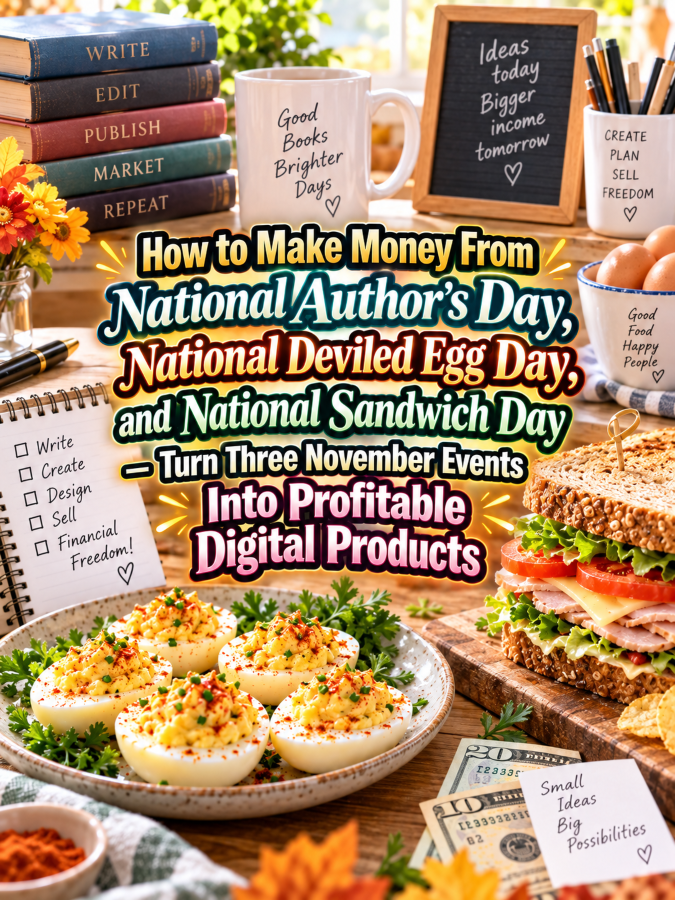
November is here, and apparently the holiday calendar decided it was time to get creative.
We’ve got authors, deviled eggs, and sandwiches.
Yes, really.
And that’s exactly why I love this kind of research.
You don’t need every holiday to be a giant commercial event. Sometimes the smaller, stranger, more specific observances can uncover very focused audiences with very specific needs.
National Author’s Day can lead us into writing, reading, publishing, journaling, and creative-business products.
National Deviled Egg Day can open the door to recipes, entertaining, cooking journals, holiday food planning, and party printables.
National Sandwich Day can take us into meal planning, lunch organization, recipe collections, lunchbox systems, and food-business resources.
Three days.
Three completely different markets.
And potentially a whole lot of digital products.
National Author’s Day — November 1, 2026
Let’s start with the writers.
National Author’s Day is observed every November 1 in the United States. It is a literary observance intended to honor authors and encourage appreciation for their work. Historical accounts connect the observance with Nellie Verne Burt McPherson of Bement, Illinois, and its recognition by the U.S. Department of Commerce in 1949. It is an observance rather than a U.S. federal holiday.
And from a digital-product perspective, this one is packed with possibilities.
Because authors don’t just write books.
They plan books.
They outline.
They develop characters.
They research.
They track chapters.
They organize ideas.
They edit.
They publish.
They promote.
Readers do their own thing, too.
They track books they want to read, books they’ve finished, favorite authors, ratings, quotes, reading challenges, book-club discussions, and recommendations.
That gives you two large audiences right away:
Authors and readers.
Research National Author’s Day Before Creating Products
Before you start designing, spend a little time researching the author and reader markets.
- Google: National Author’s Day November 1
- Google: National Author’s Day Activities
- Google: Author Planner Printable
- Google: Writing Planner Printable
- Google: Reading Journal Printable
- Google: Book Review Printable Template
Don’t just research the holiday.
Research what authors and readers are trying to accomplish.
That’s where the real product opportunities are.
How Can People Celebrate National Author’s Day?
People can celebrate by reading a favorite author’s work, discovering a new author, recommending books, writing reviews, visiting bookstores or libraries, supporting authors, or simply spending time writing their own stories.
That gives us several directions.
You could create products for people who write.
You could create products for people who read.
You could create products for people who want to publish.
And you could create products for people who want to build a writing habit.
Now we’re getting somewhere.
3 Ways to Make Money From National Author’s Day
1. Create Author Planners and Writing Workbooks
This is probably the most obvious opportunity, but it can also become one of the most expandable.
Create an Author Planner that helps writers organize their entire project.
It could include:
- Book idea pages
- Writing goals
- Project timelines
- Chapter planning
- Character development
- World-building notes
- Research trackers
- Scene planners
- Editing checklists
- Publication planning
- Book launch planning
- Marketing notes
Then you can niche it down.
Create a Novel Writing Planner.
Create a Nonfiction Book Planner.
Create a Children’s Book Planning Workbook.
Create a Self-Publishing Planner.
Create a NaNoWriMo Writing Planner.
Suddenly one basic idea has several branches.
2. Create Reading Journals and Book Trackers
Authors aren’t the only people who love books.
Readers are another huge audience for printable products.
A Reading Journal could include pages for books to read, books completed, author information, ratings, favorite characters, favorite quotes, memorable passages, book-club notes, reading goals, and yearly reading challenges.
You could also create specialized products such as:
- Book Club Discussion Journal
- Annual Reading Tracker
- 50 Books Challenge
- Book Review Journal
- Library Reading Tracker
- Children’s Reading Log
- Homeschool Reading Journal
- Reading Challenge Printable
And because reading is an evergreen hobby, these products don’t have to depend on November 1.
3. Create Publishing and Book-Business Planners
Here’s where you can move into a more business-focused market.
Authors who are serious about publishing need more than a manuscript.
They may need to organize editing, cover design, formatting, publishing tasks, launch activities, promotional campaigns, email marketing, social media content, reader outreach, and future book ideas.
A Book Launch Planner could help organize those moving pieces.
You could create:
- Book Launch Checklist
- Author Marketing Planner
- Book Promotion Calendar
- Author Content Planner
- Book Release Timeline
- Self-Publishing Project Planner
- Author Business Organizer
Now you’re creating a product that helps customers manage a business activity rather than simply giving them something pretty to print.
That’s a valuable shift.
Money-Making Tip #1: Sell the Author’s Journey, Not Just the Notebook
Here’s the important distinction.
You don’t want to sell another generic notebook with a pen illustration on the cover.
You want to sell a system that helps an author move from idea to finished project.
That’s much more compelling.
Instead of:
“Author Notebook — 50 Pages.”
Think:
“Plan Your Novel From First Idea to Final Chapter With This Complete Writing Workbook.”
See the difference?
The second product communicates an outcome.
And customers generally care more about the outcome than the number of pages.
Build an Author Product Ladder
| Price | Product | Purpose |
|---|---|---|
| $7 | Book Idea & Writing Starter Pack | Low-cost entry product |
| $12 | Author Writing Planner | Project organization |
| $17 | Novel Planning Workbook | Detailed writing system |
| $27 | Author Project & Publishing Kit | Writing plus publishing organization |
| $47 | Complete Author Productivity Bundle | Multiple writing and publishing resources |
| $77 | Ultimate Author Business & Writing Collection | Premium author resource library |
You could build the same kind of ladder on the reader side.
A $7 reading tracker could lead to a $17 reading journal, then a $27 book-club kit, then a $47 reading bundle, and eventually a larger $77 reader’s library.
Don’t Forget Teachers and Homeschoolers
Books create another audience: educators.
Teachers and homeschool parents may need reading logs, book-report templates, comprehension organizers, character-analysis worksheets, vocabulary trackers, reading challenges, and book-club resources.
You could create products such as:
- Book Report Planner
- Reading Response Journal
- Character Analysis Worksheet
- Book Discussion Guide
- Reading Challenge Tracker
- Novel Study Organizer
- Reading Comprehension Pack
And now National Author’s Day has expanded from “products for writers” into a broader books and literacy product category.
Create Products for Different Writing Niches
One of the easiest ways to expand your author products is to specialize.
Different writers have different needs.
- Fiction writers: Characters, plots, scenes, settings, story arcs.
- Nonfiction authors: Research, chapter structures, sources, outlines, interviews.
- Poets: Writing prompts, collections, revision notes, publication tracking.
- Children’s authors: Storyboards, character planning, illustration notes, page planning.
- Bloggers: Content planning, article ideas, keyword tracking, editorial calendars.
- Self-publishing authors: Editing, formatting, publishing, launch, and marketing checklists.
The more specific the customer, the easier it becomes to explain why your product exists.
Research Etsy for Author and Reader Products
Etsy can show you how sellers are positioning writing and reading products.
- Etsy: Author Planners
- Etsy: Writing Planners
- Etsy: Reading Journal Printables
- Etsy: Book Club Printables
- Etsy: Book Report Printables
Look closely at reviews.
Reviews can tell you what customers like, what they find confusing, and what they wish had been included.
Those comments can become your product-development roadmap.
Use Canva to Build a Professional Author Collection
Canva can help you build a cohesive visual system for your author products.
Create reusable layouts for writing prompts, planning pages, checklists, trackers, and worksheets.
Then adapt those templates for different audiences.
You might have one design system for writers and another for readers.
Or you could create a consistent brand across the entire collection.
The goal is to reduce design time while increasing consistency.
Use Pinterest to Reach Writers and Readers
Books and writing are highly searchable and visual topics, which makes Pinterest worth testing.
- Pinterest: Author Planner
- Pinterest: Writing Planner
- Pinterest: Reading Journal
- Pinterest: Book Club Ideas
- Pinterest: Book Report Ideas
One product can generate several content angles.
A reading journal can become content about reading challenges, book organization, book-club ideas, reading goals, and book-review systems.
An author planner can become content about writing routines, novel planning, character development, book launches, and self-publishing organization.
Use Amazon for Author and Reader Research
Amazon can help you see the physical products already attracting writers and readers.
- Amazon: Author Planners
- Amazon: Writing Journals
- Amazon: Reading Journals
- Amazon: Book Club Journals
- Amazon: Novel Writing Workbooks
Use these products for market research and, where appropriate, affiliate-content ideas. Always make sure affiliate disclosures and platform requirements are handled correctly.
Turn National Author’s Day Into an Evergreen Business
This is where this holiday becomes particularly interesting.
Writing is not seasonal.
Reading is not seasonal.
Publishing is not seasonal.
Book clubs are not seasonal.
That means you can use November 1 as the promotional hook without making your products dependent on the date.
Your author planner can sell in January.
Your reading journal can sell in summer.
Your book launch planner can sell in March.
Your writing workbook can sell whenever someone gets struck by the terrifying and wonderful thought:
“Maybe I should finally write that book.”
Create Content Around the Author’s Journey
You can also build blog posts, social content, and email content around the problems your products solve.
For example:
- How to Organize Your First Book Idea
- What to Put in an Author Planner
- How to Plan a Novel Before Writing Chapter One
- How to Create a Simple Writing Routine
- How to Track Your Reading Goals
- How to Start a Personal Reading Journal
- How to Organize a Book Club
- How to Prepare for a Book Launch
Each topic can naturally lead to a related printable.
That’s content marketing doing its job.
The Bigger Lesson From National Author’s Day
Here’s what I really want you to notice.
National Author’s Day isn’t necessarily valuable because millions of people wake up on November 1 thinking, “I must purchase an author planner today.”
That’s not how this works.
The opportunity comes from using the observance as a timely reason to talk about an evergreen market.
Writing is evergreen.
Reading is evergreen.
Publishing is evergreen.
Literacy is evergreen.
National Author’s Day simply gives you another reason to create content and put those products in front of people.
And next, we’re going from books to food.
Because apparently November decided our brains needed a snack.
National Deviled Egg Day — November 2, 2026
Okay, we’re leaving the library and heading straight into the kitchen.
National Deviled Egg Day lands on November 2, and yes, it is exactly the kind of wonderfully specific food observance that can make a digital-product creator stop and say, “Wait… can I really make money from deviled eggs?”
The answer is: potentially, yes.
But here’s the important part.
You don’t build a business around one little appetizer.
You use the appetizer as the hook and build products around the larger interests surrounding it: recipes, entertaining, holiday cooking, family gatherings, recipe organization, party planning, and food businesses.
And November is actually a great time for this because the holiday season is beginning to ramp up.
Thanksgiving is approaching.
Holiday gatherings are coming.
Families are thinking about food.
Hosts are making menus.
And somebody is going to be searching for a recipe that doesn’t involve spending three hours in the kitchen.
Let’s give them something useful.
Research National Deviled Egg Day Before Creating Products
Before designing anything, research what people are actually searching for. The goal isn’t simply to find information about the observance. You’re looking for the problems and interests connected to it.
- Google: National Deviled Egg Day November 2
- Google: National Deviled Egg Day Recipes
- Google: Deviled Egg Party Ideas
- Google: Deviled Egg Recipe Ideas
- Google: Holiday Appetizer Recipe Printables
- Google: Recipe Journal Printable
You’ll probably notice something important as you research.
People aren’t necessarily searching for one particular holiday.
They’re searching for recipes and solutions.
That’s good news.
How Do People Celebrate National Deviled Egg Day?
The obvious celebration involves making, eating, sharing, or experimenting with deviled eggs.
But deviled eggs are also associated with family gatherings, potlucks, holiday meals, picnics, parties, brunches, and entertaining.
That means your potential customer isn’t necessarily someone who woke up knowing it was National Deviled Egg Day.
It could be someone planning a Thanksgiving appetizer table.
It could be a home cook collecting family recipes.
It could be a party host looking for make-ahead appetizers.
It could be someone creating a recipe binder.
That’s the bigger market.
3 Ways to Make Money From National Deviled Egg Day
1. Create Deviled Egg Recipe Cards and Recipe Journals
This is the most direct product opportunity.
Create a Deviled Egg Recipe Collection with pages for ingredients, preparation notes, variations, serving ideas, ratings, and personal notes.
You could create printable recipe cards for customers who want to build their own collection.
You could also create a dedicated recipe journal with sections for:
- Classic deviled eggs
- Spicy variations
- Herb and seasoning variations
- Holiday versions
- Party recipes
- Family favorites
- Recipes to test
- Recipe ratings
The customer doesn’t have to use your recipes exclusively.
You’re giving them a system for collecting and organizing recipes.
That makes the product much more evergreen.
2. Create Holiday Appetizer and Entertaining Planners
This is where the opportunity gets bigger.
Instead of creating a product only about deviled eggs, create a Holiday Appetizer Planner.
It could include:
- Appetizer menu planner
- Recipe collection pages
- Ingredient shopping lists
- Preparation schedules
- Make-ahead planning pages
- Serving notes
- Guest estimates
- Party food checklists
- Leftover planning pages
Now your product can be used for Thanksgiving, Christmas, New Year’s Eve, birthdays, family reunions, potlucks, brunches, and other gatherings.
Deviled eggs become one example inside a much larger solution.
3. Create Recipe and Food-Business Templates
Here’s another audience you can target: people who create food products for sale.
Home bakers, caterers, food bloggers, cooking instructors, recipe creators, and small food businesses may need organization templates.
You could create:
- Recipe testing sheets
- Recipe development journals
- Ingredient costing worksheets
- Menu planning templates
- Food photography shot lists
- Recipe content planners
- Customer feedback forms
- Event catering checklists
- Food business planning pages
Be careful with food-business materials, though. If a template involves food safety, labeling, licensing, allergens, or regulatory requirements, keep it informational and encourage users to follow applicable local rules rather than presenting your printable as legal or regulatory guidance.
Money-Making Tip #2: Sell the Bigger Food Problem
This is the key to making a tiny food observance useful.
Don’t ask:
“What can I sell about deviled eggs?”
Ask:
“What does someone who loves making or serving deviled eggs also need?”
They may need recipes.
They may need menu ideas.
They may need a shopping list.
They may need a party planner.
They may need a recipe journal.
They may need a holiday appetizer organizer.
They may need a way to collect family recipes.
Now you have a real product category.
Build a Deviled Egg Product Ladder
| Price | Product | Purpose |
|---|---|---|
| $7 | Deviled Egg Recipe Card Set | Simple entry product |
| $12 | Deviled Egg Recipe Journal | Recipe organization |
| $17 | Holiday Appetizer Planner | Menu and preparation planning |
| $27 | Holiday Entertaining Recipe Kit | Recipes, planning pages, and shopping tools |
| $47 | Complete Holiday Recipe & Party Bundle | Multiple cooking and entertaining resources |
| $77 | Ultimate Home Entertainer’s Printable Collection | Premium recipe and event-planning library |
Notice how the higher-priced products aren’t simply stuffed with random pages.
They’re designed to solve bigger problems.
A $7 recipe card solves one small problem.
A $17 appetizer planner helps organize an entire menu.
A $47 bundle can help someone manage multiple aspects of entertaining.
That’s how the ladder makes sense.
Target Home Cooks and Family Recipe Collectors
Recipe organization is an evergreen niche.
People have handwritten family recipes.
They have recipes saved on phones.
They have screenshots.
They have recipes bookmarked in browsers.
They have recipes printed from websites.
And somewhere in the middle of all that chaos is Grandma’s recipe that nobody wants to lose.
A well-designed Family Recipe Organizer can solve a very real problem.
It can include sections for family favorites, holiday recipes, recipes to test, ingredient substitutions, preparation notes, ratings, and family stories.
That’s much bigger than deviled eggs.
Create Holiday Recipe Collections
November gives you an opportunity to expand quickly.
You could create themed recipe organizers for:
- Thanksgiving
- Christmas
- New Year’s Eve
- Super Bowl parties
- Easter
- Mother’s Day brunch
- Summer gatherings
- Backyard parties
- Potlucks
The same basic design framework can support all of them.
That means you’re not starting from scratch every time.
Research Etsy for Recipe and Entertaining Products
Etsy can help you see how customers are shopping for recipe and party printables.
- Etsy: Deviled Egg Recipe Products
- Etsy: Recipe Journal Printables
- Etsy: Printable Recipe Cards
- Etsy: Holiday Party Planners
- Etsy: Thanksgiving Recipe Printables
Look for customer complaints and requests.
If people want more recipe space, create it.
If they want a better family-recipe format, improve it.
If they want a complete holiday cooking system instead of individual cards, build that.
You’re not trying to make the prettiest recipe card on the internet.
You’re trying to make the most useful solution for a particular customer.
Use Canva to Build a Recipe Product Family
Canva can help you build a consistent collection of recipe products.
Create a master recipe-card layout.
Create a recipe-journal layout.
Create a shopping-list layout.
Create a menu-planning layout.
Create a preparation-timeline layout.
Then combine those pieces into different products.
One design system can become a deviled egg collection, Thanksgiving collection, Christmas collection, brunch collection, and general family recipe collection.
That’s a much better use of your design time.
Use Pinterest for Recipe Discovery
Food is one of Pinterest’s most natural content categories.
- Pinterest: Deviled Egg Recipes
- Pinterest: Holiday Appetizer Ideas
- Pinterest: Thanksgiving Appetizers
- Pinterest: Recipe Organization Ideas
You can create content around recipe organization, holiday entertaining, appetizer planning, family recipes, and meal preparation.
Then connect that content to your printable products.
Use Amazon for Recipe and Cooking Research
Amazon can provide additional clues about what home cooks and entertainers buy.
- Amazon: Deviled Egg Recipe Books
- Amazon: Recipe Journals
- Amazon: Holiday Cookbooks
- Amazon: Entertaining Cookbooks
You can use this research for blog posts, gift guides, cooking-resource articles, and affiliate content where appropriate. Remember to use the required affiliate disclosures for your program.
Turn One Recipe Into a Content Series
Here’s a fun content strategy.
Suppose you create a Deviled Egg Recipe Journal.
You could write an article about organizing deviled egg recipes.
Then create a post about holiday appetizer planning.
Then another about building a family recipe binder.
Then one about preparing appetizers for a large gathering.
Each article can point toward the same or related products.
You’re creating an interconnected content system rather than constantly hunting for completely new topics.
Think Beyond the Home Kitchen
Recipe products can also serve food creators.
A food blogger could use a recipe-development tracker.
A caterer could use an event menu planner.
A cooking instructor could use lesson-planning pages.
A recipe creator could use a content calendar.
A small food business could use customer feedback sheets and product-testing forms.
That opens the door to higher-value business templates.
And business customers often have different needs than hobby customers, which gives you another opportunity to specialize.
Make Your Food Products Evergreen
National Deviled Egg Day gives you a reason to promote the product on November 2.
But your recipe journal can continue selling long after that date.
Promote it for Thanksgiving.
Then Christmas.
Then New Year’s.
Then Easter.
Then Mother’s Day.
Then summer gatherings.
Then football parties.
Then back around to November.
That’s the beauty of building around a broader customer need.
The holiday creates the attention.
The evergreen product keeps working.
One Tiny Egg. A Whole Product Category.
And that’s the real lesson from National Deviled Egg Day.
You don’t have to believe that deviled eggs are the next billion-dollar digital-product niche.
You simply need to recognize that a tiny observance can point toward a much larger audience.
Food lovers.
Home cooks.
Recipe collectors.
Party hosts.
Holiday entertainers.
Food bloggers.
Small food businesses.
That’s a lot of potential customers hiding behind one very specific appetizer.
And we’re not finished yet.
Tomorrow, we’re moving from appetizers to one of the most flexible food categories imaginable.
National Sandwich Day — November 3, 2026
Now we’re moving into a food category that practically comes with its own product ladder.
National Sandwich Day is celebrated on November 3, and sandwiches are about as flexible as food gets. Breakfast sandwiches, lunch sandwiches, grilled sandwiches, wraps, tea sandwiches, school lunches, picnic sandwiches, party sandwiches, leftover makeovers, and quick meals all fit under the same delicious umbrella.
And that flexibility is exactly what makes this observance interesting for a digital-product business.
You aren’t really selling “sandwich stuff.”
You’re selling meal ideas, convenience, organization, creativity, and solutions for people who need to feed themselves or somebody else.
And if you’ve ever stared into the refrigerator at lunchtime thinking, “There has to be something in here I can put between two pieces of bread,” you already understand the customer problem.
Research National Sandwich Day Before Creating Products
Start with research before opening Canva. You want to understand what people are searching for and which sandwich-related problems can become useful digital products.
- Google: National Sandwich Day November 3
- Google: National Sandwich Day Activities
- Google: Sandwich Recipe Ideas
- Google: Sandwich Meal Planner
- Google: Kids’ Lunchbox Sandwich Ideas
- Google: Sandwich Recipe Printable
Pay attention to the words people use.
Are they looking for quick lunches?
Easy school lunches?
Meal prep?
Healthy lunch ideas?
Sandwich recipes?
Party food?
Those searches tell you which direction to take your products.
How Do People Celebrate National Sandwich Day?
Celebrating can be as simple as making a favorite sandwich, trying a new recipe, visiting a sandwich shop, preparing a special lunch, or sharing sandwich ideas with friends and family.
For a digital-product creator, that creates several possible customer groups.
Parents want lunch ideas.
Workers want quick lunches.
Students need lunchbox ideas.
Home cooks want recipes.
Party hosts need food ideas.
Meal planners need organization.
Food creators need recipe-development systems.
And now we’re no longer dealing with one food.
We’re dealing with a meal-planning and recipe market.
3 Ways to Make Money From National Sandwich Day
1. Create Sandwich Recipe Journals and Recipe Collections
The easiest entry point is a Sandwich Recipe Journal.
Create pages where customers can record ingredients, preparation instructions, variations, favorite combinations, ratings, photographs, and notes.
You can also create niche collections such as:
- Family Sandwich Recipe Book
- Grilled Sandwich Recipe Journal
- Breakfast Sandwich Recipe Planner
- Lunch Sandwich Recipe Collection
- Kids’ Sandwich Ideas Journal
- Party Sandwich Recipe Book
- Wrap and Sandwich Recipe Planner
Again, you’re not necessarily providing hundreds of recipes yourself.
You’re giving customers a system for collecting, testing, organizing, and rating recipes.
2. Create Lunchbox and Meal-Planning Printables
This is where the market gets considerably bigger.
Parents are constantly looking for ways to make school lunches easier.
Workers want quick lunches they can prepare without turning the kitchen into a disaster zone.
Families want meal plans that reduce the daily question of “What’s for lunch?”
Create a Lunchbox Meal Planner with weekly planning pages, shopping lists, ingredient checklists, sandwich rotation charts, lunchbox idea pages, and preparation notes.
You could create versions for:
- Kids’ school lunches
- Office lunches
- Family meal planning
- College students
- Busy parents
- Picnics
- Road trips
- Summer lunches
Now you’ve turned National Sandwich Day into a broader lunch organization niche.
3. Create Sandwich Party and Food-Business Resources
Sandwiches aren’t only individual meals.
They can also be party food.
Create sandwich-bar planning sheets, ingredient labels, menu cards, serving checklists, food-prep schedules, party shopping lists, and buffet signs.
You could also target small food businesses.
Sandwich shops, caterers, food trucks, bakers, and home-based food businesses may need menu planners, recipe-testing worksheets, product feedback forms, content calendars, and promotional templates.
That gives you a business-product angle alongside your consumer products.
Money-Making Tip #3: Sell Convenience, Variety, and Organization
Sandwiches solve a basic problem:
People need food, and they need ideas for what to make.
Your printable can make that process easier.
Instead of selling a generic sandwich recipe sheet, think about selling a system.
A 30-Day Lunch Planner.
A Family Sandwich Recipe Journal.
A School Lunchbox Planning Kit.
A Sandwich Bar Party Planner.
These products have a clear use case.
And clear use cases make digital products easier to explain and market.
Build a Sandwich Product Ladder
| Price | Product | Purpose |
|---|---|---|
| $7 | Sandwich Recipe Card Set | Simple entry product |
| $12 | Sandwich Recipe Journal | Recipe organization |
| $17 | Weekly Lunchbox Planner | Lunch planning and organization |
| $27 | Family Lunch Planning Kit | Meal planning, shopping, and lunch organization |
| $47 | Complete Lunch & Recipe Bundle | Recipes, planners, lists, and organization tools |
| $77 | Ultimate Family Meal & Lunch Printable Collection | Premium meal-planning resource library |
The same principle applies here as with the previous two holidays.
The price isn’t the strategy.
The increasing level of usefulness is the strategy.
Target Parents With Lunchbox Products
Parents are a particularly interesting market because lunch planning happens repeatedly.
A parent may need lunch ideas every school day.
That means a printable that helps them organize those decisions can have ongoing value.
Create products such as:
- School Lunch Planner
- Lunchbox Idea Cards
- Sandwich Rotation Chart
- Weekly Lunch Shopping List
- Kids’ Lunch Preference Tracker
- Lunch Prep Checklist
- School Lunch Recipe Journal
You can even make a product that helps parents record what their children actually eat.
Because there’s a big difference between “This looks adorable!” and “My child will actually eat this.”
Parents know exactly what I mean.
Target Busy Professionals
Adults who bring lunch to work are another audience.
Create a Work Lunch Planner with weekly meal planning, shopping lists, leftovers tracking, preparation notes, and quick-lunch ideas.
You could niche further into:
- Office Lunch Planner
- Meal Prep Lunch Planner
- Quick Lunch Recipe Journal
- Work-From-Home Lunch Planner
- Budget Lunch Planner
Be careful with nutrition and health claims. Focus on organization, recipes, preferences, and convenience rather than promising specific health outcomes.
Target Families and Meal Planners
Sandwiches are an easy entry point into a much larger meal-planning business.
Once someone buys a lunch planner, you can create related products for breakfasts, dinners, snacks, grocery planning, freezer meals, leftovers, and weekly meal organization.
That gives you an opportunity to build a complete family meal-planning collection.
And now National Sandwich Day has done its job.
It brought the customer in through one familiar food and introduced them to a broader organizational solution.
Create Sandwich Recipe Challenges
Challenges can make ordinary recipe products more engaging.
For example, you could create a 30-Day Sandwich Challenge where users try a different sandwich combination each day.
Include tracking pages, rating cards, ingredient notes, favorite lists, and “make again” pages.
You could also create:
- 7-Day Sandwich Challenge
- 30-Day Lunch Challenge
- Family Sandwich Challenge
- Creative Sandwich Challenge
- Lunchbox Variety Challenge
Challenges also give you excellent content opportunities for Pinterest, blogs, newsletters, and social media.
Research Etsy Before Creating Your Sandwich Products
Use Etsy to research related meal-planning and recipe products.
- Etsy: Sandwich Recipe Printables
- Etsy: Meal Planner Printables
- Etsy: Lunchbox Planners
- Etsy: Recipe Journal Printables
- Etsy: Family Meal Planners
Look at what customers are buying and, more importantly, what they say they wish the products included.
That feedback can help you build something more useful.
Use Canva to Create a Complete Lunch Collection
Canva is useful for creating a coordinated collection because your recipe cards, planners, checklists, charts, and journals can all share the same visual system.
Create a master template.
Then adapt it into different products.
One layout can become a sandwich recipe card.
Another can become a lunch planner.
Another can become a shopping list.
Another can become a sandwich rotation tracker.
Bundle them together.
You’ve just created a product family without designing every page from scratch.
Use Pinterest to Reach Lunch-Planners
Food and meal planning are highly visual, which makes Pinterest a useful discovery channel to test.
- Pinterest: Sandwich Ideas
- Pinterest: Lunchbox Ideas
- Pinterest: Meal Planning Ideas
- Pinterest: Family Meal Planning
You can create content around:
- Easy lunch planning
- School lunch organization
- Sandwich ideas
- Lunchbox planning
- Meal-prep organization
- Family recipe organization
Then connect those content pieces to your digital products.
Use Amazon for Recipe and Lunch Research
Amazon can help you research adjacent products and create relevant affiliate content.
- Amazon: Sandwich Cookbooks
- Amazon: Lunchbox Recipe Books
- Amazon: Meal Planners
- Amazon: Lunch Prep Books
These can provide ideas for blog posts, gift guides, meal-planning content, and affiliate recommendations where relevant.
Don’t Forget Kids’ Activities
Sandwiches can also become an educational theme.
For younger children, you could create printable activities involving food vocabulary, counting, sequencing, matching ingredients, writing prompts, or designing their own sandwich.
For example, a Design Your Own Sandwich Activity could ask children to choose bread, fillings, toppings, and sauces, then draw and describe their creation.
Teachers and homeschoolers could use food themes to introduce writing, math, science, or practical-life activities.
That gives you another product branch.
Create Products for Small Food Businesses
Here’s another potentially valuable market.
A sandwich shop, caterer, food truck, or small food business may need organizational materials.
You could create:
- Menu planning worksheets
- Recipe testing sheets
- Customer feedback forms
- Product development trackers
- Content calendars
- Social media planning sheets
- Catering event checklists
- Ingredient organization worksheets
Keep these products focused on organization and business workflow rather than making claims about food regulations or compliance.
Make Sandwich Products Evergreen
This is where National Sandwich Day becomes much more powerful.
People eat sandwiches all year.
They need lunches all year.
Families need meal plans all year.
Recipes don’t expire on November 4.
So your National Sandwich Day marketing campaign can simply be the launch or visibility event for a product that continues to sell.
You can reposition the same product for back-to-school season, summer travel, office lunches, picnics, road trips, meal prep, and family organization.
That’s exactly what we want.
Turn Sandwiches Into a Broader Meal-Planning Business
Here’s the progression:
Sandwich recipe card → Sandwich journal → Lunch planner → Family meal planner → Complete meal-planning bundle.
That’s the product ladder.
And then you can expand sideways:
- Breakfast planners
- Dinner planners
- Snack planners
- Grocery planners
- Meal-prep planners
- Freezer meal organizers
- Recipe binders
One little sandwich has opened the refrigerator door to an entire meal-planning category.
The Bigger Lesson From National Sandwich Day
National Sandwich Day is a perfect example of why you shouldn’t judge an opportunity by the size of the holiday.
The observance is the hook.
The customer problem is the opportunity.
People need ideas.
People need organization.
Parents need lunch solutions.
Families need meal-planning systems.
Food creators need recipe-development tools.
And all of those needs exist long after November 3.
That’s how you take a one-day observance and turn it into an evergreen digital-product category.
And now we’ve covered all three November events.
We’ve gone from authors to deviled eggs to sandwiches, which sounds less like a marketing strategy and more like the strangest lunch meeting ever.
But there’s a strategy hiding underneath all three.
Part 4: Turn Three November Events Into a Repeatable $7–$77 Digital Product Business
By now, you can probably see the pattern.
National Author’s Day gives you a reason to talk about writing, reading, publishing, and creative organization. National Deviled Egg Day gives you a fun excuse to create recipe, entertaining, and food-planning products. National Sandwich Day opens the door to lunch planning, meal prep, recipes, family organization, and even food-business resources.
And that is the real opportunity.
You are not trying to build three completely separate businesses because three holidays showed up on the calendar. That would be exhausting before you even finished your coffee.
Instead, use the holidays as marketing hooks that lead customers into broader, evergreen product categories.
Use the Holiday as the Hook, Not the Whole Business
This is one of the most useful ideas in holiday-based digital product marketing.
A holiday can help you get attention, but your product should solve a problem that exists beyond that single day.
For example, someone might search for an Author’s Day printable in November. But that same customer may also need a writing planner in December, a book launch checklist in January, and a publishing planner later in the year.
Someone looking for a deviled egg recipe card may eventually want a complete family recipe binder. Someone searching for sandwich lunch ideas may also want a weekly meal planner or school lunchbox organizer.
See what happened there?
The little holiday opened the door. The larger customer need keeps the door open.
Build Three Simple Product Ladders
You already have the individual product ideas. Now let’s connect them into simple $7–$77 product ladders.
National Author’s Day Product Ladder
- $7: Book Idea & Writing Starter Pack
- $12: Author Writing Planner
- $17: Novel Planning Workbook
- $27: Author Project & Publishing Kit
- $47: Complete Author Productivity Bundle
- $77: Ultimate Author Business & Writing Collection
The beauty of this ladder is that it can serve multiple audiences without requiring an entirely new product every time.
You can create variations for fiction writers, nonfiction writers, poets, children’s authors, self-publishing authors, bloggers, and even students working on longer writing projects.
National Deviled Egg Day Product Ladder
- $7: Deviled Egg Recipe Card Set
- $12: Deviled Egg Recipe Journal
- $17: Holiday Appetizer Planner
- $27: Holiday Entertaining Recipe Kit
- $47: Complete Holiday Recipe & Party Bundle
- $77: Ultimate Home Entertainer’s Printable Collection
Now your product is no longer dependent on November 2.
You can market recipe organization and entertaining products around Thanksgiving, Christmas, New Year’s Eve, birthdays, potlucks, family gatherings, game days, brunches, and other occasions.
National Sandwich Day Product Ladder
- $7: Sandwich Recipe Card Set
- $12: Sandwich Recipe Journal
- $17: Weekly Lunchbox Planner
- $27: Family Lunch Planning Kit
- $47: Complete Lunch & Recipe Bundle
- $77: Ultimate Family Meal & Lunch Printable Collection
This ladder has serious evergreen potential because people need lunch long after November 3 disappears from the calendar.
School lunches, office lunches, meal prep, road trips, picnics, family meals, and quick weekday food planning can all become future marketing angles.
Repurpose One Product Into Several Products
Here is where digital products become especially interesting.
You do not necessarily need to create everything from scratch.
One strong master product can become several smaller products, audience-specific versions, and bundles.
For example, your sandwich recipe journal might contain recipe pages, ingredient lists, rating sections, lunch-planning pages, shopping lists, and notes.
You could turn those components into:
- Sandwich Recipe Cards
- Weekly Lunch Planner
- Lunchbox Ideas Worksheet
- Family Meal Planner
- Grocery Shopping List
- Complete Lunch Planning Bundle
Same basic research. Same design system. Different packaging.
That’s not cutting corners. That’s smart product development.
Create Bundles That Solve a Bigger Problem
Individual printables can attract buyers, but bundles can give those buyers a reason to spend more.
For example, instead of selling only a $7 sandwich recipe card collection, create a larger bundle that includes:
- Recipe cards
- Lunchbox planner
- Weekly meal planner
- Grocery list
- Family favorites tracker
- Lunch idea brainstorm pages
- Recipe rating sheets
Now you are selling a system, not just a PDF.
And that distinction matters.
A random pile of PDFs is a thingee. A thoughtfully organized product ecosystem is a business.
Let Each Holiday Lead to an Evergreen Category
This is the part I really want you to remember.
National Author’s Day
Holiday hook: Celebrate authors and writing.
Evergreen category: Writing, reading, publishing, and creative productivity.
Future products: Writing planners, character development worksheets, book launch planners, reading journals, manuscript trackers, publishing checklists, author business planners, and writing challenge printables.
National Deviled Egg Day
Holiday hook: Celebrate a popular appetizer.
Evergreen category: Recipes, cooking organization, entertaining, and meal planning.
Future products: Recipe binders, recipe cards, party planners, appetizer planners, holiday menu planners, grocery lists, cooking journals, and entertaining checklists.
National Sandwich Day
Holiday hook: Celebrate sandwiches.
Evergreen category: Lunch planning, meal prep, family meals, and recipe organization.
Future products: Lunchbox planners, weekly meal planners, sandwich recipe collections, school lunch organizers, grocery planners, family meal kits, and meal-prep worksheets.
Now you’ve got three holidays feeding three larger product ecosystems.
Build a Simple November Promotion Calendar
You do not have to wait until the actual holiday to start promoting.
In fact, waiting until the holiday arrives means you may already be late.
Try this simple sequence:
- 7–14 days before: Publish educational content and Pinterest pins related to the upcoming holiday.
- 3–5 days before: Introduce your printable and show how it solves a problem.
- Holiday day: Publish your strongest promotional content and direct people to the product.
- 1–3 days after: Reposition the product around its evergreen use.
- Later in November: Bundle related products and promote them as holiday-season solutions.
This keeps you from creating a product, shouting about it for twelve hours, and then throwing it into the digital attic.
Use Pinterest as Your Long-Game Traffic Machine
Pinterest can be especially useful for printable businesses because people often use the platform to discover ideas, planning resources, recipes, crafts, organization tools, and printable products.
Create several pins from one product.
For an author planner, you might create pins around:
- Author planning ideas
- Novel planning worksheets
- Writing organization
- Book planning printables
- Self-publishing organization
For food products, you can create pins around recipes, meal planning, entertaining, lunch organization, and recipe organization.
Start your research with Pinterest and look at the words and phrases people are already using.
Then create content that answers those searches.
Use Etsy to Study What Buyers Understand
Etsy can be useful for product research because you can see how sellers package similar ideas.
Search for terms such as:
- Author planner printable
- Writing planner
- Recipe journal
- Holiday recipe printable
- Meal planner printable
- Lunchbox planner
- Family meal planner
Pay attention to the product names, thumbnails, page counts, bundle structures, and customer questions.
Don’t copy somebody else’s product.
Instead, look for gaps.
Maybe customers want a simpler version. Maybe they want a family-friendly version. Maybe they want a more detailed version. Maybe they want a version designed for a particular audience.
That’s where your opportunity can appear.
Use Canva to Build a Consistent Product Family
Canva makes it easier to build a recognizable visual system across your products.
Choose a few fonts, colors, page layouts, icons, and design elements and reuse them.
Then your $7 product can look like it belongs to the same family as your $47 bundle.
That’s important because customers should recognize your products.
You’re not just selling another printable.
You’re building a little brand.
Use Communities to Discover Real Customer Problems
Don’t rely only on keyword research.
Go where your potential buyers are already talking.
Look at relevant Facebook groups, Reddit communities, Pinterest searches, forums, author communities, cooking communities, meal-planning groups, homeschooling communities, and family organization groups.
Pay attention to questions people repeatedly ask.
Those questions can become product pages.
For example:
- “How do I organize all my book ideas?” → Writing idea organizer.
- “How do I keep track of family recipes?” → Recipe binder system.
- “What can I pack for lunch this week?” → Lunchbox planner.
- “How do I organize my book launch?” → Publishing planner.
- “How do I plan food for a party?” → Entertaining planner.
The thundering herd of product ideas is usually already standing there.
You just have to listen.
Add Amazon Affiliate Content Where It Makes Sense
Your content can also support affiliate income when you recommend physical products that naturally complement your digital products.
For authors, that could include notebooks, pens, reading accessories, book stands, and organizational supplies.
For cooks and entertainers, it could include recipe binders, storage supplies, serving accessories, kitchen tools, and meal-prep containers.
For lunch planners, it could include lunch containers, reusable bags, food storage products, and organization accessories.
You can research complementary products on Amazon.
When using affiliate links, follow Amazon’s current affiliate program rules and disclosure requirements. Don’t recommend products simply because they have an affiliate opportunity. They should genuinely make sense for the reader.
Track What Actually Gets Attention
You don’t need a giant analytics department.
Start with a simple spreadsheet.
Track:
- Product name
- Holiday or seasonal hook
- Price
- Views
- Clicks
- Sales
- Conversion rate
- Traffic source
- Customer questions
After a few weeks, patterns start to appear.
Maybe your $7 products bring lots of attention. Maybe your $27 bundles convert better. Maybe Pinterest sends traffic to recipe products while your social posts work better for author products.
Don’t guess.
Look at the evidence and adjust.
Turn the Three Holidays Into a Repeatable Formula
Here’s the whole strategy in one simple process:
- Find an upcoming observance.
- Identify the audience connected to it.
- Find a problem, desire, or activity connected to that audience.
- Create a useful $7 entry product.
- Expand the idea into a $12–$27 product.
- Create a $47 bundle.
- Build a premium $77 collection.
- Promote the product before and during the observance.
- Reposition it for evergreen use after the holiday.
- Track results and improve the next version.
Then do it again.
And again.
Eventually, you’re not scrambling around asking, “What should I make this week?”
You have a repeatable product-research and product-creation system.
Final Thoughts
National Author’s Day, National Deviled Egg Day, and National Sandwich Day might look like three completely unrelated November observances.
But that’s exactly why they are useful examples.
National Author’s Day can lead you into the enormous world of writing, reading, and publishing products.
National Deviled Egg Day can introduce customers to recipe organization, entertaining, cooking, and holiday food products.
National Sandwich Day can lead into lunch planning, meal prep, family organization, and recipe products.
The holiday gets attention.
The problem-solving product gets the sale.
The product ladder creates the opportunity to increase customer value.
And the evergreen version keeps the product useful after the calendar page turns.
That is the bigger game.
You’re not just making a printable because a quirky holiday exists.
You’re using a timely topic to discover an audience, solve a problem, create a product, and build something that can continue selling long after November 1, 2, or 3 has passed.
And honestly, that’s always a good thing.
Enjoy!