Introduction
Somewhere between breakfast, laundry, dishes, school bags, work, pets, grocery shopping, and the mysterious pile of things sitting on the kitchen counter, somebody eventually says, “Why am I the only one doing everything?” And just like that, the family cleaning routine has gone from mildly annoying to full household drama. That’s exactly why Family Cleaning Binders can become a useful digital product because they give families a visible system for dividing household work instead of relying on one person to remember every single thing.
The opportunity isn’t really about creating another cleaning checklist. Families can find cleaning checklists everywhere, but a checklist doesn’t necessarily solve the bigger problem of deciding who does what, when it gets done, what needs to happen weekly or monthly, and how everyone knows what is expected. A Family Cleaning Binder can turn all those loose responsibilities into one shared household system.
And here’s the Good Thing: you don’t need to create a complicated household management command center with seventeen tabs and enough labels to organize a warehouse. You can start with a simple system that helps families see the work, divide the work, and track the work. When your printable reduces the “I thought you were doing it” problem, you’ve created something people can actually use.
Quick Answer
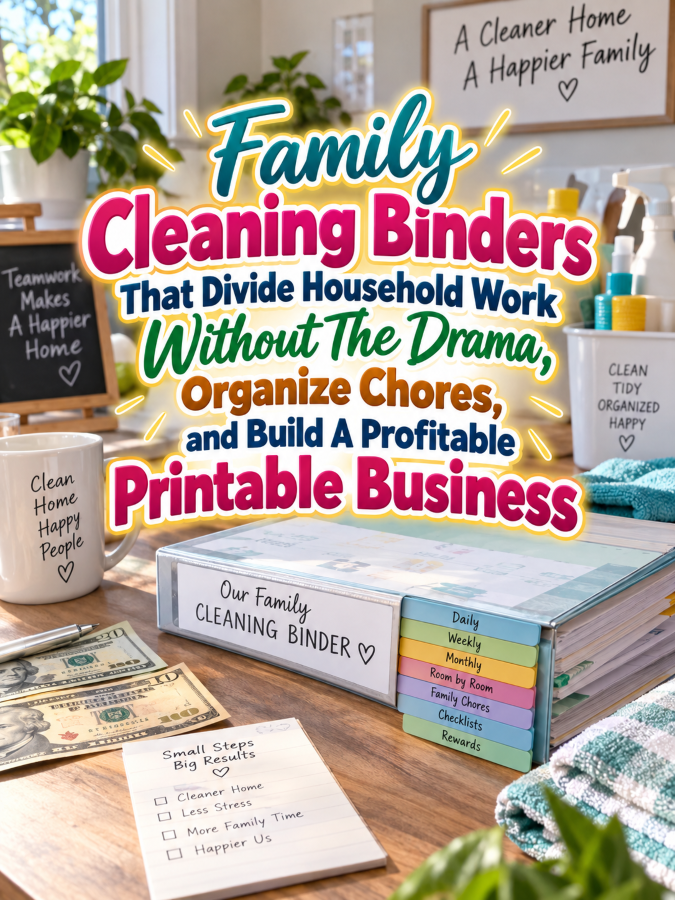
Family Cleaning Binders are printable or editable household organization systems that help families divide chores, assign responsibilities, schedule recurring cleaning tasks, track completion, and keep important household routines in one place. Instead of one person carrying the entire mental load of remembering what needs to be cleaned, the binder makes responsibilities visible. That makes it useful for families, couples, roommates, blended households, and parents teaching children how to contribute at home.
A $7 starter product could include a weekly chore chart, family responsibility list, room-by-room cleaning checklist, daily reset sheet, and chore assignment page. From there, you can expand into a $17 family cleaning bundle, a $27 complete cleaning workbook, a $47 household management binder, and a $77 family home systems library. The key is to sell the outcome-less confusion about household work-not simply another stack of printable checkboxes.
Why This Niche Works
Household cleaning is a recurring problem, which makes it naturally suited to reusable printables. Homes don’t become permanently clean because someone checked “vacuum living room” on Tuesday, unfortunately, because Wednesday has opinions. Families need systems that repeat, adapt, and make responsibilities clear over time.
The second opportunity is the division of labor. Many cleaning products tell people what to clean but don’t help households decide who should do it. A family binder can solve that missing piece by connecting tasks with people, frequency, and expectations.
There’s also a strong audience range. Families with young children can use chore charts and age-appropriate responsibility pages, while couples can use shared cleaning schedules and household maintenance routines. Roommates, college students, busy professionals, and multigenerational households can all benefit from variations of the same basic system.
What You Can Put Inside Family Cleaning Binders
1. Family Responsibility Map
Start with a page that shows the major household responsibilities and who owns each one. Include cleaning, laundry, dishes, trash, pet care, meal cleanup, bathroom maintenance, bedroom responsibilities, and other recurring household tasks. The word “owner” doesn’t mean that person has to do every tiny step forever; it simply makes it clear who is responsible for making sure the task gets handled.
This distinction is important because “somebody should do it” is not actually an assignment. If everyone assumes somebody else will remember, the task can sit there until it becomes a household emergency. A responsibility map makes the invisible work visible, and that alone can make your printable much more valuable.
2. Weekly Family Chore Chart
Create a simple weekly chart showing who is responsible for which chores on which days. You can include spaces for family members to write their names, check off completed tasks, and note anything that needs to be carried over. Keep it flexible because households have different schedules and not everyone has the same availability every day.
You could also create versions for families with young children, teenagers, adults, or mixed ages. A child might be responsible for putting away toys and feeding a pet, while an adult might handle bathroom cleaning or taking out heavy trash. The goal isn’t to make every task perfectly equal; the goal is to make the household workload visible and manageable.
3. Room-by-Room Cleaning Checklists
Break the home into practical zones such as kitchen, bathrooms, bedrooms, living areas, laundry area, entryway, outdoor spaces, and storage areas. Each room can have daily, weekly, monthly, and occasional tasks. This helps families avoid the common problem of remembering the obvious chores while forgetting the less frequent ones.
Keep the lists realistic because a cleaning checklist that requires an entire Saturday to complete isn’t exactly motivating. You can also include a “minimum reset” section for each room so families know what matters most when time is limited. That gives buyers a useful option for both normal weeks and those weeks when life decides to throw a chair through the schedule.
4. Daily Home Reset Sheet
A daily reset page can focus on the small tasks that prevent household mess from becoming overwhelming. Include dishes, counters, clutter pickup, laundry movement, trash, pet-related cleanup, and preparing key areas for the next day. Families can assign different tasks to different people rather than assuming one person will magically notice everything.
You can make this page especially useful by dividing tasks into “Morning,” “After School/Work,” and “Evening.” That creates natural opportunities for household members to contribute throughout the day. It also helps families avoid the idea that cleaning is one giant job that must be completed all at once.
5. Chore Rotation Planner
Some families prefer rotating responsibilities so one person isn’t permanently stuck cleaning the bathroom or taking out the trash. Create a rotation page where chores can move between family members each week or month. This can make the system feel more balanced and prevent one person from becoming the household’s official toilet-cleaning department.
Include a simple rotation schedule with names across the top and chores down the side. You could also add a notes section for special circumstances, vacations, busy work weeks, or temporary swaps. Flexibility makes the system more likely to survive real life.
6. Age-Appropriate Kids’ Chore Pages
Parents often want children to contribute to household work but aren’t sure which responsibilities make sense for different ages. Create pages that organize chores by general developmental stage, while reminding buyers that every child and household is different. Include simple tasks such as putting toys away, making a bed, sorting laundry, wiping surfaces, feeding pets, or helping with dishes.
Make these pages visually friendly without making them feel like school worksheets. You could add spaces for the child’s name, weekly responsibilities, completion checks, and a small “I helped with…” section. The objective is to make contribution visible and understandable, not to turn the kitchen into a tiny corporate office.
7. Deep Cleaning and Seasonal Planner
Some household tasks don’t need to happen every week, but they still need to happen eventually. Create monthly, seasonal, and occasional cleaning lists for tasks such as cleaning appliances, washing curtains, organizing storage, wiping cabinets, cleaning windows, checking under furniture, and refreshing overlooked areas.
You can divide these tasks across months so the family doesn’t feel like everything has to happen during one giant spring-cleaning marathon. A seasonal planner can also become its own standalone product later. That’s a smart way to turn one section of your binder into another product opportunity.
8. Family Cleaning Meeting Page
This could become one of your most distinctive pages because it connects cleaning with communication. Give the family a simple monthly or weekly meeting page where they can discuss what is working, which chores are being missed, whether assignments need to change, and what upcoming events might affect the schedule.
Add prompts such as “What needs to change?”, “Which task is taking too long?”, “Does anyone need help?”, and “What should we rotate next?” This helps families adjust the system instead of blaming people when the system stops working. And that is exactly the kind of practical feature that can separate your product from a generic chore chart.
Tools You’ll Need
Canva can handle the design of your Family Cleaning Binders, from chore charts and checklists to divider pages and colorful household trackers. Use clear typography, simple icons, generous writing space, and layouts that remain readable when printed in black and white. You want “easy household system,” not “the cleaning checklist equivalent of Times Square at midnight.”
Google Docs is useful for drafting chore lists, cleaning prompts, household meeting questions, instructions, and product descriptions before you design the final pages. It also makes it easy to reorganize your ideas as you test the system. Writing the structure first can save you from spending an hour designing a beautiful page and then discovering you forgot the actual useful part.
AWeber can help you build an email list around household organization, cleaning routines, family chores, and home management. You could offer a free Weekly Family Chore Chart as your lead magnet and then introduce subscribers to your complete binder. Helpful emails about simplifying household work can naturally lead readers toward your paid products.
GetResponse can help you build landing pages and email campaigns for your cleaning printable products. You could create a short sequence explaining how to divide household work, create a realistic cleaning routine, involve children, and handle missed chores without turning the kitchen into a courtroom. The product then becomes the practical system that supports what your emails teach.
Gumroad can provide a simple storefront for selling downloadable Family Cleaning Binders and related products. You can start with one affordable starter kit and add larger bundles as you learn what customers actually want. That lets you validate the niche before building an enormous collection of pages nobody asked for.
Teachable could become useful later if you want to turn your cleaning system into a short course or household organization program. You could teach families how to set up their chore system, hold a weekly household check-in, divide responsibilities, and keep the system flexible. That creates another product layer without abandoning your original printable niche.
Amazon can help you research chore charts, family cleaning planners, household organization binders, and related products. Read customer reviews carefully because they can reveal what buyers find frustrating, confusing, useful, or missing. You’re looking for problems to solve, not designs to copy.
Your 5-Step Action Plan
Step 1: Pick One Household Problem
Don’t begin by trying to solve every household organization problem known to humanity. Choose one clear issue, such as families struggling to divide cleaning responsibilities fairly or parents constantly reminding everyone to do their chores. A focused problem gives your first product a clear purpose and makes your marketing much easier.
Write a simple transformation statement such as, “This binder helps families see, divide, and track household cleaning responsibilities.” Use that sentence as your filter when deciding what belongs inside the product. If a page doesn’t help create that transformation, it probably doesn’t need to be in version one.
Step 2: Build the $7 Starter Product
Create a compact starter kit containing the family responsibility map, weekly chore chart, room-by-room cleaning checklist, daily reset sheet, chore rotation planner, and action page. Make every page immediately usable without requiring a long instruction manual. The buyer should be able to download the product, print it, write in the names, and start using it quickly.
Include a one-page setup guide explaining how to choose responsibilities, assign tasks, and adjust the system. Keep the instructions practical and encouraging rather than preachy. Nobody wants their cleaning printable to sound like a disappointed principal standing outside the bathroom.
Step 3: Create a Free Chore Chart
Turn one of your strongest pages into a free download. A Weekly Family Chore Chart or Family Responsibility Map would make a useful lead magnet because the value is obvious before someone even downloads it. The free page should solve a small problem while making the buyer curious about the complete system.
Then create content around household workload and cleaning organization. You could publish posts such as “How to Divide Chores Without Arguing,” “Why Family Cleaning Charts Fail,” or “How to Get Kids Involved in Household Work.” Your content should teach something useful instead of simply shouting, “Here is my printable, please buy it!”
Step 4: Build the Product Ladder
Once the starter product is working, expand it into a logical ladder. Your $7 offer could become a $17 Family Cleaning Bundle with seasonal checklists, chore rotations, kids’ pages, and deep-cleaning sheets, while the $27 level could become a complete Family Cleaning Workbook. At $47, you could offer a full Household Management Binder, and at $77, you could create a comprehensive Family Home Systems Library.
Specialized versions could include Cleaning Binders for Families With Young Children, Teen Chore Systems, Roommate Cleaning Systems, New Home Cleaning Binders, Seasonal Cleaning Libraries, and Busy Family Reset Systems. You can reuse your core framework while changing the tasks, prompts, and examples. That’s a Good Thing because your creativity should build an asset, not repeatedly reinvent the wheel.
Step 5: Test It in a Real Household
Before publishing, actually use the system or have someone use it in a real household. Pay attention to whether people understand their responsibilities without needing verbal reminders every five minutes. If the binder creates more questions than it answers, simplify the pages.
Also look for tasks that are missing, assignments that aren’t realistic, and pages nobody touches. Your first version doesn’t need to be perfect because customer feedback can show you where the real opportunity is. That’s it. That’s your beginning!
What Comes Next
A Family Cleaning Binder can become the foundation for a much larger household management product line. Once you have cleaning organized, you can create related products for laundry schedules, pantry organization, home maintenance, meal preparation, family routines, seasonal household resets, and moving organization. The same buyer who needs help dividing chores may eventually need help organizing several other parts of the home.
You can also create specialized products for different family stages. Families with toddlers have different household routines from families with teenagers, while newlyweds and multigenerational households may need different systems again. Instead of creating one giant binder for everyone, you can build smaller products that speak directly to specific household situations.
And don’t underestimate the marketing power of the emotional problem behind the printable. People aren’t simply tired of dirty bathrooms; they’re tired of feeling like they’re the only person who notices the dirty bathroom. Help them create a system where responsibilities are visible, expectations are clear, and the household can adjust when life gets messy.
3 Ways to Stand Out From The Thundering Herd!
Way 1: Sell “Who Does What?” Instead of Just “What to Clean”
Most cleaning printables tell people what needs to be cleaned, but your Family Cleaning Binder can solve the more frustrating question of who is responsible for making sure it happens. Create a clear responsibility system that connects each recurring task with a person, frequency, and simple completion check. That turns your product from a cleaning checklist into a household workload management system.
You can even include a page called “Who Owns This?” where families list recurring household responsibilities and assign an owner. Include things such as laundry, dishes, trash, pet care, bathrooms, kitchen cleanup, grocery-related cleanup, and seasonal tasks. When the invisible work becomes visible, families have something concrete to discuss instead of arguing about who supposedly “does everything.”
Way 2: Build a “No Nagging” System
Parents often don’t want another chore chart that requires them to stand over everyone reminding them what to do. Create a system designed to move responsibility from the person who remembers everything to the people who actually own the tasks. Use clear assignments, recurring schedules, completion boxes, and a weekly review so everyone can see what needs to happen.
Call this feature something memorable such as the “No Nagging Household System.” The goal isn’t to promise that nobody will ever remind anyone of anything again because, well, children exist and laundry mysteriously reproduces. The goal is to create enough visibility and structure that the family doesn’t depend on one person to act as the household’s human notification app.
Way 3: Make the Binder Adaptable to Real Life
Households don’t operate on perfect schedules, so your system shouldn’t either. Add pages for chore swaps, busy weeks, vacations, illness, visitors, school activities, work changes, and temporary responsibilities. A flexible system is much more likely to survive beyond the first enthusiastic Sunday when everybody declares, “This is going to change our lives!”
You can create a simple “This Week Is Different” page where families can record temporary changes. Someone may be traveling, working late, preparing for an event, or handling another responsibility, so another household member may temporarily take over a task. This keeps the system practical without requiring families to redesign their entire binder every time life happens.
3 Nifty Ways to Find Customers
Way 1: Market the “Why Am I Doing Everything?” Problem
Instead of leading with the words “printable cleaning binder,” lead with the problem people actually feel. Content such as “Why One Person Ends Up Managing the Whole House,” “How to Divide Chores Without Constant Reminders,” and “The Difference Between Helping and Owning a Chore” can attract people who recognize the problem immediately. Then introduce your printable as the tool that helps turn that frustration into a shared system.
This gives you a much stronger marketing angle than simply posting pictures of checklists. People don’t wake up thinking, “I desperately need a PDF with seven columns.” They wake up thinking, “Why am I the only one who knows the trash needs to go out?” Solve that problem in your content, and your product becomes much easier to explain.
Way 2: Offer a Free “Who Does What?” Chart
Create a one-page responsibility map and give it away as a free download. The page can help a household list recurring tasks and assign each one to a family member. It’s simple enough to use immediately but useful enough to demonstrate the bigger idea behind your paid binder.
After someone downloads it, your email sequence can teach them how to build a weekly cleaning routine, create chore rotations, involve children, and handle tasks that keep getting forgotten. Then introduce your complete binder as the next step. You’re not simply selling a PDF; you’re teaching people how to use the system that the PDF supports.
Way 3: Create Products for Specific Household Situations
Specific audiences give you specific marketing opportunities. Consider products for families with toddlers, families with teenagers, blended families, multigenerational households, couples sharing chores, roommates, busy working parents, and families moving into a new home. Each audience has slightly different household challenges, even though the basic chore system remains similar.
You can also create seasonal versions such as Spring Cleaning Binders, Back-to-School Household Reset Planners, Holiday Cleaning Systems, and New Year’s Home Organization Binders. This gives your shop timely reasons to attract returning customers. The thundering herd may be selling generic cleaning checklists, but you can sell a system designed around a specific moment or household problem.
3 Takeaways You Won’t Find Elsewhere!
Takeaway 1: The Mental Load Is Part of the Problem
Cleaning isn’t only the physical work of wiping, sweeping, washing, sorting, and scrubbing. Someone also has to notice what needs to be done, remember when it needs to happen, decide who should do it, and follow up when it doesn’t get done. Your binder becomes more valuable when it helps distribute some of that remembering and planning work.
Add sections such as “Things That Need Attention,” “Upcoming Household Tasks,” and “Who Is Responsible?” so the mental work isn’t trapped inside one person’s head. This can be one of the strongest selling points of the product because you’re helping organize the management side of household work. That’s a much bigger problem than simply remembering to vacuum.
Takeaway 2: Fair Doesn’t Always Mean Equal
A smart family cleaning system doesn’t necessarily divide every chore into perfectly equal pieces. A younger child may contribute differently from an adult, and someone who works longer hours may have a different responsibility mix from someone with more flexible time. Your printable should give families a framework for discussing what feels workable rather than dictating what “fair” must look like.
Include a household discussion page where family members can identify tasks they prefer, tasks they dislike, and responsibilities they are able to handle. That information can help families create a system that fits their actual circumstances. The product provides structure, while the family decides how to use it.
Takeaway 3: The Best Cleaning System Includes a Reset Button
Every household eventually falls behind. Someone gets sick, a busy week happens, guests arrive, school gets hectic, or everybody simply decides that cleaning is tomorrow’s problem until tomorrow becomes next Thursday. Your product should include a reset system that helps families recover without feeling like they have failed.
Create a “Household Reset Day” checklist with the most important tasks first. Divide it into “Must Do,” “Should Do,” and “If We Have Time” so families can regain control without trying to deep-clean the entire house in one heroic afternoon. That makes the binder more useful precisely when people need it most.
3 Common Mistakes to Avoid
Mistake 1: Making the System Too Complicated
A cleaning binder should make household work easier, not create another household project. If buyers need 45 minutes every Sunday just to update the chore chart, there’s a good chance the system is working against them. Keep the recurring parts simple enough that families can maintain them even during busy weeks.
Use recurring templates wherever possible. A reusable weekly chart, monthly deep-cleaning list, and rotating responsibility schedule can do more work than dozens of specialized pages. Remember, the goal is to help people clean their homes, not give them another binder they need to organize.
Mistake 2: Designing for a Perfect Household
Real families have sick days, late nights, unexpected visitors, forgotten chores, changing schedules, and children who occasionally stare directly at a chore and somehow fail to see it. If your system assumes everyone completes everything exactly on schedule, buyers may abandon it as soon as real life happens. Design for recovery instead of perfection.
Include missed-task boxes, swap pages, catch-up lists, and reset routines. Make it easy to restart after a messy week. That flexibility can become one of the strongest reasons buyers keep using the product.
Mistake 3: Turning Chores Into Punishment
A family cleaning system should help organize contribution, not make the home feel like a disciplinary institution. Avoid overly negative language that frames every missed chore as failure. Instead, use neutral language such as “needs attention,” “reschedule,” “swap,” and “complete.”
This is especially important for products designed for children. You can make chore tracking engaging without making every task about rewards, penalties, or competition. The bigger lesson is that everyone contributes to the household in age-appropriate ways, and the printable simply helps make those contributions easier to see.
Scaling Your Results
Your $7 Family Cleaning Starter Kit can become the entry point into a much larger household organization product line. A $17 bundle could add deep-cleaning schedules, seasonal checklists, chore rotations, kids’ responsibility charts, and household reset pages. A $27 workbook could provide a complete year-round cleaning system, while a $47 binder could combine cleaning, laundry, home maintenance, and household routines.
At $77, you could create a Family Home Management Library containing cleaning systems, laundry planners, meal cleanup routines, household maintenance trackers, seasonal reset plans, family meeting pages, and responsibility charts. You could also create specialized versions for busy parents, large families, blended households, roommates, and multigenerational homes. Each version can reuse your core framework while addressing a different audience.
Another smart opportunity is creating seasonal mini-products. A Spring Cleaning Reset, Holiday Home Prep Binder, Back-to-School Household Reset, New Home Cleaning Planner, and End-of-Year Home Organization Kit can each become smaller offers. These products give you natural marketing moments throughout the year and can introduce buyers to your larger household organization system.
A collection containing 40 well-designed family cleaning and household organization products could potentially generate an additional $700 to $2,200 per month through bundles, repeat customers, memberships, and complementary offers, although actual results will vary based on traffic, pricing, product quality, audience fit, and marketing. The important part is that every product should solve a recognizable household problem. Don’t build 40 products just to say you have 40 products because that is how you end up owning a digital closet full of things nobody opens.
Your Next Steps
Start with the smallest useful system: a responsibility map, weekly chore chart, room-by-room checklist, and household reset page. Test those pages with a real household and pay attention to where people hesitate or ask questions. If everyone understands what needs to happen and who is responsible, you’re onto something useful.
Next, turn the strongest page into a freebie and start creating content around the problem. Talk about dividing chores, reducing mental load, creating realistic cleaning routines, getting children involved, and recovering after a chaotic week. Your content should make people think, “That’s exactly what happens in my house,” because recognition is often the first step toward a purchase.
Then build outward carefully. Add specialized chore systems, seasonal cleaning products, kids’ responsibility packs, deep-cleaning planners, household meeting pages, and eventually a complete home management library. Every new product should connect naturally to the original problem instead of sending your shop wandering into an unrelated forest.
Final Thoughts
Family Cleaning Binders are interesting because the real problem isn’t dirt; it’s coordination. Somebody has to notice the mess, remember the task, assign the work, check whether it happened, and figure out what to do when the schedule changes. A good binder moves some of that invisible coordination into a simple shared system.
The best products in this niche will feel practical rather than preachy. Give families a way to see responsibilities, divide them according to their circumstances, rotate tasks when needed, and reset after difficult weeks. You’re not creating a perfect-house fantasy; you’re creating a system that helps a real household function a little better.
And that’s where the product opportunity gets bigger. Once families trust your cleaning system, you can help them organize laundry, home maintenance, seasonal resets, meal routines, household meetings, and other recurring responsibilities. One well-designed cleaning binder can become the first piece of a much larger family home organization business.
That’s it. That’s your beginning! If you were creating your first Family Cleaning Binder tomorrow morning, would you start with the “Who Does What?” responsibility map, the weekly chore chart, or the no-nagging household system? Pick the problem that makes families sigh the loudest, build a simple solution around it, and then let customer feedback show you where to go next.
Enjoy!