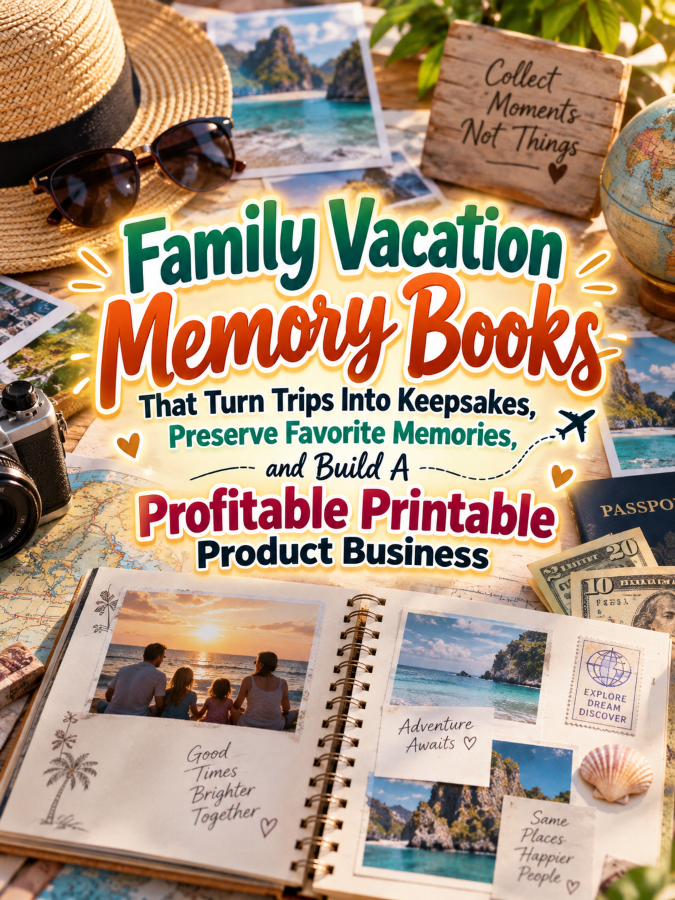
Introduction
Family vacations are funny little things because everybody spends weeks planning the trip, days packing the bags, and hours getting somewhere, but then the memories can end up scattered across phones, camera rolls, ticket stubs, receipts, and one random folder nobody can find six months later. That’s where Family Vacation Memory Books come in because they give families a simple place to capture the stories, photos, favorite moments, funny mishaps, and little details that made the trip special. And yes, somebody probably took 347 pictures of the same sunset, so giving those pictures somewhere useful to live is a Good Thing.
The digital product opportunity here is bigger than creating a few pretty pages with beach illustrations. You can build a complete printable memory system that helps families document a vacation before they leave, during the trip, and after they return home. That means your product can become part travel planner, part journal, part scrapbook companion, and part family keepsake.
There’s also an emotional reason this niche works. People aren’t simply buying pages because they love checkboxes; they’re buying a way to hold onto experiences that matter to them. When your printable helps a parent turn a messy collection of vacation photos and memories into something the family can revisit years later, you’re selling a finished memory instead of just another PDF.
Quick Answer
Family Vacation Memory Books are printable or editable pages that help families record where they went, what they did, what they ate, who they met, what made them laugh, and which moments they never want to forget. A starter product could include a trip overview, daily memory pages, favorite moments, photo prompts, food memories, travel highlights, funny moments, and a final “Our Favorite Memories” page. The product can be designed for printing, digital handwriting, or combining with photos in Canva.
You could sell a simple $7 Vacation Memory Book Starter, expand it into a $17 Family Travel Memories Bundle, create a $27 Complete Vacation Journal, offer a $47 Family Travel Keepsake Binder, and eventually build a $77 Vacation Memory Library with specialized versions for road trips, beach vacations, camping trips, theme parks, cruises, national parks, and family reunions. The secret sauce is not stuffing the product with hundreds of pages; it’s creating pages that make remembering the trip easy and fun. That’s the difference between a useful keepsake system and a giant pile of thingees nobody prints.
Why This Niche Works
Vacation memories have built-in emotional value, which gives this product category a different selling angle from purely functional planners. A family may forget exactly how much they spent on lunch three years from now, but they may remember the restaurant where everyone laughed until they cried or the moment a child saw the ocean for the first time. A well-designed memory book helps capture those details while they are still fresh.
This niche also works because vacations naturally create lots of content. Families collect photographs, tickets, maps, postcards, restaurant receipts, attraction passes, souvenirs, funny stories, favorite meals, and little discoveries along the way. Your printable can give those pieces a home and help turn random travel leftovers into an organized keepsake.
There’s another smart opportunity here: different types of trips create different memory needs. A road trip might need mileage, stops, roadside discoveries, and favorite roadside restaurants, while a theme park vacation might need ride favorites, character encounters, and show memories. That means one core product can lead to many specialized versions without you having to reinvent the entire business every time.
What You Can Put Inside Family Vacation Memory Books
1. Our Trip at a Glance
Start with a simple overview page that captures the basic details of the trip. Include the destination, travel dates, travelers, places visited, and the reason for the trip, whether it was a family vacation, reunion, birthday celebration, anniversary, or simply a much-needed escape. This page becomes the opening snapshot that helps everyone remember the trip later.
You can also add a small “Before We Left” section with questions such as what everyone was most excited about and what they hoped to see. Those answers become surprisingly fun to read later because children especially have a way of making predictions that age very well. A child who writes “I hope we see dolphins” before the trip and later records seeing dolphins has just created a tiny family time capsule.
2. Daily Vacation Memory Pages
A daily memory page gives families a simple place to record what happened each day. Include the date, location, activities, favorite moment, funniest moment, best meal, something new we discovered, and a small space for photos or memorabilia. The goal is to capture enough detail to bring the day back to life without asking families to write a three-page essay after walking around a theme park for eight hours.
Keep the prompts short and friendly so even children can participate. You could include “Today we…,” “We laughed when…,” “The best thing we saw was…,” and “I want to remember…” as writing starters. These little prompts can turn a blank journal page into something much easier to complete.
3. Favorite Places and Attractions
Create a page where the family can rate or record their favorite places from the trip. They might list the best attraction, prettiest view, favorite beach, coolest museum, best park, most interesting town, or most memorable stop. This page can become especially useful when the family starts planning another trip because they’ll have a personal record of what they loved.
You can keep the rating system simple and avoid turning the vacation into a complicated research project. Include categories such as “Would Visit Again,” “Family Favorite,” and “Surprise Favorite.” Sometimes the place nobody expected to love becomes the story everybody tells later.
4. Food Memory Pages
Food is often one of the strongest parts of a vacation memory, so give it its own section. Families can record favorite restaurants, memorable meals, unusual foods, desserts, snacks, drinks, and dishes they want to recreate at home. You could include space for the restaurant name, location, meal, family rating, and “Would We Order It Again?”
This can also become a great add-on product later. A standalone Vacation Food Journal, Family Restaurant Memory Book, or Travel Recipe Keepsake could grow naturally from the same concept. One page can quietly introduce you to your next three products, which is exactly the kind of sneaky-good product planning we like.
5. Funny Moments and Vacation Mishaps
Not every vacation memory needs to be beautiful, peaceful, and worthy of a postcard. Sometimes the best stories involve a wrong turn, a forgotten suitcase, a ridiculous misunderstanding, a child saying something hilarious, or the family getting caught in unexpected rain. Give those moments their own page because the mishaps are often the stories people remember most clearly.
You could call this section “The Stuff We’ll Laugh About Later.” Add prompts for what happened, who was involved, how everyone reacted, and why it became funny. That playful framing makes the memory book feel more personal and less like a formal travel diary.
6. Photo Story Pages
Instead of simply giving buyers blank boxes for photographs, help them tell a story with the photos they choose. Create layouts for “Our Arrival,” “A Day We Loved,” “The View,” “Family Favorites,” “Best Food,” and “Goodbye.” Each page can combine a few photo spaces with short captions and memory prompts.
This is where an editable Canva version can become especially attractive because buyers can drop their own photos directly into the layouts. You can sell a printable version for people who enjoy handwriting and a digital version for families who want to create a finished photo book on their computer. Same core idea, two delivery formats, more opportunities to serve different buyers.
7. Souvenirs and Keepsakes Tracker
Families often return from vacations carrying tiny objects that seem unimportant at first but become meaningful later. Create a page for recording souvenirs, postcards, tickets, shells, pressed items, attraction passes, or other small keepsakes. Include the item, where it came from, who chose it, and why the family wanted to keep it.
You can even design small spaces where buyers can tape or glue lightweight paper keepsakes directly onto the printed page. That turns the printable into a hybrid memory scrapbook. Suddenly that little museum ticket isn’t junk hiding in a drawer; it’s part of the story.
8. Our Vacation Favorites and Final Reflection
End the memory book with a reflection section that brings the whole trip together. Ask questions such as “What was our favorite day?”, “What surprised us?”, “What would we do again?”, “What did we learn?”, and “Where should we go next?” You can also include a family vote for favorite meal, favorite activity, favorite destination, funniest moment, and biggest surprise.
Finish with a final page called “Our Vacation in One Sentence” where the family creates a short summary of the trip. That one sentence can become the perfect caption when the family looks through the photos years later. It also gives the memory book a real ending instead of simply stopping because the designer ran out of pages.
Tools You’ll Need
Canva can handle the design of your Family Vacation Memory Books, especially if you want colorful photo layouts, editable templates, travel-themed graphics, and print-ready pages. Keep the layouts spacious because families need room for photos, handwriting, tickets, and little keepsakes. A memory book should feel inviting, not like a form someone has been ordered to complete by the Department of Vacation Documentation.
Google Docs can help you brainstorm prompts, organize page ideas, write instructions, and develop different versions before you move everything into your final design. Drafting the wording separately makes it much easier to test whether each question is actually useful. The last thing you want is a beautiful page asking a question nobody knows how to answer.
AWeber can help you build an email audience interested in family travel, vacation planning, and memory keeping. You could offer a free printable such as a “10 Favorite Vacation Memories” page to encourage signups. Then you can introduce subscribers to your full memory book and related travel products over time.
GetResponse can be used to create landing pages and email campaigns around your vacation memory products. You could build a short sequence that teaches families how to capture memories during a trip without spending the entire vacation writing in a journal. Useful content first, product invitation second, because nobody wants an email inbox that feels like a traveling carnival of sales pitches.
Gumroad can provide a simple storefront for selling downloadable vacation memory books. You can offer printable PDFs, editable versions, bundles, and themed editions from the same general product concept. Start small, watch what buyers respond to, and let customer demand guide your next designs.
Teachable could become useful if you eventually create a mini-course about turning vacation photos and memorabilia into finished family keepsakes. You could teach buyers how to organize photos, choose stories, write captions, and assemble a printable memory book. That gives you another product layer without abandoning the original niche.
Amazon can help you research existing family travel journals, vacation memory books, travel scrapbooks, and related products. Pay attention to customer reviews because they can reveal what buyers wish those products included or what made certain layouts useful. Use that research to identify opportunities rather than copying somebody else’s design.
Your 5-Step Action Plan
Step 1: Pick Your Vacation Memory Angle
Start by deciding exactly who your first product is for. You could target families with young children, multigenerational families, road-tripping families, theme park visitors, beach vacationers, or families who simply want to preserve ordinary weekend getaways. A clear audience makes the prompts, illustrations, page layouts, and marketing message much easier to create.
For your first product, don’t try to serve every possible traveler. Pick one group and make the memory book feel like it was designed specifically for them. That’s a much stronger starting point than creating a generic 100-page travel journal that tries to be everything to everybody.
Step 2: Build the $7 Starter Memory Book
Create a simple starter product with a trip overview, five daily memory pages, favorite places, favorite foods, funny moments, photo story pages, souvenirs, and a final reflection. Keep the page count manageable so buyers can actually imagine using it. Your goal is to create a product that feels complete without requiring a suitcase just to carry the printable.
Add a short instruction page explaining how families can use the book before, during, and after their vacation. Encourage them to print only the pages they need if they don’t want a huge book. That flexibility can make the product more appealing because buyers aren’t forced into one rigid format.
Step 3: Create a Free Vacation Memory Page
Choose one highly useful page and turn it into a free download. A “Favorite Vacation Memories” page or “Vacation Photo Story” page would work well because people can understand the benefit immediately. Use the freebie to attract families who enjoy travel, scrapbooking, photography, memory keeping, or family activities.
Then create helpful content around the problem. You could write posts such as “How to Preserve Vacation Memories Without Scrapbooking for 20 Hours,” “10 Questions Kids Can Answer About a Family Vacation,” or “What to Save From Your Next Trip.” Every useful piece of content gives you another doorway into the same product.
Step 4: Build the Product Ladder
Once your starter product is finished, expand it logically. Your $7 offer could become a $17 Family Vacation Memory Bundle with extra daily pages, photo layouts, food memories, and souvenir pages, while the $27 level could become a Complete Family Vacation Keepsake Workbook. At $47, you could offer a Family Travel Memory Binder, and at $77, you could create a complete Vacation Memory Library with specialized editions for different trip types.
Specialized versions can include road trips, camping trips, beach vacations, cruises, theme parks, national parks, international vacations, family reunions, and weekend getaways. You can also create versions for children, teens, grandparents, or the entire family. One good core design can become a whole collection when you change the prompts and layouts to match the travel experience.
Step 5: Test the Memory-Making Experience
Before you publish the product, actually use it yourself with a past vacation. Pretend you are the buyer and try answering every question, placing photos into the layouts, and imagining where physical keepsakes would go. If a page feels awkward, boring, repetitive, or too difficult to complete, fix it before customers have to tell you about it.
Ask a few people to look at the pages and tell you which ones make them immediately think of a vacation memory. Those reactions can reveal which sections have emotional pull and which ones are simply taking up space. That’s it. That’s your beginning!
What Comes Next
The smartest part of this niche is that the memory book doesn’t have to stop when the vacation ends. You can create pre-trip planning pages, during-trip journals, post-trip photo organizers, travel scrapbook layouts, family travel bucket lists, destination journals, and annual family travel recap books. Each product can connect naturally to the next one.
You can also create seasonal and destination-specific editions throughout the year. Summer vacation memory books, Christmas travel journals, road trip journals, camping memory books, Disney-style theme park memory pages, beach vacation journals, and national park adventure books can all serve different audiences. That’s a Good Thing because you can build your catalog around real travel moments instead of constantly inventing completely unrelated products.
And remember, the emotional value is the secret ingredient here. You’re helping families preserve the little things they may otherwise forget, from the best breakfast of the trip to the funniest thing a child said in the car. Build around those details, and your printable becomes much more than a collection of decorative pages.
3 Ways to Stand Out From The Thundering Herd!
Way 1: Make It About Stories, Not Just Photos
Lots of travel products give people a place to paste pictures, but your memory book can go one step further by helping families remember the story behind each picture. Add prompts such as “What happened right before this photo?”, “Why do we want to remember this moment?”, and “What did someone say that made us laugh?” Those questions turn a pretty photo collection into something much more personal.
You can also create little story prompts for ordinary moments because those often become the memories families treasure most. The funny breakfast conversation, the wrong turn, the unexpected rainstorm, or the child who refused to leave the playground can all become part of the finished keepsake. That makes your product feel less like a photo album template and more like a family storytelling tool.
Way 2: Build a “Memory Before the Memory” Section
One clever way to differentiate your product is to capture the family’s expectations before the trip begins. Ask what each person is excited about, what they hope to see, what food they want to try, and what they think the vacation will be like. After the trip, they can compare those predictions with what actually happened.
This creates a before-and-after experience that most ordinary vacation journals don’t include. It also makes the product especially fun for children because their answers can be wonderfully unpredictable. A simple “Before We Go” section can therefore become one of the most memorable parts of the entire book.
Way 3: Create a Family Signature Page
Give every family member a small space to contribute their own voice to the keepsake. You might include “My Favorite Moment,” “My Favorite Food,” “The Funniest Thing,” “Something I Learned,” and “Something I Want to Do Again.” This allows children, parents, grandparents, and other travelers to remember the same trip from completely different perspectives.
You could also create a final page called “Our Family’s Vacation Story.” Everyone contributes one sentence, one favorite memory, or one word describing the trip, and the family combines them into a shared recap. That little feature can turn the book into something that feels uniquely theirs instead of something that could belong to any family.
3 Nifty Ways to Find Customers
Way 1: Target Families Before They Travel
The best time to sell a vacation memory book is often before the vacation happens because families are already thinking about what they need to organize. Create content around pre-trip preparation, such as “What to Pack for a Family Memory-Keeping Kit” or “5 Things to Save From Your Next Vacation.” Then introduce the memory book as something families can prepare before they leave.
You can also create seasonal content around summer vacations, school breaks, holiday travel, and long weekends. Families planning trips during those periods are already searching for ideas, activities, packing help, and travel organization. Your product can become the memory-keeping piece of that larger planning conversation.
Way 2: Give Parents a Kids’ Vacation Memory Freebie
Create a free one-page printable designed specifically for children. It could ask them to draw their favorite vacation moment, write about their favorite food, name the funniest thing that happened, and choose their favorite place. Parents may download it because it gives children something fun to do while also creating a keepsake.
Once parents see how much their children enjoy recording memories, your full family memory book becomes a natural next step. You can then offer a larger product containing pages for multiple children and adults. The freebie becomes a tiny sample of the experience you’re selling rather than just another generic travel worksheet.
Way 3: Build Around Specific Travel Communities
Different travel groups have different memory-keeping needs, so don’t limit your marketing to the broad phrase “family vacation.” Road-tripping families, campers, cruise travelers, theme park visitors, beach vacationers, grandparents traveling with grandchildren, and families visiting national parks all have unique stories they want to preserve. Create specialized products and content for the communities that match your designs.
This approach also gives you more specific marketing language. A “Family Road Trip Memory Book” feels different from a “Family Vacation Journal,” even though they may share many of the same core pages. Specificity helps buyers recognize that your product was designed with their actual experience in mind.
3 Takeaways You Won’t Find Elsewhere!
Takeaway 1: Ordinary Moments Can Be the Best Memories
Don’t design the book only around spectacular attractions and beautiful scenery. Some of the most meaningful memories can come from eating breakfast together, playing cards in the hotel room, singing in the car, getting lost, or laughing over something completely silly. Give those ordinary moments a place in the book because they are often the pieces families forget to photograph.
Add prompts such as “What happened when nobody was taking pictures?” or “What little moment made this day special?” Those questions encourage people to document the invisible parts of a vacation. That makes the keepsake much more personal than a collection of perfectly staged travel photographs.
Takeaway 2: Let Different Ages Participate Differently
A five-year-old and a fifty-year-old aren’t going to document a vacation in the same way, and that’s perfectly fine. Give younger children drawing prompts, simple sentence starters, and rating systems while giving older children and adults more room for longer reflections. A flexible design can let the entire family participate without making the youngest traveler feel like they have been assigned homework.
You could even create a “My Trip” mini-section that can be printed separately for each child. Those individual pages can then be added to the family’s larger keepsake. Now your product works both as a family book and as a collection of individual memories.
Takeaway 3: Design for Printing and Digital Use
Some customers love printing pages and writing by hand, while others would rather drag their vacation photos into an editable digital template. If your product can support both habits, you open the door to a wider audience without changing the core idea. A printable PDF can serve traditional memory keepers while an editable Canva version can appeal to digital scrapbookers.
You can also offer a bundle containing both versions. Make the difference between the products clear so buyers understand exactly what they’re receiving. More importantly, make sure the digital version is genuinely editable and the printable version is genuinely easy to print because That’s Not a Good Thing if customers need a treasure map just to figure out how the files work.
3 Common Mistakes to Avoid
Mistake 1: Making Every Page a Photo Grid
Photos are important, but a memory book shouldn’t become a giant collection of empty boxes waiting for pictures. Without prompts and storytelling space, buyers may simply drop photos into the pages and forget the details behind them. Mix photo layouts with questions, captions, reflections, lists, drawings, and family responses.
Think of the photographs as evidence of the memory rather than the entire memory itself. The words and little details explain why the photo mattered. That combination is what gives the finished keepsake personality.
Mistake 2: Creating Too Many Pages
It’s tempting to create a 150-page vacation book because you have 150 ideas and every one of them seems brilliant at midnight. But families may only want enough pages to capture their actual trip without feeling pressured to complete a giant project. A smaller product that feels easy and enjoyable can be more appealing than a huge workbook that becomes another unfinished household project.
Instead of creating endless pages, give buyers flexible page counts. Offer a core book with essential sections and optional pages that they can print when needed. This lets a three-day weekend and a three-week international trip use the same system.
Mistake 3: Forgetting the After-Vacation Experience
Many travel journals focus heavily on what happens during the trip and then simply stop when the family gets home. But the post-vacation period is when families often have time to sort photos, print pictures, organize souvenirs, and tell stories about what happened. Give them pages specifically designed for that stage.
Create sections such as “Our Favorite Photos,” “What We Brought Home,” “What We Learned,” “What We’d Do Differently,” and “Where We Want to Go Next.” This gives the product a complete life cycle from anticipation to reflection. It also creates natural opportunities for future products because the next trip becomes another reason to return.
Scaling Your Results
Once you have a strong Family Vacation Memory Book, you can expand into an entire travel keepsake collection. Your $7 starter could become a $17 Family Vacation Memory Bundle with additional photo layouts, kids’ pages, food memories, souvenir trackers, and reflection pages. Your $27 product could become a complete annual family travel journal, while the $47 level could offer a Family Travel Keepsake Binder that stores memories from multiple trips.
At the $77 level, you could create a Family Vacation Memory Library containing specialized books for road trips, camping, beach vacations, cruises, theme parks, national parks, international travel, family reunions, and weekend getaways. You could also include editable versions, printable versions, bonus photo layouts, children’s sections, and annual travel recap pages. The buyer gets a complete memory-keeping system while you get multiple ways to package the same core intellectual property.
Another smart scaling strategy is to create seasonal products. Summer Vacation Memory Books, Christmas Travel Journals, Spring Break Memory Books, Thanksgiving Family Travel Journals, and New Year’s Travel Recap Books can all become timely offers. The same design framework can be refreshed with different prompts, illustrations, and examples without requiring you to start from a blank Canva page every time.
A collection containing 40 well-designed family travel and memory-keeping products could potentially generate an additional $700 to $2,200 per month through bundles, repeat customers, memberships, and complementary offers, although actual results will vary based on traffic, pricing, product quality, audience fit, and marketing. The important part is the product ecosystem rather than the number itself. Build useful products that naturally lead into other useful products, and you have a business model instead of a one-hit printable.
Your Next Steps
Start with one very clear customer and one very clear vacation experience. If you want the easiest starting point, create a Family Vacation Memory Book for families with children because you can combine adult prompts, kid-friendly pages, photo layouts, funny-moment sections, and simple activities. Keep the first version small enough that someone could print it, pack it, use it during the trip, and finish it afterward without needing a second suitcase.
Then test the product using an actual past vacation. Look at your own photos and ask whether the pages help you remember the story behind them, not just what was visible in the picture. If a page doesn’t make you think of a specific memory, improve the prompt until it does.
After that, create your freebie and start publishing helpful content. Show people how to preserve memories, what to save from a trip, how to involve children in memory keeping, and how to organize vacation photos without spending an entire weekend buried in their camera roll. Your content becomes the bridge between someone who loves family travel and someone who realizes they need a system for preserving those experiences.
Final Thoughts
Family Vacation Memory Books have something special going for them because they solve a practical problem while also connecting with emotion. Families don’t just want to remember where they went; they want to remember what happened, who was there, what made them laugh, and why the trip mattered. A thoughtful printable gives those memories somewhere to live instead of letting them disappear into an overloaded phone gallery.
The smartest products will make memory keeping easy enough to use during a busy vacation and meaningful enough to revisit years later. Keep the prompts simple, make room for photographs and stories, include children and adults, and give families a way to capture both the spectacular moments and the ridiculous little ones. Those ridiculous little ones are often the stories that get told at family gatherings twenty years later.
And remember, your first product doesn’t have to contain every possible vacation memory page ever invented. Start with the core experience, listen to what customers want, and then build specialized versions around road trips, camping, beaches, cruises, theme parks, national parks, reunions, and other travel experiences. That’s a Good Thing because your first printable can become the seed for an entire travel memory product garden.
That’s it. That’s your beginning! If you were creating your first Family Vacation Memory Book tomorrow morning, would you start with the daily memory pages, the kids’ vacation section, or the photo-story layouts? Pick the part that would make a real family say, “Oh, I want to save that,” build it beautifully, and then grow from there.
Enjoy!