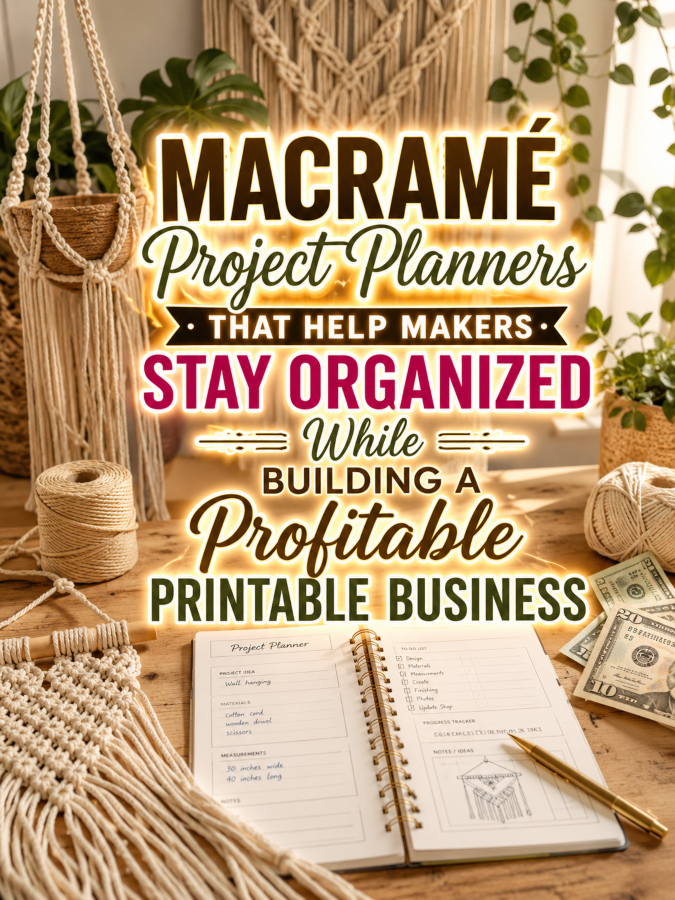
Introduction
Macramé has a funny way of pulling people in.
Someone starts by making one little plant hanger, then decides a matching wall hanging would look nice. Before long they’re surrounded by cotton cord, wooden beads, driftwood, metal rings, measuring tape, and enough unfinished projects to decorate an entire neighborhood.
The creativity isn’t usually the problem.
Keeping every project organized is.
Which cord thickness worked best? How many meters did that wall hanging actually require? Which knot pattern created that beautiful texture? Which customer requested the natural cotton version instead of the sage green one?
Every successful project teaches valuable lessons.
Without organized notes, those lessons can quietly disappear with the leftover scraps of cord.
That’s exactly why Macramé Project Planners continue selling year after year. They help fiber artists stay organized while giving printable creators an evergreen niche with exceptional repeat-purchase potential.
One thoughtfully designed planner can quickly become the trusted companion every macramé maker reaches for before tying the very first knot.
Quick Answer
Macramé Project Planners are downloadable printable systems that include project worksheets, cord inventories, knot reference pages, supply trackers, pattern journals, customer order forms, pricing calculators, inventory sheets, and finished project galleries.
A starter planner can comfortably sell for around $7. Expand it into macramé business planners, knot technique journals, home décor collections, fiber art organizers, and premium maker libraries, and you’ve built a natural product ladder reaching $27, $47, and even $77.
Your customers aren’t simply buying printable pages. They’re buying better organization, consistent project planning, fewer costly mistakes, and more time creating beautiful handmade pieces.
Why This Niche Works
Macramé makers almost never stop after one project.
One plant hanger inspires a matching shelf. One wall hanging leads to table runners, keychains, ornaments, handbags, pet accessories, wedding décor, and personalized gifts.
Creative inspiration grows faster than finished projects.
Once customers discover your planner, they’ll often return for knot journals, fiber inventories, pricing guides, handmade business planners, workshop organizers, and countless related thingees.
Unlike trendy home décor items that quickly fade away, handcrafted fiber art continues attracting customers who appreciate natural textures and timeless craftsmanship.
Prior to pouncing upon this opportunity, you should first know all about the:
Tools You’ll Need
You don’t need a studio overflowing with cotton rope or an entire forest full of driftwood. These dependable tools are more than enough.
- Canva for designing planner pages, project worksheets, supply logs, and printable layouts.
- Google Docs for organizing project notes, tutorials, and creative references.
- AWeber for building your email list with macramé tips and printable updates.
- GetResponse for newsletters, launches, and customer follow-up.
- Gumroad for selling downloadable planners and printable bundles.
- Teachable if you’d eventually like to teach macramé techniques, workshop organization, or handmade business management.
- Amazon Macramé Planner Research for discovering the planner features makers appreciate most.
Don’t spend three weeks deciding whether your knot tracker should use beige or cream borders while your future customers are already trying to remember how much cord they used for their bestselling wall hanging.
Next, move to:
Your 5-Step Action Plan
Follow these five steps unless you’d rather spend 24 hours untangling cotton cord while somebody else’s printable quietly becomes the planner every fiber artist recommends.
Step 1. Research Real Macramé Challenges
Spend about 94 minutes exploring macramé Facebook groups, fiber art communities, Etsy reviews, Pinterest boards, YouTube tutorials, and handmade business forums.
Create a master list containing 30 to 40 planner pages. Include project planners, cord inventories, knot references, pattern journals, customer commissions, pricing worksheets, inventory logs, workshop planners, and completed project galleries.
Your research becomes an X-ray machine that reveals exactly where makers struggle before, during, and after every project.
Step 2. Build Your Core Planner
Create a collection containing 40 to 55 printable pages that guide makers from the first sketch to the finished handmade masterpiece.
Include planning worksheets, supply trackers, project timelines, knot references, inventory records, customer notes, and creative reflection pages. Keep everything simple because simplicity is always a Good Thing.
Step 3. Create Specialty Editions
Build separate planners for beginners, home décor artists, wedding decorators, plant hanger specialists, handbag makers, pet accessory creators, holiday décor designers, and handmade business owners.
Specific planners always feel more valuable than one giant workbook attempting to organize every type of fiber art simultaneously.
Your customers will appreciate having choices.
Step 4. Add High-Value Bonuses
This is where your planner begins standing out from the thundering herd.
Include printable knot cheat sheets, cord conversion charts, color palette planners, project pricing calculators, supplier directories, seasonal collection planners, and customer order worksheets.
Those bonus thingees require very little additional effort yet dramatically increase the perceived value of your planner.
Fiber artists love complete systems that simplify every stage of the creative process.
Step 5. Build Your Product Ladder
Launch your starter planner for $7. Expand into specialty macramé collections around $27, then introduce premium fiber art studio libraries approaching $77.
Before long, your business won’t simply be selling printable planners. You’ll be helping makers preserve successful techniques, organize growing businesses, and enjoy their creative hobby with far less stress.
Once you’ve figured out all of the above, the next step is implementing:
3 Ways to Stand Out From The Thundering Herd!
There are plenty of printable planners available for crafters.
The Good Thing is that very few are designed specifically for the everyday workflow of macramé makers.
Your planner can become the trusted studio companion that artists keep beside every spool of cotton cord.
Way 1. Track Every Project from Start to Finish
Beautiful macramé pieces don’t happen by accident.
Create pages that record project dimensions, cord thickness, cord length, knot patterns, wooden ring sizes, bead selections, color combinations, finishing techniques, customer requests, and lessons learned.
Those record-keeping thingees help makers recreate bestselling projects without measuring everything all over again.
Saving time is always a Good Thing.
Way 2. Create a Complete Fiber Inventory
Most macramé artists collect supplies faster than they use them.
One shopping trip somehow becomes shelves full of natural cotton cord, recycled rope, colored fibers, beads, rings, driftwood, clips, tassels, and decorative accents.
Include printable inventory pages, supplier directories, shopping trackers, color swatch logs, and reorder worksheets.
Helping customers organize their supplies makes your planner valuable every single week.
Way 3. Help Makers Build a Business
Many macramé hobbyists eventually begin selling handmade décor.
Add commission worksheets, pricing calculators, order trackers, packaging checklists, inventory planners, social media content calendars, and craft fair preparation pages.
Supporting business growth dramatically increases the usefulness of your planner.
Next, here’s the thing. You’re probably NOT the only person offering this service. So you now require:
3 Nifty Ways to Find Customers
Your customers already gather wherever handmade creativity is celebrated.
Way 1. Macramé and Fiber Art Communities
Facebook groups, Reddit communities, Pinterest creators, and fiber art forums are filled with makers sharing projects, asking questions, and looking for better ways to stay organized.
Offer free knot reference pages, cord inventory sheets, or project planners before introducing your complete printable system. Helpful creators quickly become trusted creators.
Way 2. Pinterest
Macramé wall hangings, plant hangers, nursery décor, boho weddings, and handmade gifts perform exceptionally well on Pinterest.
Create attractive pins featuring beautiful planner pages beside finished projects to encourage clicks and saves.
Way 3. DIY Bloggers and Workshop Instructors
Many craft bloggers, YouTube creators, Etsy educators, and macramé teachers regularly recommend resources that simplify project planning.
Affiliate partnerships and collaborations can introduce your planner to thousands of highly engaged fiber artists.
Speaking of successful projects, now let’s move to:
3 Takeaways You Won’t Find Elsewhere!
These aren’t ordinary organization tips. They’re practical lessons that quietly transform one printable planner into an entire creative business.
Takeaway 1. You’re Selling Peace of Mind
Your customers aren’t buying worksheets.
They’re buying confidence that every measurement, knot sequence, and supply list is safely recorded for future projects.
That feeling is worth far more than a few printable pages.
Takeaway 2. Every Finished Project Becomes Future Inspiration
Completed projects aren’t just products.
They’re learning opportunities.
Recording what worked—and what didn’t—helps artists improve faster while building a growing library of successful designs.
Takeaway 3. One Planner Can Grow into an Entire Fiber Art Collection
Your Macramé Project Planner can naturally expand into knot technique journals, wedding planning binders, home décor collections, fiber inventory systems, seasonal craft planners, handmade business organizers, workshop workbooks, and complete maker libraries.
Those connected thingees make scaling dramatically easier because your customers already know and trust your planning style.
Now that you know the above, it’s time for:
3 Common Mistakes to Avoid
Many creators forget measurement pages.
That’s Not a Good Thing. Finished dimensions, cord usage, and knot spacing often determine whether a project can be successfully recreated.
Some sellers ignore inventory management.
Cord inventories, bead logs, supplier lists, and shopping trackers quickly become the pages customers use most often. Including them is always a Good Thing.
Others stop after creating one planner.
The biggest opportunities often appear when customers begin requesting planners for weddings, seasonal décor, nursery decorations, handbags, pet accessories, holiday ornaments, and complete handmade business organization.
What else should you know? How about:
Scaling Your Results
Expand into a complete fiber art organization system.
Create knot reference journals, project sketchbooks, inventory binders, supplier directories, pricing workbooks, craft fair planners, customer commission systems, seasonal collection planners, and handmade business management resources that naturally complement your original planner.
Create a Monthly Macramé Makers Club.
Release new printable planning pages every month featuring seasonal projects, fresh knot libraries, color inspiration, holiday collections, workshop planners, and exclusive business worksheets that members eagerly add to their growing binders.
Build an email list makers genuinely appreciate.
Share macramé tips, free printable pages, project inspiration, organization ideas, seasonal decorating trends, and handmade business advice throughout the year. A collection containing 36 macramé organization products could realistically generate an additional $588 to $1,836 each month through memberships, bundles, repeat customers, and affiliate partnerships. Trust me, you’ll thank me later.
Let’s now wrap up everything via the:
Your Next Steps
Start by listing 40 common macramé activities, then organize them into categories like project planning, cord management, knot references, inventory tracking, customer orders, pricing, seasonal collections, and business growth.
Build your first planner in Canva using clean layouts, practical worksheets, generous note sections, and reference pages that makers will actually use while creating. If one artist successfully recreates a bestselling wall hanging because of your planner, you’ve created something genuinely valuable.
Then share your planner with five macramé Facebook groups, Pinterest boards, fiber art communities, handmade business forums, or craft instructors. Remember, 5 good messages beats 50 generic ones every single time.
One thoughtfully designed planner can quietly become the foundation of an entire macramé printable business.
Next, let’s finish with:
Final Thoughts
The most beautiful macramé creations begin long before the first knot is tied. They begin with thoughtful planning, organized supplies, careful measurements, and creative ideas that are captured before they’re forgotten.
Your Macramé Project Planner can become part of that creative process. Every completed worksheet, every successful project, and every recorded lesson helps makers become more organized, more productive, and more confident artists.
Start with one planner that solves one meaningful organization challenge exceptionally well. Keep listening to your customers. Keep improving your planning systems. Keep creating printable products that help makers spend less time searching for supplies and more time creating beautiful handmade art.
You don’t need bazillions of products to build meaningful income. You simply need one thoughtfully designed planner that makes someone smile and say, “Now I know exactly how I made my favorite piece!”
That’s it. That’s your beginning!
If you were creating your first Macramé Project Planner tomorrow morning, would you design it for beginners, plant hanger makers, wedding decorators, home décor artists, or handmade business owners?
Enjoy!