

Feeling of alienation
WHYY News visited Kinservik’s class on the day the essays were due. The room was quiet — fewer than 20 students gathered in a small, intimate space, representing majors from kinesiology and finance to medical diagnostics and more. They leaned over laptops and notes, ready to talk about what it meant to write with AI.
Kinservik began by asking how many felt that chatbots like ChatGPT, Gemini or Grammarly had done a great job on their essays. Most hands went up. But when he asked how many felt the chatbot cited information accurately, nearly every hand went down.
One student explained that the bot had invented an entire list of citations. He described catching the error, confronting the bot, and watching it apologize before attempting to correct itself — a moment that drew laughter but spoke to a deeper truth: AI wasn’t doing the real work for them.
Isabella Abdmessih, a freshman university studies major on the kinesiology track, said she began the semester skeptical of AI. But by the end of the main assignment, she had a clearer picture of both its capabilities and its limitations.
“At first, I was very hesitant, and I think that comes from just not knowing AI’s capabilities, and I think that this class did give me a good grasp on its capabilities. So it kind of eased my mind a little bit,” she said. “With this assignment, it was hard because it was like you weren’t in control of what you were writing. I was given the essay, but I almost had to learn about the essay in itself. It’s not like I had the information and I was controlling the information and manipulating it.”
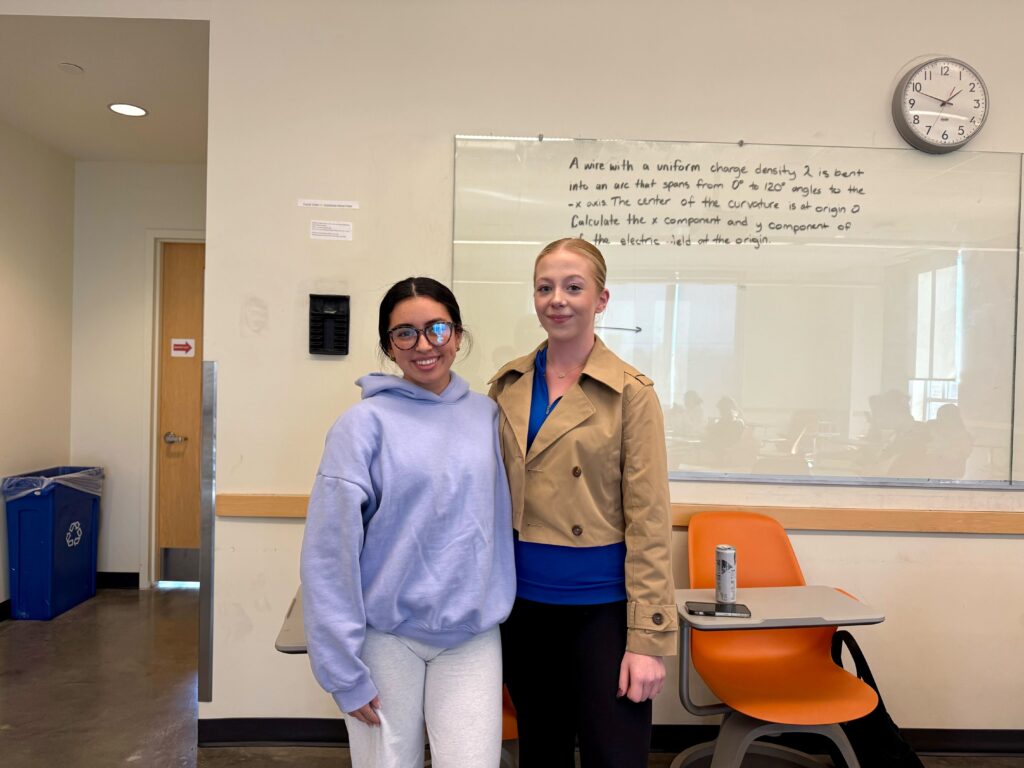
She struggled most with tone. Her first draft sounded far too formal for the audience she wanted to reach. When she asked the bot to make it more friendly, it overcorrected and added slang inappropriate for a college essay.
“It is a revolution, it’s something that’s new. So I appreciated that a class like this is teaching us more about it because it’s going to change everything.”
For sophomore finance major Amber Sirrell, the assignment felt emotionally distant — especially when the AI wrote about something she cared about.
“Having ChatGPT write something that I’m already really passionate about took away from its creativity because the chatbot is just pulling from somebody else’s writing and somebody else’s writing after that,” Sirrell said. “It really didn’t feel interpersonal.”
But the project also revealed something important: AI is already reshaping the finance industry she hopes to enter.
“With my interview with Savant Wealth Management, we talked about how I’d be peer reviewing AI in the workplace, checking what it puts into documents and correcting it if it’s wrong,” she said.
Both students — and most of the class — admitted that using AI wasn’t the shortcut many assume it is. If anything, it created more labor: more fact-checking, more editing, more rewriting.
For Kinservik, that was exactly the point. AI isn’t replacing students’ work, he argued, but it is reshaping the skills they must master. Reading, fact-checking, editing and synthesizing information are becoming the backbone of modern writing.
“If we don’t change our instruction, it’s too easy for students to save time and labor and to be lazy and to use these tools,” he said. “What I’m trying to do is to get the students to understand the stakes, to motivate them to do their own intellectual work and then to have them critically use and assess the use of chatbots because I know for a certainty they have not been challenged.”
He encourages educators not to push back against AI, but to embrace it and meaningfully integrate it into their lesson plans.