
It’s three weeks before the audit window opens, and someone on the team is taking screenshots of cloud configs, exporting access logs to a spreadsheet, and pinging engineers for proof that a control ran. The evidence grind is the part of SOC 2 nobody warns you about, and it’s the part AI is now built to carry. This guide ranks the 10 best AI for SOC 2 compliance platforms in 2026, judged on what their AI does with that evidence burden and, just as important, whether the output survives contact with an auditor.
One clarification before the list, because this keyword pulls in three different things. “AI for SOC 2 compliance” here means software that uses AI to help you achieve and maintain a SOC 2 report. It doesn’t mean an “AI SOC,” the security-operations centers that share the acronym, and it doesn’t mean guides on how AI companies pass SOC 2. The platforms below all apply AI to the compliance program itself, and the best of them keep a human in the loop so the evidence holds up.
What AI for SOC 2 compliance really does
AI earns its place in a SOC 2 program by handling the repetitive, high-volume work that used to eat weeks. In practice that means a handful of jobs. It collects evidence automatically, reading configuration and activity data from connected systems instead of waiting for screenshots. It maps controls to the Trust Services Criteria, often pulling structure out of unstructured policy documents. It monitors controls continuously and flags drift the moment something breaks. It drafts answers to security questionnaires and due-diligence requests from data already on file. It also runs gap analysis, surfacing what’s missing before an auditor does.
The catch is that automation isn’t the same as audit-ready. An auditor has to accept the evidence, and AI-generated artifacts can be wrong or unfounded if nothing grounds them. That’s why the strongest tools split the work in two: AI does the heavy collection and first-pass analysis, then a person verifies the output before it counts. Keep that division in mind as you read the list, because it separates tools that shorten a real audit from tools that just generate more to check.
Why AI matters for SOC 2 in 2026
Two pressures make the evidence grind worse every year. Enterprise buyers now expect a current Type II report and won’t sign without one, so the report sits on the critical path of revenue. At the same time, auditors want evidence that reflects continuous operation, not a tidy snapshot assembled the week before. Manual collection can’t satisfy both at once; it’s too slow to stay current and too error-prone to trust at scale.
AI closes that gap when it’s applied well. It keeps evidence fresh by pulling it continuously, catches drift before it becomes an audit finding, and frees the team to handle the judgment calls automation can’t. The platforms that win in 2026 aren’t the ones that automate the most tasks on paper. They’re the ones that automate the grind and still hand an auditor something defensible.
The 10 best AI for SOC 2 compliance platforms
1. Scytale
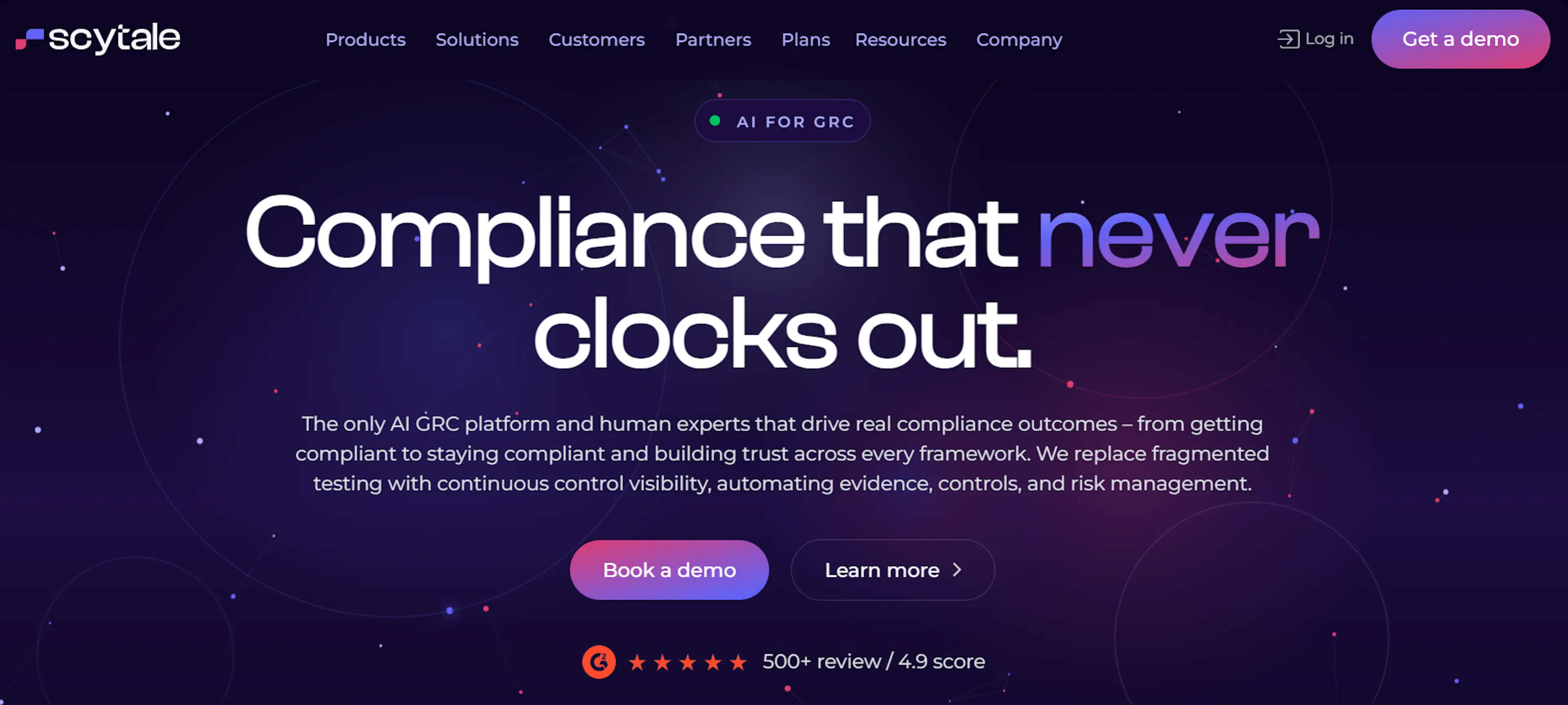
Scytale is a leading AI GRC platform that combines AI automation with dedicated GRC expert support to help organizations achieve and maintain SOC 2 compliance. AI GRC agents automate evidence collection and validation, identify compliance gaps, draft policies, and assist with security questionnaires, while continuous control monitoring keeps organizations audit-ready year-round. Every AI-generated output is reviewed by a GRC expert before reaching an auditor, giving teams the efficiency of automation without sacrificing confidence or accuracy.
Platform at a glance
Scytale centralizes controls, risks, policies, evidence, vendors, and audits in a single platform, where AI agents automate repetitive compliance work across the SOC 2 lifecycle. SOC 2 is its primary framework, supported alongside 80+ others through cross-framework mapping, allowing organizations to reuse controls and evidence as their compliance programs expand. Built-in audit management, auditor matching, penetration testing, and a customizable Trust Center help organizations manage the entire compliance process from one platform rather than coordinating multiple vendors.
What its AI does for SOC 2
- Automated evidence collection and validation: Collects evidence from connected systems, validates it against control requirements, and flags compliance gaps.
- AI-powered policy management: Drafts, updates, and maps policies to relevant controls as requirements evolve.
- Continuous control monitoring: Continuously monitors controls and identifies issues before audit preparation begins.
- Security questionnaire automation: Prefills security questionnaires and DDQs using existing platform data.
- Multi-framework intelligence: Reuses controls and evidence across SOC 2 and 80+ additional frameworks through cross-framework mapping.
Core problems Scytale removes
- Manual evidence collection by continuously collecting and validating evidence instead of relying on spreadsheets and screenshots.
- Last-minute audit preparation through continuous compliance and automated control monitoring.
- Disconnected compliance tools by combining AI automation, audit management, penetration testing, and expert guidance in a single platform.
What to validate
Pricing isn’t publicly available, so you’ll need a custom quote for a direct comparison. Some advanced capabilities are reserved for higher-tier plans, making a demo the best way to evaluate the features that match your organization’s needs.
2. Drata
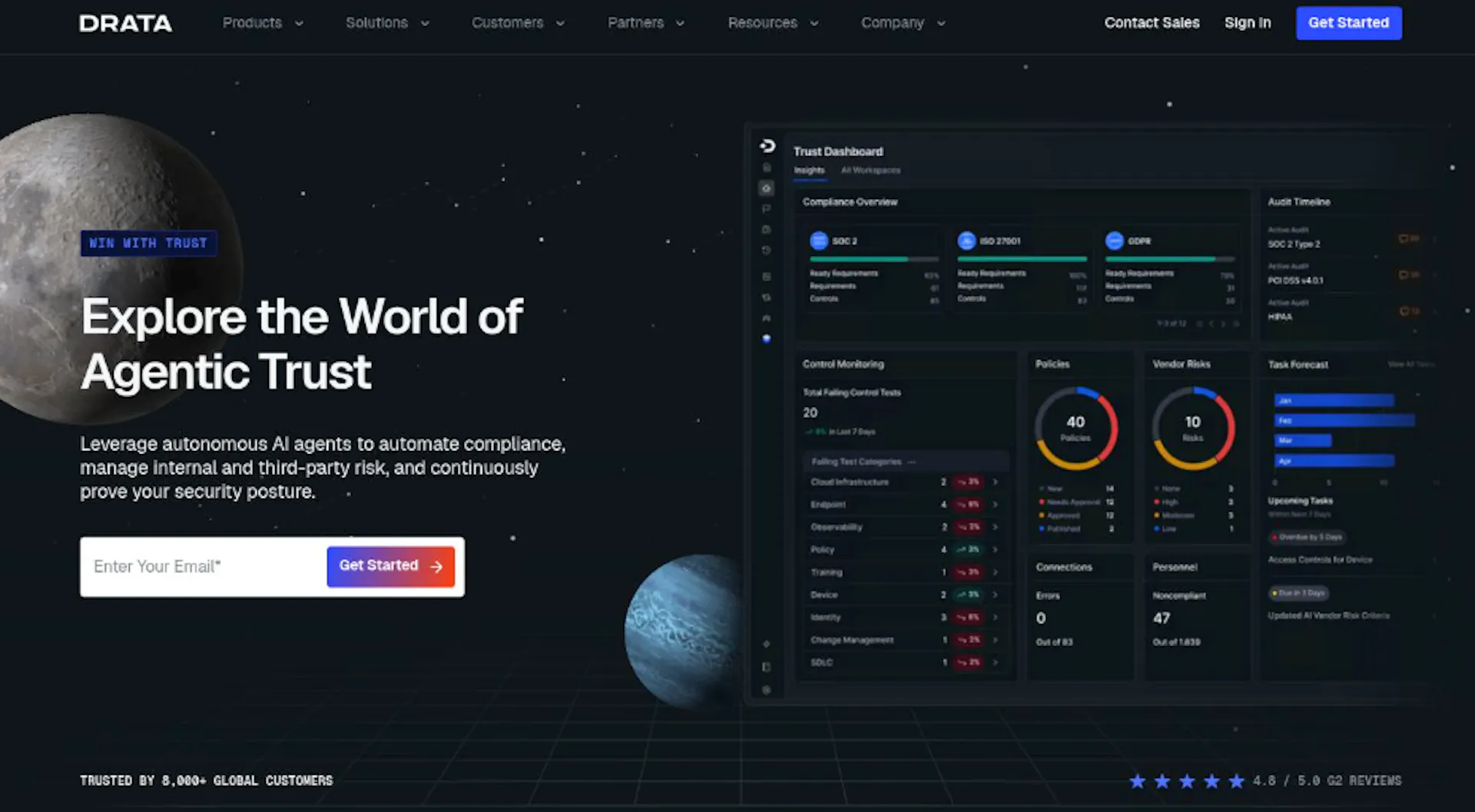
Drata leans on autonomous agents to drive SOC 2 compliance, risk, and continuous monitoring, an AI-native model now serving a base above 8,000 customers.
What its AI does for SOC 2
- Autonomous agents drive compliance and risk workflows
- Automated evidence collection with continuous monitoring
- Questionnaire automation that Drata reports saving 375+ hours a year on
- Deep integrations feeding a unified trust workflow
What to validate
Reviewers praise the support and ease of setup, but the human advisory layer over AI output is thin, and 35 reviews flag that configuration and the auditor experience need work. Pricing is reported near $5,000 per additional framework, so a multi-framework program adds up.
3. Vanta
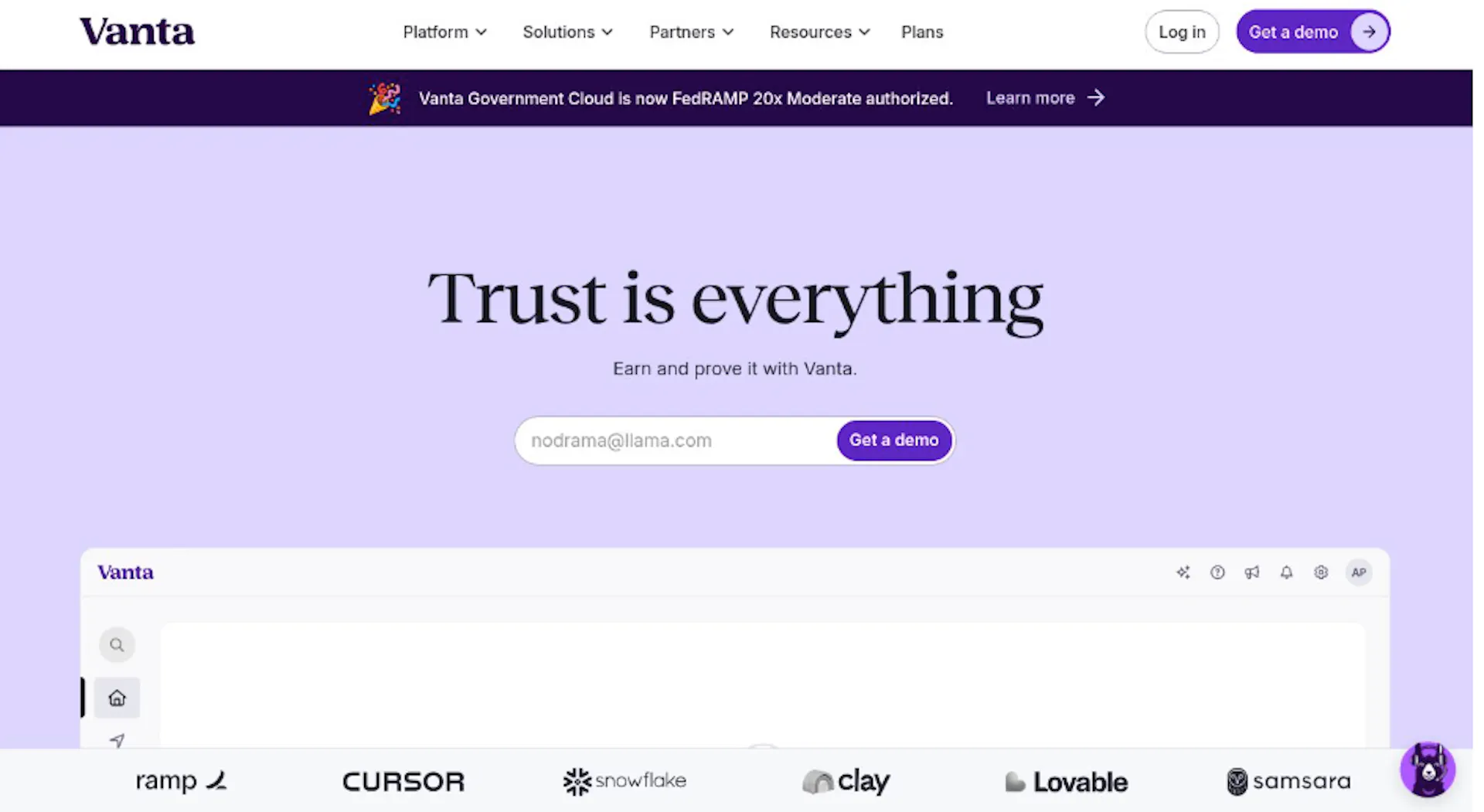
Vanta automates SOC 2 with continuous monitoring and an agentic-trust layer, adding AI agents for third-party risk and questionnaires across more than 16,000 customers.
What its AI does for SOC 2
- Automated handling of vendor-risk review and security questionnaires
- Automated evidence collection with near-hourly monitoring
- 375+ integrations, the broadest here, feeding evidence
- Risk and trust-center automation
What to validate
Vanta’s automation is strong, but its self-serve model leaves the human review auditors expect to the customer. Pricing draws heavy criticism, with high-pricing and very-expensive themes across roughly 291 G2 mentions, and 179 reviews cite integration issues that still require manual work.
4. Secureframe
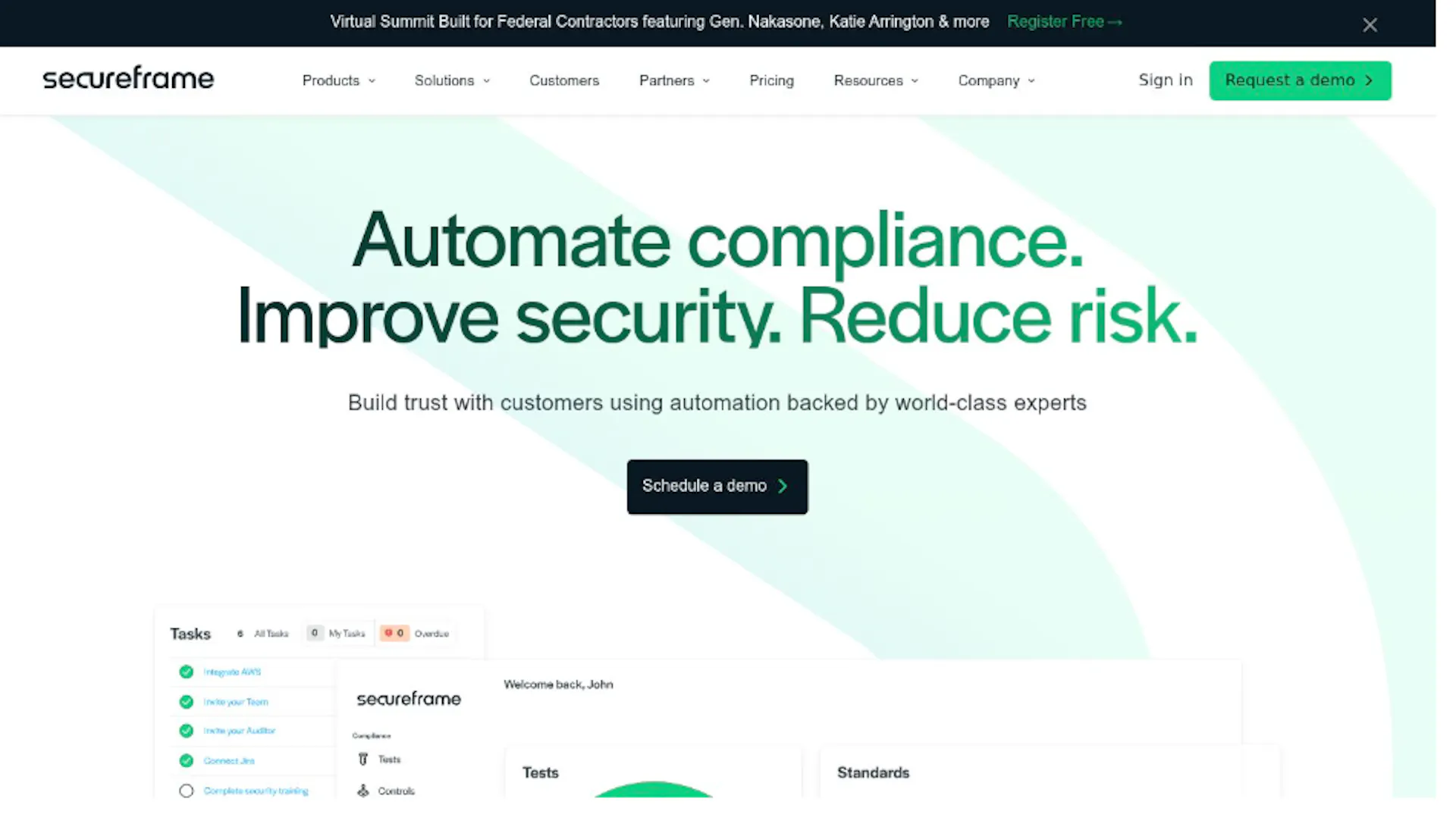
Secureframe automates SOC 2 with AI-powered remediation, risk analysis, and questionnaire work, backed by in-house experts across more than 6,000 customers.
What its AI does for SOC 2
- Comply AI for remediation drafts fixes, and Comply AI for risk analyzes exposure
- AI questionnaire automation and automated evidence collection
- Readiness reports and a Trust Center
- 150+ integrations with dedicated expert support, so some human review is built in
What to validate
The expert backing helps with auditor acceptance, but audit functionality is flagged for improvement in 109 reviews, and 184 cite integration gaps with niche tools and named platforms like Azure DevOps and Stripe.
5. Sprinto
Pitched as an autonomous trust platform, Sprinto automates SOC 2 work and claims 90 to 95 percent coverage over 200+ checks alongside guided onboarding.
What its AI does for SOC 2
- High automation across 200+ SOC 2 control checks
- Continuous monitoring with an AI-assisted risk register
- Built-in MDM for device health
- 160+ integrations across the cloud and identity stack
What to validate
Sprinto frames hands-on support as a trade-off against automation, which gets the auditor-acceptance question backwards. It also uses add-on pricing for extra framework layers and carries fewer integrations than Vanta.
6. Thoropass
Thoropass pairs a compliance platform with in-house SOC 2 audit execution, and its practitioner guide is the clearest articulation of the auditor-acceptance problem on the market.
What its AI does for SOC 2
- Platform plus in-house audit execution in one vendor
- AI-assisted compliance with an explicit human-verification framing
- A two-speed evidence model splitting automated technical checks from human-verified controls
- Multi-framework support
What to validate
Thoropass nails the human-review philosophy, but customers are locked into its own audit firm with no auditor choice, and UX polish is the recurring complaint across 39 and 33 review mentions.
7. Centraleyes
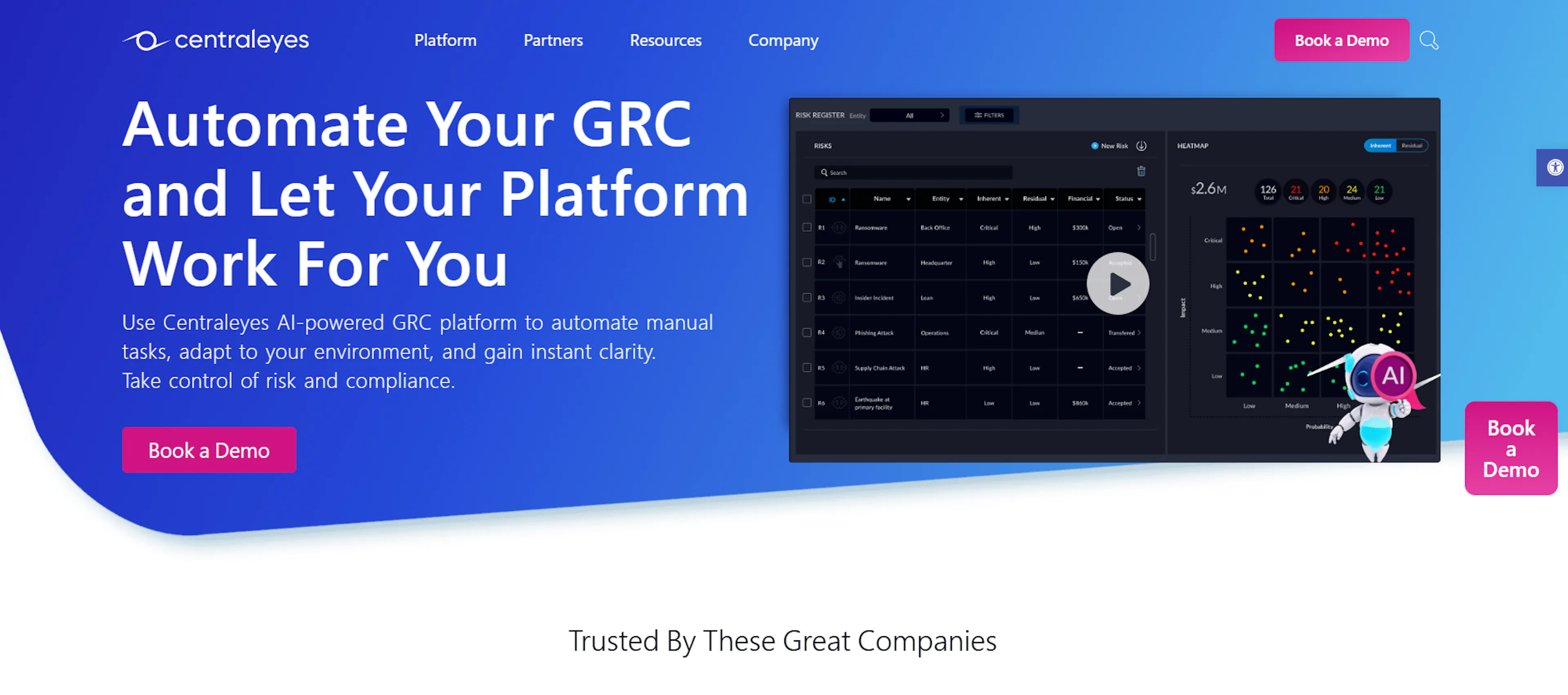
Centraleyes runs AI through a GRC platform spanning compliance operations, risk management, and regulatory tracking, with an AI Governance Module layered on top.
What its AI does for SOC 2
- AI-driven risk register automation and remediation
- Regulatory change tracking and control mapping
- Evidence reuse and audit-ready reporting
- An AI Governance Module that inventories and classifies AI models
What to validate
The AI-for-compliance breadth is real, but the platform is GRC-team oriented rather than built for SOC 2 first-timers, its public review base is only 3 G2 reviews, and pricing isn’t transparent.
8. Controllo
Controllo is an emerging AI-driven compliance platform centered on an AI co-auditor that validates evidence and identifies gaps across 20+ frameworks, with audit-bundle offers.
What its AI does for SOC 2
- An AI co-auditor that validates evidence and flags gaps
- AI-driven control mapping across 20+ frameworks
- Automated compliance with audit-bundle options
- Asset monitoring and a free trial
What to validate
The “AI co-auditor” framing aims straight at this intent, but Controllo has no public G2 profile and no independent review base, so its claims are unproven. It’s an emerging vendor with limited track record, which matters when the whole point is evidence an auditor will trust.
9. Hyperproof
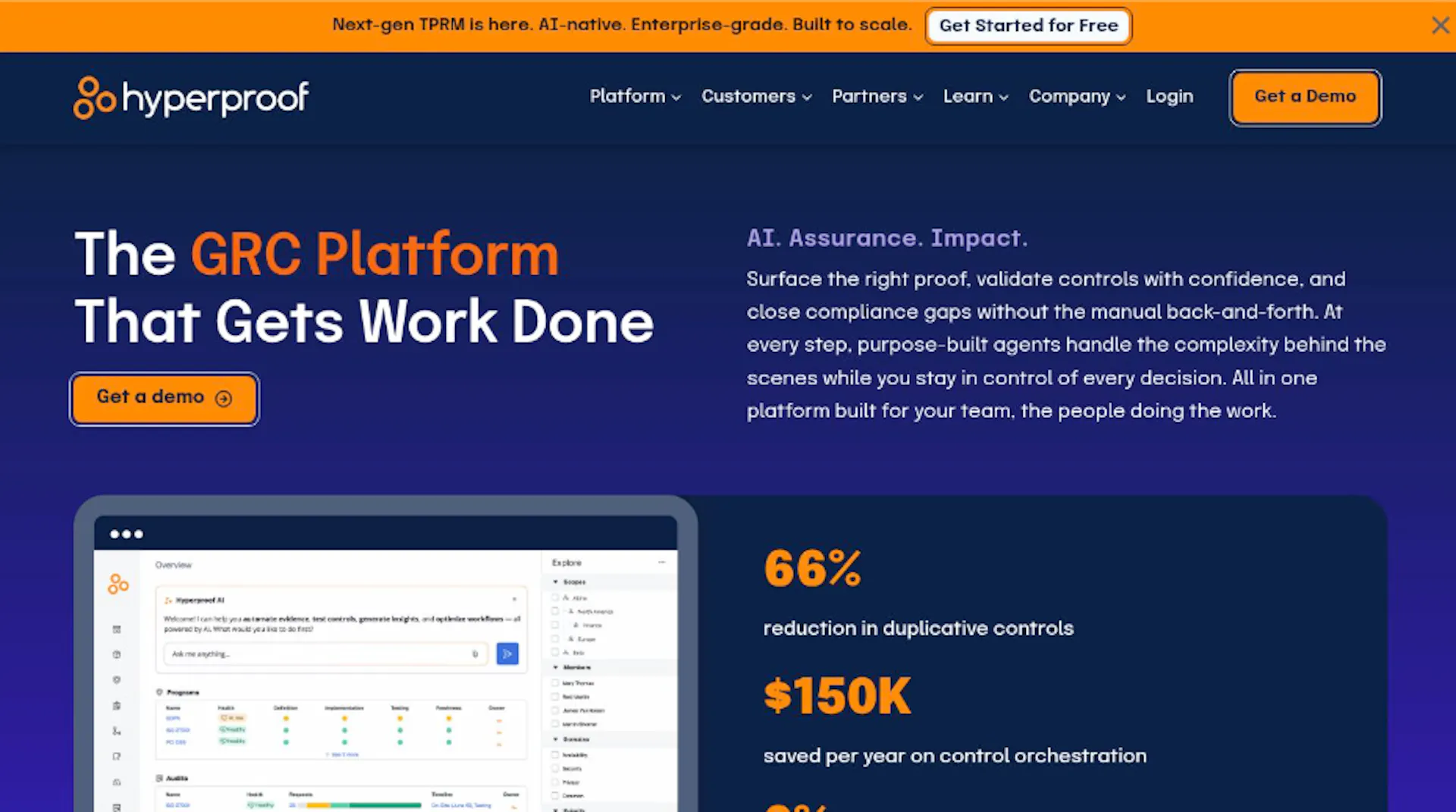
Hyperproof sits in the compliance-operations and GRC category, mapping controls over 118+ frameworks and layering AI onto a program-management foundation.
What its AI does for SOC 2
- Cross-framework control mapping across 118+ frameworks
- Risk-based compliance and workflow automation
- AI-assisted program management
- Evidence and audit collaboration spaces
What to validate
Hyperproof leans manual on evidence compared with the automation leaders, a steep learning curve dominates its cons, and around 70 integrations means more hand-collection of SOC 2 proof.
10. Scrut Automation
Scrut Automation rolls GRC and SOC 2 into one platform that spans 60+ frameworks without locking features behind tiers, pairing staff experts with AI-assisted workflows.
What its AI does for SOC 2
- AI-assisted compliance workflows across 60+ frameworks
- Continuous monitoring and risk management
- In-house experts and a Trust Vault, so human review is present
- All-inclusive, competitively positioned pricing
What to validate
Scrut earns the highest raw satisfaction in this set, but UI and overall functionality are flagged for improvement in 69 reviews, technical bugs break workflows in others, and it carries around 80 integrations on a newer platform.
How to choose AI for SOC 2 compliance
The fastest way to separate real AI value from marketing is to ask what the AI does and who checks it. Start with the evidence question: does the tool collect and validate evidence automatically, or just remind you to upload it? Then ask about the audit: does AI output pass through human review before it reaches an auditor, and does the platform connect you to one or leave you to find your own? Confirm the integrations validate controls across your actual stack rather than pulling surface data. Check how the vendor handles AI risks like hallucination and training-data use, since sensitive compliance data shouldn’t feed a model you can’t account for. Finally, weigh track record, because the auditor-acceptance promise is only as good as the customers who’ve already tested it.
Choosing the best AI for SOC 2 compliance in 2026
AI has taken over the worst part of SOC 2, the evidence grind, but the best AI for SOC 2 compliance in 2026 does one more thing: it keeps the result audit-ready by putting a person between the AI and the auditor. Scytale leads this list for that reason, since its AI carries evidence collection, mapping, and monitoring while GRC experts verify the output and a matched auditor works inside the platform. Drata, Vanta, Secureframe, and Sprinto bring deep automation for teams ready to own more of the review themselves, Thoropass and Centraleyes articulate the human-verification and AI-governance angles well, and the emerging and program-management options round out the field. Shortlist for the evidence-and-review combination, not the automation percentage, and demo against your own systems before you commit.
FAQs
Q: How does AI improve SOC 2 compliance?
A: AI dramatically reduces the manual effort involved in achieving and maintaining SOC 2 compliance. It can automatically collect evidence from cloud services, map that evidence to relevant controls, detect configuration drift, and flag potential compliance gaps before they become audit issues. Platforms like Scytale take this a step further by using AI agents to handle high-volume evidence collection while ensuring every AI-generated output is reviewed and verified by GRC experts, helping organizations maintain both efficiency and audit confidence.
Q: Does automation replace the need for an auditor?
A: No. A SOC 2 report must still be issued by an independent licensed auditor. Automation simply makes the audit process faster and less disruptive by continuously collecting evidence, organizing documentation, and maintaining an audit-ready environment throughout the year. Solutions such as Scytale also streamline auditor collaboration by providing built-in auditor matching and a centralized workspace where verified evidence is readily available, significantly reducing preparation time.
Q: What is the most important factor when choosing a compliance platform?
A: The most important consideration is how well the platform keeps your organization continuously audit-ready, rather than simply automating individual tasks. While evidence collection is essential, the strongest platforms also provide robust control monitoring, clear audit trails, policy management, and expert guidance to ensure your compliance program can withstand external scrutiny. A combination of intelligent automation and human oversight typically delivers the most reliable results.
Q: Can I use one platform for multiple security frameworks?
A: Yes. Most leading compliance platforms now support multiple frameworks from a single dashboard, allowing organizations to map controls once and reuse evidence across several standards. This greatly reduces duplicate work and makes it easier to expand compliance programs over time. Scytale is particularly strong in this area, supporting SOC 2 alongside more than 80 additional frameworks, including ISO 27001, HIPAA, PCI DSS, and GDPR.
Q: Is AI-generated compliance evidence accepted by auditors?
A: Yes, provided the evidence is accurate, complete, and verifiable. AI can accelerate evidence collection and documentation, but auditors ultimately assess whether the supporting artifacts meet the required standards. Many organizations prefer platforms that combine AI automation with expert review, ensuring the evidence presented during an audit is both reliable and defensible.
Q: Is SOC 2 compliance only necessary for large companies?
A: No. SOC 2 is increasingly important for startups and small to mid-sized SaaS companies, especially those selling to enterprise customers. Many larger organizations require vendors to demonstrate SOC 2 compliance before signing contracts. Implementing a compliance platform early can simplify the certification process, reduce manual work as the business grows, and build customer trust from the outset.
Disclaimer: This article is paid content. HackerNoon’s editorial team has reviewed it for clarity and quality standards, but the views, claims, benchmarks, and comparisons expressed are solely those of the sponsor, and HackerNoon assumes no responsibility for third-party assertions contained in sponsored content.