Introduction
Creating printable products can be fun, but marketing those products every week can feel like the part where the fun quietly walks out the back door. A creator may have a lovely collection of planners, checklists, trackers, worksheets, and templates ready to sell, yet still wake up Monday morning wondering what in the world they are supposed to post. That’s Not a Good Thing when inconsistent marketing makes an otherwise useful shop nearly invisible, but it creates a fantastic opportunity for a printable shop content calendar that turns “What should I post?” into a much easier question.
A printable shop content calendar can help digital-product creators plan promotional posts, educational content, product demonstrations, customer-focused tips, seasonal campaigns, email messages, launches, and repurposed content. Instead of inventing a new marketing idea every morning, creators can organize their content around the products they already have and the customers they want to reach. That makes the calendar more than a collection of dates because it becomes a practical system for turning a product catalog into a steady stream of useful marketing content.
This niche also gives you plenty of room for a digital product ladder. You could begin with a $7 Printable Shop Content Calendar, expand into a $17 30-Day Marketing Workbook, create a $27 Content Planning Bundle, build a $47 Complete Printable Shop Marketing System, and eventually offer a $77 Content Calendar Library packed with monthly calendars, campaign planners, promotional worksheets, email planners, social-media prompts, and repurposing tools. Actual results will vary based on audience fit, traffic, product quality, pricing, and marketing, but the underlying problem is wonderfully persistent: creators need content ideas long after the excitement of creating the printable has worn off.
Quick Answer
Printable shop content calendars are planning tools that help digital-product sellers organize what they will publish, when they will publish it, which product it supports, and what customer problem the content addresses. A strong calendar can include educational posts, product demonstrations, customer questions, testimonials, behind-the-scenes content, email campaigns, seasonal promotions, launch dates, and repurposing notes. The goal is to make marketing more consistent without requiring creators to become full-time content machines.
A simple product ladder could start with a $7 monthly content calendar, move to a $17 30-day content planning workbook, expand into a $27 bundle of calendars and content prompts, grow into a $47 complete printable-shop marketing system, and eventually become a $77 library of content calendars and promotional resources. You can also create specialized versions for Etsy sellers, teacher-printable creators, wedding-template shops, planner sellers, business-template creators, or general digital-product businesses. The opportunity is to make consistent marketing easier to organize, not to promise that posting on a particular schedule will guarantee sales.
Why This Niche Works
Consistency is one of the biggest challenges for small digital-product businesses because the creator is often doing everything. They are designing products, answering questions, updating listings, creating graphics, managing files, handling customers, and somehow expected to produce fresh marketing content while doing all of that. Without a system, marketing can become the task that gets pushed aside until the creator suddenly realizes they haven’t mentioned their products publicly since the dinosaurs were checking email.
A content calendar creates visibility. Instead of asking what to publish every single day, the creator can plan content around specific products, customer problems, upcoming launches, seasonal opportunities, and business priorities. This reduces the amount of daily decision-making required, which is a Good Thing because creativity is much more enjoyable when it isn’t being used to decide whether Tuesday should feature a checklist or a motivational quote about checklists.
There is also a natural connection between content and product collections. One printable can generate several pieces of content because the creator can discuss the problem it solves, show how it works, demonstrate a page, explain who might use it, answer common questions, share a use case, and connect it to related products. Your calendar can teach creators to get more marketing mileage from products they have already created instead of constantly feeling pressured to invent something new.
The niche also works well because marketing calendars can be updated and reused. A creator may want a monthly calendar, a quarterly campaign planner, a holiday content planner, a product-launch calendar, or a year-round evergreen content system. That gives you multiple opportunities to create complementary products for the same audience, which is exactly what you want when building a product ladder instead of a one-and-done thingee.
What You Can Put Inside a Printable Shop Content Calendar
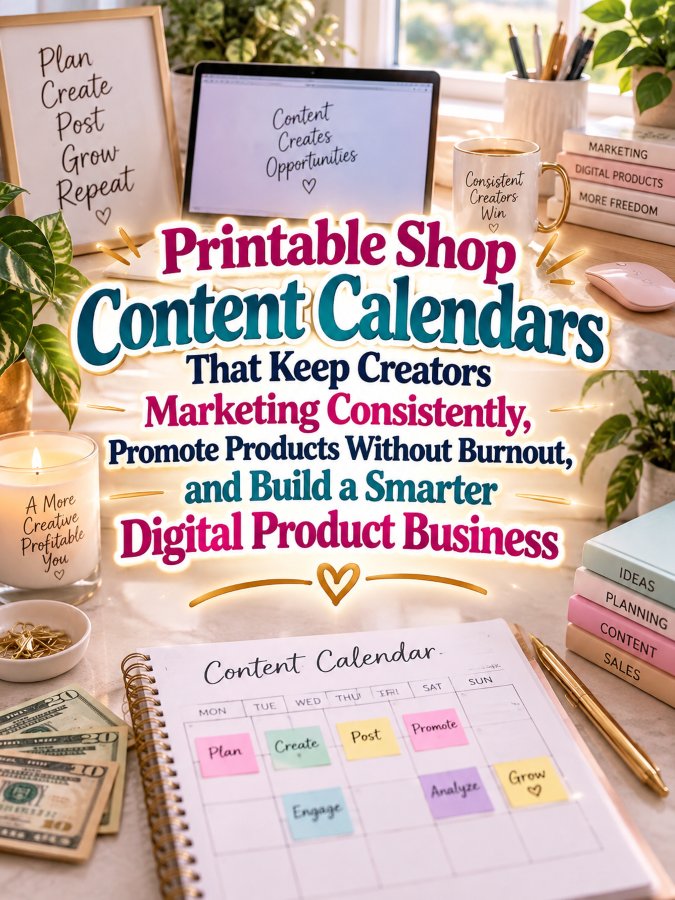
Start with a monthly calendar where creators can record the date, content topic, content format, product being promoted, platform, call to action, and status. You can keep the basic version simple so customers don’t need a decoder ring before they can plan their first week. The goal is to make the calendar fast enough to use regularly.
Add content-category planning so creators don’t accidentally spend an entire month saying, “Here is my product, please buy it.” Categories could include education, inspiration, product demonstrations, behind-the-scenes content, customer questions, product features, social proof, seasonal topics, and direct promotions. This helps create variety while keeping the marketing connected to the products being sold.
A repurposing tracker can make the calendar even more valuable. One blog post could become an email, a short social post, a carousel, a video idea, a product tip, and a reminder several weeks later. Your planner can give creators a place to record those variations so useful content doesn’t disappear after being published once. That’s a Good Thing because making one strong piece of content work harder is usually easier than inventing six completely unrelated pieces from scratch.
You can also include launch-planning pages, email calendars, seasonal campaign worksheets, product-feature trackers, customer-question logs, and content-performance review pages. These additions turn the product from a simple calendar into a broader marketing system. The more thoughtfully the sections connect, the more valuable the finished product becomes.
Tools You’ll Need
You can create a polished printable shop content calendar without a complicated software setup. Canva can help you design monthly calendars, weekly planners, content worksheets, campaign pages, promotional graphics, and product mockups, while Google Docs can help you draft prompts, organize content categories, and build your written framework before moving it into your final design.
For email marketing, AWeber and GetResponse can help you build an audience and organize email campaigns around products, educational content, launches, and promotions. You can sell your digital planning products through Gumroad, while Teachable can become useful later if you turn your content-planning system into a course or guided marketing program.
For research, Amazon Printable Content Calendar Research can help you study related planning products, themes, customer language, and different approaches to content organization. Look for recurring customer needs and gaps that you can address with original ideas. You’re researching the market so you can create something more useful, not gathering ingredients for another copy-and-paste thingee.
Your 5-Step Action Plan
Step 1: Define the Creator You’re Helping
Start by deciding who needs your content calendar. A new printable seller may need help creating their first month of marketing, while an established shop owner may have plenty of products but struggle to promote them consistently. Those customers may need different levels of planning, so defining your audience first will help you decide what belongs inside the product.
You can also create specialized versions later. A teacher-printable seller might need content around classroom seasons and educational topics, while a wedding-printable creator may need a calendar built around engagement and wedding-planning timelines. Start with one audience, solve their specific marketing-organization problem, and then expand when the opportunity becomes obvious.
Step 2: Create Your Core Content Categories
A useful content calendar should prevent creators from relying on one type of marketing message. Create several categories that can rotate throughout the month, such as education, inspiration, product demonstration, customer problem, behind the scenes, product feature, social proof, and direct promotion. This gives the creator a simple framework for balancing helpful content with promotional content.
You don’t need every category to appear every week. The calendar should provide structure without becoming another rigid rulebook. If a creator has an important launch coming up, they may naturally publish more promotional content, while a quieter week may focus on education and relationship-building.
Step 3: Connect Content to Products
One of the biggest advantages of your planner is helping creators stop treating content and products as separate activities. Give them a place to identify which product each piece of content supports and which customer problem it addresses. This makes it easier to see whether their marketing is actually connected to the products they want people to discover.
For example, a budget printable could inspire content about common budgeting challenges, ways to organize bills, mistakes people make when planning expenses, or how the printable works. A classroom resource could generate posts showing classroom use cases, organization ideas, teacher tips, and examples of the resource in action. One product can create an entire little family of content thingees when you know where to look.
Step 4: Build a Repurposing System
Teach creators to stop treating every published piece of content as a one-use object. A helpful blog post can become an email, several social posts, a short video, a carousel, a checklist, or a future reminder. Add a repurposing worksheet where creators can record the original content, possible variations, publishing dates, and platforms.
This can dramatically change how a small creator thinks about content production. Instead of asking, “What six new things do I need to create this week?” they can ask, “How can I make this useful idea work in six different ways?” That’s a Good Thing because it gives the creator more marketing opportunities without requiring six times the creative energy.
Step 5: Turn the Calendar Into a Product Ladder
Your own content calendar can follow the same collection strategy. Start with a $7 monthly calendar, then create a $17 30-day planning workbook with content categories, prompts, product connections, and repurposing pages. A $27 bundle can add multiple calendars, launch worksheets, email planning, seasonal content, and promotional templates.
Your $47 offer can become a Complete Printable Shop Marketing System, while a $77 library can include monthly calendars, quarterly planners, seasonal campaigns, product-launch content plans, repurposing systems, email calendars, and content-review worksheets. That’s how you build a connected product line that teaches creators to market consistently while demonstrating the same strategy inside your own business.
Don’t try to create the entire library immediately. Start with one calendar that solves one clear problem, test it, improve it, and then build the next thingee based on what customers actually need. That’s it. That’s your beginning!
Once you’ve figured out all of the above, the next step is turning your calendar into a practical marketing system that helps printable creators stay visible without feeling like they have to post every waking minute.
3 Ways to Stand Out From The Thundering Herd!
Way 1: Build The Calendar Around Actual Shop Goals
One of the easiest ways to make your printable shop content calendar different is to stop treating it like a simple list of dates and start treating it like a business tool. Your customer should be able to look at the calendar and understand why each piece of content exists, what product it supports, and what action they want the reader to take next. That’s a Good Thing because suddenly your calendar is doing more than saying, “Post something today,” which is about as helpful as yelling “Do marketing!” from across the room.
Create sections for goals such as product discovery, audience education, product promotion, customer trust, seasonal content, and relationship building. You can then give creators a simple way to choose the purpose of each post before they start writing or designing it. This makes the calendar useful for someone selling ten products just as much as it is for someone with fifty products and a digital shop that has started producing thingees faster than they can remember what they made.
Way 2: Add A Content Repurposing Machine
Repurposing can become one of the most valuable parts of your calendar because creators often do not need more ideas nearly as much as they need more mileage from the ideas they already have. A single blog post, product tutorial, customer question, or product demonstration can become an email, social post, short video, Pinterest graphic, checklist, and product-related tip. That’s always a Good Thing because your customer gets more value from one idea without having to invent seven completely new ideas before breakfast.
Build a repurposing tracker directly into your printable and give users columns for the original idea, the new format, the platform, the publication date, and the product connected to it. You could even include prompts such as “Turn this tutorial into a checklist” or “Turn this customer question into an educational post.” That little addition can make your calendar feel less like another planning worksheet and more like a tiny marketing assistant that does not drink your coffee.
Way 3: Create A “What Should I Promote?” Decision System
Creators can easily reach the point where they have plenty of products but no idea which one deserves attention today. Your content calendar can solve that problem by including a simple product-promotion rotation that helps users choose what to feature based on season, customer need, product age, sales activity, or upcoming events. This gives your calendar a practical purpose that many generic content planners completely miss.
You could create a monthly product spotlight section with questions such as “Which product needs more visibility?”, “Which product solves a current customer problem?”, and “Which product pairs naturally with another product?” Then connect those answers to the content schedule so promotion becomes intentional instead of random. That’s Not a Good Thing when a creator spends three hours making beautiful content and realizes afterward that they never actually mentioned the product they hoped to sell.
3 Nifty Ways to Find Customers
Way 1: Teach Creators How To Market While They Use The Free Content
One smart way to attract buyers is to create free content that demonstrates exactly why a content calendar is useful. Show examples of turning one product into a week’s worth of content, explain how to create a simple promotional rotation, or demonstrate how to plan a month without sitting in front of a blank screen for two hours. When people see the system working, the paid product becomes easier to understand because you are not merely telling them that planning helps; you’re showing them how it helps.
Create short tutorials, blog posts, videos, or social posts around common marketing problems faced by printable sellers. A post such as “What Should I Post When I Have Nothing To Say?” can naturally lead into your calendar product without sounding like a giant flashing sales sign. Five good messages beats 50 generic ones every single time, especially when your audience is already overwhelmed by the thundering herd shouting “BUY MY THING!” from every direction.
Way 2: Offer A Free Mini Content Planning Worksheet
A small free worksheet can become an excellent lead magnet because it lets potential customers experience your planning method before they purchase the complete calendar. Give them a one-week planning page with sections for the content topic, customer problem, product connection, call to action, and repurposing opportunity. If the worksheet saves them time or gives them an idea they can actually use, they have a much clearer reason to explore the full product.
Connect the free worksheet to an email sequence that teaches simple content-planning habits rather than immediately sending a parade of sales messages. You might send one email about choosing content categories, another about repurposing, another about product promotion, and then introduce the full calendar as the natural next step. Trust me, you’ll thank me later because an email subscriber who understands the problem you solve is usually far more valuable than a random visitor who wandered into your shop while looking for something completely different.
Way 3: Create Content For Specific Types Of Printable Sellers
Instead of marketing one generic calendar to everybody, create content that speaks directly to different types of digital-product creators. You could create examples for teachers, wedding planners, homeschool creators, small-business template sellers, crafters, family organizers, fitness printable sellers, or creators who sell planners and journals. Specific examples make the product easier to imagine because customers can immediately see how the system would fit their own shop.
You can also create different versions of your calendar for different business stages, such as a beginner calendar, a growing-shop calendar, and a more advanced promotional calendar. This approach gives you multiple product angles without forcing you to reinvent the entire business every time you want to reach a new audience. That’s a Good Thing because your original calendar becomes the foundation for an entire little ecosystem of useful products.
3 Takeaways You Won’t Find Elsewhere!
Takeaway 1: Your Calendar Should Connect Content To Customer Problems
A strong content calendar does not begin with “What should I post?” because that question can send creators wandering around the internet until midnight. A better question is “What problem can I help my customer solve today?” Once you know the problem, you can create useful content around it and then connect the appropriate printable product as the next logical step.
For example, a creator selling meal-planning printables might create content about reducing grocery waste, organizing busy weeknight meals, or planning around a tight budget. The related products then become solutions rather than random items being pushed into the conversation. That shift is important because customers generally want an outcome, not another pretty PDF sitting in a digital drawer next to seventeen other pretty PDFs.
Takeaway 2: Plan For Energy, Not Just Time
Many content calendars assume that every creator has unlimited energy and a cheerful supply of brilliant ideas every Tuesday at 9:00 AM. Real people do not work that way, so your calendar can stand out by including low-energy, medium-energy, and high-energy content options. A low-energy day might involve sharing an existing product tip, while a high-energy day might involve creating a tutorial, video, or detailed educational article.
This simple idea makes the calendar more realistic and easier to follow because it recognizes that consistency does not mean producing your most complicated content every single day. You can give creators a “minimum viable marketing day” option for busy periods and a larger content option when they have more time. That’s always a Good Thing because a flexible system is much more likely to survive the week when life decides to throw a banana peel directly into your carefully organized schedule.
Takeaway 3: Your Best Content Can Become Tomorrow’s Product
Your content calendar can also become an idea-generation tool for future products. When creators notice that the same customer question keeps appearing in comments, emails, or social conversations, that question may reveal a product opportunity. Instead of thinking of content and product creation as two separate activities, teach your customers to use their content results as research.
A popular tutorial might become a workbook, a frequently requested checklist might become a printable bundle, and a series of related educational posts might eventually become a mini-course or larger digital system. This creates a natural loop where content attracts questions, questions reveal needs, and needs inspire products. That’s it. That’s your beginning!
3 Common Mistakes to Avoid
Mistake 1: Filling Every Day With Promotional Posts
A calendar packed with “Buy this,” “Buy that,” and “Have you bought this yet?” can make a shop feel exhausting very quickly. Customers need useful information, inspiration, examples, answers, and reasons to trust the creator before every interaction turns into a sales pitch. Your calendar should create a healthy mix of educational, conversational, inspirational, promotional, and relationship-building content.
A useful rule is to make promotion part of the overall customer journey instead of making every post a sales event. Some content should attract attention, some should build trust, some should demonstrate expertise, and some should make the offer. That’s Not a Good Thing if every square on the calendar screams “SALE!” because eventually your audience may develop the digital equivalent of running away while pretending they didn’t see you.
Mistake 2: Making The Calendar Too Complicated
More boxes do not automatically mean more value. If a creator opens your calendar and sees seventeen columns, six color codes, four tracking systems, and a mysterious symbol that apparently means something important but nobody remembers what, you’ve created friction instead of help. The best calendar should make the next action obvious.
Use optional sections for advanced users while keeping the basic workflow simple enough for beginners. You might create a one-page weekly view, a more detailed monthly planning page, and separate optional trackers for repurposing, promotions, email marketing, and analytics. This gives customers room to grow without making the first five minutes feel like they accidentally enrolled in Marketing University.
Mistake 3: Never Reviewing What Actually Worked
A content calendar should not simply tell users what to publish and then disappear into the digital wilderness. Add a simple review section where creators can record which topics received attention, which products were promoted, which emails performed well, and which content generated questions or clicks. The goal is not to turn a small printable shop into a giant analytics department; the goal is to help the creator make smarter decisions next month.
Encourage users to look for patterns instead of obsessing over individual numbers. If several posts around one customer problem consistently receive engagement, that topic may deserve more content and perhaps a new product. If a particular product repeatedly performs well when paired with a certain type of educational content, that pairing can become part of the next marketing cycle.
Scaling Your Results
Once your core content calendar is working, you can turn it into an entire product family. Start with a $7 basic monthly content planner, then offer a $17 expanded version with prompts and content categories, a $27 workbook with repurposing and promotional trackers, a $47 complete marketing system, and a $77 comprehensive content-planning library with multiple calendars, seasonal planning pages, campaign worksheets, and review tools. This product ladder gives customers different entry points while allowing your strongest buyers to move into more complete solutions.
You can also create niche-specific versions using the same underlying structure. A teacher-printable content calendar, wedding-template content calendar, homeschool-printable marketing calendar, or craft-business content calendar can each use the same basic framework while changing examples, prompts, seasons, and product references. That’s a Good Thing because you’re not starting from a blank page every time; you’re building a reusable product-development engine.
A collection containing 40 well-designed printable shop content products could potentially generate an additional $700 to $2,200 per month through bundles, repeat customers, memberships, and complementary offers, although actual results will vary based on traffic, pricing, product quality, audience fit, and marketing. The real advantage is that one useful calendar can lead naturally into templates, worksheets, launch planners, promotional trackers, email-planning tools, and niche-specific versions. Trust me, you’ll thank me later when your product catalog starts working like a connected system instead of a pile of unrelated thingees.
Your Next Steps
Start by creating the simplest version of your calendar before worrying about making it enormous. Choose your target customer, identify the biggest marketing problem you want to solve, and build a useful monthly or weekly planning system around that problem. Then add content categories, product-promotion prompts, repurposing pages, and a simple monthly review so the customer can actually learn from using it.
Next, turn that first product into your $7 entry offer and use customer questions to decide what belongs in the $17 and $27 versions. Once you know what people need, build the $47 system and eventually the $77 comprehensive library around deeper organization, planning, and implementation. You do not need to create everything on day one, and that’s always a Good Thing because trying to build the entire empire before lunch is generally how the lunch gets cold.
Finally, create content that demonstrates the exact problem your calendar solves. Show before-and-after planning examples, demonstrate how one product can generate several content ideas, teach repurposing, and share simple ways to organize promotions without burnout. Keep improving the calendar based on real customer questions and your own experience, because the best digital products become better as their creator pays attention.
Final Thoughts
Printable shop content calendars are more than pretty monthly grids because they can become practical systems for helping digital-product creators stay visible, organized, and intentional. When your calendar connects customer problems, useful content, product promotion, repurposing, and simple review habits, it becomes much more valuable than a generic list of posting dates. That gives you a strong foundation for building a digital product business around a problem that many creators understand very well: knowing they should market consistently but not knowing what to do next.
The biggest opportunity is not creating one calendar and hoping it becomes a bestseller overnight. The opportunity is building a family of connected products that help customers at different stages, from a simple $7 starter calendar to a $77 comprehensive marketing library. Keep your system practical, keep your pages easy to use, and keep your marketing focused on helping people solve real problems rather than shouting into the internet void with the rest of the thundering herd.
If you were creating your first printable shop content calendar tomorrow morning, what kind of creator would you build it for, and what marketing problem would you help that person solve first?
Start there, build one genuinely useful page, and then let customer questions guide the next pages and products you create. That’s it. That’s your beginning, and once you have that first useful thingee in someone’s hands, you can keep building from there.
Enjoy!