Introduction
Candle making has a funny way of turning one innocent little experiment into a kitchen-counter science lab. You start with wax, fragrance, a container, and a cheerful belief that you’ll remember exactly what you did. Then three batches later, you’re staring at six nearly identical jars wondering which fragrance percentage you used, what wick size you tested, and why one candle tunneled while the other behaved beautifully.
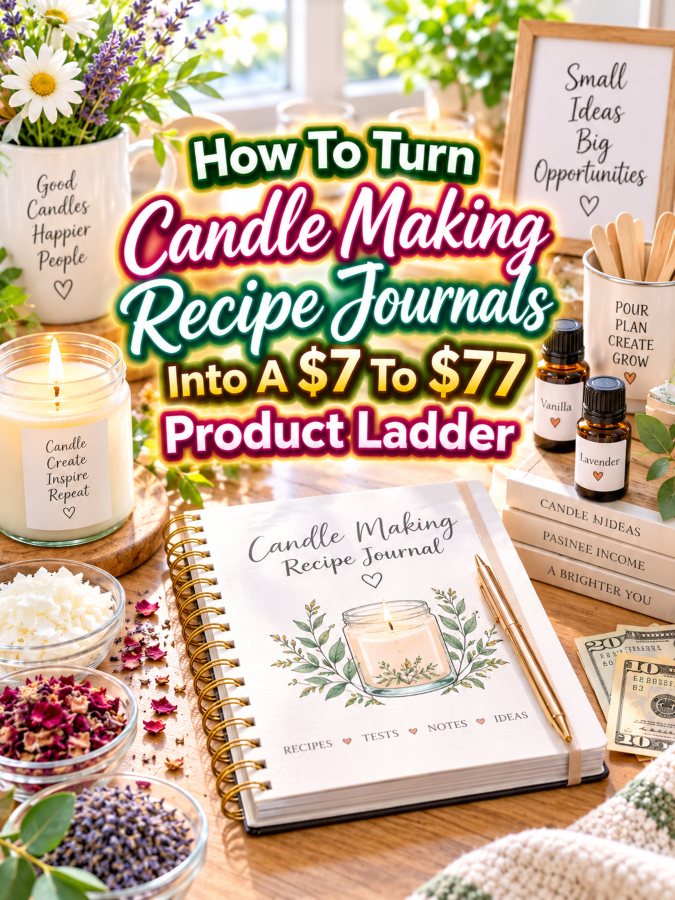
That’s where a candle making recipe journal becomes genuinely useful. It gives makers a dedicated place to record wax type, fragrance, percentages, wick choices, vessel details, colors, temperatures, curing observations, burn-test results, and changes between batches. Instead of relying on memory, random scraps of paper, or the classic “I’ll definitely remember this” strategy, they have a repeatable record they can return to.
That usefulness also creates a natural digital product ladder. A $7 journal can help a maker record individual recipes, while a $17 to $27 toolkit can organize experiments and supplies. A $37 to $47 bundle can become a complete candle recipe and testing system, and a $67 to $77 premium version can add editable templates, specialty editions, business-oriented pages, and customization resources.
Quick Answer
The simplest candle making recipe journal product ladder starts with a focused $7 recipe tracker, expands into a $17 to $27 recipe and testing toolkit, grows into a $37 to $47 complete candle-making journal system, and finishes with a $67 to $77 premium editable bundle.
The $7 product should provide a quick win: one attractive, practical way to document a candle recipe. The $17 to $27 level can add multiple recipe sheets, supply tracking, fragrance logs, testing pages, and project organization. The $37 to $47 level can bring those tools together into a complete workflow, while the premium version can add editable files and additional customization.
The important pricing principle is that every level should solve a bigger problem. You’re not charging more because the PDF got taller. You’re charging more because the buyer can do more with it.
Why Candle Making Recipe Journals Work As A Product Ladder
Candle makers often experiment. They may change fragrance loads, waxes, colors, containers, wicks, additives, pouring conditions, or other recipe variables as they work toward a candle that performs and looks the way they want. Once several variables are changing, keeping reliable notes becomes much more valuable than trying to remember what happened during the last batch.
A recipe journal can therefore serve beginners, hobby makers, serious experimenters, and small candle businesses. A beginner may simply want to remember the ingredients and steps for a favorite candle. An experienced maker may need a more detailed record of testing, batch information, costs, supplier details, and repeat-production notes.
That gives you several legitimate ways to expand the product. You can create beginner journals, fragrance testing journals, candle recipe books, seasonal candle planners, small-business batch journals, and specialty versions without abandoning the central concept. One useful framework can become an entire family of products.
The Reasonable Pricing Rule
$7 should deliver a quick win. A $7 candle recipe journal might include several reusable recipe-recording pages, a fragrance information page, a materials checklist, and a simple notes section. The customer should understand the product within seconds and be able to use it immediately.
$17 to $27 should deliver a toolkit. Add fragrance inventory, wax and wick tracking, batch notes, testing logs, project planning, supply checklists, and multiple recipe formats. The buyer should feel that they’re getting a useful collection rather than simply more copies of the same page.
$37 to $47 should deliver a complete system. This level can combine recipe development, testing, project tracking, inventory, cost organization, production notes, and finished-product reviews. The value comes from connecting the pieces into a workflow.
$67 to $77 should deliver premium flexibility. Editable Canva templates, printable PDFs, digital-friendly versions, specialty layouts, customization instructions, promotional resources, and appropriately licensed commercial-use options can all contribute to premium value.
Don’t add random pages just to reach a higher price. That’s Not a Good Thing. A smaller, well-designed journal that genuinely helps someone is worth more than a gigantic digital brick nobody wants to open.
The $7 Starter: Candle Making Recipe Journal
The $7 starter should focus on the most obvious problem: recording a candle recipe so the maker can reproduce or compare it later. A strong journal could include fields for recipe name, date, wax type, wax quantity, fragrance, fragrance amount, fragrance percentage, vessel, wick information, color, additives, temperatures, pouring notes, and observations.
Include a simple testing section where the maker can record what happened during curing and burning. They could note appearance, scent performance, melt pool observations, tunneling, soot, wick behavior, and other observations relevant to their testing process. The journal doesn’t need to tell people what result they will get; it simply gives them a consistent place to document their own results.
Add a small “recipe changes” section so makers can compare one batch with another. That turns the journal from a pretty notebook into a practical record-keeping tool, which is exactly what a $7 product should do.
The $17 To $27 Expanded Kit: Candle Making Recipe & Testing Toolkit
At $17 to $27, expand beyond individual recipes. Create a Candle Making Recipe & Testing Toolkit that helps the buyer organize experiments, supplies, fragrances, and finished results.
Include reusable recipe pages, fragrance test logs, wax comparison sheets, wick-testing pages, vessel records, color and design planning pages, batch notes, curing logs, burn-test records, supply checklists, inventory pages, and a project queue. You can also add a recipe index so the maker can quickly locate a successful formula later.
This is an excellent place to introduce specialty project pages. For example, you might have separate layouts for container candles, seasonal collections, gift candles, test batches, or new fragrance experiments. You’re giving the customer choices without turning the product into a confusing maze.
The value increase comes from organization and repeatability. The buyer can now manage an ongoing collection of experiments instead of documenting one candle at a time.
The $37 To $47 Working Bundle: Complete Candle Recipe Journal System
The $37 to $47 version should feel like a complete candle-making documentation system. Call it something like the Complete Candle Recipe & Testing Journal System and build it around the full journey from idea to tested recipe.
Include everything from the lower levels, then add a master recipe index, fragrance library, supplier information pages, materials inventory, project planning pages, batch records, testing logs, comparison sheets, troubleshooting notes, finished-product reviews, and repeat-production records. A maker who discovers a successful candle should be able to document enough information to find and reproduce the relevant notes later.
You can also add business-friendly pages for product names, collection planning, batch quantities, packaging notes, and basic cost tracking. These pages don’t need to turn the product into a full accounting system. They simply help makers connect their creative experiments with the practical side of producing finished candles.
A QuickStart guide can make the bundle feel even more valuable. Explain which pages to use when developing a new recipe, which pages are useful during testing, and which pages belong in the archive once a recipe is considered successful.
The $67 To $77 Premium: Editable Candle Making Journal Kit
The premium product should give buyers substantially more flexibility. A Premium Editable Candle Making Journal Kit could include editable Canva templates, finished PDF versions, multiple journal styles, specialty layouts, business-oriented editions, and digital-friendly versions.
You can also include a customization guide that shows buyers how to change colors, fonts, headings, cover designs, and selected fields. This is especially valuable for creators who want a journal that matches their brand or serves a specific audience.
Promotional resources can add another layer of value. Consider including product-description templates, short social captions, Pinterest title ideas, mockup suggestions, and a simple checklist for preparing the journal for sale. If you’re offering commercial-use, resale, or PLR rights, define exactly what those rights include rather than tossing a vague licensing sentence into the package and hoping everyone interprets it the same way.
The premium price should come from convenience, customization, and flexibility. That’s what makes it premium.
Example Product Ladder
| Price | Product | Core Value |
|---|---|---|
| $7 | Candle Making Recipe Journal | Quick recipe and batch documentation |
| $17–$27 | Candle Recipe & Testing Toolkit | Recipe, fragrance, supply, and testing organization |
| $37–$47 | Complete Candle Recipe Journal System | Full recipe-development and documentation workflow |
| $67–$77 | Premium Editable Candle Journal Kit | Customization, editable templates, specialty editions, and promotional resources |
Notice how each level answers a different buyer need. The $7 product says, “Help me remember what I did.” The $17 to $27 product says, “Help me organize my experiments.” The $37 to $47 product says, “Help me manage the entire process.” The $67 to $77 product says, “Give me the flexibility to customize and use this system my way.”
That’s a much stronger ladder than simply making the same journal thicker at every price point.
Recommended Tools
Canva is an excellent choice for creating the printable journal, recipe cards, testing pages, covers, and editable premium templates. Create a consistent visual system once, then duplicate and customize layouts for different candle-making audiences.
ChatGPT can help brainstorm journal fields, project categories, reflection questions, product names, FAQ sections, descriptions, and promotional copy. You can also use it to organize ideas for different customer types, such as beginner candle makers, hobbyists, or small handmade-product businesses.
Google Docs can work well for written instructions and quick-start guides, while Google Sheets can be useful if you want to offer a digital inventory or recipe index alongside the printable journal.
For selling, Etsy, Payhip, and Gumroad can provide different storefront and delivery options. Systeme.io can be useful if you want to build a broader funnel around your candle-making resources.
How To Know If Your Price Is Fair
Start by asking what problem the buyer is paying you to solve. If the answer is “they get 60 pages,” that’s weak. If the answer is “they can systematically document recipes, compare test batches, organize fragrances, and find successful formulas later,” that’s much stronger.
Next, compare the products side by side. The $17 to $27 product should make the $7 version feel pleasantly simple rather than incomplete. The $37 to $47 version should save the buyer significant organizational work. The $67 to $77 version should offer enough customization or additional resources to make its premium price understandable.
Also consider how reusable the product is. A journal that can be printed repeatedly, duplicated digitally, or adapted for multiple candle projects has more practical value than a one-use worksheet.
If you wouldn’t happily pay the listed price because the product would genuinely make your own candle-making process easier, keep working on the offer.
5-Step Action Plan
- Create the $7 recipe journal. Focus on recording recipes, materials, batch information, and testing observations.
- Build the $17–$27 toolkit. Add fragrance logs, inventory pages, project planning, testing sheets, and reusable templates.
- Create the $37–$47 system. Connect recipe development, testing, organization, production notes, and archiving into one workflow.
- Develop the premium version. Add editable Canva templates, specialty editions, digital formats, customization instructions, and promotional resources.
- Show the differences clearly. Make it obvious what the buyer gets at every price so upgrading feels useful rather than confusing.
Don’t start by building the $77 version. Start with the problem that is easiest to understand and solve it beautifully.
Once you’ve created a useful starter journal, you’ll have a foundation for every other level. That makes the process much less overwhelming and gives you something real to improve instead of trying to design the entire thingee before you’ve tested the first idea.
Common Pricing Mistakes
Charging based on page count: More pages aren’t automatically more valuable. Ten useful pages can beat 100 repetitive ones.
Putting every feature into the $7 version: If the starter already contains inventory, testing, business planning, customization, and every bonus under the sun, there’s nowhere meaningful to go next.
Making premium just “more pages”: Premium should add flexibility, convenience, editability, specialization, or another meaningful benefit.
Making technical claims you haven’t tested: Candle making involves variables that can affect performance. A journal should help customers document their own testing rather than promising that a particular recipe, wick, fragrance load, or process will automatically work.
Ignoring the business buyer: Some makers eventually sell their candles. Adding appropriate production, batch, product, and cost-recording pages can make the higher-tier products more useful without turning the journal into a full accounting program.
Unclear licensing: If you’re selling editable templates or commercial-use rights, define the permitted uses carefully. Clarity is part of the product experience.
Where To Find Buyers
Visual platforms are a natural fit for candle-making content because finished candles, fragrance collections, color palettes, vessels, and workspace organization are highly visual. Pinterest can be especially useful for content such as candle-making organization tips, recipe journal ideas, fragrance tracking, and maker-planner inspiration.
Etsy can reach shoppers already looking for printable craft resources, while social platforms can help demonstrate how the journal works. Show an actual filled-in recipe page, a fragrance log, or a testing record rather than only displaying the cover. When people can see the tool solving a problem, the product becomes much easier to understand.
Free resources can also bring in the right audience. A one-page candle recipe tracker or fragrance-testing sheet can act as a lead magnet, with the $7 journal positioned as the natural next step.
Affiliate Opportunities
Candle-making content can naturally connect with affiliate opportunities around craft supplies, containers, thermometers, scales, labels, storage solutions, tools, books, and other maker resources, depending on the affiliate programs available to you.
Instead of randomly recommending products, build useful educational content around the workflow. An article about organizing a candle-making workspace can naturally mention storage. A post about documenting fragrance experiments can introduce the recipe journal. A guide about preparing for a new candle collection can connect to project-planning resources.
The best affiliate content feels like helpful advice first and monetization second. If readers trust your recommendations, the commercial opportunity becomes much stronger.
Internal Links
Connect this article to related posts about craft project planners, handmade-business planners, product development journals, inventory trackers, creative business organization, printable journals, and other maker-focused digital products.
You can also build a content cluster around candle-making organization. Potential companion topics include candle inventory trackers, fragrance collection logs, craft-business product planners, craft-fair preparation planners, handmade product pricing worksheets, and small-business production planners.
These connections give readers additional help while creating a stronger internal structure for your website.
Pinterest Ideas
Create pins that lead with the problem or outcome rather than simply naming the product. Strong ideas include How To Keep Track Of Your Candle Recipes, Candle Making Journal Pages Every Maker Needs, How To Organize Candle Fragrance Experiments, and Stop Forgetting What You Changed In Your Candle Tests.
You can also showcase individual pages from the journal. A fragrance-testing page, batch record, recipe sheet, or project index can communicate the product’s usefulness immediately.
Seasonal content creates even more opportunities. Think holiday candle collections, fall fragrance experiments, gift-making projects, spring collections, wedding candles, or craft-fair preparation. Each topic can lead readers toward the same core organizational product.
FAQ
What should a $7 candle making recipe journal include?
A focused starter can include recipe information, wax and fragrance details, vessel and wick information, batch notes, temperatures, testing observations, and a project review. The goal is to help makers record what they did and what they observed.
Should a candle recipe journal include actual candle recipes?
It doesn’t have to. A recipe journal can be valuable simply by providing a structured place for customers to document and develop their own formulas. If you include recipes, make sure the content is appropriate for the product and presented responsibly.
Can I make a candle fragrance testing journal separately?
Yes. A fragrance-testing journal can become its own focused product or an excellent addition to a higher-tier bundle. It can include fragrance name, supplier information, test notes, preferences, batch references, and performance observations.
Can I make a candle-making journal for small businesses?
Absolutely. A business-focused version can include batch records, product names, collection planning, production notes, supplier information, inventory tracking, cost-recording pages, and customer or commission notes.
Can I sell an editable Canva version?
Yes, when the design and licensing setup permit it. Clearly explain what customers receive and what they are allowed to customize or use.
What makes the $77 version worth more?
The premium version should provide meaningful flexibility, such as editable templates, multiple editions, digital and printable formats, customization resources, promotional assets, and other time-saving features. It should feel like a more complete implementation package, not simply a much longer journal.
Promo Angles
“Never Forget What You Did In Your Last Candle Batch” focuses directly on the memory and documentation problem.
“Turn Candle Experiments Into Repeatable Recipes” highlights the value of keeping organized records without promising a specific technical outcome.
“Keep Your Wax, Fragrance, Wick, And Testing Notes In One Place” emphasizes organization.
“Your Candle-Making Notebook, But Much More Organized” gives the product a friendly, accessible positioning.
“Build A Candle Recipe Library You Can Actually Find Again” appeals to makers with growing collections of recipes and experiments.
“Customize Your Own Candle Making Journal” works especially well for the premium editable version.
These angles can become product-description headlines, Pinterest titles, email subject lines, social posts, and promotional graphics.
Final Product Ladder Summary
The $7 Candle Making Recipe Journal provides a focused way to document recipes, batches, materials, and observations. The $17 to $27 Candle Recipe & Testing Toolkit adds fragrance logs, testing pages, supply organization, project planning, and reusable resources.
The $37 to $47 Complete Candle Recipe Journal System turns those tools into a full workflow for developing, documenting, testing, organizing, and archiving candle projects. Business-friendly pages can make the system even more useful for makers who are beginning to sell their work.
The $67 to $77 Premium Editable Candle Journal Kit adds editable templates, multiple versions, customization resources, digital-friendly formats, promotional materials, and appropriate licensing options. The premium value comes from control and convenience rather than unnecessary bulk.
Every level should make the customer think, “Yes, this solves a bigger problem for me.” That’s what makes a product ladder feel natural.
Conclusion
Candle making recipe journals solve a surprisingly practical problem. Makers experiment, change variables, test batches, discover combinations they like, and then need a reliable way to remember what happened. A good journal turns those scattered notes into an organized creative record.
That makes this niche particularly well suited to a $7 to $77 product ladder. Start with a focused recipe journal, expand into a testing and organization toolkit, build a complete working system, and then add premium flexibility through editable templates and specialty resources.
You don’t need to remember every candle you’ve ever made. That’s what the journal is for. Your job is simply to create a system that makes remembering easier, experimenting more organized, and the next batch a whole lot less mysterious.
So here’s what you discovered today. If something sparked your interest, take it as your sign to start moving toward that goal now. Even one small step counts.
Enjoy!