Introduction
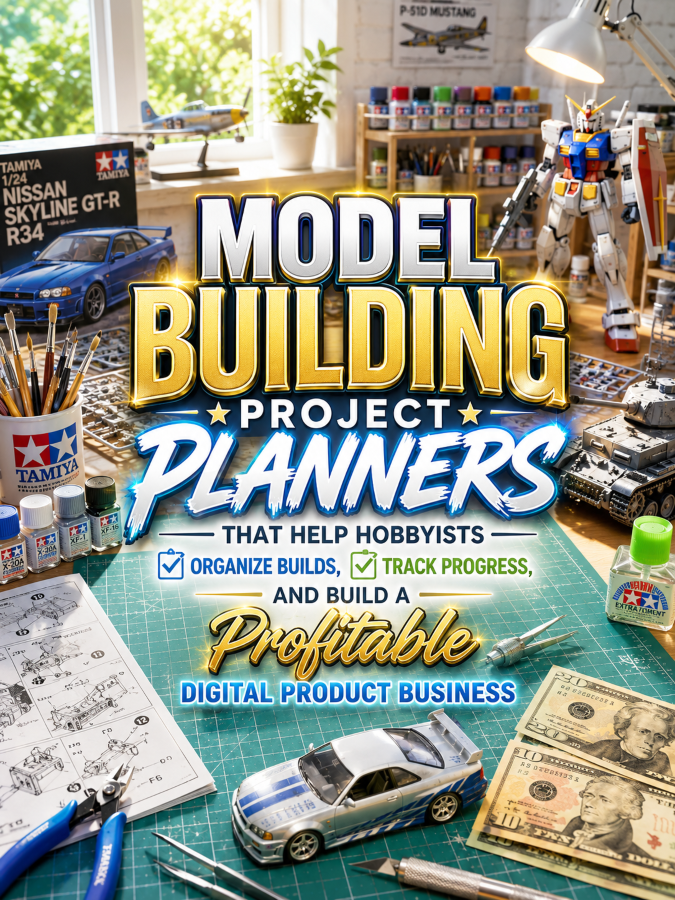
Model building has a sneaky little habit of turning one innocent project into an entire hobby ecosystem. One kit becomes two. Then you discover paints, tools, decals, spare parts, reference photos, unfinished builds, display cases, and that one project sitting in a box because you are “definitely going to finish it soon.”
That makes Model Building Project Planners a practical digital product niche with plenty of room to grow.
Model builders need ways to plan projects, track kits, organize supplies, record paint colors, document techniques, track progress, manage budgets, photograph completed builds, and keep a running list of future projects.
For digital product sellers, this creates a natural $7 to $77 product ladder. Start with a focused project planner, expand it into a $17–$27 model-building organization toolkit, grow it into a $37–$47 complete hobby planner, and finish with a $67–$77 premium Model Building Command Center.
Quick Answer
A Model Building Project Planner can start as a $7 project worksheet, expand into a $17–$27 hobby organization toolkit, grow into a $37–$47 complete model builder planner, and reach $67–$77 as a premium customizable model-building command center.
The trick is to make every tier more useful rather than merely more enormous. The $7 product should help someone successfully plan one build. The $17–$27 product should organize the hobby. The $37–$47 product should manage multiple projects, supplies, budgets, techniques, and displays. The $67–$77 product should add specialty editions, editable templates, digital formats, and advanced project-management tools.
Quick Win
Create a Model Building Project Planner that records the kit name, manufacturer, scale, subject, purchase date, cost, project goal, required tools, paint colors, materials, build stages, start date, completion date, problems encountered, and final rating.
Why This Niche Works
Model builders include beginners, scale-model enthusiasts, miniature builders, aircraft and vehicle modelers, ship modelers, military-model hobbyists, science-fiction builders, diorama creators, kitbashers, custom builders, and serious collectors.
Every project can involve different materials, tools, techniques, paints, decals, references, construction stages, and display requirements.
That makes the hobby naturally suited to planning and recordkeeping.
A good planner can help answer questions such as:
- Which kits do I own?
- Which projects are unfinished?
- What should I build next?
- Which paints and supplies do I already have?
- Which tools do I need?
- What techniques worked well?
- What went wrong on a previous build?
- How much did a project cost?
- Which completed models are ready for display?
And there is a business opportunity hiding in there, too. Model builders may create tutorials, post build videos, enter competitions, sell finished models, create custom pieces, or participate in hobby clubs.
The Reasonable Pricing Rule
Do not turn a $7 planner into a $77 product by adding 200 nearly identical project pages.
More pages are not automatically more value. In fact, if the buyer needs a forklift to move the printable, you may have wandered slightly off course.
The $7 product should solve one focused problem: planning and documenting a model build.
The $17–$27 product should organize the broader hobby.
The $37–$47 product should connect projects, supplies, tools, budgets, techniques, displays, events, and content.
The $67–$77 product should provide flexible digital formats, specialty editions, editable templates, and a complete model-building management system.
Your $7 Starter Product
Create a printable called the Model Building Project Planner.
Include:
- Project Overview
- Kit Name
- Manufacturer
- Scale
- Model Type
- Purchase Date
- Purchase Price
- Project Goal
- Reference Image Space
- Required Tools
- Required Materials
- Paint Color List
- Build Stage Checklist
- Start Date
- Completion Date
- Problems & Solutions
- Final Rating
- Lessons Learned
The goal is to give builders one organized place to plan, document, and review a project from beginning to end.
Grow It Into a $17 to $27 Model Building Organization Toolkit
Once a hobbyist has several kits waiting on the shelf, the basic project planner can grow into a complete organization system.
Create a Model Builder’s Organization Toolkit priced between $17 and $27.
Include:
- Everything from the $7 starter product
- Model Kit Inventory
- Unstarted Project Tracker
- Work-in-Progress Tracker
- Completed Model Tracker
- Project Priority Planner
- Future Build Wishlist
- Paint Inventory
- Material Inventory
- Tool Inventory
- Decal Inventory
- Spare Parts Tracker
- Reference Material Log
- Technique Notes
- Project Cost Tracker
- Workbench Organization Planner
- Storage Location Tracker
- Display Planning Worksheet
- Model Club Meeting Planner
- Competition Preparation Checklist
- Monthly Building Goals
- Annual Hobby Review
This turns a single project planner into a practical hobby-management toolkit.
Build a $37 to $47 Complete Model Builder Planner
The next level should feel like a command center for serious hobbyists who manage multiple builds, supplies, competitions, displays, or content projects.
Create a Complete Model Builder Planner priced between $37 and $47.
Include:
- Annual Model Building Planner
- 90-Day Build Challenge
- Project Pipeline Tracker
- Collection Growth Tracker
- Model Kit Spending Tracker
- Monthly Hobby Budget
- Project Cost Worksheet
- Build Time Tracker
- Paint & Material Usage Log
- Technique Development Journal
- Problem-Solving Log
- Reference Research Journal
- Diorama Project Planner
- Custom Build Planner
- Display Planning Workbook
- Competition Preparation Planner
- Model Club Event Planner
- Finished Model Sales Tracker
- Marketplace Listing Planner
- Product Photography Checklist
- Social Media Content Planner
- Build Video Planning Worksheet
- Quarterly Hobby Review
- Year-End Collection Review
This version moves beyond simply organizing kits.
It helps hobbyists manage the entire creative process: planning, building, troubleshooting, learning, displaying, documenting, and occasionally selling completed work.
Create a $67 to $77 Premium Bundle
The premium version should provide flexibility and specialization rather than simply creating a gigantic binder.
Create a Model Building Command Center priced between $67 and $77.
Include:
- Editable Canva Templates
- Fillable PDF Version
- Tablet-Friendly Digital Version
- Scale Model Builder Edition
- Aircraft Model Builder Edition
- Vehicle Model Builder Edition
- Ship Model Builder Edition
- Military Model Builder Edition
- Science-Fiction Model Builder Edition
- Diorama Builder Edition
- Custom Model Builder Edition
- Model Club Edition
- Competition Edition
- Model Reseller Edition
- Project Inventory System
- Marketplace Listing Workbook
- Build Content Calendar
- Social Media Promotion Templates
- Competition Preparation Kit
- Workbench Organization Workbook
- Collection Budget Workbook
- Quick-Start Setup Guide
- Customization Instructions
- Commercial Use Options Where Appropriate
The premium bundle should feel like a flexible system that can support a personal hobby, serious collection, model club, competition journey, content business, or small custom-model operation.
Example Product Ladder
$7 Starter: Model Building Project Planner
$17–$27 Toolkit: Model Builder’s Organization Toolkit
$37–$47 Bundle: Complete Model Builder Planner
$67–$77 Premium: Model Building Command Center
Recommended Tools
- Canva for planner layouts, editable templates, covers, worksheets, and promotional graphics
- ChatGPT for project prompts, build checklists, troubleshooting questions, content ideas, and marketing copy
- Google Sheets for larger kit, paint, and supply inventories
- Creative Fabrica for commercial-use graphics, fonts, and design resources
- remove.bg for clean product mockups
- Google Trends for researching model-building interests and seasonal demand
- Etsy for researching digital product demand
- Payhip or Gumroad for digital product delivery
Your 5-Step Action Plan
Step 1: Start With One Build
Build the $7 planner around one clear problem: helping a modeler successfully organize one project.
Keep it practical. The buyer should be able to record the kit, supplies, steps, problems, and final results without fighting the planner itself.
Step 2: Solve the “Too Many Kits” Problem
Expand the product with kit inventories, work-in-progress trackers, project priorities, wishlists, storage records, and supply inventories.
This creates the $17–$27 organization toolkit.
Step 3: Add the Serious Hobby Experience
For the $37–$47 version, introduce budgets, project costs, build-time tracking, technique journals, diorama planning, competition preparation, content creation, displays, and resale tools.
Now the planner supports the entire hobby instead of only one project.
Step 4: Create Specialty Editions
Develop versions for aircraft, vehicles, ships, military models, science-fiction models, dioramas, custom builders, competition participants, clubs, and content creators.
Specialization makes the marketing message much stronger because the buyer immediately sees how the planner fits their particular hobby.
Step 5: Build the Premium Command Center
Add editable Canva templates, fillable PDFs, digital versions, specialty editions, promotional templates, and customization instructions.
The premium product should save time and make the system easier to adapt to different model-building styles.
Common Pricing Mistakes to Avoid
The first mistake is making the planner beautiful but difficult to use.
Model builders need writing space, checklists, project notes, and practical reference fields. Decorative elements should support the hobby, not consume the entire page.
The second mistake is putting every feature into the $7 product.
If the starter already includes supply inventories, budgeting, competition planning, content calendars, resale tools, and digital templates, there is little reason to upgrade.
The third mistake is treating every model builder as the same customer.
A beginner assembling a weekend kit has very different needs from a competition modeler managing multiple detailed builds. A diorama creator has different requirements from someone who collects unopened kits.
Specialty editions solve that problem.
Where to Find Buyers
- Model-building Facebook groups
- Scale-model communities
- Aircraft modeling groups
- Military modeling communities
- Vehicle model groups
- Ship modeling communities
- Diorama-building groups
- Science-fiction modeling communities
- Model club communities
- Competition and show communities
- Pinterest hobby audiences
- Etsy digital-product communities
Visual platforms can work particularly well because work-in-progress photos, finished models, workbenches, dioramas, paint stations, and before-and-after transformations are naturally shareable.
Affiliate Opportunities
Model-building content creates natural opportunities for related affiliate products.
- Model kits
- Paint sets
- Paint brushes
- Airbrush equipment
- Modeling knives
- Sanding tools
- Cutting mats
- Glue and adhesives
- Decal supplies
- Modeling tools
- Display cases
- Workbench organizers
Instead of simply recommending products, create helpful content around the problems they solve. For example, write about setting up a beginner model-building station, organizing paints, creating a practical workbench, storing unfinished projects, or preparing a model for display.
Internal Link Suggestions
- Coin Collection Trackers
- Stamp Collection Trackers
- Vinyl Record Collection Trackers
- Book Collection Trackers
- Board Game Collection Trackers
- Puzzle Collection Trackers
- LEGO Collection Trackers
- Dollhouse Project Planners
Pinterest Pin Ideas
- The Model Building Project Planner Every Hobbyist Needs
- Finally Organize Your Model-Building Projects
- Track Your Kits, Paints, Tools, and Builds
- Stop Losing Track of Unfinished Model Projects
- Build a Better Model-Building Workflow
- Build a $7 to $77 Model Building Product Ladder
Frequently Asked Questions
Who buys Model Building Project Planners?
Scale-model builders, aircraft modelers, vehicle modelers, ship builders, military-model hobbyists, diorama creators, custom builders, serious collectors, model clubs, content creators, and hobby resellers can all benefit from these products.
Can this niche generate repeat customers?
Yes. Model builders can maintain multiple projects, collect kits, experiment with techniques, attend competitions, join clubs, create tutorials, build dioramas, and occasionally sell finished models. Each activity creates opportunities for additional specialized planners.
Should I create different versions for different model builders?
Absolutely. Aircraft, vehicle, ship, military, science-fiction, diorama, competition, and custom-building editions can all target different audiences.
Can the $7 starter product work for beginners?
Yes. Keep the first product approachable. A beginner should be able to plan a project without knowing advanced terminology or maintaining a complicated hobby database.
Can I include a paint inventory?
Yes. Paint inventory is one of the most useful additions to a model-building toolkit. Include fields for brand, color name or number, quantity or status, project use, and replacement needs.
Can I include project cost tracking?
Absolutely. A project-cost worksheet can record the kit, paints, tools, materials, decals, display supplies, and other expenses. This is especially useful for serious hobbyists and anyone selling completed models.
Call to Action
Model building can involve creativity, patience, tiny parts, paint, glue, research, and the occasional moment when a piece disappears despite being approximately the size of a breadcrumb.
Start with a $7 Model Building Project Planner that helps people organize one build. Then expand it into a $17–$27 hobby organization toolkit, a $37–$47 complete model builder planner, and finally a $67–$77 premium Model Building Command Center.
Do not build the entire ladder at once. Start with one useful solution, watch what your audience needs next, and build each upgrade around a real problem.
That’s how a simple project planner can become the foundation for a much bigger digital product business.
Conclusion
Model builders already have enough tiny parts to keep track of. They should not also have to remember which kit is unfinished, where the correct paint is stored, which technique caused trouble last time, or what project they promised themselves would be next.
A Model Building Project Planner turns a pile of kits and supplies into an organized creative workflow. It gives hobbyists a practical way to document projects, materials, tools, techniques, costs, progress, problems, displays, and future builds.
Start with the focused $7 planner. Expand it into the $17–$27 hobby organization toolkit. Add budgeting, research, supply management, competitions, content, displays, and resale tools at $37–$47. Then create the premium $67–$77 command center with editable and specialized resources.
Once you have the framework working, you can adapt the same system for dollhouses, puzzles, LEGO collections, stamps, coins, vinyl records, books, board games, miniatures, and other project-based or collectible hobbies.
One model kit is a project. Several unfinished kits are a system. And a good planner keeps that system from turning into a plastic-and-paint thundering herd.
Here’s what you uncovered today. If something made you pause, smile, or feel curious, follow that spark and start working toward it today. Momentum begins with one decision.
Enjoy!