Introduction
Sandra’s grandmother made the best chicken and dumplings in three counties. No written recipe. No measurements. Just “a good handful of flour, enough butter to scandalize a cardiologist, and love!” Sandra watched her cook it forty times. Never wrote a single thing down.
When her grandmother passed, the recipe went with her. 🙁
Gone! Which is, as losses go, quietly devastating.
Does this sound familiar? It should – because it is happening in families everywhere right now. Recipes that exist only in someone’s head disappear every year. So do the ones on a water-stained index card tucked inside a 1984 church cookbook nobody can currently locate. And people will pay real money to stop that from happening in their family!
The family recipe preservation business looks like a hobby and operates like a serious income stream. You help families collect, organize, and publish their food history. As a done-for-you service, or as digital templates people buy and fill in themselves. Both models work. Let’s look at why this niche actually holds up before we build anything.
Why Family Recipe Preservation Is a Real Business
People buying a recipe book are not buying a collection of instructions. They are buying a time machine. A well-made family collection takes someone back to their grandmother’s kitchen. To Sunday dinners that smelled like pot roast and belonging. To the sense that certain people are still here in some form.
That is not a product. That is an heirloom!
Studies on family food traditions suggest roughly 74% of families have at least one treasured recipe that lives only in someone’s memory. Or on a document nobody can currently find. The window is closing. People know it! They feel it at every holiday dinner where there is an empty chair that used to hold someone who cooked things nobody else knows how to make anymore.
You do not need a culinary degree to do this work. You need organizational skills and a little design talent – or access to Canva, which is functionally the same thing. And a willingness to sit with families while they tell food stories. That last part turns out to be one of the more pleasant ways to spend a Tuesday afternoon. Occasionally tearful. Mostly wonderful.
The business model is flexible enough to fit around almost any schedule and light enough to start with zero overhead. How often does a combination like that show up? Not often enough – which is exactly why this one is worth your attention!
Before we build anything, let’s make sure you have the right tools – several of which cost nothing at all.
Tools You Will Actually Need
Canva is where you will design everything – recipe page layouts, cover templates, section dividers, and the beautifully formatted PDFs you either deliver to clients or sell as downloadable templates on Etsy. The free tier handles this entire business without issue. Start there and stay there until the paid features genuinely earn their keep.
A family recipe binder from Amazon runs about $18-$25. It makes an excellent upsell or gift recommendation for clients who want something they can hold. Gerald ordered four of them for Christmas last year after you helped him document his family recipes. This happens regularly and it is always delightful.
A flatbed photo scanner in the $80-$120 range handles the physical material. Old handwritten recipe cards. Torn magazine clippings. The occasional grease-stained document that looks more like a crime scene exhibit than a recipe for peach cobbler. (It still counts. Do not judge it.)
Google Forms is how you will collect recipes from scattered family members. Free, simple, and accessible to anyone who has been using the Internet for any length of time at all. No learning curve required.
For selling digital products, both Etsy and Gumroad work well here. Etsy brings built-in buyer traffic. Gumroad handles subscriptions and bundles cleanly. Are you selling printable templates to complete strangers at 2am while you sleep? Yes. Both platforms make that happen with minimal setup.
For email marketing – and you absolutely need this from day one – there are several solid choices. Solopreneurs could use AWeber, GetResponse, or the really bespoke No Limit Emails (they offer individual servers, spam-free service, and second to none customer care).
That is the complete toolkit – and it costs a fraction of what most service businesses need to launch! With these in hand, here is the 10-step path to your first paying client and well beyond.
Your 10-Step Blueprint for Building a Family Recipe Preservation Business
Step 1: Choose Your Business Model Before Anything Else
You have two main paths. The service model means clients hire you to interview their family, collect the recipes, design the book, and deliver a finished product. Prices range from $150 to $600 depending on scope. The template model means you design recipe book layouts once, list them on Etsy, and collect income whenever someone buys a download.
Most people start with the service model because it generates income faster. Then add digital templates once they have finished projects to use as portfolio examples. Start with services if you need income now. Add templates when you want income that runs while you are doing something else entirely.
Step 2: Define the Families You Most Want to Serve
Trying to serve every family is like trying to fill a crockpot with a garden hose. Technically possible.
Wildly inefficient!
And somehow involving a kazoo you found in the process that you still cannot explain. Pick one specific client type to start. Families with aging grandparents actively cooking. People who recently lost a family member and want to preserve what remains. Reunion organizers creating keepsakes. Each group has different urgency and different pricing sensitivity.
The families-with-aging-grandparents niche carries the highest urgency because clients feel a real timeline bearing down on them. Urgency moves people from “interesting idea” to “yes, please start immediately!”
Start there.
Step 3: Build Your Design Templates Before Your First Client Calls
Open Canva and build five things before you talk to a single client:
- A clean lined recipe page.
- A decorative version with photo space.
- A simple card format for shorter recipes.
- A cover page.
- A section divider.
Build them.
All of them!
This week. Not eventually. Not “once I get my first client.” Now – because you will need them the moment someone says yes and you do not want to be building your toolkit while their grandmother is waiting.
Having polished templates ready means your sales conversations become demonstrations instead of descriptions. You can show the finished product rather than explain it. Showing closes projects about four times faster than enthusiastic verbal explanations ever will. (Four times faster is not a figure of speech. It is a real dynamic. Ask anyone who has done both.)
Step 4: Create a Recipe Collection System That Actually Works
The hardest part of this business is not the design. It is getting the actual recipes out of people’s heads and into a document! After all, family members are scattered. Recipes are half-remembered. Great-grandma measures everything in “some” and “enough” and “until it looks right.” You need a system that handles this gracefully.
Build a simple Google Form with fields for recipe name, servings, ingredients, and instructions. Add one story field: “What memory do you have of this recipe?” Never.Skip.The.Story.Field! It is the part that transforms a collection of instructions into something families put on a bookshelf next to the wedding album.
You will receive recipes the client had no idea existed; the stories will make you love this business.
Step 5: Price Your Service Based on the Actual Value You Deliver
The most common mistake in this niche is underpricing because the work feels too enjoyable to charge full rates for. This logic is (wait for it) a trap!

A completed family recipe book is NOT “a pretty document.”
It is irreplaceable family history. Preserved in a format that can be shared for generations. The families who want it most feel that value deeply before you say a single word about price.
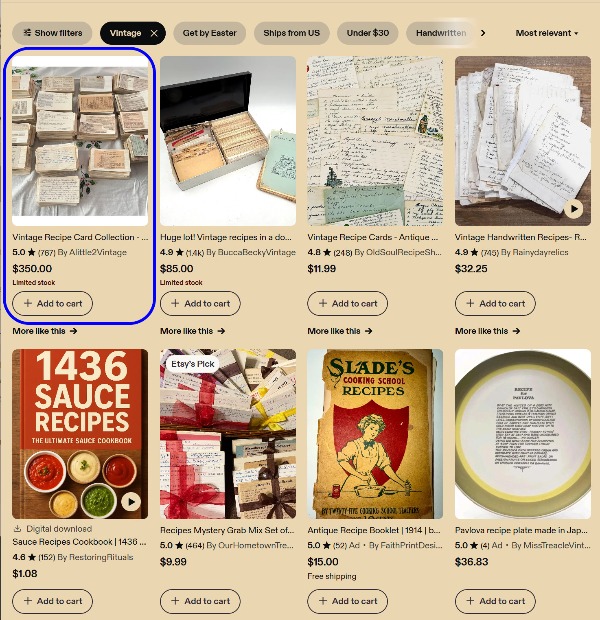
A starter package – 10 to 15 recipes, customized, clean design, digital PDF delivery – should start at $150 minimum. (If you’re offering NON-customized recipes, of course, you could charge ‘way less… and you can even FIND vintage recipes at Etsy (not customized of course for those types of prices.
Back to the customization:
A complete family collection – 30 to 50 recipes, full design, printed proof included – is comfortably worth $350 to $500.
The families who are serious about preservation do not flinch at these numbers.
Step 6: Build Your First Portfolio Project This Week
Before charging full price for anything, do one or two projects at a hugely discounted rate. In exchange: honest testimonials and permission to use the finished book as a portfolio example!
Your own family is the obvious starting point. Most people have four or five family recipes that need documenting right now – sitting in their kitchen, waiting to be noticed.
A portfolio of two completed books with genuine testimonials attached closes sales faster than any marketing copy you could write. People buy based on evidence, after all. Give them something real and beautiful to look at!
Step 7: List Your Templates on Etsy and Start Generating Passive Income
Once your design templates are polished from real project work, list them as digital downloads on Etsy. A “Family Recipe Book Template” priced at $8 to $15 sells to people who want to do this themselves. A six-template bundle at $22 to $28 sells to people who want options! These sales happen any time of day with no active involvement from you after the listing goes live.
Etsy SEO matters a great deal here. Use search terms like “recipe book template printable,” “family cookbook template download,” “heirloom recipe collection printable,” and “personalized recipe book PDF.” Etsy shoppers search with specific intent. Meet them with specific titles and tags and your listings will find their audience without you promoting them constantly.
Step 8: Build Your Email List From the Very First Project
Every client who finishes a project and every Etsy customer who buys a template is an opportunity to build a direct relationship. Create a simple two-page “Family Recipe Interview Guide” as a free download! People who grab it are already thinking about preservation; they are pre-qualified buyers who have raised their hands.
Set up a welcome sequence and let it run automatically. Use whichever platform fits your situation – whether that’s AWeber, GetResponse, or No Limit Emails. Write the sequence once. It introduces your work to every new subscriber indefinitely whether you are designing recipes or not.
Step 9: Get Your First Three to Five Paying Clients
Tell ten specific people what you are building. Not a social media post.
Ten actual human beans – family friends, coworkers, the neighbor whose grandmother is 93 and still making tamales from memory! The person at work who mentions her mother’s pierogies in every lunch conversation. Describe what you do in one sentence: “I help families document their treasured recipes before they are lost, and I make the finished book beautiful enough to pass down as an heirloom treasure.”
Your first month income will likely fluctuate wildly. It depends on how many projects you close and at which package level. However, month two should be higher as word of mouth begins doing some of the lifting for you.
This is not a get-rich-immediately business – it is a get-paid-consistently-for-genuinely-meaningful-work business. That is the better deal anyway!
Step 10: Systemize Delivery So Every Client Gets the Same Great Experience
After three completed projects you know the process cold. Next step?
- Write it down.
- Build a client welcome email template.
- A recipe submission reminder.
- A delivery email.
- A post-delivery testimonial request.
Four documents, written only once. Every future client moves through the same clean experience regardless of what else is happening in your life that week.
Systemized delivery means you can handle three clients simultaneously instead of one. Three clients at a $300 average is $900 for a project cycle that takes two to three weeks of part-time work. Run two cycles a month and you are looking at $1,500 to $1,800 in project income. That’s before any Etsy template sales even count! The math on this starts to feel very interesting very quickly.
Now that you have the full blueprint, here are the five things I most want you to carry out of this article when the overwhelm tries to talk you out of starting.
3 Standout Takeaways for Recipe Preservation Business Builders
Takeaway 1. The Stories Are the Product – Never Skip the Interview Step
The recipes are the structure. The stories are what people are actually paying for.
A recipe book without family memories is just a collection of instructions, y’know. A recipe book with “Grandpa made this every New Year’s Eve and always burned the onions, which he claimed was the correct technique” is an heirloom! The story field in your Google Form is the entire difference between a commodity and something people cry over.
Tell every client upfront: the stories are what will make this worth giving to your grandchildren. Every client who hears that fills in the story fields completely. And every client who does that cries a little when they see the finished book. Clients who cry happy tears at delivery refer you to everyone they know. The whole word-of-mouth engine lives right there in one story field on a free form.
Takeaway 2. Digital Templates Are Income You Build Once and Collect Indefinitely
Your service income requires your active time on every single project. Your Etsy template income does not! A well-optimized listing can generate $30 to $150 a month consistently once it finds its audience on the platform. Five good listings at the lower end of that range adds $150 a month to your income. Think about what that means for how you spend your time going forward!
What does a product line with a multi-year shelf life look like for a one-person service business? It looks exactly like this: Every hour you put into making your first template set genuinely excellent is an hour that pays you back repeatedly over years.
Remember, you are not doing client prep work. You are instead building a product line.
Takeaway 3. Seasonal Demand Makes This a Recurring Revenue Opportunity
The family recipe preservation business spikes hard around the holidays. November and December bring reunion planning, holiday cookbook gifts, the annual family dinner where someone mentions Grandma’s famous green bean casserole, the quiet realization that she is 88 and nobody has started this yet, and more. Mother’s Day and Father’s Day create another wave! The anniversary of a family member’s passing triggers another.
If you build your email list consistently, you can reach past clients before each seasonal wave. Offer a follow-up project – a second volume, a holiday baking companion, or a themed collection they did not think of the first time. Past clients are your warmest audience and the easiest people to serve again. The relationship is already built and the the trust is already there.
Common Mistakes and How to Sidestep Them
The first mistake is skipping the discovery conversation and jumping straight to collecting recipes. Without that conversation, you miss the context that makes a book meaningful.
- Who is this really for?
- Which recipes matter most?
- What tone should the finished product carry?
Ten minutes of upfront conversation prevents two full rounds of revisions. This one pays for itself immediately every single time.
The second mistake is undercharging because the work feels too good to charge full price for. Work that people value emotionally commands premium rates. The enjoyment you take in the process is completely irrelevant to what the finished product is worth to the families receiving it. Charge accordingly.
The third mistake is competing on Etsy without a distinct visual identity. Pick one design style – clean modern, vintage farmhouse, bold and colorful – and make that your recognizable look throughout your entire template line. Are buyers recognizing your work before they even read the shop name? They should be. Build toward that kind of instant visual identity and protect it once you have it.
Sidestep these mistakes consistently and you will find yourself with a genuinely working business – at which point the natural next question is how to grow it.
Scaling Your Recipe Preservation Business
Once your process runs smoothly with three to five regular clients, the natural first scaling move is themed collections:
- A “Holiday Recipes Only” edition.
- A “Passed-Down Bread and Baking” volume.
- A “Summer Traditions” compilation.
These specialized editions command the same price as a full collection. They require less material to fill, which means faster turnaround and more projects running in parallel.
The next scaling move is building partnerships with estate planning attorneys, hospice organizations, and senior living communities. These organizations serve families who think about legacy and preservation every single week! What would it mean to have a referral source that is already in those conversations?
A simple arrangement – you offer a small discount to their clients, they mention your service – produces steady inbound work. No extra marketing required.
And a third scaling move is adding a professionally printed delivery option. Partner with a local print shop or use an online print service and offer hardcover printed versions as a premium add-on. A $45 print cost billed at $120 adds $75 to the margin on every project with no additional design work. Most clients who see the printed option choose it. And better yet, most clients who receive a printed book tell everyone who asks where they got it!
Scale at the pace your business actually needs. A business generating $800 to $1,200 a month consistently is real and sustainable. A few clients, a handful of Etsy templates, and a delivery process that runs itself. It compounds every month you keep showing up for it. Knowing that path exists makes the first steps feel even more worthwhile!
Your Next Steps Starting Right Now
Three things. That is the whole assignment. Not ten. Three!
First, open Canva today and build one single recipe page template. Just one. It does not need to be your best work ever. It needs to exist so you have something concrete to show when someone asks what your finished books look like. This takes about 45 minutes and produces the single most important asset you need to launch this business.
Second, identify one family member whose recipes need documenting right now. Write down three or four of their signature dishes from memory. Call them today and ask if they would let you formally document their recipes. Nobody has ever said no to this question. Your first portfolio project is waiting for a single phone call.
Third, set up your email list today using your chosen platform – whether that’s AWeber, GetResponse, or No Limit Emails. An empty list with a working sign-up form is still a list that can grow. You will be genuinely glad you started it on day one. Trust that – because month four without a list feels very different from month four with one!
With those three things in motion, here is the one thing I want to say before you close this tab and go build something.
Final Thoughts
Somewhere right now there is a family with one person left who knows how to make the thing that tastes like home. One person, still cooking from memory, who has never thought to write any of it down! When that person is gone, those recipes go with them – unless someone does something about it before then.
That someone can be you. And you can get paid well for being that someone.
True, this is not the flashiest niche on the Internet. It does not involve crypto or complicated funnels or seventeen new software platforms to learn in a single weekend. It is quiet, meaningful work that produces something families genuinely treasure. And it generates consistent, referral-driven income for people who deliver beautifully and keep showing up!
Does this feel like the kind of business that fits your life? If so, why not take that very first step today?
Enjoy!