Introduction
Ever notice how most productivity tools seem designed for robots?
I mean, think about it! Perfect grids. Cold checkboxes. Rigid systems that shout, “Comply or fry!” In other words….
The Borg? Borg have nothing on ’em!
And okay, that’s fine for people with brains wired for monotony. But for neuro-diverse entrepreneurs? Disaster! Instead of momentum, you get overwhelm. Instead of results, you get guilt.
However, there are several coolio twists we can apply to this situation. Notion, y’know, isn’t *just*t another notes app. With the right tweaks, it becomes a brain playground – a dopamine machine where ND entrepreneurs can track habits without the shame spiral. Reset buttons, bright visuals, tiny wins. That’s the difference between an abandoned planner and a tool someone uses daily.
And here’s where you come in. By creating ND-friendly Notion habit tracker templates and selling them on Gumroad, you can start pulling in $5/day. That’s not small change. That’s proof-of-concept cash. And once people see your trackers work for them, you can scale – bundles, memberships, and premium systems that command $27, $47, even $97.
Ready to make life easier for brains like ours – and get paid for it? Let’s dive into:
Helpful Tools to Make Life Easier
- Notion – The platform where you’ll build and share your habit tracker templates.
- Canva – Design playful covers, icons, and dashboard art that make your templates visually irresistible.
- Gumroad – Your storefront to sell and deliver templates, from $5 basics to premium bundles.
- Loom – Record simple demo walkthroughs so buyers know exactly how to use your trackers.
- EmojiPedia – Sprinkle dopamine-inducing emojis across your templates to make habits fun.
- Flaticon – Grab quirky icons that give your templates personality.
- Wireless Keyboard – Clean setup, smoother creation. Less clutter means more flow.
- Blue Light Glasses – Protect your eyes while you binge-build dashboards late into the night.
- Ergonomic Mouse – Drag-and-drop without hand fatigue. A small investment that saves your wrists.
- Noise Cancelling Headphones – Silence distractions so you can design in peace.
And now, let’s talk templates. Move to:
What Your Templates Could Look Like
Think of your templates as brain-friendly playgrounds. They should feel less like spreadsheets and more like fun dashboards that reward tiny wins. ND entrepreneurs thrive on momentum, not perfection. That means forgiving designs, reset buttons, and dashboards that visually shout, “You did it!” when a task is complete.
Each template can target a different ND pain point. Consider:
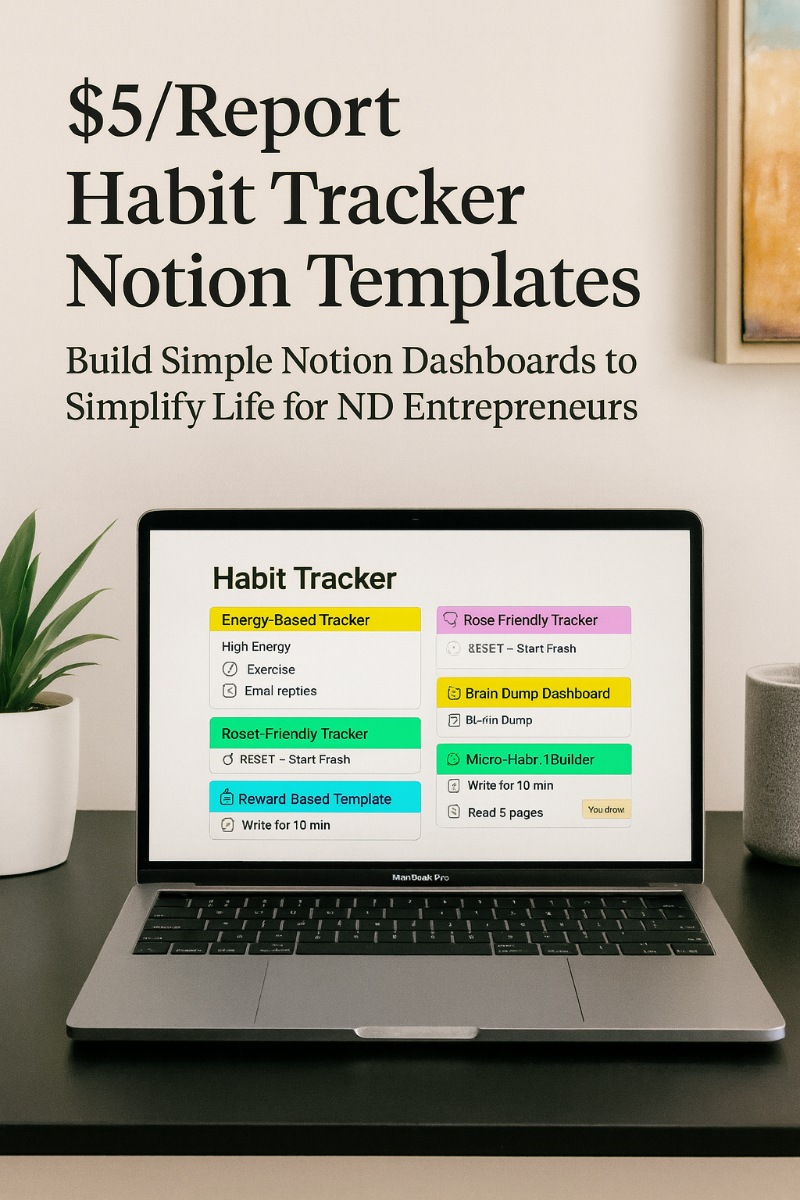
- An Energy-Based Tracker removes the stress of rigid scheduling by letting users choose tasks based on how they feel – high-energy or low-energy.
- A Reset-Friendly Tracker is designed to kill shame spirals, with one click to start fresh when yesterday fell apart.
- A Brain Dump Dashboard gives a safe space to unload mental clutter, then drag-and-drop tasks into order later, so overwhelm doesn’t win.
- A Micro-Habit Builder focuses on ultra-small wins like “Drink water” or “Open laptop,” giving constant dopamine boosts instead of impossible streaks.
- Even a Reward-Based Template that unlocks affirmations or memes after tasks taps into novelty and fun, which ND brains crave.
Each one solves a unique friction point that generic planners ignore – and that’s what makes them magnetic to neuro-diverse entrepreneurs.
Looking good! Let’s now really get you ready via:
Your 10 Step Action Plan
Step 1: Research ND Struggles
You cannot design a brain-friendly tool without first understanding the pain. Spend a few hours browsing communities like r/ADHD, r/Autism, and r/Entrepreneur. Look for the rants – “I lose momentum if I miss a day,” “I start fresh but crash by Wednesday,” “Tracking feels like another job.” Those complaints? They’re your blueprint.
Save the most common struggles into a doc. Then categorize: “needs forgiveness,” “needs dopamine,” “needs visual clarity.” This is the raw gold that shapes your template features. You are not guessing – you are building solutions for problems they’ve already screamed into the void.
Step 2: Build a Skeleton Dashboard in Notion
Open Notion and resist the urge to overcomplicate. ND-friendly templates thrive on simplicity. Create a base dashboard with three sections: Habits, Brain Dump, and Reset. Add a few placeholder tasks like “Drink water” or “Send invoice.” This skeleton is your foundation.
Focus on navigation. Can a user tell what to do in three seconds or less? If not, strip it back. ND entrepreneurs often abandon tools that feel overwhelming. Your skeleton should feel like a gentle invitation, not a homework assignment.
Step 3: Add Micro-habits
Now break everything down into snack-sized tasks. Forget “Write a blog post.” Replace it with “Open draft,” “Write headline,” “Type 100 words.” Each one is tiny enough to finish quickly. Micro-habits create dopamine hits with every checkmark.
Sell this as your unique angle. Call it “bite-sized success tracking.” ND buyers will love that your template is designed to celebrate progress instead of punishing failure. Bonus: micro-habits also make the template look fuller, which feels more valuable.
Step 4: Create Reset Buttons
Here’s your million-dollar feature. Add a simple toggle, button, or formula that lets users reset streaks instantly. Label it “RESET – Start Fresh.” No shame. No guilt. Just a clean slate in one click.
Why? Because ND brains often quit when they miss a day. The streak breaks, motivation tanks, and the tracker gathers dust. By baking forgiveness into your template, you make it sustainable. Market this as “the no-shame restart button.” It will resonate hard.
Step 5: Insert Dopamine Rewards
Gamify it! Link completed tasks to GIFs, emojis, or silly affirmations. Example: check “Workout” and a dancing otter pops up. Check “Invoice sent” and you get “Future You is rich!” in neon letters. These tiny surprises keep users coming back.
Do not underestimate this. ND entrepreneurs thrive on novelty and reward. Your template should feel like a slot machine that spits out joy instead of coins. Every checkmark becomes a dopamine drip – that’s addictive in the best way.
Step 6: Style for Sensory Needs
Create two versions of your template. One bright and colorful with playful icons for stimulation-seekers. One muted and minimalist for sensory-sensitive users. Give buyers the choice.
Why both? Because the ND market is not one-size-fits-all! Some brains light up at color explosions. Others shut down. By offering both, you double your customer pool. Package them together as a bundle to increase order value.
Step 7: Test Your Templates
Use them yourself. Seriously. Run your template for a full week. Notice where you stumble. Did you avoid a section because it felt confusing? Did the reset button feel clunky? Fix it before you launch.
Then recruit 2 – 3 ND friends or colleagues for beta testing. Give them free copies in exchange for blunt feedback. Their input will highlight blind spots and give you testimonials to paste into your Gumroad page.
Step 8: Package for Gumroad
Polish matters. Do not just dump a Notion link. Create a neat package: the template link, a short PDF quick-start guide, and maybe a bonus like a set of icons. Add a clean cover image designed in Canva.
Your Gumroad description should focus on feelings, not features. Instead of “Includes a weekly brain dump box,” write “Finally, a safe place to throw all your random thoughts so they stop circling your head.” Sell the relief, not the checkbox.
Step 9: Make a Demo Video
Open Loom and record a 2 – 3 minute walkthrough. Show how the reset button works. Show a dopamine GIF popping up. Show the calm of the minimalist version. Keep it casual and human – ND buyers will connect with authenticity, not polished perfection.
Post the video directly on your Gumroad page, then slice shorter clips for TikTok, Instagram, and YouTube Shorts. The video sells the experience better than text ever will.
Step 10: Launch at $5 and Scale
Start with a single $5 template. That’s your beachhead. Once you make your first sales, expand. Offer bundles: $17 for a 3-pack, $27 for the bright + calm + bonus version. Add premium workshops (“How to Use Notion to Finally Stick With Habits”) at $47 – $97.
Scaling also means licensing. Let coaches or therapists buy bulk rights to share your templates with their clients. Gumroad makes this simple – just create a higher-priced tier. Suddenly your $5/day system is a $500/week machine.
5 Super Creative Tips
-
Build a Meme Pack Add-On
ND folks love humor. Create extra packs of funny memes or affirmations that plug into your template. Example: “I drank water today” unlocks a cat with sunglasses. Sell the meme packs as $2 – $5 upsells. -
Make Theme Packs
Offer seasonal versions – Halloween trackers with pumpkins, New Year’s with fireworks, spring with pastel flowers. ND entrepreneurs crave novelty, and swapping trackers keeps engagement alive. Release quarterly for recurring sales. -
Add a Co-Working Dashboard
Design templates that track group accountability sessions. Entrepreneurs can log what they did during co-working. Market these to online mastermind or ADHD accountability groups. -
Bundle With Printable PDFs
Some ND buyers prefer physical backups. Export simplified versions of your Notion dashboards as printables. Bundle both digital + printable for a higher price point. -
Hide Easter Eggs
Gamify your template. Example: complete all tasks for 7 days and a hidden toggle reveals a “Legendary Streak Winner!” badge. Buyers will talk about it online, giving you word-of-mouth marketing.
5 Excellent Ways to Get in Front of Customers
-
Reddit Communities
Reddit is gold if you respect the culture. Don’t waltz in with “Buy my thing.” Instead, share actual lived experience: “I built a reset button in Notion because I hated streak-breaking apps.” Then link your Gumroad when people ask. Your product will spread because it solves the exact problems they complain about daily. -
TikTok/Instagram Reels
ND buyers live on short-form video. Record 30 – 60 second clips demoing your template. Show a reset button in action. Show a dopamine GIF firing. Add captions like “Finally, a tracker that forgives you when you miss a day.” End with your Gumroad link in bio. TikTok’s algorithm loves visually satisfying tools. -
Facebook ND Groups
These groups are hungry for practical solutions. Show up first as a contributor. Drop helpful posts like “3 tricks I use to restart my routines after a meltdown.” Once people resonate, casually share your Gumroad link. You’re not selling – you’re handing over a resource. -
Email Signature
This is the slow-burn strategy. Add a one-liner under your email: “Finally, a habit tracker built for neuro-diverse brains → [Gumroad link].” Every email, from casual chats to business deals, becomes subtle advertising. Over months, it drives steady trickle-traffic. -
YouTube Shorts
YouTube has staying power. Post short “how-to” clips showing your tracker in action: “How I restart habits when I miss a day.” People searching for ADHD or productivity tips will stumble across your video months later. Each view is a chance for a sale – long after you uploaded.
Your Next Steps
You’ve got the full plan. Now it’s about action!
Start by designing one simple tracker: Reset button, energy categories, and a dopamine GIF. Package it, post it on Gumroad, and share a short demo video. That’s your proof of concept.
Then, expand. Add bundles, seasonal packs, meme packs. Rotate fresh designs so buyers always have something new to grab. Each variation is another little $5/day machine running in the background.
Finally, stay visible. Post demos on TikTok, Shorts, and Reddit. Answer questions in groups. Share your own ND struggles honestly. When people see that you “get it,” they’ll trust your templates – and trust buys.
You’re not just selling habit trackers. You’re selling momentum, forgiveness, and joy for people who desperately need it. And in return, you’re stacking $5/day into something far bigger.
You’ve got this!
Enjoy.