Introduction
Somewhere on a hard drive right now – possibly yours, quite honestly – there’s a digital product that someone poured real effort into. It sold okay for a while but then?
Then the market shifted, the tools changed, and the screenshots started looking like they were taken on a flip phone from 2009! The creator stopped promoting it. The sales page went quiet. The whole thing got shoved into a folder called “old stuff” and promptly ignored like last year’s gym membership, alas.
But!
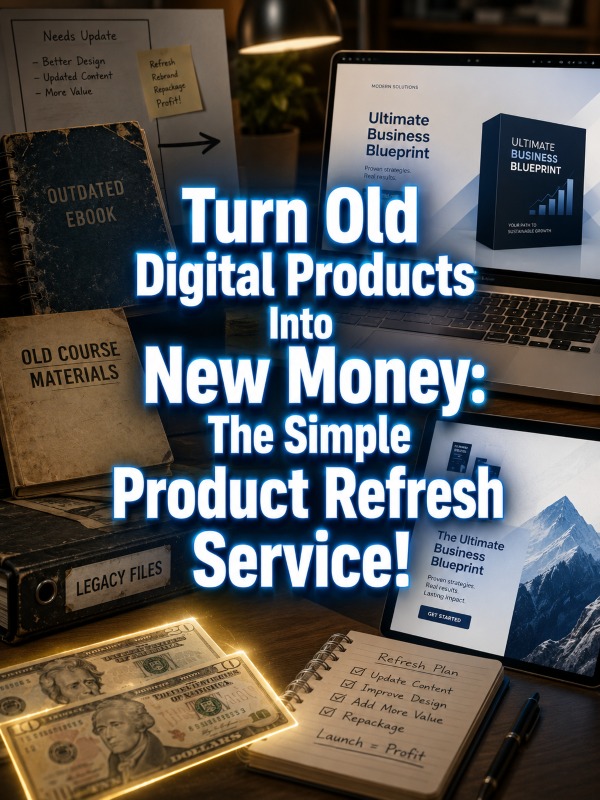
That forgotten folder is YOUR opportunity. You don’t have to create products from scratch to build a real income with digital content; you just have to know how to take something that already exists – something with a proven concept and a real audience – and make it relevant once more. That’s the product refresh service, and it’s one of the most underestimated money-making opportunities sitting right in front of you right now today.
Quick Answer
A product refresh service means you take existing digital products – ebooks, courses, templates, guides – that have gone stale and update them for today’s market. You modernize the content, swap out dead tools and outdated screenshots, and hand the creator back something they can actually sell again.
Clients pay anywhere from $150 to $800 per refresh depending on scope, and most creators have more than one product sitting all lonely-like in that “old stuff” folder, collecting digital dust and dreaming of bygone glory days.
You don’t need to be a designer or a developer to do this well. Instead, you need solid research skills, a working knowledge of current tools, and the ability to spot what’s outdated versus what still holds up. The creators you’ll work with already trust their content – they just need someone to dust it off and point it at this years’ buyers instead of 2018 ones. That someone could absolutely be you!
Why This Niche Works
The digital product market has been running full speed for over 25 years. That means there are bazillions of products floating around in various stages of obsolescence – and the people who created them are often too close to the work, too busy, or just too exhausted to tackle the refresh themselves. After all, they’re busy making money! And they know their course needs updating; they’re just not doing anything about it because sleeping every 63 hours is a Good Thing.
That gap between “I know this needs fixing” and “I actually fixed it” is where your business lives.
There’s also a trust factor here that makes this easier to sell than starting from nothing. When you approach a creator about refreshing their existing product, you’re not asking them to gamble on something new, no.
Instead, you’re offering to fix something they already believe in! That’s a much shorter sales conversation – like the difference between convincing someone to try a new restaurant versus asking if they want dessert at a place they already love. Creators with an existing audience and an outdated product are highly motivated buyers, and they exist in every niche from marketing to cooking to personal finance to dog training to wood carving to moose wrangling and beyond.
Prior to pouncing upon this opportunity, you should first know all about the:
Tools You’ll Need
You don’t need an expensive toolkit to run this service. Most of what you need either has a free tier or costs less than $30 a month! The key is knowing which tool does which job so you’re not spending Tuesday afternoons figuring out Sumerian software when you should be doing actual client work. Consider the following idea:
- Start with Canva for visual updates – new covers, updated graphics, refreshed slide decks.
- Use Google Docs for content editing and client collaboration, since it’s free and most creators already use it.
- Loom is essential when you need to record walkthrough videos showing clients exactly what you changed and why – and trust me, they love those!
- For project management, Trello keeps your refresh checklists and client deliverables organized without turning into a second job.
- Grab a copy of The Chicago Manual of Style for content consistency – it’s the kind of reference that makes you look like you’ve been doing this for decades.
- If you’re updating course content, Teachable and Thinkific are the two platforms you’ll encounter most often.
And when a product comes bundled with email sequences – they often do – you’ll want solid working knowledge of AWeber and GetResponse so you can update those deliverables as well without breaking anything.
Next, move to:
Your 5-Step Action Plan
These five steps take you from zero to delivering your first paid refresh. They’re in order for a reason – skip step two and you’ll quote a project you understand less than deconstructing thermal detonators, which is a special kind of chaos that nobody, absolutely NOBODY, needs.
Step 1. Build Your Refresh Audit Checklist
Before you pitch a single client, you need a standardized way to evaluate any product you might be asked to refresh. After all, your audit checklist is what separates a professional service from someone who’s just making it up as they go! It should cover at least 6 core areas: content accuracy, tool references, screenshots and visuals, platform compatibility, pricing and resource links, and overall reading level and tone.
Think of it like an X-ray machine – clients can’t see what’s broken, but you can use your very own Super Hero Xray Eyes (otherwise known as your ver own SHXE) to save the day.
Build this in Google Docs so you can duplicate it for each new client project. A solid checklist runs 28 to 35 line items and takes about 90 minutes to work through a standard ebook or short course. When you hand a client their completed audit, you’re showing them exactly what the refresh will fix – and that document alone often closes the sale before you’ve even quoted a price! It’s the kind of thing that makes people say “oh, wow, okay, yes, let’s do this so it’s no longer terrorizing me by hanging over my head.”
Step 2. Find Your First Three Clients
You don’t need a website, a logo, or a carefully curated Instagram presence to land your first client. Instead, you need to go where creators with existing products already are! Think, say, WarriorPlus, JVZoo, Gumroad, and Udemy.
You can sort by products that haven’t had a significant update in 18 months or more, or look for sales pages with outdated screenshots, references to tools that have changed dramatically or disappeared entirely, or bonus resources pointing to non-existing links.
Those 2 searches should
When you reach out, be specific. “I can help with your business so please fling your wallet open at me!” lands straight in the trash. But “I reviewed your [product name] and noticed 6 specific things that are probably costing you sales right now – here’s one example” gets read! Lead with one (just 1) concrete observation that proves you actually looked at their work.
That approach alone often gets replies because you’ve already shown them the problem that actually exists before they’ve even asked about the solution.
Step 3. Run Your First Paid Audit
Charge $37 to $67 for a standalone audit. Remember, this is NOT a “get your foot in the door” freebie – it’s a real deliverable with real value, and it funds your time whether or not the client moves forward with a full refresh. The paid audit creates commitment on their end and gives you full access to the product so you can do a thorough job sooner should that full refresh order comes through.
Deliver the audit as a Google Doc with a clear executive summary at the top – three to four sentences on the overall state of the product, followed by your full checklist with specific notes on each item. Finish with a prioritized recommendation list: what to fix first, what can wait, and what’s still genuinely working well. And the good, no, AWESOME news?
Most clients who receive a thorough audit will want you to handle the actual refresh!
Step 4. Deliver the Full Refresh
A full product refresh can have four deliverables: updated content document, refreshed visuals, revised resource and tool list, and a one-page summary of every change you made. The content update is the heaviest lift – you’re fact-checking every claim, replacing dead links, swapping outdated tool references, and modernizing the examples without changing the creator’s voice. That last part matters more than people often realize; you’re NOT rewriting their book, you know.
You’re making their book relevant again.
Thus, set a written scope before you start a single task.
“Update all screenshots to reflect current platform UI, replace references to [discontinued tool] with [current alternative], and refresh the bonus resource list” is a scope.
“Make it better” is a support ticket waiting to happen.
Such things are not Good Things whatsoever; scope creep is how a 5-day project turns into three weeks of unpaid overtime. Use Trello to track every task and send the client a brief weekly update so they never have to wonder whether anything is happening.
Step 5. Build Your Recurring Revenue System
One refresh is a paycheck. A recurring system is a business! After you’ve delivered a strong refresh, the smartest way to create ongoing income isn’t a monthly retainer – because a product that just got refreshed doesn’t need monthly attention. What the creator needs is a package deal for their next product instead.
Here, offer a “Product Library Refresh Bundle” where you commit to refreshing 3 products over the next 6 months at a discounted total rate. Creators with multiple products love this because it solves a problem they’ve been procrastinating on, and you love it because the work is already lined up without hunting for new clients.
You can also productize the audit itself as a standalone offer. Create a fixed-price “Digital Product Health Check” at $57 and list it on Gumroad; then mindfully promote it in creator communities, email lists, and Facebook groups (but become a valued member first!). When someone buys the health check and sees what’s actually wrong with their product, your full refresh service becomes the logical next conversation – not a pitch, just the obvious answer to a problem you just helped them see clearly and with precision.
Next, here’s the thing. You’re probably NOT the only person offering this service, unfortunately. So you now require:
3 Ways to Stand Out From The Thundering Herd!
Most people who drift into this kind of service position themselves as generalists who “update digital content.” That’s roughly as distinctive as a restaurant menu that just says “food.” But you?
You stand out by being specific, having a system, and showing up like someone who’s done this more than once – even when you’re just getting started.
Way 1. Specialize in One Niche First
Pick one content niche for your first 90 days – marketing, personal finance, health, or any area where you already have real background knowledge. When you specialize, your audit checklist gets sharper, your research takes less time, and you can speak to creators in their own language without sounding like you googled everything on the way to the call! After all, a marketing course creator doesn’t want a generalist.
They want someone who already knows the difference between what’s evergreen and what aged like a carton of milk left on the counter!
After you’ve completed 4 refreshes in one niche, you’ll have developed pattern recognition that speeds up every project after it. You’ll know which tools keep changing, which platforms generate the most complaints, and which types of content age the fastest. That knowledge compounds into a genuine competitive advantage that a generalist simply can’t replicate – they’d have to start over in every new niche while you’re already running on your second lap.
Way 2. Offer a Risk-Reversal Guarantee
Offer one free revision round if the creator doesn’t feel the product is significantly improved after delivery. This sounds terrifying until you realize that a well-scoped refresh backed by a thorough audit almost NEVER needs a revision round – because you already identified every problem before you started fixing anything in the very beginning.
The guarantee isn’t really about protecting against refunds; it’s about removing the hesitation a creator feels before saying yes to a $400 project from someone they met last Tuesday.
Put the guarantee right on your outreach message and your project proposal. It signals that you stand behind your work, which immediately separates you from the freelancers who deliver a file and then vanishes like a WiFi signal during a thunderstorm. Creators talk to each other constantly, and a reputation for standing behind your work spreads fast through small online communities where everyone seems to be in the same three Facebook groups.
Way 3. Deliver a Before-and-After Video Walkthrough
When you deliver the finished refresh, record a 6-to-8 minute Loom walkthrough showing the creator exactly what changed and why. Walk through the old version and the new version side by side. Point to specific updates – this screenshot replaced that one, that tool reference was swapped because the original tool shut down in 1822, this section was rewritten because the stat it cited was from a study that’s since been retracted. Make every change visible and intentional.
Creators genuinely love this because it makes them feel involved in the process even though you did all the actual work. It also functions as an internal handoff document – if they have a team or a VA who’ll be managing the updated product, the video tells them everything they need to know. More than a few clients will ask you to include this video on every future project.
Make sure that answer is always yes! It generally takes around 8 minutes and it makes your work look twice as thorough as it already is.
Once you’ve figured out all of the above, the next step is implementing:
3 Nifty Ways to Find Customers
The good news is that you don’t need paid ads, a big social following, OR a cold email sequence with 11 follow-ups to find your first paying clients. The buyers for this service are already concentrated in specific, findable places – and they’re NOT hiding. They’re posting in communities, listing products on marketplaces, and talking openly about the fact that their old stuff isn’t converting the way it used to.
Those kinds of convos are just like lighting up the Bat Signal in Gotham City. Very effective indeed!
Way 1. Mine Product Marketplaces Directly
WarriorPlus, JVZoo, and Gumroad are goldmines for this. Sort by products that launched more than 18 months ago and still have active sales pages. Then look at the screenshots – if they show interface designs that platforms have since updated completely, congrats! You’ve found a real live lead. Look at the tool recommendations – if they reference software that’s been discontinued or acquired and folded like digital origami into something else, you’ve found another one. Rejoice!
Then build a spreadsheet of 20 to 30 solid prospects before you send a single outreach message.
When you DO reach out, lead with one (just 1!) concrete, specific observation about their product – NOT a generic compliment and NOT a vague “I can help.”
Instead, consider something like “I noticed your course still shows the old Canva dashboard from before the 2023 redesign – new buyers trying to follow along will get lost at the very first step.” That’s a message that gets opened and read and pondered upon. It proves you actually looked, it names a real problem, and it makes the creator feel like you’re already working on their side before they’ve agreed to a single thing.
Way 2. Show Up in Creator Communities
Facebook groups, Skool communities, and Reddit forums where digital product creators spend time are full of people saying some version of “I know I need to update my old course but I just don’t have the bandwidth.” That’s a client waiting to happen! You don’t need to pitch aggressively in those moments – respond helpfully, let them know this is exactly what you do, drop a link to your audit offer, and move on.
Low pressure, high value, and the interested ones will follow up on their own schedule.
Consistency matters much more than volume in communities. Show up three or four times a week, answer questions about content updates and tool changes, and let people see over time that you DO know what you’re talking about. After 30 days of genuine participation, you won’t need to pitch anyone directly – people will start tagging you the moment someone else mentions they need a refresh, because you’ve quietly become the obvious person for that particular job.
Way 3. Partner With Launch Managers and VAs
Launch managers and virtual assistants who work with digital product creators run into the same problem on a regular basis: a client wants to relaunch something old, and it needs real work before it’s ready to go back out into the real world.
Not only that, but they can’t always do the content refresh themselves, and honestly they don’t even want to.
If you build referral relationships with 3 to 4 launch managers or VAs who work in your niche, they’ll send you qualified leads consistently because you’re solving a problem they keep bumping into with their own clients (who will remember them favorably because they introduced them to you!).
Offer a referral fee – 10 to 15 percent of the project value is standard and expected. Make it genuinely easy for them to refer by giving them a one-page PDF that describes exactly what you do, who you do it best for, and what the process looks like from the client’s side. The more specific your ideal client description, the better the referrals you’ll receive. A VA who manages 6 digital product creators and knows your exact criteria will send you far better leads than a general post in a Facebook group full of 400 people who mostly lurk or post memes from the 1920s.
What else should you know? How about:
3 Takeaways You Won’t Find Elsewhere!
These aren’t feel-good reminders – these are specific thingees that separate people who build a real, sustainable refresh service from people who try it twice, don’t gain traction, and blame the model before the model ever had a fair chance to actually work.
Takeaway 1. The Audit Is the Product
Most freelancers treat the audit as a free discovery call dressed up in a Google Doc.
But when you charge for it properly, three things happen at once: you filter out people who aren’t serious, you fund your research time regardless of what happens next, AND you hand the client something tangible to hold before they commit to a larger project. A client who pays $57 for your audit and receives a thorough 30-item analysis has already experienced your quality firsthand – the full refresh stops being a leap of faith and starts being the obvious next move.
Treat the audit as a real standalone product with real positioning. Give it a specific name – “The Digital Product Health Check” communicates exactly what it is without requiring any additional explanation. Put a fixed price on it and then list it on Gumroad so it can be found without you actively promoting it every day. The audit should be able to sell itself without you personally in the room; that means it needs a clear description, a defined deliverable, and a concrete promise about what the buyer walks away with when it’s done.
Takeaway 2. Old Products Have Built-In Proof
When you refresh a product that already sold 312 copies at $27, you’re NOT starting from zero on social proof. That product has a documented sales history, real testimonials from real buyers, and a creator who can speak credibly to its track record! Your job is to make it worthy of that history again – not to rebuild it from scratch, just to bring it current and up to date. That’s a completely different selling environment than launching something brand new; quite frankly, it’s one of the underrated reasons this service is generally easier to sell than most people expect when going in.
When you’re in the early conversation with a potential client, ask them how many copies their product sold before it went quiet. Then ask what they’d need to update before they’d feel comfortable promoting it again. Those two questions tell you almost everything about the scope and how motivated the creator actually is to move forward.
I mean, a creator who says “it sold 400 copies and I just need the screenshots updated” is a very different project than one who says “it sold 14 copies and I’ve never been sure the core concept was actually correct in the first place.”
It’s better to know which one you’re dealing with before you even consider writing a proposal.
Takeaway 3. Your First Client Is a Case Study, Not Just a Paycheck
Treat your first two or three refresh projects as portfolio builders, even while you’re charging full price for them. Document every step – the before state, the specific changes made, and any measurable result the creator can share with you afterward. If their product went from 1 sale in 3 months to 14 sales in the first 30 days after the refresh went live, that specific number belongs in your outreach messages, your Gumroad listing, and any community post you write about the service going forward.
Specific, documented results close sales faster than any guarantee or pricing incentive you could offer! When you tell a prospect “I refreshed a marketing course that hadn’t converted in 4 months – the creator relaunched it 2 weeks after I delivered, and they recovered 6 times my fee in the first 10 days,” you’re not making a promise about what might happen. You’re presenting evidence of what already DID with another creator.
That’s the entire difference between a freelancer who has to convince people and one who just has to show up and let the track record do the talking for them.
Next, let’s make your future effort a wee bit easier by going over:
3 Common Mistakes to Avoid
Most of the mistakes people make with this service come from moving too fast or scoping too loosely – which is a bit like trying to paint a room while someone keeps adding walls and N-dimensional spaces. The refresh business is genuinely straightforward, but ONLY if you protect your time and set clear expectations before any work starts.
The biggest mistake is starting a refresh without a written scope. “Make it current” is not a scope – it’s an invitation for three weeks of unpaid extra work. You’ll find yourself updating things that weren’t in the original conversation because the creator got excited and kept adding requests.
Thus, write the scope before you start, list exactly what’s included, and have a clear process for handling anything that falls outside of it.
Clients who’ve dealt with unscoped freelancers will probably appreciate your professionalism.
The second most common mistake is underpricing the audit to get your foot in the door. When you charge $12 for an audit that takes 22 hours to do properly, you’re training the client to see your time as nearly free – and that pricing signal follows you into every conversation after it. Charge $37 to $67 and deliver something genuinely thorough and valuable.
After all, a client who paid $57 for your audit will take your $400 full refresh proposal far more seriously than one who paid $12 and wonders why the price jumped so dramatically.
A third mistake is trying to serve every niche simultaneously before you’ve proven the model in even one! It’s tempting to pitch marketing creators on Monday, cooking course creators on Tuesday, and fitness coaches on Wednesday, I know.
But what you’re actually doing is diluting your expertise, your checklist, and your outreach message all at once. That is NOT a Good Thing.
Instead, go deep in one niche, get 4 to 5 completed projects, and only then expand from a position of actual credibility instead of starting over in each new category from scratch.
Not only does this structure your business, it also helps protect your sanity. That alone makes it worthwhile to do!
Speaking of completed projects, now let’s move to:
Scaling Your Results
Once you’ve completed 6 to 8 refreshes and found your rhythm, two clear paths to scaling open up. The first is to raise your prices incrementally as your portfolio grows. A documented case study showing real before-and-after results from an actual product refresh is worth more than any sales page you could write about your services!
Collect those case studies from every single project – even if it’s just a short paragraph from the creator describing what changed after the refresh went live and back on the market. Trust me, you’ll thank me later.
The second path is to bring in a subcontractor for the visual work. If you’re strong on content and research but slower on design, hire a Canva-proficient VA at $15 to $20 an hour to handle the visual refresh while you manage the content work and client communication. That structure lets you take on more projects without attempting to stuff 54 hours into a 24 hour day (without sleep, I might add).
At 4 active clients per month with an average project value of $350, you’re looking at $1,400 a month from refresh projects alone – and that number doesn’t include audit fees, bundle deals, or any of the referral income that starts showing up once you’ve been around for a few months.
Now that you know the above, it’s time for:
Your Next Steps
You do NOT need a website, a professional headshot, OR a 14-step funnel before you start. The fastest path to your first paid client is a checklist, a direct message, and a Google Doc. Everything else – the website, the testimonials page, the polished process deck – can come later, after you have an actual paying client who’s confirmed that this whole thing works.
So.
This week, build your 28-item refresh audit checklist in Google Docs. Then go to WarriorPlus or JVzoo and identify 10 products that launched before January 2023 and still have active sales pages. Then reach out to 5 of those creators with a specific, one-observation message about something concrete you noticed in their product.
Remember, you don’t need to send 50 messages to land your first client – you need to send 5 genuinely good ones to the right people. That’s a big difference!
Let’s now wrap up everything via the:
Final Thoughts
There’s no shortage of digital products that need a second life. The people who created them aren’t always in a position to do the refresh work themselves, and most of them would genuinely rather pay someone who knows what they’re doing than spend 3 weeks staring at outdated screenshots and a blinking cursor and questioning their life’s choices.
The gap between “this needs fixing” and “I actually fixed it” is where your business lives – and it’s a gap that isn’t going away anytime soon.
You don’t need a big audience, a polished website, or a course about freelancing to make this work. You need a checklist, a clear offer, and the willingness to send 5 specific outreach messages to real people this week.
That’s it. That’s your beginning!
The product refresh service is one of those genuinely rare opportunities where the buyers are already motivated before you even reach out, the work is completely doable without a technical background. Plus the whole model gets easier – not harder – as your portfolio grows and grows.
So. Does this sound fascinating to you? If so, go out and uncover your first outdated product. It’s sitting right there on someone’s hard drive, waiting for exactly what you’re about to offer.
Enjoy!