Introduction
Diamond painting starts out innocently enough with one kit, a few packets of drills, and the cheerful belief that you will definitely finish everything you buy. Then the kits multiply, the drills develop mysterious personalities, and suddenly you have containers, bags, trays, tools, spare diamonds, and unfinished canvases scattered around your craft space. That’s Not a Good Thing when you need one particular color and have absolutely no idea where you put it.
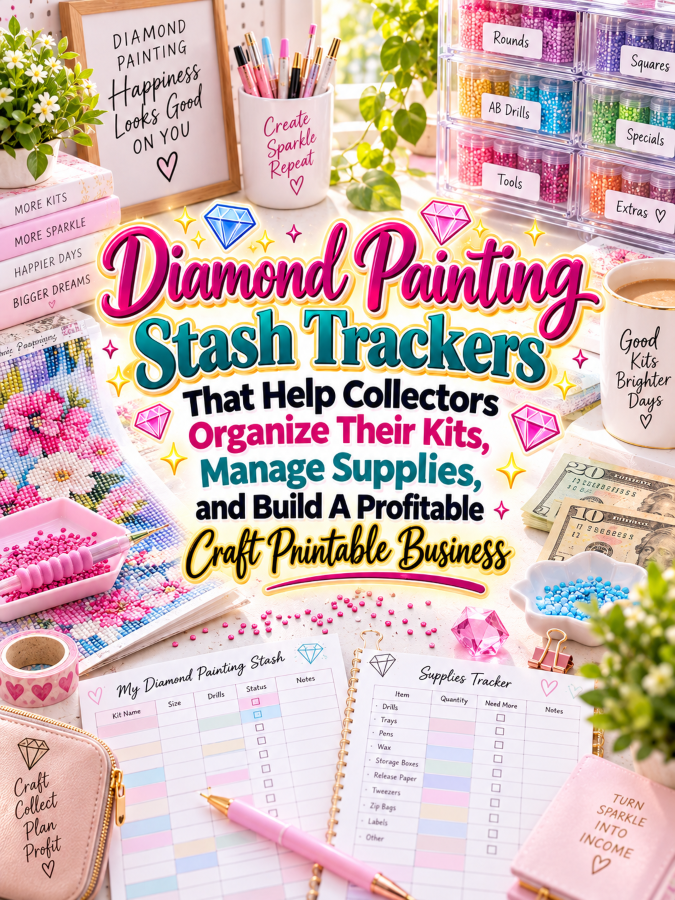
That’s exactly why diamond painting stash trackers can become such useful printable products. A well-designed tracker gives collectors a simple place to record their kits, drills, accessories, unfinished projects, and supplies without making organization feel like another chore. Better yet, the same idea can grow into a complete product line for beginners, serious collectors, and diamond painters who sell finished artwork or create content around the hobby.
You don’t need to create a giant 100-page binder on your first attempt either. Start with the information diamond painters actually need, make it easy to fill out, and then expand based on the problems your audience wants solved. Trust me, you’ll thank me later when your product doesn’t require a table of contents just to find the page for purple drills.
Quick Answer
A Diamond Painting Stash Tracker is a printable organization system that helps collectors record and manage their diamond painting kits, drills, canvases, accessories, and works in progress. You can create pages for kit inventories, drill colors, storage locations, project status, missing supplies, finished pieces, and future projects. The key is to make the tracker useful enough that collectors want to keep using it as their stash grows.
You can start with a $7 basic stash tracker and then expand it into higher-value products such as a $17 expanded organizer, $27 workbook, $47 binder system, and $77 comprehensive diamond painting library. Companion products can include drill inventory sheets, WIP trackers, project planners, storage labels, completion logs, and collector record books. That’s a Good Thing because one useful product can become the foundation for an entire niche product ladder.
Why This Niche Works
Diamond painting is a hobby where physical supplies can accumulate surprisingly quickly. Collectors may have unopened kits waiting for their turn, multiple active canvases, leftover drills from completed projects, replacement tools, storage containers, and accessories collected because they looked useful at two o’clock in the morning. Without a simple tracking system, remembering what they already own can become harder and harder.
That creates several natural problems your printable can solve. A collector may want to know whether they already own a particular kit, where a specific color of drills is stored, which project is currently active, or which supplies need replacing. When your product answers those questions quickly, you’re selling organization and convenience rather than simply selling a collection of pretty printable pages.
The niche also gives you plenty of opportunities to create specialized products. Beginners need simple kit trackers, experienced collectors may want detailed stash systems, and serious hobbyists may want drill inventories and project histories. You can also create products around storage, completion tracking, gift planning, challenge participation, and craft-room organization.
What You Can Put Inside A Diamond Painting Stash Tracker
1. Diamond Painting Kit Inventory
The kit inventory should be one of the main sections because collectors need a quick way to see what they own. Include fields for kit name, design, brand or designer, kit number, size, canvas type, diamond type, purchase date, purchase price, and storage location. Add a status field such as Unstarted, Planned, In Progress, Paused, Completed, or Gifted.
You can also add a small notes section for information such as missing drills, damaged canvas pieces, replacement needs, or special instructions. A checkbox for “Inventory Complete” can help collectors confirm that they’ve recorded the important details. This turns a pile of kits into an actual collection that can be searched, reviewed, and managed.
2. Drill Color Inventory
Drill organization is another major opportunity because diamond painters often accumulate leftover drills from completed projects. Create inventory pages where users can record color numbers, color names, quantity, storage container, and location. You can include separate sections for round drills, square drills, and specialty drills if your audience uses them.
Leave enough room for collectors to update quantities as they use or acquire drills. A simple “Need More,” “Have Enough,” and “Low Stock” system can make the page easier to use than a complicated inventory spreadsheet. The goal isn’t to make collectors count every tiny diamond under a microscope while questioning their life choices.
3. Works-In-Progress Tracker
A WIP tracker helps collectors manage projects that have already been started. Include the project name, kit number, start date, current percentage, current section, storage location, and next action. Add a space for notes about drills, canvas sections, color changes, or problems encountered during the project.
You can also add progress boxes so users can visually mark milestones. For example, they could track 25%, 50%, 75%, and 100% completion or record progress by section. This gives collectors a satisfying reason to return to the tracker while helping them see that the project really is moving forward.
4. Unopened Kit Stash Tracker
Unopened kits deserve their own section because many collectors have a growing queue of future projects. Create pages for kit details, purchase date, price, desired start date, priority, storage location, and planned completion date. Add a “Why I Bought This” field for a little personality because sometimes the answer is simply, “Look at it! It was pretty!”
A priority system can help collectors decide which kits should move from the stash into the active project queue. You could use categories such as Must Make, Seasonal, Gift Project, Challenge Project, and Someday. This transforms a collection from a random pile into a manageable project pipeline.
5. Diamond Painting Tool Tracker
Diamond painting isn’t just about kits and drills because collectors can accumulate pens, trays, multiplacers, wax, putty, tweezers, storage containers, light pads, rulers, labels, and other accessories. Create a tool and accessory inventory page where users can record what they own and where it is stored. Include a quantity field and a “Need to Replace” checkbox for consumable supplies.
This section can become especially useful when paired with a craft-room storage system. Collectors can record which drawer, bin, cabinet, or container holds each item. When they need something later, they have a reference instead of launching an expedition through every craft box they own.
6. Project Cost Tracker
A project cost page can help collectors understand how much they spend on their hobby. Include kit price, shipping, storage supplies, replacement drills, accessories, tools, and other project-related expenses. You can also include a total project cost field so users can compare spending across different projects.
This feature is useful for hobbyists who want better control over their craft budget. It can also become valuable for creators who sell finished diamond paintings or use their projects as part of a content business. Once users begin tracking costs, they have information they can use to make smarter purchasing decisions.
7. Finished Project Library
Finished projects should have a place where collectors can record what they’ve completed and celebrate the work. Include project name, kit information, start date, completion date, size, drill type, framing details, recipient, and notes. Add a space for a photo so the page becomes part tracker and part personal portfolio.
You can include a “Would I Make This Again?” rating and a “Favorite Part” section to make the record more useful. Over time, this creates a visual history of the collector’s diamond painting journey. That’s a Good Thing because finishing a diamond painting deserves more recognition than quietly putting it on a shelf and immediately ordering another kit.
8. Wishlist and Future Project Planner
The final section can help collectors manage what they want to buy next. Create fields for design name, source, price, size, diamond type, priority, and reason for wanting it. Include a space for a product link or reference number so users can find the item again without having to remember where they saw it.
You can also add a “Buy Now,” “Watch for Sale,” and “Maybe Later” system. This gives collectors a simple way to slow impulse purchases while still keeping track of the designs they love. And if they eventually buy the kit, they can move the information directly into their main stash inventory.
Tools You’ll Need
Canva can handle the design work for your tracker, including page layouts, headings, tables, checkboxes, icons, and printable worksheets. You can create a consistent visual style once and reuse it across your entire diamond painting product line. That’s a Good Thing because you don’t want to redesign every page from scratch like a caffeinated squirrel with a deadline.
Google Docs can help you write instructions, organize product content, and create simple planning drafts before moving the finished layout into your design software. It also makes it easy to keep your product copy organized. Use it for the thinking first, then make the final pages pretty.
AWeber can help you build an email list around diamond painting organization and related craft topics. You could offer a free one-page kit tracker as an opt-in and then introduce your full stash organizer to subscribers. Remember, 5 good messages beats 50 generic ones every single time.
GetResponse can support email campaigns, lead magnets, and automated follow-up sequences for your printable business. You could create a short series teaching collectors how to organize kits, manage WIPs, track drills, and reduce duplicate purchases. Each lesson can naturally lead readers toward a related printable.
Gumroad can give you a straightforward place to sell downloadable diamond painting organizers and related printable products. You can start with a small product and add bundles as your catalog grows. This lets you test the market before building a giant digital storefront.
Teachable can be useful if you eventually want to turn your printable expertise into a larger educational offer. You could create a mini-course about organizing a diamond painting stash and include your printable trackers as downloadable resources. That gives you another way to package the same knowledge without creating an entirely unrelated product.
Amazon diamond painting stash organizer research can help you study the kinds of physical organizers, storage systems, labels, and related products already being purchased by the niche. Look for repeated customer problems, common features, and questions in reviews. Those observations can help you design printable pages that solve problems people are already trying to solve.
Your 5-Step Action Plan
Step 1: Choose Your Diamond Painting Collector
Start by deciding exactly who your first product is for. A beginner with three kits needs something different from a collector with fifty unopened canvases and enough drills to fill a small swimming pool. Pick one audience so your first version feels specific instead of trying to please the entire thundering herd.
You could focus on beginners, serious stash collectors, WIP-heavy hobbyists, budget-conscious diamond painters, or creators who sell finished pieces. Once you know your buyer, every page becomes easier to decide. Ask yourself what this particular person needs to find, remember, track, or plan most often.
Step 2: Solve The “Where Did I Put That?” Problem
Build the organizer around the information collectors frequently lose track of. Storage location, kit number, drill color, project status, and unfinished-project details are excellent starting points. If your tracker helps someone locate something in seconds instead of digging through boxes for twenty minutes, you’ve created a clear benefit.
Keep the system simple enough to update regularly. A tracker that is beautiful but annoying to maintain will eventually become another abandoned craft project. That’s Not a Good Thing, especially when your entire product promise is organization.
Step 3: Connect Stash, Supplies, and Projects
Don’t treat the kit inventory, drill inventory, WIP tracker, and finished-project library as completely separate products. Design them so information can naturally move from one stage to another. An unopened kit becomes a planned project, then an active WIP, and eventually a finished project record.
This creates a complete workflow that follows the collector’s actual hobby journey. It also gives you a stronger foundation for a larger product because customers aren’t simply buying individual pages. They’re buying a system that helps them manage their entire diamond painting collection.
Step 4: Turn One Tracker Into A Product Ladder
Start with a $7 Diamond Painting Stash Tracker that includes the most useful inventory and project pages. Expand it into a $17 version with more detailed drill, tool, WIP, and wishlist tracking, then create a $27 workbook with deeper project planning and budgeting pages. Your $47 offer can become a complete printable binder system, while the $77 level can combine the entire collection with specialized trackers and bonus resources.
You can also create companion products that don’t require customers to buy the entire system. A Drill Inventory Pack, Diamond Painting WIP Tracker, Kit Collection Catalog, Craft Room Storage Labels, or Finished Project Journal can each become separate offers. That’s how one idea becomes a product family instead of one lonely PDF sitting in your shop waiting for somebody to notice it.
Step 5: Market The Organization Transformation
Don’t market your product by simply saying, “Here are 30 printable pages.” Show what those pages help the customer accomplish. Talk about finding kits faster, remembering unfinished projects, tracking leftover drills, avoiding duplicate purchases, organizing supplies, and seeing completed projects in one place.
Use before-and-after examples whenever possible. Show the difference between a random pile of kits and a categorized stash, or between an overflowing WIP collection and a simple project queue. Your marketing message should make the transformation obvious because people buy solutions to problems, not just pretty PDFs.
What Comes Next
Once you’ve created the basic Diamond Painting Stash Tracker, the next opportunity is to turn it into a complete collection-management system. You can expand into drill inventories, WIP planners, project cost trackers, tool inventories, finished-project portfolios, storage labels, and seasonal project planners. Each new product can solve another piece of the same collector’s organization problem.
The biggest opportunity isn’t necessarily creating more pages just for the sake of having more pages. It’s creating a system that helps diamond painters understand what they own, what they’re working on, what they want to make next, and what supplies they actually need. That’s it. That’s your beginning!
3 Ways to Stand Out From The Thundering Herd!
Way 1: Create A “Know What You Own” Dashboard
Most stash trackers simply give collectors places to write things down, but you can make yours feel much more useful by giving them a quick overview of their entire collection. Create a dashboard where users can see the number of unopened kits, active WIPs, completed projects, low-stock supplies, and favorite designs at a glance. Suddenly, the tracker isn’t just a pile of worksheets because it feels like a command center for the craft room.
You can add simple checkboxes, totals, category summaries, and monthly update sections without turning the page into a complicated spreadsheet. A collector should be able to open the dashboard and understand the state of their stash in less than a minute. That’s a Good Thing because nobody wants to spend more time organizing diamond painting supplies than actually placing the tiny sparkly things.
Way 2: Add A “Buy or Use What I Have?” Planner
Impulse buying is part of the fun of many hobbies, but collectors may also appreciate a tool that helps them see what they already own before buying something new. Add a decision page where they can record the kit they want, compare it with similar kits already in their stash, check available supplies, and decide whether to buy now, wait for a sale, or use an existing project instead. This gives the tracker a money-saving angle that goes beyond basic organization.
You can make the page especially helpful by including prompts such as “Do I already own something similar?”, “Do I have space for another kit?”, “Do I have the supplies needed?”, and “When do I realistically plan to start it?” These questions don’t tell the customer what to buy because they simply help the customer make a more informed decision. That little distinction can turn an ordinary inventory page into a genuinely practical planning tool.
Way 3: Turn Completed Projects Into A Collection Story
Collectors often remember the finished artwork but forget the details of the journey that created it. Give each completed project a dedicated record where users can document the kit, dates, size, drill type, techniques, challenges, favorite parts, and final destination. Include a generous photo area so the finished page becomes something they may actually enjoy looking through later.
You can also create milestone pages for first completed project, tenth completed project, favorite project, biggest project, fastest project, and most challenging project. These pages add an emotional layer to an otherwise practical organizer. When customers can see their progress over time, your printable becomes part of their hobby history rather than another file sitting quietly in a downloads folder.
3 Nifty Ways to Find Customers
Way 1: Give Away A One-Page Stash Inventory
Create a free one-page kit inventory that collectors can print and immediately use. Include fields for kit name, size, brand, purchase date, storage location, status, and notes so the freebie solves a real problem instead of acting like a tiny advertisement wearing a printable costume. At the bottom, invite users to explore the full stash tracker when they discover that one page isn’t quite enough.
Use the free page to build an email list and follow up with helpful organization ideas. Your emails could cover stash organization, drill storage, WIP management, project planning, and ways to avoid losing track of unfinished kits. The goal is to become useful before asking for the sale because 5 good messages beats 50 generic ones every single time.
Way 2: Create Before-and-After Organization Content
Diamond painting is highly visual, which gives you plenty of opportunities to demonstrate the value of your product. Show a messy collection of kits before organization and then show the same collection categorized by project status, size, theme, or storage location. You can also demonstrate how a collector moves one kit from Unstarted to Planned, In Progress, and finally Completed.
Short videos and social posts can focus on one tiny organization problem at a time. A post about “How to track unfinished diamond paintings” can point toward your WIP pages, while a post about “How to find your spare drills” can introduce your drill inventory pages. You’re not shouting “Buy my printable!” into the internet void because you’re teaching something useful and giving your product a natural place in the conversation.
Way 3: Build Products Around Collector Types
Instead of marketing one generic tracker to everybody, create versions for different types of diamond painters. A Beginner Diamond Painting Organizer can focus on simple kit records and project tracking, while a Serious Collector Stash System can include detailed inventories, storage maps, drill records, and collection statistics. A Diamond Painting Business Planner can then target people who sell finished artwork, create content, or participate in craft markets.
This approach gives you several customer entry points while allowing much of your design framework to remain reusable. You can change the prompts, pages, examples, and bonus sections without rebuilding the entire business from scratch. That’s a Good Thing because scalable doesn’t have to mean complicated.
3 Takeaways You Won’t Find Elsewhere!
Takeaway 1: Track Storage Location, Not Just Inventory
Knowing that you own a kit isn’t enough if you still can’t find it. Add specific storage fields such as Room, Cabinet, Shelf, Bin, Box, Drawer, or Container Number so users can record exactly where each item lives. You can even create a simple storage map page that lets collectors assign codes to physical containers.
For example, a collector could label a container DP-01 and then record that code beside every kit stored inside it. The system becomes much faster once the physical storage labels and digital or printable tracker speak the same language. This is one of those small thingees that can make the entire organizer feel much smarter.
Takeaway 2: Add A “Project Queue” Instead Of Only A Wishlist
A wishlist tells collectors what they want, but a project queue helps them decide what they’re actually going to work on. Create sections for Next Up, Waiting, Seasonal, Gift Projects, Challenge Projects, and Someday. This helps turn a giant stash into a manageable sequence of projects.
You can add priority levels and planned start dates so users can make realistic choices. A collector might decide that one holiday-themed canvas belongs near the top while another enormous project can wait until next year. The result is a system that helps people enjoy their collection instead of feeling overwhelmed by it.
Takeaway 3: Make Your Tracker Useful Before And After The Project
A strong stash tracker can support the entire project lifecycle rather than disappearing once a kit is opened. The collector can record the kit before starting, track supplies and progress during the project, and document the finished artwork afterward. That creates a continuous record from purchase to completion.
This also gives you a natural product structure. The stash section solves the “What do I own?” problem, the WIP section solves the “What am I doing?” problem, and the finished-project section solves the “What have I accomplished?” problem. When one product answers all three questions, it becomes much easier to explain why the complete version is worth buying.
3 Common Mistakes to Avoid
Mistake 1: Making The Tracker Too Complicated
A collector should not need a training seminar before they can record their first kit. Too many columns, tiny writing spaces, complicated codes, and unnecessary calculations can make a simple organizer frustrating. Start with the information users actually need and let optional pages handle the advanced details.
Test every page by imagining that someone is sitting at their craft table with a kit in front of them. Can they understand what to write without reading a giant instruction manual? If the answer is no, simplify the page until the information feels obvious.
Mistake 2: Forgetting Different Kit Types
Diamond painters may work with different canvas sizes, drill shapes, special drills, partial drills, full drills, and other project variations. A tracker designed around only one type of project may leave part of your audience feeling like they were invited to dinner but handed the wrong fork. Give users flexible fields where possible so the system can work with different project styles.
You can also create optional pages for specialty drills, custom projects, poured glue versus double-sided adhesive canvases, or other categories your audience commonly uses. Don’t overload the basic product with every possible variation, though. Put advanced features into bonus sections or higher-tier products so the starter version stays approachable.
Mistake 3: Selling Pages Instead Of A Result
Customers don’t wake up thinking, “I desperately need twelve beautifully formatted inventory pages today.” They think, “Where is that kit?”, “Do I already own this design?”, “Which project should I work on next?”, or “Where did I put those drills?” Your marketing needs to connect the printable to those real-life frustrations.
Show customers what changes after they use your system. Explain how they can find supplies faster, see their project queue clearly, avoid duplicate purchases, and keep a record of finished artwork. When you sell the result instead of the page count, your product has a much stronger reason to exist.
Scaling Your Results
Once your core Diamond Painting Stash Tracker is working, build specialized add-ons around the problems your audience keeps mentioning. You could create a Drill Inventory System, WIP Tracker, Diamond Painting Storage Planner, Kit Collection Catalog, Finished Project Journal, Challenge Tracker, and Diamond Painting Budget Planner. Each product can stand alone while also working as part of the larger system.
Your product ladder can begin with a $7 Diamond Painting Stash Tracker containing essential inventory pages and then move to a $17 Expanded Stash Organizer with additional project and supply pages. The $27 level could become a complete Diamond Painting Collection Workbook, while the $47 level could include a printable binder system with storage labels, indexes, dashboards, and project records. At $77, you could bundle the complete collection into a comprehensive Diamond Painting Organization Library with specialized packs and future-use bonus pages.
You can also create themed collections that target specific moments in the customer’s hobby. A Diamond Painting Challenge Planner could help users organize monthly or yearly challenges, while a Holiday Gift Project Planner could help them manage handmade gifts and deadlines. A Craft Room Organization Pack could combine storage maps, container labels, inventory sheets, and supply checklists.
A collection containing 40 well-designed diamond painting organization products could potentially generate an additional $700 to $2,200 per month through bundles, repeat customers, memberships, and complementary offers, although actual results will vary based on traffic, pricing, product quality, audience fit, and marketing. The important part is that every new product should solve a different problem or serve a clearly different use case. Otherwise, you’ve just created the same thingee forty times and changed the font.
Your Next Steps
Start by building one focused $7 product that solves the biggest stash-management problem. Include a kit inventory, unopened-kit tracker, WIP tracker, storage-location fields, and a finished-project record so the customer can manage the basic journey from collection to completion. Keep the design clean, printable, and easy enough that someone can start using it immediately.
Next, test the product concept with free content and a small lead magnet. Create a free kit inventory sheet, demonstrate how to use it, and invite collectors to see the complete system when they want more organization. Pay attention to the questions people ask because those questions can reveal your next products.
Then begin building your product ladder one useful step at a time. Add drill inventory pages, storage labels, project queues, challenge planners, budgeting sheets, and finished-project journals based on real customer needs. You don’t need a thundering herd of products on day one because one genuinely useful product can become the seed for the whole garden.
Final Thoughts
Diamond painting collectors often don’t need more motivation to buy another kit because motivation is usually doing just fine. What they may need is a better way to understand the collection they’ve already built, remember where things are stored, manage unfinished projects, and enjoy their progress. That’s where a well-designed stash tracker can become much more than a printable inventory sheet.
The strongest opportunity is to build around the collector’s complete journey. Start with what they own, help them decide what comes next, support them while they’re working, and give them a place to celebrate what they’ve finished. That creates a product customers can return to repeatedly as their collection grows.
You can also turn the same foundation into a full printable business by serving different collector types and different problems. Beginners can get a simple starter organizer, serious collectors can get advanced inventory systems, and experienced makers can get business-focused planning tools. The products become connected without becoming carbon copies of one another.
Remember, the goal isn’t to create the biggest tracker in the thundering herd. The goal is to create the tracker that makes a collector say, “Finally, I know where everything is.” That’s a Good Thing, and that feeling is exactly what your product should deliver. If you were creating your first diamond painting stash tracker tomorrow morning, what would you help collectors organize first: their unopened kits, drill stash, works in progress, or finished projects?
Enjoy!