Introduction
Let me paint you a picture (pun absolutely intended). You’re sitting in your kitchen. The coffee is lukewarm, your printer has that “use me or lose me” glare, and your walls look like they were decorated by a monk who took a vow of boring. But then – like lightning in a thunderstorm of opportunity – you discover the magical world of DIY printable wall art.
This is the kind of business that whispers sweet nothings to your bank account. No inventory. No shipping. No sweatshop hours folding bubble wrap. Just you, a little creativity (or a lot of copy-and-paste), and a storefront where customers practically throw digital dollars at you for making their walls look less tragic.
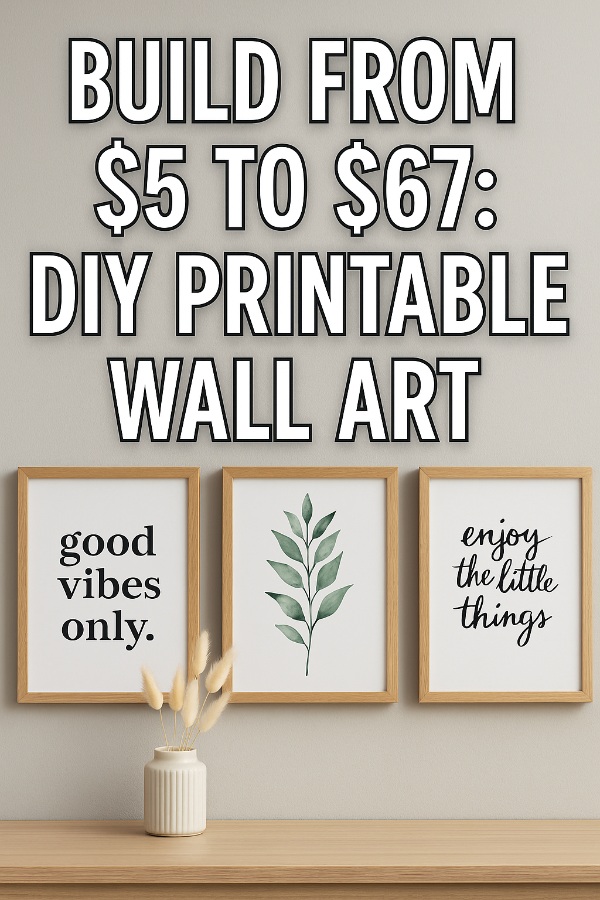
People will pay $5 for a printable file they can download instantly. And here’s the kicker – they’ll also pay $67 for you to “pretty please” resize it, customize it, or ship it to them on canvas. That’s the price leap. That’s the profit jump. That’s how you turn pixels into paydays.
What This Report Is
This is not some highfalutin art school lecture where you’re forced to say things like “the juxtaposition of brush strokes demonstrates existential dread.” Nope. This is a blueprint. A blueprint that shows you how to crank out digital art files that look fantastic, sell like pumpkin spice lattes in October, and make you money without leaving your pajamas.
You’ll see the tools you need. The exact 10 steps to start. Five money-making angles. Creative tips to stand out. And ways to get buyers to notice you without spamming like a raccoon breaking into garbage bins. But first, let’s check out some tools you might know.
Tools You Need
-
HP DeskJet 4155e – A basic printer that keeps you in business if you decide to test-print at home. Affordable, compact, and good enough for mockups.
-
Epson Premium Presentation Paper – The kind of paper that makes your art look like “gallery chic” instead of “printed at the DMV.” Crisp, heavy, professional.
-
Canva Pro – Your design hub. You can start free, but Pro gives you fonts, mockups, and templates that save hours.
-
Placeit Mockup Generator – Shows your art on walls, frames, bedrooms, nurseries – buyers need to see it in their space.
-
External Hard Drive – Because losing your designs is like dropping lasagna on a white rug. Protect your files, protect your sanity.
So what do you do NOW? Move now to:
Your 10 Step Action Plan
Step 1: Pick Your Vibe
Before you even open Canva, you need a “why would someone hang this on their wall?” direction. Random clipart won’t cut it. Buyers want a theme they can latch onto and brag about. That’s why farmhouse quotes, nursery animals, and boho abstract splashes are goldmines – they fit into a lifestyle. Picking a vibe keeps you from selling “random floating shapes” and instead makes you the go-to seller for that style. Think of it like walking into Target – everything has a look. You want that.
Your vibe is your brand’s heartbeat. Do you want to sell sarcastic kitchen quotes like “Alexa, clean the dishes”? Or pastel baby animals that melt hearts faster than a Hallmark movie marathon? Or maybe bold motivational posters that scream “GET UP AND WORK” without having to scream at all? Choosing a lane makes everything else easier – your keywords, your mockups, your bundles. Buyers start to see you as that shop, the one that nails their personality every time.
Step 2: Open Canva (aka your secret weapon)
Forget Photoshop unless you love endless updates and watching YouTube tutorials just to rotate text. Canva is like design training wheels that still win races. Open it, click “Create a Design,” and choose 8×10 inches. Why 8×10? Because that’s the IKEA and Target frame standard. Your art slides in, the buyer feels genius, and you get the sale. It’s the small detail that makes you look pro.
Canva also hides treasures in its templates. Don’t just stare at a blank screen like it’s your high school algebra test – start with a template, swap in your words, maybe adjust colors, and boom, you’re in business. You can even snag Canva Pro for more fonts and fancy assets, but the free version will let you launch without excuses. This step is about eliminating friction. The faster you get to “finished art file,” the sooner your Etsy shop starts buzzing.
Step 3: Make Simple, Bold Designs
Simplicity sells. Buyers don’t want to squint. They want bold fonts, legible quotes, and art that looks professional when printed on their $12 Target paper. Black text on white background is not “boring” – it’s timeless. Add in a leafy doodle, a watercolor swoosh, or a minimalist icon and suddenly it’s not clipart, it’s “modern farmhouse chic.” Remember: less design effort often equals more sales.
Here’s the big secret: art buyers want the feeling, not the design complexity. A “Relax and Breathe” print in a calming blue script hits just as hard as an over-engineered piece with fifty gradients. The less clutter, the better it prints at home – and that’s exactly what your buyers need. Think in terms of bathroom breaks: if it takes longer than that to understand your art, it’s too complex.
Step 4: Bundle Them Up
Selling one lonely printable is like offering one French fry. Buyers want the whole basket. That’s why sets of 3, 5, or 7 always outsell singles. Humans like to decorate in groups – three frames over the couch, five prints down the hallway, or a trio in the bathroom. Your bundles not only look like more value, they actually are more value. Price them smart: $5 for one, $12 for three. Shoppers love feeling like they “won” by buying more.
Bundling also makes your store look professional. Instead of throwing spaghetti at the wall with random singles, you present collections. A “Rustic Kitchen Quotes Pack.” A “Nursery Safari Set.” A “Minimalist Motivational 5-Pack.” Collections elevate your store into “curated brand” territory, not “random printable factory.” Plus, you only need to make three designs to suddenly offer a whole set. Less work, more perceived value, more money.
Step 5: Save in Multiple Ratios
Here’s a fun fact: your buyers don’t want to learn Photoshop just to resize your file. If you give them a single 8×10, they’ll sigh, get annoyed, and maybe never come back. But if you offer 5×7, 8×10, 11×14, and even 16×20, you’ve just made their life ridiculously easy. Multiple ratios turn one design into a buffet of options – and convenience is what separates $5 shops from $67 premium sellers.
Saving in different ratios also protects you from refund requests. Trust me, the last thing you want is an angry buyer emailing at midnight because their local printer said “wrong size, can’t print.” If you pre-empt that drama with five ratios, suddenly you’re their favorite seller who “thought of everything.” That tiny bit of extra effort means fewer headaches and more 5-star reviews.
Step 6: List on Etsy (or Gumroad if you’re rebellious)
Etsy is the playground where buyers are already searching for “boho printable wall art.” It’s like fishing where the fish are. Set up a clean storefront, name it something brandable like “Fox & Fern Prints” instead of “Random Clipart Cave,” and load up your listings. Keywords matter – nobody is typing “pretty digital picture.” They’re searching “printable bathroom quotes set of 3 farmhouse.” Write your titles and tags to match.
Your listing photos are critical. Don’t just slap the JPG in there – use styled mockups (living rooms, nurseries, kitchens). Buyers need to imagine the art already on their walls. Etsy is a visual marketplace. The more you look like a pro shop instead of a hobbyist, the faster you’ll move from zero to sales. Gumroad and Shopify also work if you want independence, but Etsy is where the traffic’s at.
Step 7: Create the $67 Upsell
This is where the magic happens. Buyers may come in for $5 instant downloads, but many will happily pay $67 if you remove their friction. Offer “custom name prints” for weddings, “color matching” for nurseries, or “printed and shipped canvas” for the I-hate-DIY crowd. $67 feels like a premium, but it’s still low enough for impulse buying. It’s the sweet spot.
Upsells are not about tricking people – they’re about offering choice. Some buyers want to DIY, and they’ll grab the $5 file. Others just want it done for them. By stacking both options, you catch both crowds. And let’s face it, it’s way easier to make $67 from one customer than chase down 13 more $5 sales. The upsell is your real profit engine.
Step 8: Add Gorgeous Mockups
Mockups are your silent salespeople. Nobody buys a flat JPG – it looks lifeless. But show that same design hanging in a cozy bedroom with fairy lights? Suddenly buyers whip out their credit cards. Placeit and Canva have ready-made mockups that make your files look like lifestyle magazine spreads. Use them.
The trick is matching your mockup to your theme. Nursery animals? Show them above a crib. Kitchen quotes? On a wall near coffee mugs. Abstracts? Over a minimalist couch. Context sells. When buyers can see it in their space, the leap from “that’s nice” to “I need this” is instant. Think of mockups as the difference between describing ice cream and handing someone a cone.
Step 9: Cross-Sell Like a Genius
Starbucks sells coffee. But they make billions by asking “how about a muffin?” You need to do the same. If a buyer grabs your kitchen printables, show them your bathroom quotes. Nursery animals? Suggest a matching milestone chart. Cross-selling turns one customer into two sales.
The beauty of cross-selling is that it feels natural. Buyers are already in the mood to decorate – why wouldn’t they grab a matching set? Create bundles, related listings, or even discounts like “Buy 2, Get 1 Free.” Each sale becomes a chain reaction, boosting your revenue without doubling your traffic.
Step 10: Track, Double, Repeat
This step separates dabblers from money-makers. If your boho quotes outsell your watercolor florals 3 to 1, that’s your signal: make more boho quotes. Use Etsy’s stats, track what styles move fastest, and keep multiplying your winners. Chasing random new themes is fun, but scaling your proven sellers builds steady income.
Doubling down doesn’t mean you stop experimenting – it means you use data to prioritize. Make five variations of your best seller. Bundle them. Create seasonal twists. Every successful design is a seed. Plant more from the seeds that sprouted, not from the ones that flopped. That’s how your $5 file turns into a $67 ecosystem.
5 Cool Ways to Make Money
1. Seasonal Collections
The holidays are your goldmine. Think Halloween typography (“Creep It Real”), Christmas farmhouse quotes, or Valentine’s pastel hearts. Buyers are desperate to decorate fast, cheap, and seasonal. Your digital bundle gives them exactly what they need, right when they need it. Pro tip: make your Halloween art now, so it’s already live when buyers swarm Etsy in October.
2. Niche-Specific Themes
Dog owners. Coffee addicts. Yoga fans. Star Wars nerds. Everyone loves seeing their obsession on a wall. If you create “Coffee Quote Printables” or “Dog Lovers Wall Art Sets,” your designs don’t just sell – they become impulse buys. These niches are emotional, and emotional buyers don’t think, they click.
3. Premium Custom Orders
Some buyers want their names, dates, or colors. “Emma & Lucas Wedding Printable, est. 2025.” That’s where you step in. Charge $67 for customization, because it takes you five minutes but feels priceless to them. Personalized printables sell like candy on Valentine’s Day.
4. Membership Bundle
Why sell once when you can sell monthly? Offer 10 new printables every month for $9/month. Subscribers stay because it’s cheaper than therapy and more fun than Netflix. It’s recurring revenue without recurring effort – design once, deliver forever.
5. Licensing Your Designs
When you’re ready to scale, sell PLR (Private Label Rights). Other sellers pay you for permission to resell your designs. You make money from their hustle, like a silent investor who gets paid without lifting a finger. This turns your files into assets that keep paying you long after you created them.
5 Creative Tips
-
Steal from your fridge. That crumpled grocery list? Goldmine. “Eggs, Bread, Milk” can become a farmhouse-style print called “Kitchen Essentials.” Funny, simple, relatable. Use it now: grab a sticky note, Canva it up, sell it by tonight.
-
Font mashups. People love the “contrast look.” One bold sans font + one curly script = instant designer magic. How to use now: head to Google Fonts, pair two opposites, and type your next wall art quote.
-
Recycle themes. Your best-seller in October (“Pumpkin Spice Life”) can be flipped into December (“Peppermint Mocha Vibes”). How to use now: open last month’s file, swap the words, and relist as a new seasonal product.
-
Give display hacks. Offer a free bonus PDF called “5 Ways to Hang Printables Without Frames.” Add washi tape, binder clips, and string. How to use now: create it once, attach it to every listing, and watch your shop look ten times more valuable.
-
Add sarcasm. Inspirational quotes are overdone. Sarcastic ones stand out. Instead of “Love Lives Here,” sell “Chaos Lives Here.” How to use now: brainstorm 10 cheeky lines your buyers will laugh at, and drop them into bold font designs.
5 Excellent Ways to Get in Front of Customers
First rule: do not, under any circumstance, spam random groups with your links. That’s how you get ignored faster than a “Who wants to join my MLM?” post. Instead – engage, network, and become part of the community before you ever drop a product link. People buy from people they like, not from spammy strangers.
-
Facebook Groups. Join home decor or DIY groups. Post mockups, answer questions, share tips. When people ask where you got that art, then you share your shop. Natural, not forced.
-
Pinterest. This is the kingdom of printable wall art. Create pins showing your designs on walls. Link them to Etsy. Pinterest buyers are planners – they’ll pin your design in July and buy it in October.
-
Instagram. Styled lifestyle posts of your art look like influencer gold. Hashtags like #printablewallart or #homedecorinspo get you discovered. Bonus: Instagram Reels showing “behind-the-scenes” design processes are hot right now.
-
Reddit Communities. Subreddits like r/HomeDecor and r/EtsySellers are full of buyers and sellers. Be helpful, post cool mockups, and only link when appropriate. The Reddit crowd is allergic to spam but loves value.
-
YouTube Shorts. A 30-second “Watch me design a $5 printable that sells” video gets tons of views. People love fast tutorials. Even if they don’t buy, they share. The eyeballs are endless.
What You Have Just Learned
You’ve learned how to turn $5 digital files into $67 premium products with simple upsells. You’ve seen the exact tools, the 10-step action plan, creative twists, and even how to get in front of buyers without looking desperate. Most importantly – you now see that printable wall art isn’t about art degrees or years of training. It’s about clarity, consistency, and clever packaging.
You can start today with nothing but Canva, a good font, and a splash of humor. This business is quick to launch, light on overhead, and fun to scale. The best part? Every design you create is an asset that sells forever. That means your work today can still be making you money next Christmas.
Your Next Steps
First, open Canva and create your first printable bundle. Do not wait for inspiration, divine lightning, or the perfect font combination to descend from the heavens. Open the software, type three simple quotes, and save them as high-quality files. This first bundle is not about achieving design immortality – it’s about getting something done and breaking the seal of hesitation. The only way to build momentum is to create. Even if your first set is “Coffee, Please,” “Tea Time,” and “Wine O’Clock,” you’ll have a real product in your shop.
Second, save those files in multiple ratios immediately. Offer them in 8×10, 11×14, 5×7, and 16×20. This small action instantly makes you look like a professional who thought ahead instead of a hobbyist winging it. Buyers will appreciate that they can pop your files into any frame without doing math. And the more friction you remove, the more glowing reviews you collect. This step turns a “cute shop” into a reliable brand, and reviews fuel the algorithm on platforms like Etsy.
Third, set up your storefront and give it a brand name that feels like an experience, not an afterthought. “Rustic Bloom Printables,” “Fox & Fern Prints,” or “The Cozy Wall Co.” stand out and make people curious. Avoid names that sound like you just mashed your keyboard. Your storefront is your first impression – it should say, “This is a place worth browsing.” Spend an hour writing a shop bio, uploading your first listing with mockups, and making sure the keywords are aligned with what people actually search for.
Fourth, do not wait to add your $67 upsell. Put it in your listing today. Even if you feel like you’re still learning, buyers love choices, and some will instantly go for the higher-tier option. By offering customization or done-for-you printing, you open the door to bigger paydays without any extra traffic. If you hold back the upsell, you’re leaving money on the table and forcing buyers to shop elsewhere for custom options. Start as you mean to go on – with a premium choice right there for the taking.
Finally, get comfortable tracking your wins and doubling down. Once you have a few sales, take time every week to look at what’s moving fastest. Maybe your nursery animals fly off the digital shelves while your kitchen sass sits there sulking. That’s your signal. Create more nursery animals. Build seasonal versions. Expand into bundles. Treat your winners like rabbits – multiply them until they fill your shop. The printables world rewards those who repeat what works instead of constantly chasing the next shiny distraction.
When you follow these steps in sequence, you’re not just “selling printables.” You’re building a storefront, a brand, and a mini-empire where every design you upload has the potential to earn for years. Your next step is not to keep reading. It’s to act. Because the walls around you – and the wallets of buyers worldwide – are waiting for your art.
Conclusion
Printable wall art is one of those rare money-making ideas that feels almost unfair once you see how simple it is. You are not building furniture, hand-painting canvases, or shipping crates from your garage. You are creating files that live online forever – files that can be downloaded a thousand times while you sleep. Each design becomes a worker bee buzzing in your shop, quietly generating cash long after you’ve moved on to your next idea. That’s leverage. That’s freedom. That’s the kind of business model that makes you grin when the “cha-ching” Etsy app notification goes off.
And the best part? You are not trapped in one lane. You can start with $5 bundles to attract bargain hunters, then smoothly upsell them to $67 premium options for custom or done-for-you work. You can play with niches, spin out seasonal hits, or bundle your designs into memberships that generate recurring income. Your little wall art side hustle can morph into a full storefront, a steady monthly earner, or even a licensing business where other sellers spread your designs across the globe. The growth potential is baked in – you just need to keep creating, keep listing, and keep testing what works.
So, take your coffee, your laptop, and a dash of courage, and put your first design out there today. It does not have to be perfect. It does not have to win design awards. It just has to exist. Because once you’ve broken that barrier, you’ll realize the walls around you are not blank canvases – they’re dollar signs waiting to be printed. The market is ready, the buyers are scrolling, and the only thing missing is your name on the storefront. From $5 to $67, from empty walls to full wallets, your printable wall art empire begins now. You’ve got this.