Introduction
Stargazing has a fascinating habit of starting innocently.
Someone steps outside to admire the moon for five minutes and somehow ends up thirty-seven minutes later Googling meteor showers, debating telescope upgrades, and wondering whether that bright object near the horizon is Mars, Jupiter, or a particularly ambitious airplane.
The sky isn’t usually the confusing part.
Remembering observations is.
Astronomy hobbyists track lunar phases, meteor showers, planetary sightings, constellations, telescope settings, weather conditions, and observation notes while trying to remember whether Saturn looked better through the 10mm eyepiece or the 25mm one.
Meanwhile, that notebook containing last month’s observations has apparently developed independent travel ambitions and disappeared entirely.
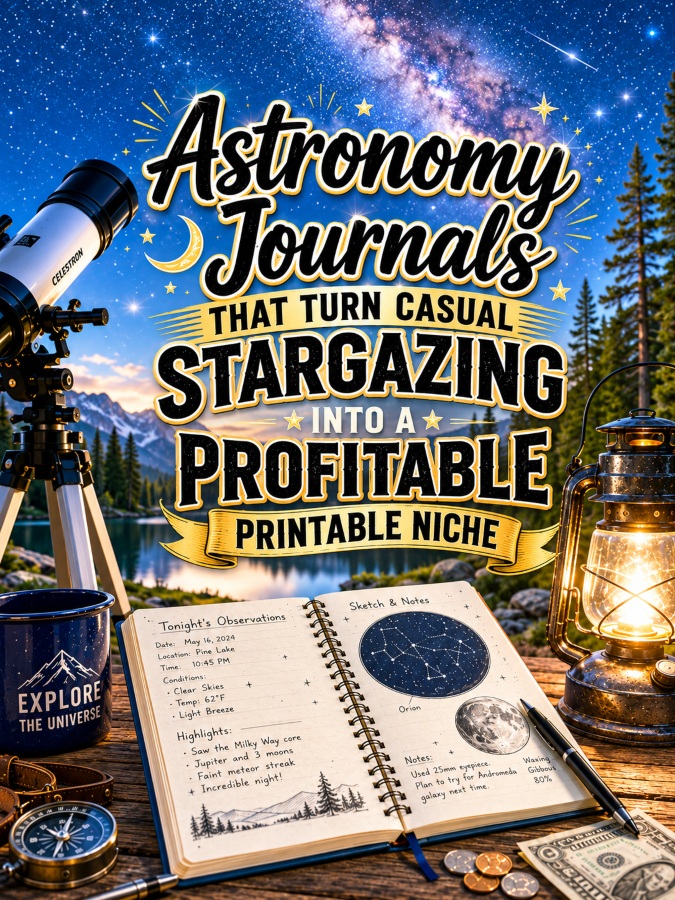
That’s exactly why Astronomy Journals continue selling year after year. They help hobbyists document discoveries, improve observation skills, and deepen their enjoyment of the night sky while giving printable creators an evergreen niche with passionate customers.
One thoughtfully designed journal can quietly become a stargazer’s favorite companion for years.
Quick Answer
Astronomy Journals are downloadable observation logs, sky trackers, lunar calendars, telescope records, and stargazing planners designed to help hobbyists record celestial observations and improve their astronomy skills.
A starter journal can comfortably sell for around $7. Expand it into astrophotography planners, meteor shower trackers, telescope setup guides, and premium astronomy libraries, and you’ve built a natural product ladder reaching $27, $47, and even $77.
Customers aren’t simply buying worksheets. They’re buying a way to preserve discoveries and create a personal record of their journey through the night sky. That someone creating that solution could absolutely be you!
Why This Niche Works
Astronomy hobbyists love tracking progress.
Observers naturally enjoy documenting sightings, improving techniques, and comparing observations over time.
Many hobbyists rely on scattered notes, screenshots, weather apps, and memories that become surprisingly unreliable after several late-night observing sessions.
Once customers discover a journal that genuinely improves their experience, they’ll often return for lunar planners, astrophotography logs, equipment trackers, and countless related thingees.
Unlike hobbies that come and go, the stars appear remarkably committed to maintaining their schedule.
Prior to pouncing upon this opportunity, you should first know all about the:
Tools You’ll Need
You don’t need an observatory on a mountain or a telescope that requires its own insurance policy. These dependable tools are more than enough.
- Canva for designing journal pages and observation logs.
- Google Docs for organizing instructions and astronomy guides.
- AWeber for building your email list with stargazing tips and updates.
- GetResponse for launches, newsletters, and customer follow-up.
- Gumroad for selling downloadable journals and bundles.
- Teachable if you’d eventually like to teach astronomy or astrophotography.
- Amazon Astronomy Journal Research for studying features observers appreciate most.
Don’t spend three weeks debating constellation icons while your future customers are currently trying to remember exactly when they spotted Jupiter’s moons.
Next, move to:
Your 5-Step Action Plan
Follow these five steps unless you’d rather spend 22 hours redesigning star borders while somebody else’s observation journal quietly becomes the favorite notebook of an entire astronomy club.
Step 1. Research Real Stargazing Challenges
Spend about 91 minutes exploring astronomy forums, hobby groups, telescope communities, and customer reviews.
Create a master list containing 28 to 35 journal pages. Include observation logs, weather conditions, telescope settings, object lists, moon phases, sketch pages, and equipment records.
Your research becomes an X-ray machine that reveals frustrations many stargazers simply accept as part of the hobby.
Step 2. Build Your Core Journal
Create a collection containing 36 to 48 printable pages that guide hobbyists from their first lunar observation all the way to deep-sky discoveries.
Include checklists, observation records, sketches, equipment notes, and reflection pages. Keep everything simple because simplicity is always a Good Thing.
Step 3. Create Specialty Editions
Build separate versions for beginners, astrophotographers, telescope owners, binocular observers, students, and astronomy clubs.
Specific journals always feel more valuable than one giant workbook attempting to support every astronomer from backyard beginners to professional observatories.
Your customers will appreciate having choices.
Step 4. Add High-Value Bonuses
This is where your journal begins standing out from the thundering herd.
Include observing targets, seasonal sky guides, equipment checklists, meteor shower calendars, and monthly challenge pages.
Those bonus thingees require very little additional effort yet dramatically increase the value of your bundle.
Hobbyists love extras that improve the observing experience.
Step 5. Build Your Product Ladder
Launch your starter journal for $7. Expand into hobby bundles around $27, then introduce premium astronomy libraries approaching $77.
Before long, your business won’t simply be selling printable pages. You’ll be helping people build a richer relationship with the night sky.
Once you’ve figured out all of the above, the next step is implementing:
3 Ways to Stand Out From The Thundering Herd!
Let’s be honest. Most observation journals look like laboratory paperwork that accidentally wandered into a telescope case.
The Good Thing is that astronomy is about wonder just as much as it is about data. Your journal can capture both.
Way 1. Include Space for Stories, Not Just Statistics
Most stargazers remember their first glimpse of Saturn’s rings or the first meteor shower they shared with family and friends.
Create sections for memories, emotions, sketches, and personal reflections alongside the technical observations. Those extra thingees transform your journal into a keepsake rather than a spreadsheet with stars on it.
People treasure experiences as much as measurements.
Way 2. Build Around Different Experience Levels
A beginner learning constellations has very different needs than an astrophotographer chasing nebula exposures.
Create editions for children, beginners, telescope owners, astrophotographers, astronomy clubs, and educators. Specific journals always feel more valuable than generic alternatives.
Way 3. Support Seasonal Observing
The night sky changes throughout the year.
Include seasonal observing targets, meteor shower schedules, lunar events, eclipses, and monthly challenges. Buyers appreciate journals that guide them toward what to look for next.
Next, here’s the thing. You’re probably NOT the only person offering this service. So you now require:
3 Nifty Ways to Find Customers
You don’t need paid advertising because astronomy enthusiasts practically shine the Bat Signal every meteor shower season.
Way 1. Astronomy Communities
Facebook groups, astronomy forums, Reddit communities, and local clubs contain thousands of passionate hobbyists.
Offer useful observation tips, beginner advice, and equipment ideas before introducing your products. Helpful creators become trusted creators remarkably quickly.
Way 2. Schools and Educational Programs
Teachers and science clubs constantly search for engaging astronomy resources.
Offer educational versions and classroom licenses that make adoption simple and affordable.
Way 3. Astronomy Bloggers and YouTube Creators
Content creators already speak directly to your ideal customers.
Affiliate partnerships and collaborations can place your journals directly in front of active hobbyists and beginners alike.
Speaking of completed projects, now let’s move to:
3 Takeaways You Won’t Find Elsewhere!
These aren’t feel-good reminders. They’re practical lessons that quietly transform one journal into a dependable digital product business.
Takeaway 1. You’re Selling Wonder
Customers aren’t buying observation logs and checklists.
They’re buying a way to remember moments of discovery and preserve experiences that genuinely feel magical.
Takeaway 2. Hobbyists Love Tracking Progress
Watching skills improve over months and years is one of the joys of astronomy.
That creates excellent opportunities for repeat customers and companion products.
Takeaway 3. One Journal Can Become an Entire Astronomy Ecosystem
Your observation journal can naturally expand into astrophotography logs, telescope setup guides, lunar calendars, and beginner learning systems.
Those connected thingees make scaling dramatically easier because you’re serving customers who already enjoy documenting their progress.
Now that you know the above, it’s time for:
3 Common Mistakes to Avoid
Many creators make journals too technical.
That’s Not a Good Thing. Beginners often feel intimidated enough already. Simplicity is always a Good Thing.
Some sellers focus only on telescope owners.
Many people enjoy astronomy with binoculars or simply with their eyes and curiosity. Inclusive products reach larger audiences.
Others stop after creating one journal.
The biggest opportunities often appear when customers begin asking for equipment logs, challenge books, and specialty editions.
What else should you know? How about:
Scaling Your Results
Expand into complete astronomy systems.
Create lunar calendars, meteor shower planners, astrophotography logs, equipment inventories, educational workbooks, and sky challenge packs that naturally complement your original journal.
Create premium memberships.
Offer monthly observing guides, seasonal sky updates, challenge pages, and exclusive printable resources that astronomy enthusiasts eagerly anticipate.
Build an email list stargazers genuinely appreciate.
Share observing opportunities, sky events, seasonal targets, and printable updates throughout the year. A collection containing 28 astronomy products could realistically generate an additional $462 to $1,382 each month through memberships, bundles, repeat customers, and affiliate partnerships. Trust me, you’ll thank me later.
Let’s now wrap up everything via the:
Your Next Steps
Start by listing 35 questions and frustrations astronomy hobbyists regularly experience while observing the night sky. Then create pages that solve those problems one by one.
Build your first journal in Canva using clean layouts, practical observations, and plenty of room for notes and sketches. If someone reaches for your journal every time they head outside with a telescope, you’ve created something valuable.
Then share your journal with five astronomy groups, science clubs, educators, bloggers, or YouTube creators. Remember, 5 good messages beats 50 generic ones every single time.
One thoughtful journal can quietly become the beginning of an entire science and hobby business.
Next, let’s finish with:
Final Thoughts
The best astronomy journals don’t simply record observations. They preserve moments of wonder that remind us how beautifully enormous the universe really is.
Your Astronomy Journals can help create those memories. They encourage curiosity, support learning, and give hobbyists a place to document discoveries that might otherwise fade with time.
Start with one journal that solves one meaningful problem exceptionally well. Keep listening to your customers. Keep improving your products. Keep building resources that inspire people to look up more often.
You don’t need bazillions of products to build meaningful income. You simply need one thoughtful journal that helps somebody remember the night they first saw Saturn’s rings or a meteor streak across the sky.
That’s it. That’s your beginning!
If you were creating your first Astronomy Journal tomorrow morning, would you build it for beginners, children, telescope owners, astrophotographers, or astronomy clubs?
Enjoy!