

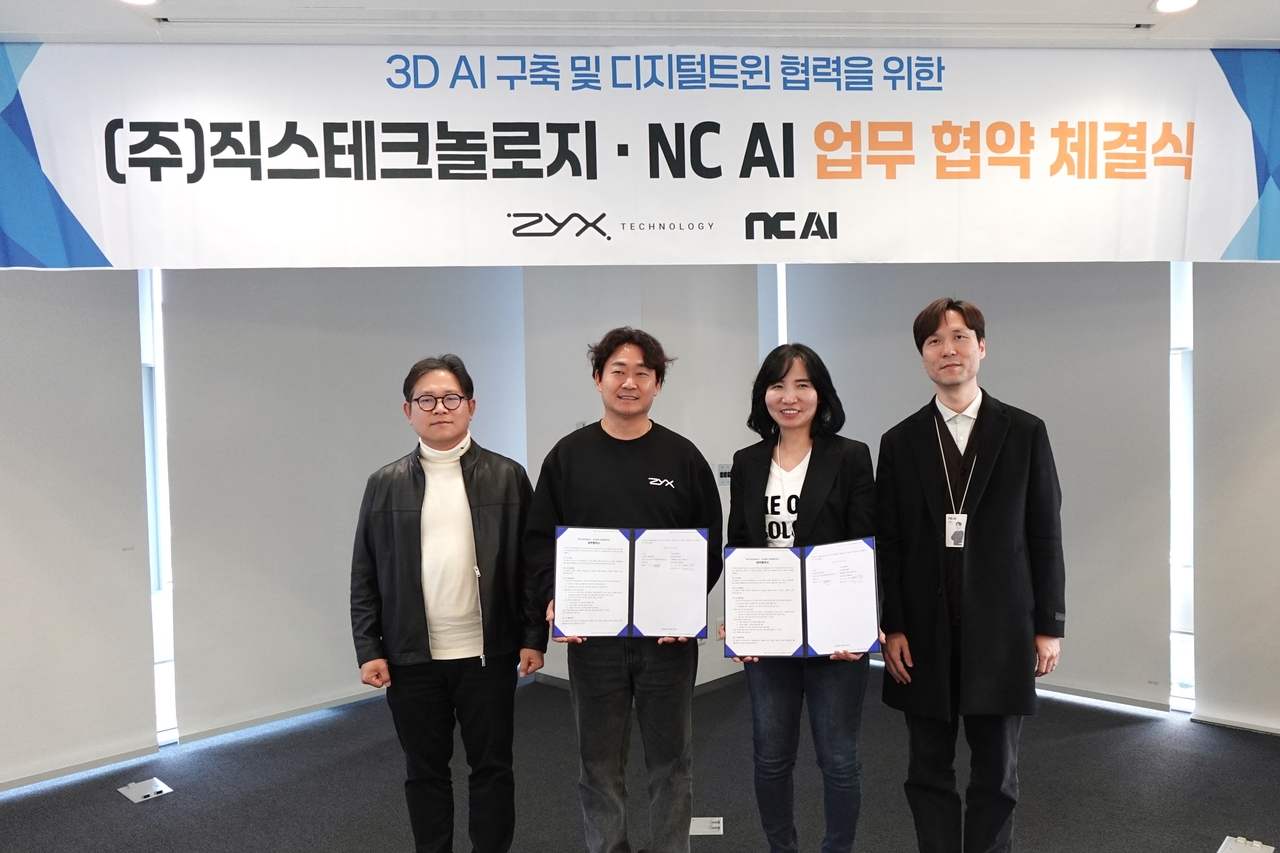
Zyx Technology, a South Korean digital design platform provider, said Monday it has partnered with NC AI, the artificial intelligence subsidiary of gaming firm NCSoft, to jointly develop 3D generative AI and digital twin technologies for industrial applications.
Under the agreement signed Friday, the two companies will combine AI capabilities with engineering expertise to create AI-based platforms that support the entire project lifecycle — from design and construction to on-site operations and decision-making. The collaboration is aimed at accelerating AI transformation (AX) across the construction, architecture and manufacturing sectors.
The partnership will focus on improving the precision and scalability of 3D generative AI models. The companies plan to train AI systems using design data such as blueprints, 3D models and images to automate the generation of complex 3D objects and structures.
The partners also aim to strengthen digital twin capabilities by linking design-stage 3D models with real-time field data. This integration is expected to enhance risk management, operational monitoring and decision-making accuracy at industrial sites.
Zyx Technology will contribute its proprietary platforms, including ZyxCAD AX, an AI-enabled CAD solution designed to improve design efficiency through automated workflows and high-speed data processing, and ZYX Space, a next-generation digital twin solution based on 2D-to-AI technology. The company will also deploy DIVE, its construction infrastructure platform, to further enhance operational efficiency.
“This collaboration marks an important step toward next-generation industrial AX, where AI understands design data and expands into 3D models and digital twins,” said Choi Jong-bok, chair of Zyx Technology. “We aim to further advance our AX-based platforms through close technical cooperation with NC AI.”
“The partnership is focused on bringing AI technologies into real-world industrial environments,” Um Sin-jo, CEO of Zyx Technology, said. “By connecting 3D generative AI and digital twin technologies with actual construction and manufacturing sites, we expect to broaden the practical use of AI and strengthen its on-site applicability.”



