


Navigating New York City used to mean wandering the block until you spotted a sign, but today, customers start their journey before they even leave the house. Local residents searching for a boutique in SoHo or a repair shop in Queens simply ask their phone, a mapping app, or an AI answer engine which business is nearby, open, and ready right now. Your website functions as more than a static placeholder; it acts as the primary bridge between a digital query and a physical transaction. For several storefronts and service providers, the website has become local discovery infrastructure, and web developers like EnovaCreations leverage high-performance NYC web development and local SEO to bridge the gap between neighborhood search intent and physical business growth.
The shift is easy to miss because it happens quietly inside search results. Brand loyalty takes a backseat to immediate utility. The local business that presents itself as the most accessible, verified, and responsive option typically wins the customer’s trust in seconds.
Modern digital strategy focuses on clarifying content for search algorithms and users to ensure that technical optimization remains grounded in providing real value. Successful local visibility is not about buying a magic ranking. It is about making the business easier for search engines, digital maps, and AI systems to interpret through Answer Engine Optimization (AEO) and Generative Engine Optimization (GEO).

Quick Facts For NYC Local Search, Google Maps, and AI Search Visibility
Keeping track of these foundational signals is vital as NYC search visibility has moved beyond a single ranking position and into a complex, multi-platform digital ecosystem.
For an NYC business owner, the practical question is simple: can a customer quickly understand who the business serves, where it operates, what it offers, and how to take the next step?
- Google says local rankings are mainly shaped by relevance, distance, and prominence, not paid shortcuts.
- A complete Google Business Profile can help customers find accurate and up-to-date business details, including hours, photos, reviews, directions, services, and contact options.
- A mobile-first website optimized for Google’s core user experience metrics allows potential clients to book or request directions without experiencing technical delays.
- The LocalBusiness schema is structured data that helps Google classify business details such as address, hours, departments, and service information.
- Answer engine optimization, or AEO, means writing clear answers to real customer questions.
- Generative engine optimization, or GEO, means making business information clear enough for AI search tools and AI-generated answers to interpret accurately.
Think of these technical layers as the digital versions of a visible storefront sign, a responsive doorbell, and a knowledgeable staff member who answers questions instantly.
Linking web development, Google Business Profile optimization, and local search strategies together ensures you reduce confusion the moment a nearby customer decides to call, book, or visit your location.
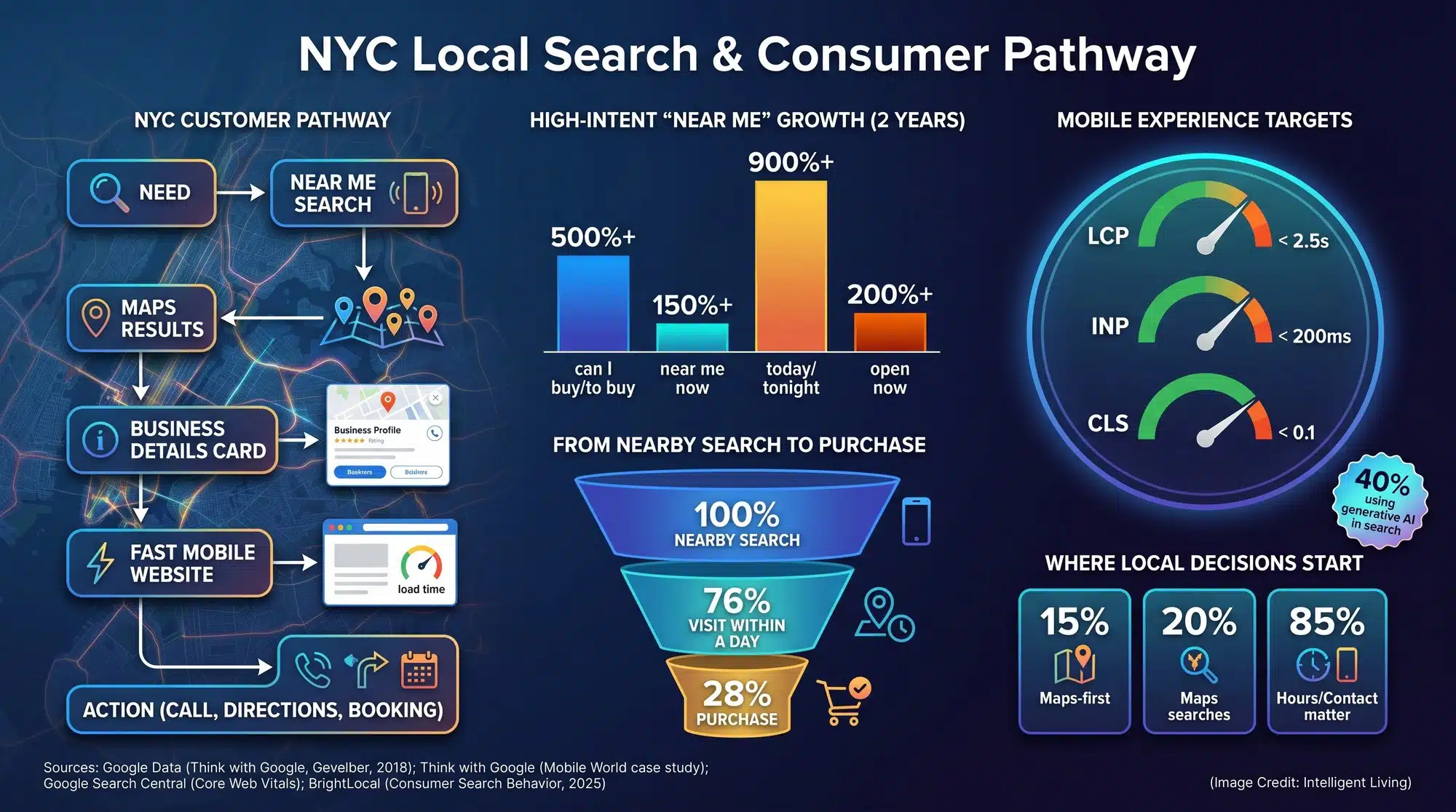
How NYC Search Visibility Turns Websites Into Customer Pathways
Local Search is The New Storefront
The first impression for many NYC businesses now happens inside search results. When someone stands three blocks away in the rain comparing nearby salons or urgent care clinics on their screen, your digital presence becomes your most important storefront.
In that moment, “near me searches,” “open now searches,” reviews, photos, service descriptions, and directions matter as much as a bright sign over the door. This immediate availability of information transforms local search from a directory into a real-time decision-making tool.
Search algorithms prioritize nearby results across Search and Maps by analyzing relevance, distance, and prominence. This automated vetting process ensures that when an NYC resident looks for a local specialist, the system promotes businesses that demonstrate the highest degree of authority and physical proximity. Securing a prominent position within the local Map Pack is now a critical component of neighborhood discovery rather than a technical luxury.
Capturing Hyper-Local Intent in New York’s Micro-Markets
New York makes this even sharper. A dentist in Midtown is not competing with every dentist in America. Instead, businesses like a café in Astoria or a plumber in Staten Island must battle for borough-specific search and neighborhood visibility. This requires maintaining service-area clarity and earning customer trust inside very tiny windows of attention.
A user searching for an ’emergency electrician near me open now’ isn’t looking for a corporate history; they are seeking immediate relief through verified location data, real-time availability, and a frictionless path to a phone call.

What A Web Developer Actually Builds
Strategic web developers reach far beyond surface-level aesthetics to engineer a digital platform that converts local traffic into measurable business growth. Building a high-performing site requires more than just aesthetic choices; it requires a deep technical architecture designed for conversion.
A professional developer ensures that your local presence is supported by a robust framework of tools and optimization signals. In its service descriptions, EnovaCreations integrates responsive NYC small business web design with a technical feature set designed to capture immediate local demand:
- Dedicated service pages that target specific neighborhood needs.
- Optimized hosting for ultra-fast mobile loading speeds.
- Seamless click-to-call and online booking integration.
- Comprehensive schema markup and LocalBusiness structured data.
- Strategic metadata and internal linking for better crawlability.
By integrating these technical essentials, web developers like EnovaCreations allow your business to communicate clearly with search engines while providing a fast, reliable path for customers to take the next step.
Leveraging Schema and Speed to Sharpen Search Engine Clarity
Using structured data for local business entities gives search engines a reliable way to interpret names, addresses, and service categories without guesswork. For a local service company, that clarity can matter when search engines are deciding how to interpret a page.
High-performance web architecture must synchronize site speed and mobile usability with the conversational patterns of spoken search queries. Prioritizing modern technical SEO and conversational search patterns ensures your content remains accessible for voice-activated queries and neighborhood-specific searches.
A strong service page should answer the next obvious question before the visitor has to hunt for it. A Queens contractor might need separate pages for emergency repairs and renovation work to maintain topical relevance. This structure ensures both customers and search systems understand the specific scope of the business without confusion.

How AI and Google Maps Algorithms Rank Local NYC Businesses
Why Google Business Profile Still Matters
While your website handles the complex narrative of your brand, your Google Business Profile serves as the digital front window, offering the immediate facts customers use to make split-second decisions.
Aligning your profile with Google’s core local ranking factors requires keeping your business data accurate and your customer interactions consistent. Those steps may sound basic, yet they are the basics many local owners overlook. Late at night, a homeowner with a burst pipe is not patiently comparing brand language. Current hours, recent reviews, clear service details, and a working phone button can decide who gets the call.
Why Profile Accuracy Changes Customer Behavior
This is where Google Business Profile optimization, local citations, review management, photo optimization, accurate categories, and service-area setup become part of the same local SEO system. While you cannot purchase a higher map ranking, you can eliminate the conflicting data that confuses search algorithms. Strengthening your digital footprint requires absolute consistency in your business name, address, and service categories to build the algorithmic trust needed for top-tier visibility.
Accuracy in your business profile serves as a silent trust signal that validates your brand before a customer reaches out. Wrong hours, mismatched addresses, outdated photos, or vague service categories can make a real business look unreliable, even when the work itself is excellent.

Optimization Strategies for AI Answer Engines and Search Models
Rather than rendering SEO obsolete, the rise of AI search has intensified the demand for precise, authoritative data. Modern visibility hinges on your ability to provide search models with clear, factual answers that are easy to digest and cite. When people ask, “How do I get my NYC business on Google Maps?” or “Why is my business not showing up near me?” answer engines look for pages that explain things plainly, organize information well, and provide trustworthy details.
Answer engine optimization focuses on providing direct, useful responses to common customer questions, while generative engine optimization makes that data easier for AI systems to cite. To support the evolution of AI-driven search metrics, your digital presence must prioritize:
- Clear service descriptions and FAQ sections.
- Clean entity signals and accurate business details.
- Structured service pages that define your local offerings.
Focusing on these signals ensures your visibility is measured by actual search intent and engagement rather than just old-fashioned website traffic.
Why Clear Answers Help Machines and Customers
Maintaining high-quality textual content and crawlable site maps is essential for surfacing in AI Overviews and modern discovery modes. AI tools need clean facts. They know what the business offers, what area it serves, how customers can book, and why the business appears credible.
This is where plain language becomes a technical advantage. A page that says “same-day appliance repair in Brooklyn with online booking and weekend availability” gives humans, search engines, and AI answer systems a clearer signal than a stylish page that only says “premium home solutions.”
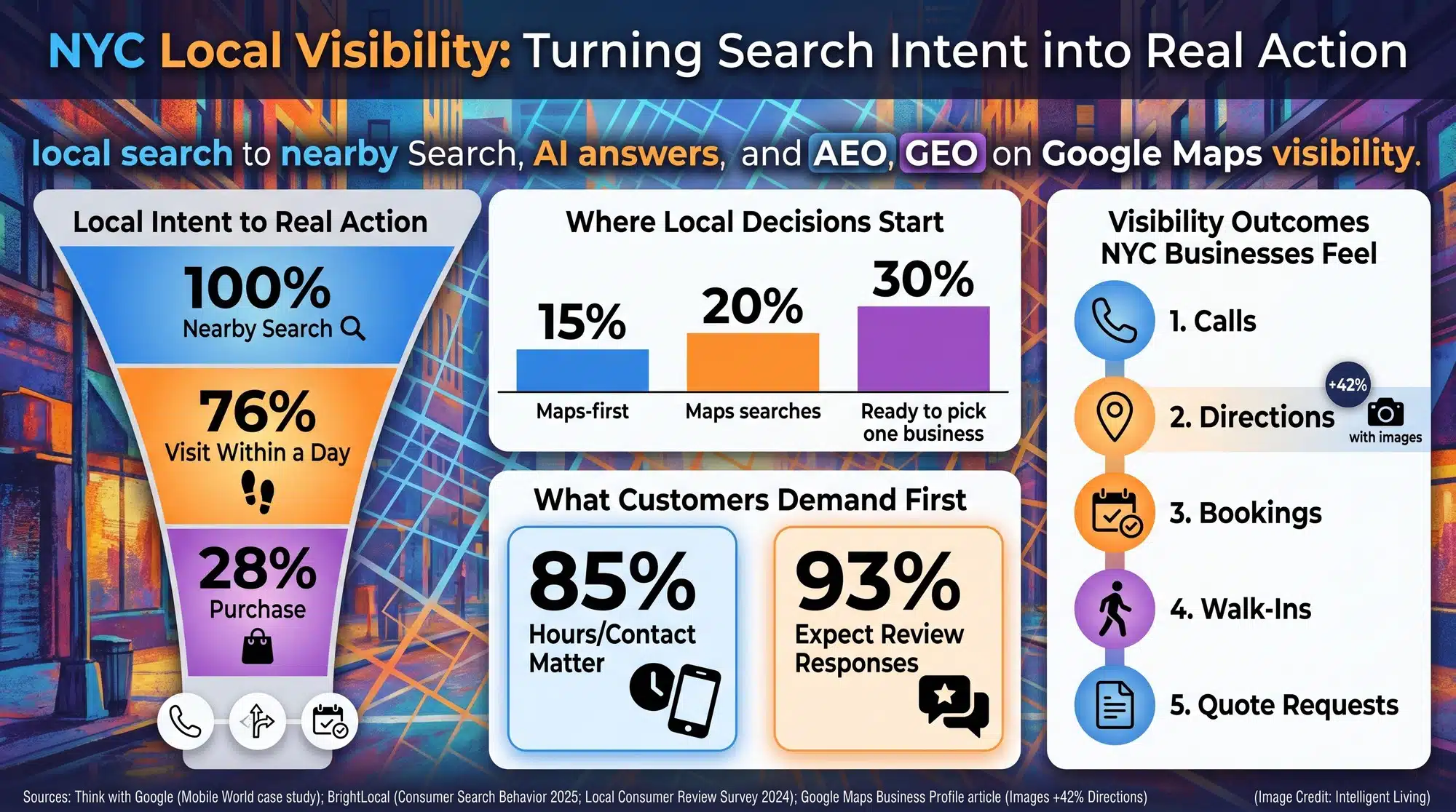
Five Ways Better Search Visibility Helps NYC Businesses
Better search visibility should lead to practical actions, not vanity metrics. For local businesses, the most useful outcomes are calls, map directions, bookings, quote requests, walk-ins, and stronger trust before the first conversation. The strongest local SEO strategy connects every digital signal back to customer intent. A searcher should be able to move from question to answer to action without feeling lost, delayed, or unsure whether the business serves their neighborhood.
- More Calls From “Near Me” Searches: A clear local business website and complete Google Business Profile can make phone calls easier when someone searches for a nearby service and wants help now.
- More Direction Requests From Google Maps: Accurate addresses, hours, photos, and categories can help customers feel confident enough to tap for directions instead of scrolling to the next option.
- More Trust From Reviews And Complete Profiles: Fresh reviews, useful photos, service descriptions, and consistent business details help reduce doubt before a customer ever speaks to the owner, especially when establishing hyper-local authority connects your technical profile accuracy with clear neighborhood discovery.
- Better AI Search Readiness: Answer-ready content, FAQ optimization, LocalBusiness schema, and entity-based SEO help search engines and AI answer systems understand what the business actually does.
- More Bookings From Faster Pages: A fast mobile-first site with click-to-call buttons, contact forms, booking tools, and clear service-area pages turns attention into action before a distracted customer moves on.
These performance gains transform your digital presence into a measurable growth engine for your company. By removing the obstacles between a user’s question and your professional answer, a web developer ensures that your business stays ahead of changing search behaviors. Aligning your website, profile, and technical setup creates a seamless environment where discoverability naturally leads to a sustained increase in local revenue.

Why NYC Businesses Cannot Afford Invisible Local Search Signals
Success in the NYC market requires operationalizing your digital assets: prioritizing ultra-fast load times, completing every field of your business profile, and refining your service pages for total semantic clarity. By removing every point of engagement friction, you transform your website into an automated system that captures local demand the moment it surfaces. Partnering with a web developer focuses your efforts on building a frictionless pathway between a customer’s urgent question and your business’s solution.
The smarter play is practical: make the website fast, make the business profile complete, make service pages clear, make answers easy to understand, and make contact friction almost disappear. Building resilient local visibility across search and maps depends on a simple truth: your digital signals must never force a customer to guess what you do. When your digital presence is built to answer search intent accurately, the customer journey from discovery to the first phone call becomes inevitable.
FAQ: Answers for NYC Business Owners About Local SEO, AEO, GEO, and Google Maps Visibility
Does my NYC business still need a website if I have a Google Business Profile?
Yes. Your profile provides quick facts, but a website offers deep proof. It handles detailed service descriptions, online booking, and trust signals that build authority beyond a map listing.
Can a developer guarantee the top spot on Google Maps?
No. Google uses relevance, distance, and prominence for ranking. A professional developer builds the technical foundation that makes your business the most logical answer for local queries.
What is Answer Engine Optimization (AEO) for local shops?
AEO involves structuring your content to provide direct, concise answers to customer questions. It ensures that when someone asks, ‘Who is the best plumber in Brooklyn?’ AI and search engines find your facts first.
How does Generative Engine Optimization (GEO) help my business?
GEO makes your business data easy for AI models to summarize and cite. It relies on clean facts, structured service pages, and consistent information across all digital platforms.
Why isn’t my business showing up in ‘near me’ searches?
Common hurdles include incomplete profiles, slow mobile speeds, missing service-area keywords, and inconsistent contact details (NAP) that confuse search algorithms.
How do fast websites increase local calls and bookings?
Speed removes the impulse to scroll away. A fast, mobile-friendly site with clear click-to-call buttons captures the customer’s attention at the exact moment they are ready to act.