Introduction
School nights always seem so simple… until they actually arrive.
One child can’t remember where the math worksheet went. Another suddenly announces there’s a science project due tomorrow that somehow never came up before. Meanwhile, someone insists they don’t have homework at all, right before a crumpled assignment magically appears at the bottom of their backpack like it was hiding since 1822.
Parents aren’t lazy, and children aren’t trying to create household chaos. Life simply gets busy, and homework has a sneaky habit of slipping through the cracks.
But!
That’s exactly why printable homework systems continue attracting buyers year after year. They help families replace nightly stress with simple routines, and they give digital creators an evergreen product that keeps selling long after back-to-school season ends.
The best part is that you’re not creating another planner destined to collect dust beside an abandoned gym membership. You’re building something families can actually use every school week.
Quick Answer
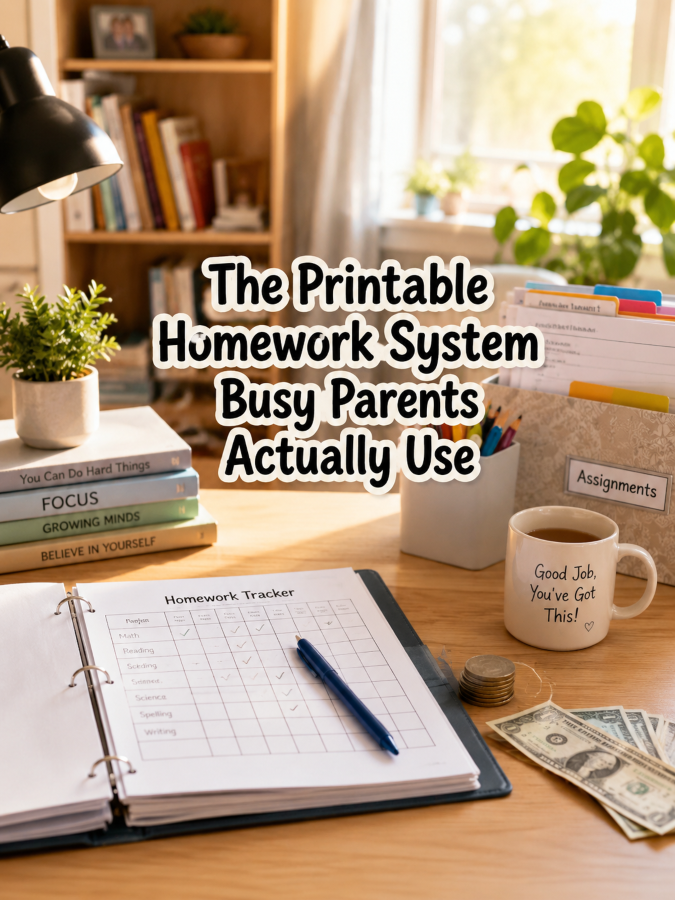
A Printable Homework System is a collection of printable planners, assignment trackers, reading logs, study schedules, project planners, reward charts, and organization pages that help families manage homework more efficiently.
You can offer a simple starter bundle for around $7, expand into grade-specific systems around $27, and build premium family organization libraries, editable versions, and teacher licenses that comfortably reach $77.
Parents don’t want more paperwork. They want fewer stressful evenings, happier children, and homework that actually gets finished. That someone creating that solution could absolutely be you!
Why This Niche Works
Every school year brings millions of families searching for better homework routines.
Children change grades, teachers introduce new expectations, and parents suddenly find themselves juggling assignments, projects, reading logs, permission slips, and approximately bazillions of little paper thingees.
Most printable creators stop after making a single homework planner. Meanwhile, busy parents need an entire system that works together. That’s like walking into your favorite restaurant and discovering they sell hamburgers but forgot the fries, the drinks, and the napkins.
Parents also become incredibly loyal once they discover a resource that genuinely makes evenings easier. Buying another printable from someone they already trust feels much safer than trying a brand-new creator who may disappear faster than a WiFi signal during a thunderstorm.
Unlike trendy digital products that fade away after a few months, homework isn’t going anywhere. Schools keep assigning it, parents keep helping with it, and families keep searching for better ways to stay organized.
Prior to pouncing upon this opportunity, you should first know all about the:
Tools You’ll Need
You don’t need expensive software or a design degree. A few dependable tools are more than enough to build a homework system parents will love.
- Canva for designing printable planners, trackers, and worksheets.
- Google Docs for writing instructions, checklists, and study guides.
- AWeber for building your email list and sharing helpful school organization tips.
- GetResponse for automated follow-up emails and product launches.
- Gumroad for selling downloadable homework systems.
- Teachable if you eventually create courses about printable businesses or family organization.
- Amazon Student Planner Research for discovering popular layouts, page ideas, and customer feedback.
Don’t spend weeks collecting software you’ll rarely open. Spend that time building something families will actually use.
Next, move to:
Your 5-Step Action Plan
Follow these steps carefully unless you’d like to spend the next 19 hours redesigning the same assignment tracker while your coffee quietly files for retirement.
Step 1. Study What Busy Families Really Need
Spend about 93 minutes researching homework planners, student organizers, assignment logs, homeschool printables, and family command centers. Pay close attention to customer reviews because they’ll often tell you exactly what’s missing.
Create a master checklist containing 28 to 35 page ideas. Include daily homework logs, weekly planners, reading trackers, spelling practice sheets, project timelines, assignment checklists, test preparation pages, reward charts, study schedules, and after-school routines.
This research becomes your very own homework X-ray machine. It helps you spot problems parents can see but haven’t quite figured out how to solve.
Step 2. Design Your Core Homework System
Create a printable bundle containing 34 to 46 pages that work together naturally. Every page should solve one specific problem instead of trying to solve every problem ever invented.
Include assignment trackers, reading logs, project planners, weekly schedules, test countdown pages, goal trackers, and parent communication sheets. Keep everything simple enough that families can start using it immediately.
Remember, simplicity is a Good Thing. Confused customers rarely become repeat customers.
Step 3. Build Age-Specific Editions
A first grader doesn’t organize homework the same way a middle school student does. Create separate versions for younger children, upper elementary students, middle school learners, homeschool families, and teenagers.
That tiny adjustment makes your products feel custom-built instead of one-size-fits-all. It’s the difference between buying a tailored jacket and borrowing one from someone who’s about three feet taller.
Parents notice that level of thoughtfulness, and they appreciate it.
Step 4. Add Practical Bonuses
This is where your printable system starts becoming much more valuable than the competition.
Add lunch planners, after-school checklists, backpack packing pages, reading challenge trackers, reward coupons, screen-time agreements, family goal sheets, and chore planners. Those extra thingees don’t require much additional work, yet they dramatically increase the perceived value of your bundle.
Customers love feeling like they received more than they expected.
Step 5. Build a Complete Product Ladder
Launch with a $7 starter homework planner. Expand into grade-level systems around $27, then offer premium family organization libraries priced near $77.
You can also introduce editable editions, classroom licenses, homeschool versions, and seasonal updates every school year. Suddenly, one printable becomes an entire family of products that keeps growing alongside your business.
Trust me, your future self will thank you for building a system instead of a single printable.
Once you’ve figured out all of the above, the next step is implementing:
Scaling Your Results
Don’t stop with one homework system. That’s like planting a single tomato plant and wondering why your garden isn’t overflowing by harvest season.
Once your first printable starts gaining traction, create companion products that naturally fit alongside it. Add reading journals, spelling trackers, test preparation planners, project organizers, morning routine charts, and after-school checklists. Families love buying resources that already work well together.
Create versions for different age groups. Kindergarten parents have different needs than parents of middle school students. A few thoughtful adjustments can turn one product into an entire collection without starting from scratch every time.
You can also create homeschool editions, editable versions, teacher licenses, and family organization bundles. Those extra thingees help increase your average order value while giving customers more reasons to come back.
Build an email list while you’re growing your catalog. Every new school year brings a fresh wave of parents looking for better ways to organize homework, projects, and family routines. A growing email list means you won’t have to start from zero every August.
A collection of 24 family organization printables could realistically generate an additional $392 to $1,168 each month from repeat customers, seasonal launches, and bundle sales. Those numbers won’t happen overnight, but they’re absolutely achievable when you consistently create products that solve real problems. Trust me, you’ll thank me later.
Let’s now wrap up everything via the:
Your Next Steps
So.
This week, choose one grade level and outline your very first Printable Homework System. Don’t try to build the world’s largest planner on day one because that’s usually a Not a Good Thing.
Next, design your first 28 to 35 pages using Canva. Keep every page simple, practical, and easy for busy families to understand. If a page doesn’t solve a problem, it probably doesn’t belong in your bundle.
Finally, share your finished product with five parenting communities, homeschool groups, or teacher groups where your ideal customers already spend time. Remember, 5 good messages beats 50 generic ones every single time.
Small, consistent action beats waiting for the “perfect” product. Perfect has delayed more businesses than almost anything else.
Next, let’s finish with:
Final Thoughts
Busy parents aren’t searching for another planner they’ll forget about next week. They’re searching for something that helps their evenings feel calmer, their children stay organized, and homework become just a little less stressful.
That’s exactly why a Printable Homework System has so much potential. You’re not simply selling printable pages. You’re giving families a practical solution they’ll reach for again and again throughout the school year.
So.
Start with one thoughtfully designed system. Listen carefully to what your customers tell you. Improve it, expand it, and let it grow into a complete family of products over time. You don’t need bazillions of printables to build a successful business. You simply need one genuinely helpful product that solves a real problem.
That’s it. That’s your beginning!
Now I’d love to know… what page would you include first in your own Printable Homework System?
Enjoy!