Introduction
Audio.
Making money with audio?
Guess what!
You don’t need a fancy studio, a huge course, or a microphone that looks like it belongs in a late-night radio booth. You can start with one simple audio product that helps one person get one clear result.
That’s why simple audio products are such a smart digital offer. Your buyer can listen while walking, driving, cleaning, planning, or hiding from their open browser tabs like those tabs are tiny unfinished chores with blinking lights.
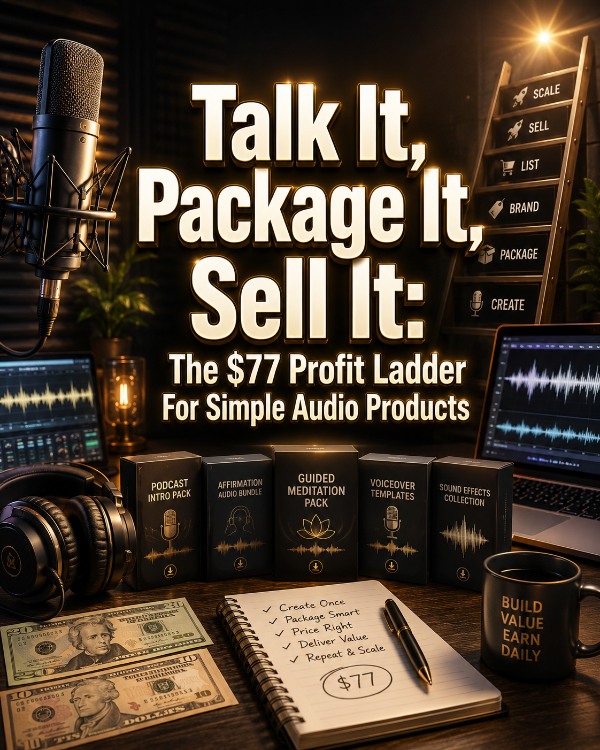
The best part? You don’t have to stop with a tiny $7 audio file. You can turn that starter product into a $27 bundle, a $47 guided kit, and then a full $77 audio product that includes editable files, rebrand value, and even resell potential if you choose to offer those rights.
Before you build the ladder, it helps to see why audio products are such a strong fit for buyers who want useful help without another giant thing to finish.
Why This Product Works
Simple audio products work because they fit into real life. Your buyer doesn’t need to sit at a desk, watch a long video, or print a giant workbook before they can start. They can press play and learn while they’re already doing something else.
That matters because people are busy. They want useful help, but they don’t always want another screen-heavy product. Audio feels lighter. It feels easier to start. And when the promise is clear, it can feel like a friendly coach in their ear instead of a digital textbook staring at them from a folder.
The secret is ensuring it’s a listener win! Your audio should help the buyer do one clear thing, such as plan a tiny product, write a welcome email, choose a niche, calm launch nerves, map a lead magnet, or create simple content ideas.
When your product gives one clear result, it becomes much easier to sell. The buyer understands what they’re getting. You understand what to create. Everybody breathes easier, including your overworked content brain!
Now that the basic opportunity is clear, here’s the quick answer so you can see the whole $7 to $77 path before we build each rung.
Quick Answer
You can turn a simple audio product into a $77 offer by starting with one clear listener win, then adding useful support pieces at each price level.
- The $7 version gives the buyer one quick audio lesson.
- The $27 version adds a transcript, checklist, and worksheet.
- The $47 version adds support audios, examples, and a short action plan.
- The $77 version becomes a complete audio product kit with editable files, templates, swipes, rebrand value, and optional resell rights if that fits your offer.
Cool!
Once you understand why the product works, the next step is getting the simple tools in place so you can build it without turning your desk into a tech jungle.
Tools You Need
You don’t need a complicated setup to create and sell a simple audio product. You need a way to plan the lesson, record the audio, clean it lightly, package the files, and deliver them to buyers.
Here are beginner-friendly tools you can use:
- ChatGPT or Claude – for brainstorming listener wins, outlining scripts, writing checklists, creating templates, and writing promo copy
- Your phone – for recording a first simple audio if you don’t want to buy equipment yet
- Audacity – for free audio recording and editing
- Descript – for easier editing if you like text-based controls
- Auphonic – for cleaning and leveling audio
- Canva – for editable covers, worksheets, checklists, and simple product graphics
- Google Docs – for editable transcripts, worksheets, quick-start guides, and swipe files
- Gumroad or Payhip – for selling and delivering the product
- MailerLite, AWeber, or GetResponse – for follow-up emails after purchase
Pick the simplest stack you’ll actually use. A phone, Google Docs, Canva, and Gumroad can be enough for a first version. The goal isn’t to build a recording studio, remember.
The goal is to create something useful and get it into a buyer’s hands!
Now that the tools are simple, let’s start with the first rung of the ladder: the tiny $7 product.
The $7 Starter Version
The $7 version should be small, clear, and easy to finish. Think of it as one helpful audio lesson that solves one tiny problem.
This isn’t where you create a full course. This is where you give the buyer a quick win they can understand right away. Your product might be a 10 to 20 minute audio lesson or 3 tiny audios that each teach one step.
A $7 audio product could be:
- A 10-minute lesson on choosing one product idea
- A guided audio for writing one welcome email
- A short lesson on planning 5 social posts
- A calm launch prep audio for nervous sellers
- A quick audio walkthrough for naming a digital product
- A tiny training on turning one PLR report into a lead magnet
The $7 version works when the buyer can say, “I know exactly what this helps me do.” That clear result matters more than the length of the audio.
For example, instead of selling “Audio Training About Digital Products,” sell “Plan Your First Tiny Digital Product In 15 Minutes.” See the difference? One sounds general. The other gives the buyer a finish line.
Once the $7 starter version is clear, the next rung adds just enough support to make the product feel easier to use.
The $27 Version
The $27 version builds on the starter audio by adding practical support pieces. The buyer is no longer getting only the audio. They’re getting help using the audio.
This is where you add a transcript, a checklist, a worksheet, and a short “Start Here” page. These pieces are simple to create, but they raise the perceived value because they help different types of buyers.
The transcript helps buyers who like to skim, search, or review later. The checklist helps them take action without guessing what comes next. The worksheet helps them apply the lesson to their own topic, offer, or situation.
A $27 version could include:
- The main audio lesson
- A clean transcript
- A one-page action checklist
- A fill-in worksheet
- A short “Start Here” page
Let’s say your $7 audio teaches someone how to plan one tiny product. The $27 version could include a worksheet where they fill in the buyer, promise, title, price, delivery method, and first promo idea.
That makes the product much more useful. The audio teaches the idea, but the worksheet helps the buyer build something. That’s why this rung feels more valuable.
After the $27 version helps the buyer apply the idea, the $47 version can turn the product into a more complete guided kit.
The $47 Version
The $47 version should feel like a stronger kit or mini-system. You’re not just adding more files because more looks impressive. You’re adding pieces that help the buyer move faster and with less confusion.
This rung is a good place to add 2 or 3 short support audios, examples, a mini action plan, and simple copy helpers. These pieces help the buyer see how the method works in real life.
A $47 version could include:
- The main audio lesson
- 2 or 3 short support audios
- Transcript for each audio
- Checklist and worksheet
- Sample completed worksheet
- Example product titles or angles
- 3-day or 5-day action plan
- Simple product listing template
- Basic promo post examples
For example, if your product helps buyers create a simple audio product, your support audios could cover choosing the listener win, recording the first version, and writing the product listing.
The examples are important here. Buyers often understand the teaching but still wonder, “What would this look like for me?” Examples answer that question before it turns into procrastination wearing a tiny hat.
The $47 version works because it feels guided. The buyer gets the lesson, the support pieces, and examples that make the whole process easier to copy and complete.
Now that the $47 version feels like a real kit, the $77 version turns it into a premium offer with editable files, stronger reuse value, and optional rebrand or resell rights.
The $77 Version
The $77 version should feel complete, polished, and easy to use. This is where the product becomes a full audio toolkit, not just a recording with a few extras.
For your audience, this is also where editable assets matter. A $77 buyer often wants more than learning. They want speed, shortcuts, and files they can customize, brand, reuse, or possibly resell if you include those rights.
A strong $77 version could include:
- Main audio training
- 3 to 5 short support audios
- Transcripts for all audios
- Quick-start guide
- Action checklist
- Fill-in worksheet
- Sample completed worksheet
- Swipe file or examples
- 7-day action plan
- Resource directory
- Editable product listing template
- Editable follow-up email template
- Editable customer welcome note
- Editable Canva cover templates
- Editable worksheet and checklist files
- Editable promo post templates
- Clear usage-rights page
This version feels worth more because it helps the buyer before, during, and after listening. Before listening, the quick-start guide shows them what to do. During listening, the worksheet helps them follow along. After listening, the checklist, examples, swipes, and action plan help them finish.
The editable files raise the value even more because they save time. Your buyer doesn’t have to stare at a blank page wondering how to create their own worksheet, cover, checklist, listing, or promo post. They can open the editable version, make it fit their own brand, and move faster.
If you want to make the $77 offer even stronger, you can include rebrand or resell rights. That means the buyer can customize the materials and use them in their own business. Depending on your rights terms, they might be allowed to sell the finished product, use it as a bonus, give it to clients, include it in a membership, or bundle it with another offer.
Be very clear about those rights. Don’t leave buyers guessing. Tell them exactly what they can and can’t do. Can they edit it? Can they add their logo? Can they sell it? Can they give it away? Can they include it in a paid membership? Clear rights make the offer feel safer, stronger, and more valuable.
This is the real $77 value. You’re not selling a longer audio. You’re selling a smoother result, a faster path, and editable assets your buyer can actually use. That’s much stronger than a folder full of files sitting there like it’s waiting for someone to adopt it.
Now that the full ladder is built, let’s turn it into a simple action plan you can follow without making the project bigger than it needs to be.
Your 5 Step Action Plan
This action plan helps you build the ladder in the right order. Start small, then add the pieces that make the product easier to use, easier to sell, and easier to customize.
Step 1: Choose One Clear Listener Win
Start by choosing one buyer and one result. Ask yourself, “After listening, what will this person be able to do?” Your answer should be small, clear, and useful.
For example, don’t choose “learn digital marketing.” Choose “write one welcome email,” “plan one tiny product,” or “create 5 simple content ideas.” Small wins sell because they feel doable.
Step 2: Outline And Record The $7 Audio
Write a simple outline before you record. Use this structure: promise, problem, 3 simple steps, quick example, and next action.
Then record the first version. Don’t wait until it sounds like a professional studio session. Your buyer needs clear, useful guidance. Clean and understandable beats over-polished and never published.
Step 3: Add The $27 Support Pieces
Create a transcript, checklist, worksheet, and quick-start page. These pieces make your audio easier to use, especially for buyers who like to read, print, skim, or fill things in as they go.
This is where your product starts feeling more complete. The buyer isn’t just listening. They’re using the lesson to make a decision, build an asset, or take a useful step.
Step 4: Build The $47 Guided Kit
Add 2 or 3 short support audios, examples, a simple listing template, and a mini action plan. These help the buyer understand the method from more than one angle.
For example, if the main audio teaches the full process, the support audios can answer common questions. One can help them choose the idea. One can help them package it. One can help them write the listing.
Step 5: Finish The $77 Editable Version
Now add the premium support pieces: a 7-day plan, swipe file, resource sheet, editable Canva covers, editable worksheets, editable checklists, editable promo posts, editable listing copy, welcome email, and follow-up help.
Then decide what rights you want to include. You might offer personal-use rights only, editable rights, rebrand rights, resell rights, or a higher-priced PLR version. Whatever you choose, write the rights clearly so buyers understand the value and the limits.
Once your product is built, the next step is showing the right buyers why this audio kit is worth paying for.
How To Sell It
Don’t sell your product as “an audio file.” That sounds too small. Instead, sell it as a guided audio kit that helps the buyer get a specific result with less effort.
Your sales message should focus on the buyer’s outcome, NOT the format. Audio is the delivery method. The result is the reason they buy.
Instead of saying, “You get a 20-minute audio,” say, “Press play, follow along, and by the end you’ll have your first tiny product idea mapped out – with a checklist and worksheet to help you turn it into something real enough to sell.”
That wording helps your buyer picture the result before they buy. They’re not just getting another file to download and forget. They’re getting a guided path from “I have no idea what to make” to “I can actually build this.”
If you include editable files or rights, make that clear in the sales copy too. Say something like, “You’ll also get editable worksheets, checklists, email swipes, listing templates, and Canva cover files so you can customize the kit for your own brand.” That tells the buyer exactly why the premium version is worth more.
If you include rebrand or resell rights, explain them in plain language. For example, “You can edit, brand, and sell the included templates as part of your own offer.” Then include a clear rights box so buyers know what’s allowed.
Good positioning could sound like this: “This simple audio kit helps you plan, package, and publish your first tiny audio product without building a giant course, buying fancy gear, or wrestling with tech that acts like it skipped breakfast.”
That works because it speaks to what your buyer actually wants. They don’t just want “audio training.” They want a result that feels possible. They want to see the path, understand the steps, and believe, “Yes, I can finish this.”
Your product listing should answer these questions:
- Who is this for?
- What problem does it solve?
- What will the buyer be able to do after using it?
- What is included?
- What editable files are included?
- What rights are included?
- How long are the audios?
- What should the buyer open first?
- How will they receive the files?
Now that you know how to position the product, let’s talk about getting it in front of people in a way that builds trust instead of making them feel chased by a sales link.
3 Great Ways To Get In Front Of Customers
Before you promote in any group, community, forum, Reddit thread, Skool space, or social platform, become useful first. Answer questions. Notice what people struggle with. Share helpful replies. Let people see that you understand the topic before you ever mention your offer.
That matters because people trust helpers faster than sellers. Don’t join a community just to drop links and vanish. Show up like someone who actually cares, because that’s what makes your offer feel welcome instead of random.
Share A Helpful Audio Tip With Your Email List
Your email list is one of the easiest places to start because those readers already know you. You don’t have to introduce yourself from scratch, which is a lovely little gift when your marketing brain already has 14 tabs open and one of them is quietly playing music you can’t find.
Share one useful idea from the audio first. Then connect that tip to the product in a natural way. For example, you could teach the listener-win sentence: “After listening, you’ll be able to…” Then you can say, “I created a simple audio kit that walks you through this step by step.”
That feels helpful because you gave value first. The product becomes the next logical step, not a random sales tap on the shoulder. Your reader gets a quick win, sees how the audio helps, and understands why the full kit could make the process easier.
Answer Beginner Questions In Communities
Look for places where people ask questions about your topic. For audio products, that might include communities about digital products, PLR, affiliate marketing, content creation, coaching, course creation, podcasting, or online business.
A few useful Reddit communities to research first are:
- r/digitalproductselling – for people discussing digital product creation and selling
- r/passive_income – for people looking for income ideas and simple digital assets
- r/Entrepreneur – for broader business questions and product-building discussions
- r/Affiliatemarketing – for affiliate marketers who may use audio bonuses or digital kits
- r/content_marketing – for people turning ideas into content, offers, and audience-building assets
- r/podcasting – for audio creation, recording, delivery, and listener experience ideas
You can also search Skool for communities around digital products, affiliate marketing, content creation, coaching, PLR, podcasting, and online business. Read the posts first. Notice repeated questions. Look for places where your audio product could genuinely help before you ever mention it.
When you find a good question, give a real answer. Don’t rush to promote. Help the person understand the next step, avoid a mistake, or make a better decision. That kind of answer builds trust because it shows you’re not just there for the click.
If the rules allow it and your product fits the conversation, mention it gently. You might say, “I made a small audio kit that walks through this if you’d like a guided version.” That works because you helped first. The offer feels like extra guidance for someone who already wants the answer, not a random link dropped into the conversation.
Turn One Audio Lesson Into Multiple Social Posts
One audio lesson can give you several useful posts. Pull out one mistake, one tip, one example, one checklist item, one question, and one encouragement point. That gives you more ways to talk about the same product without sounding like you copied and pasted yourself into a marketing blender.
You can share those posts on X, Facebook Groups, LinkedIn, Threads, Pinterest, or your own YouTube channel if you like turning short tips into videos.
For example, one post can teach the listener-win sentence. Another can explain why short audio products are easier to finish. Another can show what belongs in the $27 version. Another can ask, “What topic could you explain in 10 minutes?”
This makes promotion easier because you’re not only saying, “Buy my thing.” You’re showing the buyer why the idea matters, how it works, and why they can do it too. That’s the kind of selling that feels useful instead of pushy.
Once you have a few ways to reach buyers, you can make the product work even harder with creative money moves.
3 Super Creative Tips To Make Money
These tips help you use the same audio product in more than one way. That gives your work more mileage, and it keeps you from having to create a brand-new product every time you want another income angle. Your audio can become a tiny profit engine if you package it with care.
Sell It As A Standalone Audio Kit
The simplest option is to sell the $77 version as a complete audio kit. Make the promise clear, show what’s included, and explain how the buyer should use it.
This works best when the result is specific. “Plan Your First Tiny Audio Product” is stronger than “Audio Product Training.” A clear promise helps the buyer understand why the kit matters, what they’ll get from it, and why it’s worth more than a loose recording tossed into a folder.
Your buyer should feel like they’re getting a guided path. The audio teaches the idea. The checklist keeps them moving. The worksheet helps them apply it. The examples show them what “done” can look like. Editable files and clear rights make this even stronger because they give buyers assets they can customize and use faster.
Use It As A Bonus For Another Product
An audio kit can make a strong bonus because it feels personal and easy to use. You can add it to a PLR offer, affiliate promotion, coaching package, membership, workshop, or course.
For example, if you’re promoting a product about email marketing, you could offer a bonus audio called “Write Your First Welcome Email In 20 Minutes.” That bonus is specific, useful, and connected to the main offer, so it feels like a smart add-on instead of a random extra wearing a party hat.
This works especially well when the bonus helps the buyer use the main product faster. That’s what makes a bonus feel valuable. It doesn’t just add more stuff. It removes friction.
Turn It Into A Rebrandable Mini Audio Series
If your first audio product gets good feedback, create a small series. Each audio should solve one related problem so the buyer can keep moving forward without feeling buried.
For example, your first audio might teach product planning. The next one could teach product naming. The next could teach the sales listing. The next could teach the first promo email. Now you have a mini product line instead of one lonely file sitting in a folder waving politely.
You can also make the series rebrandable if that fits your offer. Include editable covers, editable worksheets, editable checklists, and clear rebrand or resell rights. That way buyers can use the series as their own branded bonus, client resource, membership content, or sellable mini product.
This is powerful because one good idea can grow into several offers. You’re not starting over each time. You’re building around a proven buyer need, which is much easier than inventing something new every Tuesday like a caffeinated idea machine with no brakes.
Now let’s bring this down to the next few moves you can take right away.
Your Next Steps
Start with one topic you can explain clearly in 10 to 20 minutes. Write your listener-win sentence before you record anything because that one sentence keeps the whole product focused.
Then build the ladder one rung at a time. Create the $7 audio first. Add the transcript, checklist, and worksheet for the $27 version. Add support audios and examples for the $47 version. Add the full action plan, swipes, resource sheet, follow-up help, and editable files for the $77 version.
If you want the $77 version to feel more premium, decide whether you’ll include personal-use rights, editable rights, rebrand rights, resell rights, or a separate PLR upgrade. Don’t leave this vague. Buyers need to know exactly what they can and can’t do with the files.
You don’t have to build every version in one sitting. You can start small, sell the first version, and improve it as you learn what buyers want. That’s a smart way to create without turning the project into a content marathon with sore feet.
Pick the smallest useful version you can finish first. Once that exists, the next rung becomes easier because you’re improving a real product, not wrestling with a foggy idea in your head.
And now, let’s wrap this up with the main idea to remember.
Conclusion
A simple audio product can become much more than a recording. With the right ladder, it can become a useful digital offer that helps your buyer listen, learn, and take action.
Start with a $7 quick-win audio. Add support pieces to create the $27 version. Build a guided kit for $47. Then turn it into a complete $77 audio product with templates, examples, swipes, editable files, and a clear action path.
For the strongest premium version, include editable assets or clearly defined rebrand and resell rights. That gives buyers more than a product to consume. It gives them something they can adapt, brand, use, and possibly sell, depending on the rights you choose to include.
You don’t need to teach everything. You don’t need fancy gear. You don’t need to wait until the whole thing feels perfect. You just need one clear listener win and a product ladder that helps your buyer use it.
Talk it, package it, sell it – and let your simple audio product start doing useful work for both you and your buyer!