

When Shani Mandel-Laufer joined Lightricks in 2022, the Jerusalem-based company was best known for consumer photo and video editing apps. A few months later, the generative AI revolution began reshaping the technology industry, and Lightricks began changing with it.
Today, as Lightricks splits into two companies, Mandel-Laufer sits on the management team of LTX, the new company focused on generative models, world models and the vision of Physical AI. She serves as its chief business officer, leading strategic partnerships, business development, pricing and go-to-market strategy.
3 View gallery

Shani Mandel-Laufer.
(Alex Kolomoyski)
Her path to that position began with a decision that, at the time, seemed difficult to justify.
Mandel-Laufer had been building a promising career in Israel’s public sector. While studying philosophy, economics and political science at the Hebrew University of Jerusalem, she began working as a research assistant to former Bank of Israel Governor Karnit Flug. She later joined the Budget Division at the Ministry of Finance, first as a housing referent and later as the energy coordinator, where she was involved in major reforms in the electricity and gas markets.
Then, about four years ago, just as her public-sector career was gaining momentum, she left.
In less than four years at Lightricks, she moved through a succession of roles, from investor relations to planning and strategy, business development and partnerships. She ultimately became chief business officer of LTX, the company created through Lightricks’ split.
Her work now involves turning LTX’s technology into a business: developing its business and revenue model, negotiating strategic partnerships, building its go-to-market infrastructure and working with investors. The company is in advanced negotiations with major Hollywood studios, large technology platforms, hardware and robotics companies, and other growing AI companies.
The person who encouraged her to make the leap was Shaul Meridor, her former colleague at the Finance Ministry. Meridor, who had served as director of the ministry’s Budget Division until 2020, later became CFO of Lightricks and recently joined Gadi Eisenkot’s Yashar party.
“I had a great time there,” Mandel-Laufer says of the Finance Ministry. “When Shaul moved to Lightricks he suggested I join the company several times. I told him I was in my dream position, and I also planned to do the Wexner program and continue on the public track.”
Eventually, Meridor asked her where she would go when she eventually left the ministry.
“I did a retroactive induction and told myself that I really enjoyed it, but even if I ended up becoming a deputy in the division and left, it would be more difficult to start a new track. I preferred to start from the bottom and grow within high-tech.”
The decision changed the trajectory of her career.
3 View gallery
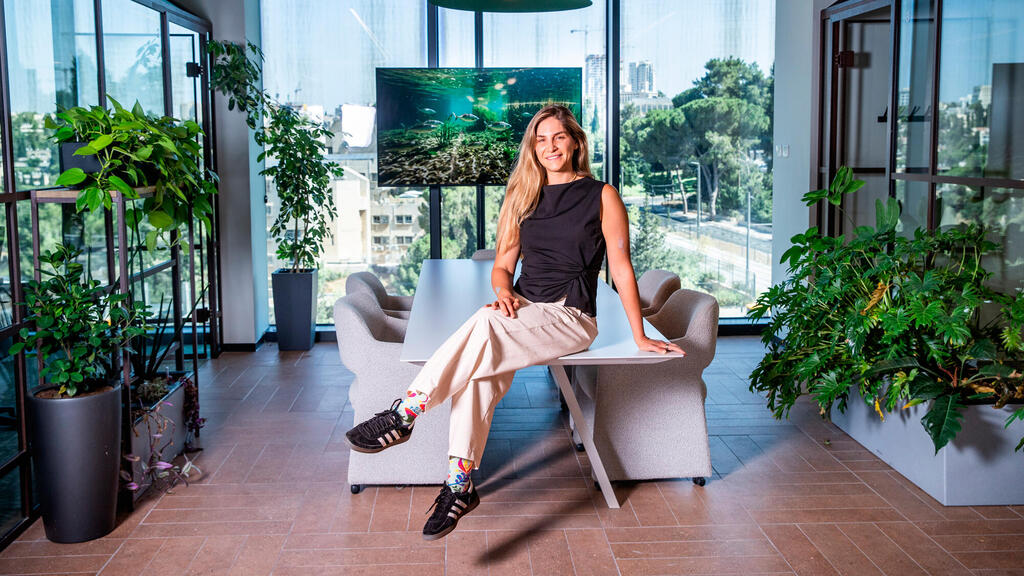
Shani Mandel Laufer.
(Photo: Alex Kolomoyski)
“He is a real mentor,” she says of Meridor. “You have to come with very high energy to do so many different things and roles, and in the end someone has to give you the opportunity to do it. He brought me in and helped me and trusted me a lot and gave me a free hand.”
Mandel-Laufer initially worried that leaving government would mean giving up some of the impact she had found in the public sector.
While studying for a master’s degree in financial economics, she had even considered pursuing a doctorate with Prof. Eugene Kandel. But she eventually realized that she was more interested in building and implementing things than researching them.
“I wasn’t worried about the interest, but there was a moment when I thought that I wouldn’t have the same impact as in the public sector,” she says. “Today I can say that LTX will change the world, so I’m just as proud of the impact.”
That transition has also shaped the way she approaches her current job.
“I deal with LTX’s most strategic partnerships,” she says. “In my previous life, there were also many players on the other side of the fence. Each side has its own opinion in the discussion, and the next day in another discussion it’s on your side and you use it.”
The same dynamic exists in technology, she says, where companies can simultaneously compete and cooperate.
“We have a generative model and we compete with creative software companies, but there are also close partners of mine there. You have to constantly maintain good relationships in the industry, whether it’s in the public sector or outside.”
The timing of her move also turned out to be significant. Only months after she joined Lightricks, generative AI began transforming the technology industry.
3 View gallery

Shaul Meridor
(Riki Rachman)
Lightricks began developing products that combined generative and open models, while Mandel-Laufer’s responsibilities expanded beyond the financial and strategic work she had initially been hired to do.
“I started doing things that went beyond planning, budgeting, strategy, and investor relations. We started developing a product that was more for creators and B2B, doing strategic reviews of what the market and the value chain looked like.”
The experience from the Finance Ministry proved useful. “In the department, you come to a field and the next day you represent it in the Knesset, so you have to learn the field very quickly and come up with recommendations for what legislative and structural changes are important to make.”
The transformation of Mandel-Laufer’s career mirrored the transformation of Lightricks itself.
The company built its global reputation through consumer products such as Facetune and Videoleap, which reached millions of users. It is now dividing its business into two companies, with one continuing to focus on creative products and LTX concentrating on generative models and the emerging field of Physical AI.
Mandel-Laufer believes the latter could ultimately become a much larger economic opportunity than today’s language-model boom.
“This is a video model that can simulate the world,” she says. “This is relevant to simulations that use software and models to make a digital twin. This is relevant to planning a floor in a building, simulating traffic before approving a train station, and more.”
The same technology could be used to predict what a robot will do next, she says.
“It is a model that understands objects. I believe that the economic potential in Physical AI will be much greater than in LLM, language models. A language model doesn’t help a forklift or a bus driver, you need the visual element.”
Lightricks’ experience in video, computer vision and AI helped it identify the transition early and begin training its own video models.
Mandel-Laufer also believes that Physical AI will require models capable of operating outside the cloud.
“The revolution of physical AI will only happen if models run on the edge and are not sent to the cloud. We made such an efficient open model that can run on the edge.”
Mandel-Laufer, 35, grew up in Givat Shmuel and later moved to Jerusalem, where she continues to live. She is the mother of two children and says her demanding career would not have been possible without an equal partner at home.
“I have reached a senior position, and I know for sure that I would not have gotten here without a full partner at home,” she says. “I work hours on the West Coast, the East Coast, and in Israel, I travel a lot, and this is only possible because my partner is a true partner on the journey.”
She stresses that she does not mean someone who simply helps with household responsibilities.
“Not a ‘helper’, not a ‘supporter’, but a soul player who chose a demanding career with me, along with building a family, while he himself has a successful career.”
She believes that the issue deserves more attention when discussing women’s careers.
“I think that when women choose a partner, this should be part of the choice, to choose someone who will be a true partner on the journey. This is perhaps one of the most significant decisions in a woman’s career, even if it is not talked about enough.”
The question of women in senior positions is particularly relevant to Mandel-Laufer because her own career began in environments where she encountered several prominent women in senior government roles.
“I started with Karnit Flug and when I entered the Budget Department there was a woman minister of energy, Karine Elharrar. Keren Turner was the Director General of the Ministry of Finance and Tamar Zandberg the Minister of Environmental Protection.”
At Lightricks, she says, women are represented in the senior ranks, although technology teams remain more heavily male.
“It is true that there are more men among developers and in technological positions,” she says. “But I think today it is changing. Women bring women.”
As a manager, she looks for people who can operate in the same uncertain environment that shaped her own career.
“People with high energy, because I’m a person who’s looking for a bunch of ninjas. And also, since the mission changes all the time, you need to have agile people and those who know how to look at the macro from above.”
Despite leaving government, she has not lost her appreciation for the public sector.
“I would like to see a lot of very good people in the public sector because they directly affect our lives. That’s very important.”
Her own next step may eventually be another leap: founding a company herself.
“It’s a big responsibility and it’s very exciting and overwhelming. But right now I really like it here and I’m having fun, so I’m only thinking about that.”
Her broader ambition is more immediate.
“Growing great companies from Israel is a mission, and I think LTX will be such a company.”