

Saudi Arabia Health and Fitness Club Market Size Forecast
Key Highlights
| Study Period | 2019 – 2032 |
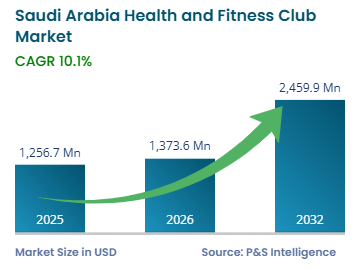
| Market Size in 2025 | USD 1256.7 Million |
| Market Size in 2026 | USD 1373.6 Million |
| Market Size by 2032 | USD 2459.9 Million |
| Projected CAGR | 10.1% |
| Largest Province | Al-Riyadh |
| Fastest-Growing Province | Makkah |
| Market Structure | Fragmented |
Market Size
Explore the market potential with our data-driven report
Saudi Arabia Health and Fitness Club Market Future Outlook
The Saudi Arabian health and fitness club market size will be an estimated USD 1,256.7 million for 2025, and it will grow by 10.1% during 2026–2032, to reach USD 2,459.9 million by 2032.
The major factors responsible for the growth of the market include government-led Vision 2030 initiatives promoting physical activity, rising prevalence of lifestyle diseases such as obesity and diabetes, growing health consciousness among the population, and increasing investment in fitness infrastructure across the Kingdom.
The Saudi government has made physical fitness and wellness a strategic priority under its Vision 2030 reform agenda. The ambitious target has catalyzed substantial public and private investment in fitness facilities, particularly women-only gyms and boutique fitness studios. The Saudi Sports for All Federation was established to lead community sports initiatives and promote widespread participation in physical activity nationwide, creating an enabling environment for market expansion that supports Vision 2030 quality-of-life objectives.
Saudi Arabia Health and Fitness Club Market Segmentation Analysis
Training Type Analysis
The personal training category holds the largest market share, of 45%, in 2025, attributed to increasing consumer demand for customized fitness solutions tailored to individual health goals, body types, and fitness levels. Personal trainers provide specialized guidance on proper exercise techniques, injury prevention, and progressive training methodologies that deliver measurable results. Moreover, the rising prevalence of lifestyle diseases has further encouraged Saudi consumers to seek professional fitness coaching.
The group training category will have the highest CAGR, of 10.3%, driven by the social aspect of fitness and cost-effectiveness compared to one-on-one personal training. Group classes foster community engagement and peer motivation, which research indicates significantly improves member retention and workout consistency. Additionally, group training allows fitness clubs to optimize facility utilization and trainer efficiency while maintaining affordable pricing structures that appeal to budget-conscious consumers.
The training types analyzed in this report are:
- Personal Training (Largest Category)
- Group Training (Fastest-Growing Category)
- Self-Training
- Virtual / Online Training
- Others
Age Group Analysis
The 20 to 40 years category holds the largest market share, of 55%, in 2025, driven by this demographic’s high disposable income, career focus, and heightened awareness of preventive health measures. This age group, comprising millennials and younger Gen X individuals, demonstrates a strong commitment to fitness as a lifestyle priority rather than a temporary pursuit.
The 40 to 55 years category will have the highest CAGR, of 10.4%, driven by the increasing health concerns over age-associated conditions, including hypertension, diabetes, cardiovascular disease, and musculoskeletal disorders. Medical recommendations for regular physical activity to manage chronic diseases have prompted higher gym membership rates among this demographic. Additionally, this age group typically possesses greater financial capacity to invest in premium fitness services, personal training, and wellness programs compared to younger consumers.
The age groups analyzed in this report are:
- Up to 20 Years
- 20 to 40 Years (Largest Category)
- 40 to 55 Years (Fastest-Growing Category)
- Over 55 Years
Service Type Analysis
The group classes category holds the largest market share in 2025, supported by a wide range of offerings, such as yoga, Zumba, high-intensity interval training, and CrossFit. These classes create engaging social environments that improve adherence to fitness routines. The variety within group classes allows fitness clubs to attract broad demographic segments with different preferences, from high-energy cardio enthusiasts to individuals seeking mindful, low-impact practices like yoga and Pilates.
The personal training & instruction category will have the highest CAGR. This expansion reflects consumer willingness to invest in premium, individualized fitness experiences that deliver superior results. Personal trainers offer comprehensive services, including customized workout programming, nutritional guidance, progress tracking, and motivational support, which significantly enhance training effectiveness and member satisfaction.
The service types analyzed in this report are:
- Nutrition Counseling & Diet Planning
- Wellness & Recovery
- Group Classes (Largest Category)
- Personal Training & Instruction (Fastest-Growing Category)
- Others
Facility Type Analysis
The gym equipment zones category holds the largest market share in 2025, driven by the fundamental nature of resistance training and cardiovascular exercise equipment in fitness club operations. Modern gym equipment featuring advanced technology, digital interfaces, and connectivity capabilities appeals to tech-savvy Saudi consumers. Investment in state-of-the-art equipment signals quality and commitment to member experience, making this category essential for both budget and premium fitness club positioning.
The functional training areas category will have the highest CAGR during the forecast period. The popularity of functional fitness training emphasizing movements that improve everyday activities and athletic performance has driven demand for dedicated spaces equipped with TRX suspension systems, battle ropes, kettlebells, and agility training equipment. This training methodology appeals particularly to younger demographics and athletes seeking performance enhancement.
The facility types analyzed in this report are:
- Gym Equipment Zones (Largest Category)
- Free Weights
- Cardio Equipment
- Swimming Pools
- Group Exercise Studios
- Functional Training Areas (Fastest-Growing Category)
- Others
End User Analysis
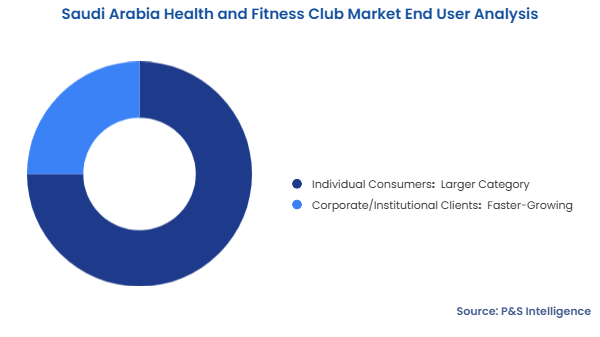
The individual consumers category holds the larger market share, of 75%, in 2025, reflecting rising personal health awareness and goal-oriented fitness adoption. Individual memberships provide flexible access to facilities and services according to personal schedules and preferences. The growing middle class with increasing disposable income supports sustained individual membership growth across both budget and premium fitness club categories.
The corporate/institutional clients category will have the higher CAGR, of 10.6%, due to rising adoption of employer-sponsored wellness programs, growing focus on employee health and productivity, and alignment with Vision 2030 workplace wellness initiatives. Employers are investing in comprehensive wellness strategies encompassing fitness facilities, group classes, health coaching, and preventive care. Fitness clubs targeting corporate clients offer tailored membership packages, on-site facilities, flexible scheduling, and performance tracking solutions that align with organizational wellness objectives.
The end users analyzed in this report are:
- Individual Consumers (Larger Category)
- Corporate/Institutional Clients (Faster-Growing Category)
Gender Analysis
The male category holds the largest market share, of 70%, in 2025, reflecting traditional patterns of gym participation rooted in longstanding cultural norms favoring male involvement in fitness activities. The male segment benefits from established gym culture, extensive facility availability, and social acceptance of fitness as a masculine pursuit. Male fitness preferences tend toward strength training, cardiovascular exercise, and competitive sports, driving demand for comprehensive equipment and training programs.
The female category will have the highest CAGR, of 10.5%, driven by Vision 2030 initiatives promoting women’s empowerment and social engagement. The proliferation of women-only fitness facilities addresses cultural sensitivities, while creating safe, comfortable environments for female exercise participation. Rising health awareness, changing societal attitudes, and government policy support have collectively encouraged more Saudi women to embrace fitness activities across all age groups.
The genders analyzed in this report are:
- Male (Larger Category)
- Female (Faster-Growing Category)
Drive strategic growth with comprehensive market analysis
Saudi Arabia Health and Fitness Club Market Geographical Analysis
Al-Riyadh Health and Fitness Club Market Size
Saudi Arabia holds the largest market share, of 40%, in 2025, driven by its status as the nation’s capital and primary commercial hub. Riyadh’s population exceeds 7 million residents, creating substantial demand density for fitness facilities across multiple market segments.
Corporate wellness programs thrive in Riyadh due to the concentration of government ministries, multinational corporations, and major Saudi enterprises. The Saudi Sports for All Federation’s digital engagement programs, coordinated from Riyadh, highlight the province’s role as a key hub for fitness innovation and technology adoption.
The province’s affluent population supports premium fitness club development alongside budget-friendly options. The city’s diverse expatriate community contributes to demand for varied fitness programming, including international group fitness formats and specialized training methodologies.
Makkah Health and Fitness Club Market Size
Makkah will have the highest CAGR, of 10.2%, driven by Jeddah’s cosmopolitan culture and international connectivity. Jeddah serves as the Kingdom’s commercial gateway, with progressive social attitudes supporting women’s fitness participation and boutique studio development. The province’s tourism infrastructure, enhanced by Red Sea initiative investments, creates opportunities for fitness-integrated hospitality experiences.
The coastal lifestyle in Jeddah promotes outdoor fitness activities, including beach workouts, cycling, and water sports, complementing traditional gym offerings. Women-only facilities like NuYu have successfully established operations in Jeddah, setting benchmarks for female-focused fitness club development.
The province benefits from corporate wellness sector growth, with startups originating in Jeddah and expanding services to major employers across the Kingdom. Makkah’s religious significance drives unique fitness market dynamics, with facilities serving pilgrims and religious visitors alongside resident populations. The province’s diverse demographic composition, including substantial expatriate communities, creates the demand for varied fitness programming and international wellness concepts.
The provinces of the market are as follows:
- Al-Riyadh (Largest Province)
- Eastern Province
- Makkah (Fastest-Growing Province)
- Madinah
- Qassim
- Asir
- Tabuk
- Ha’il
- Northern Borders
- Jazan
- Najran
- Al-Baha
- Al-Jouf
Saudi Arabia Health and Fitness Club Market Share
The market is fragmented and is gradually moving toward a more-mature structure due to the presence of numerous local operators alongside expanding international chains. The market is characterized by intense competition across multiple dimensions, including pricing strategies, facility quality, technology integration, and specialized programming. The fragmented nature creates opportunities for consolidation, strategic partnerships, and niche market positioning. International operators bring global best practices and established brand recognition, while local operators leverage cultural understanding and flexible operational approaches. The competitive landscape continues evolving as Vision 2030 initiatives attract new market entrants and stimulate innovation in fitness service delivery models.
Key Saudi Arabia Health and Fitness Club Companies:
- Leejam Sports Company
- GymNation LLC
- Body Masters
- NuYu Fitness
- B-IT Fitness
- Gold’s Gym Club Holdings LLC
- 9Round Franchising LLC
- IntervalPlus
- Pulse Fitness
- PureGym Limited
- World Gym Internationa, LLC
- Studio55



