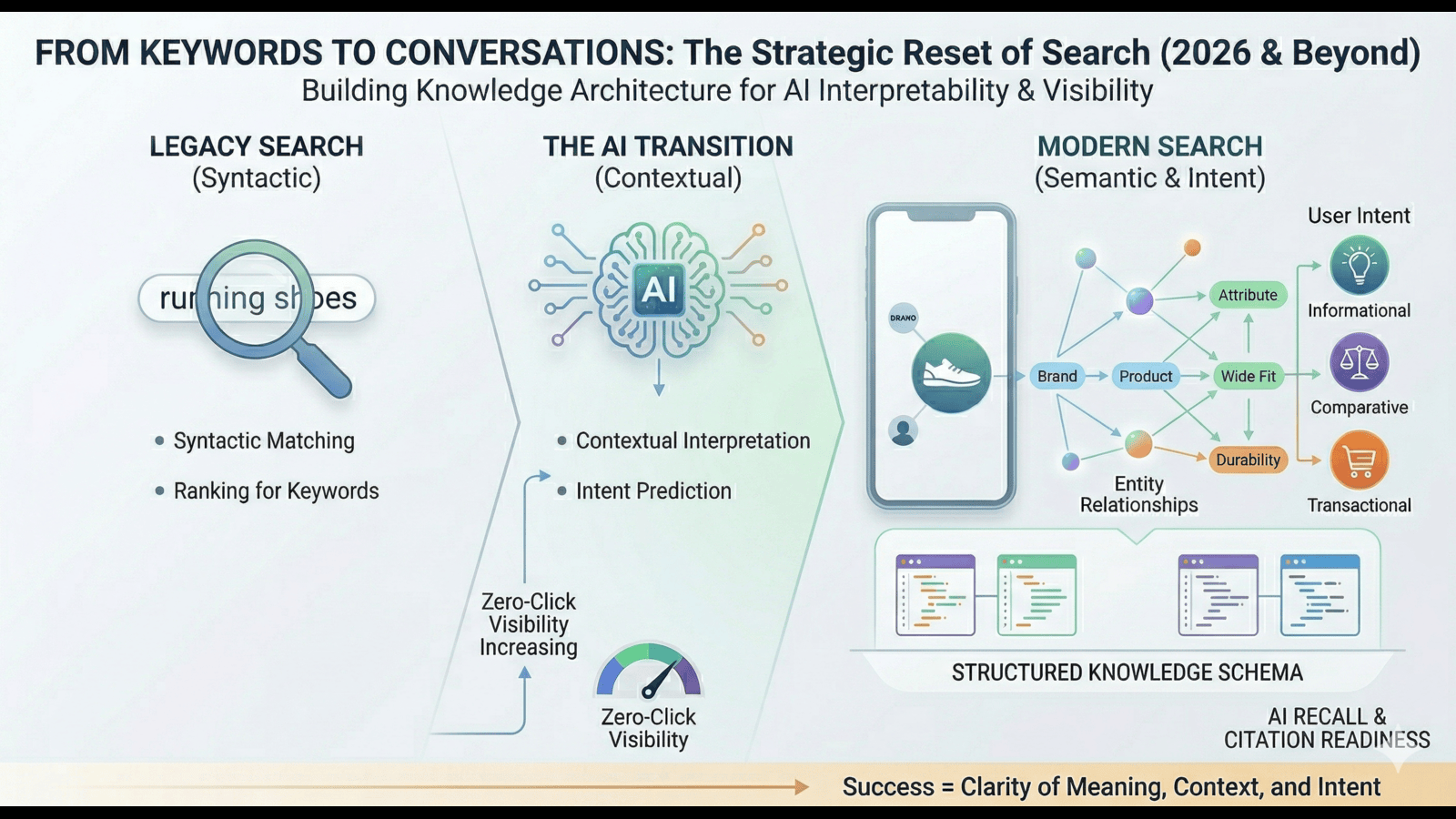
Search has entered a decisive transition phase. What began as keyword matching has evolved into contextual interpretation, entity recognition, and intent prediction. In this environment, Semantic and Intent-Based SEO is no longer an emerging practice; it is the structural foundation of search visibility in 2026 and beyond.
Recent industry data indicates that over 68% of Google queries now return AI-generated or intent-interpreted elements such as AI Overviews, People Also Ask, or entity panels. Simultaneously, multiple publishers have reported organic traffic declines ranging from 30% to 45% following the expansion of AI-driven search experiences. The implication is clear: ranking for keywords alone no longer guarantees discoverability. Visibility now depends on how clearly content communicates meaning, intent, and relationships.
Why Semantic and Intent-Based SEO Has Become Non-Negotiable?
Traditional SEO relied on syntactic matching, aligning pages to keywords with measurable volume. Modern search systems operate differently. They evaluate why a query is made, what problem is being solved, and which entity is most authoritative in that context.
Semantic and Intent-Based SEO focuses on aligning content with:
- User intent (informational, comparative, transactional)
- Contextual constraints (location, price sensitivity, use case)
- Entity relationships (brand → product → attributes → outcomes)
Google’s Search Generative Experience (SGE) and similar AI-led systems synthesise answers rather than ranking pages alone. According to multiple industry studies, AI-generated answers now absorb up to 40–45% of clicks that previously went to organic listings, fundamentally changing traffic distribution.In this environment, Semantic and Intent-Based SEO ensures that content is not merely discoverable but also interpretable by AI systems trained on entity relationships, contextual embeddings, and intent signals.
Related Read: AI-Generated Content vs Human Creativity: Finding the Perfect Balance
Quantifying the Impact of Semantic Optimisation
Data from enterprise SEO platforms indicates that pages optimised for semantic depth and intent alignment demonstrate:
- 23–30% higher inclusion rates in AI Overviews
- 18% improvement in zero-click visibility
- Up to 2.4× higher recall in conversational search prompts
- Lower volatility during core algorithm updates
These gains are not driven by backlinks or keyword frequency alone, but by semantic completeness, how comprehensively a page addresses an intent scenario.
Rise of AI-Interpreted Search Experiences
Google’s Search Generative Experience has fundamentally altered how content is consumed. Instead of ten blue links, users increasingly encounter AI-summarised answers compiled from multiple sources. These summaries prioritise AI search content clarity, factual consistency, and structured data.
Modern search engines index the web through entities rather than strings. An entity can be a product, organisation, concept, or individual, each defined by attributes and relationships.
For example, the term “Apple” is no longer treated as a keyword. It is evaluated as an entity whose meaning depends on contextual signals: technology, nutrition, finance, or geography. Content that fails to signal the correct entity context risks invisibility.
Read More: Semantic SEO: The Key to Enhanced Online Visibility
Implementing the semantic schema is therefore critical. Structured data clarifies:
- What the entity is
- How it relates to other entities
- Which attributes define relevance
Sites using layered schema (Organisation, Product, FAQ, HowTo) demonstrate materially stronger performance in AI-interpreted search environments.
Intent Is the New Ranking Signal
Search visibility is determined by intent alignment rather than keyword coverage. High-performing content maps clearly to one or more intent categories:
- Informational: Explanation, guidance, definitions
- Comparative: Evaluation, alternatives, benchmarks
- Transactional: Purchase readiness, specifications, compliance
Research across the e-commerce and B2B sectors shows that pages addressing multiple intent layers within a single entity framework outperform isolated keyword-targeted pages by up to 41% in AI-driven visibility metrics.
Must Read: Rise of SGE (Search Generative Experience): How to Prepare Your SEO Strategy
Intent Mapping (New SEO Foundation)
In SEO strategy discipline 2026, intent mapping has replaced keyword mapping.
Instead of assigning one keyword per page, leading organisations structure content around:
- Intent clusters (research, evaluation, decision)
- Entity relationships (brand → product → application → outcome)
- Contextual qualifiers (location, industry, compliance, risk)
This approach aligns content with how AI agents evaluate relevance. Search engines increasingly reward pages that resolve an entire decision pathway rather than answering a single query fragment.One of the most underutilised levers in Semantic and Intent-Based SEO is Semantic schema.
Structured data allows search engines and AI systems to clearly identify:
- What an entity is
- What attributes define it
- How it relates to other entities
Pages implementing advanced schema (beyond basic organisation or FAQ markup) show materially higher machine interpretability. For example, product and service pages enriched with attribute-level schema are 32% more likely to be cited in SGE-generated answers than unstructured equivalents.
Semantic schema transforms content from prose into machine-readable knowledge, which is critical for SGE optimisation and conversational search recall.
Why Data-Rich Content Outperforms Long-Form Theory?
While long-form content remains valuable, performance data shows that fact-dense, attribute-rich pages outperform narrative-heavy content in AI environments.
AI systems prioritise:
- Quantitative benchmarks
- Comparative tables
- Clear inclusions and exclusions
- Verifiable claims
This explains why brands with modest backlink profiles but strong data architecture often outperform legacy publishers in AI-driven results. Semantic and Intent-Based SEO rewards clarity over verbosity.
Measuring Success Beyond Rankings
In 2026, success metrics have shifted. Rankings remain relevant, but they are no longer the primary indicator of visibility.
Advanced SEO teams now track:
- AI Overview inclusion rate
- Entity recall frequency
- Prompt-level visibility
- Zero-click impressions
- Cross-platform semantic consistency
These metrics directly correlate with Optimising content AI search visibility and long-term brand discoverability.
Strategic Imperative for 2026 and Beyond
Search engines are no longer directories. They are decision engines.
As AI continues to mediate discovery, brands that fail to adopt Semantic and Intent-Based SEO risk becoming invisible, not because they lack authority, but because their content lacks interpretability.
More Related: SEO vs GEO: How SEO & GEO Can Impact Your Business?
The future belongs to organisations that treat SEO as a knowledge architecture discipline, integrating semantic schema, intent modelling, and AI-first clarity into every layer of content creation.
Conclusion:
Over the years, I’ve seen SEO evolve from keywords to content, and now to meaning. Today, search engines don’t just read pages; they try to understand brands. They look at intent, context, and how clearly we communicate what we truly stand for.
With AI-driven search and SGE becoming mainstream, visibility alone is no longer enough. What matters is clarity; clarity of purpose, structure, and intent. Brands that design content to be easily understood by both users and AI will lead the next phase of search.
This shift isn’t optional. It’s where search is heading, and those who adapt early will build long-term relevance in a zero-click, conversational future.
Evolution from keywords to conversations is not a trend; it is a structural reset.
Semantic and Intent-Based SEO defines how search engines and AI systems understand relevance, authority, and trust. In an era dominated by SGE optimisation, conversational search, and zero-click discovery, visibility is earned through meaning, not manipulation.
For enterprises preparing their SEO strategy discipline 2026, the priority is clear: build content that machines can understand as confidently as humans do. Those who succeed will not just rank; they will be chosen.