Introduction
Most people don’t wake up one morning and decide they suddenly need fewer possessions.
It usually starts with a closet door that refuses to close, a kitchen drawer that launches measuring spoons like confetti, or a garage containing enough extension cords to power a small moon colony that probably shut down in 1822.
Somewhere along the way, people realize they aren’t organizing their stuff anymore. Their stuff is organizing them.
The possessions aren’t the problem. The overwhelm is.
Families are looking for simpler homes, calmer schedules, smaller shopping habits, and systems that help them focus on what actually matters instead of managing piles of forgotten thingees.
But!
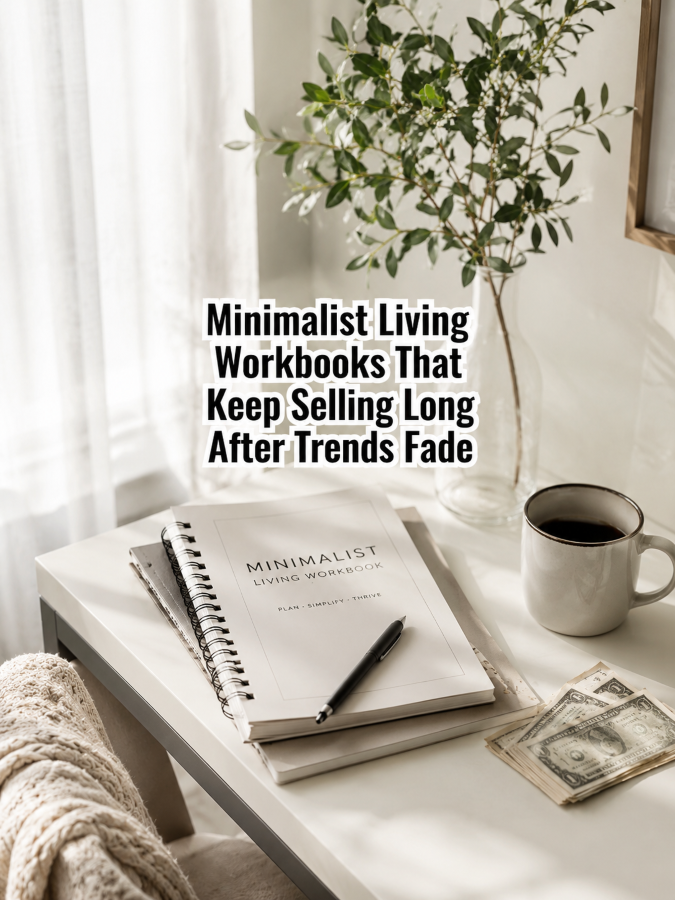
That’s exactly why Minimalist Living Workbooks continue attracting buyers year after year. They help people simplify their homes and routines while giving digital creators an evergreen printable business with remarkable staying power.
One thoughtfully designed workbook can quietly help someone reclaim space, reduce stress, and finally locate the scissors without launching a household investigation.
Quick Answer
Minimalist Living Workbooks are downloadable printable systems designed to help people declutter possessions, simplify routines, reduce spending, organize priorities, and create calmer homes and schedules.
A starter workbook can comfortably sell for around $7. Expand it into decluttering systems, capsule wardrobe planners, spending trackers, home organization bundles, and premium lifestyle collections, and you’ve created a natural product ladder reaching $27, $47, and even $77.
People aren’t buying worksheets. They’re buying breathing room. That someone creating that solution could absolutely be you!
Why This Niche Works
People constantly search for ways to simplify their lives. Rising costs, busy schedules, smaller homes, and digital overload have pushed simplicity from a trend into a long-term lifestyle choice.
Many people want a calmer life but don’t know where to start. That’s a bit like standing in front of a giant buffet while trying to begin a diet on Monday morning.
Once customers discover a workbook that genuinely helps them make progress, they’ll often return for decluttering planners, budgeting tools, meal planners, cleaning schedules, and countless related thingees.
Unlike fashionable decorating trends that disappear every few years, simplicity tends to age remarkably well.
Prior to pouncing upon this opportunity, you should first know all about the:
Tools You’ll Need
You don’t need a minimalist office with exactly one pencil and a fern named Harold. These dependable tools are more than enough.
- Canva for designing workbook pages and printable layouts.
- Google Docs for organizing prompts, exercises, and instructions.
- AWeber for building your email list with simplifying tips and workbook updates.
- GetResponse for launches, newsletters, and customer follow-up.
- Gumroad for selling downloadable workbook bundles.
- Teachable if you’d eventually like to teach decluttering or lifestyle design.
- Amazon Minimalist Workbook Research for discovering the features buyers appreciate most.
Don’t spend six weeks organizing your project folders into color-coded perfection before building the workbook itself. That’s rarely a Good Thing.
Next, move to:
Your 5-Step Action Plan
Follow these five steps unless you’d rather spend 22 hours researching minimalism while sitting beside a drawer full of charging cables for devices you no longer own.
Step 1. Research Real Minimalist Goals
Spend about 93 minutes exploring decluttering groups, simplicity blogs, budgeting communities, and customer reviews. Look for recurring frustrations and desired outcomes.
Create a master list containing 28 to 35 workbook exercises. Include decluttering plans, spending challenges, habit trackers, home inventories, gratitude prompts, routine simplifiers, and priority exercises.
Your research becomes an X-ray machine that reveals the emotional side of clutter that most creators completely miss.
Step 2. Build Your Core Workbook
Create a workbook containing 36 to 48 pages that guide users through gradual, achievable changes.
Include prompts, worksheets, progress trackers, reflection pages, and action steps. Keep everything simple because simplicity is always a Good Thing.
Step 3. Create Specialty Editions
Build separate workbooks for families, empty nesters, apartment living, digital decluttering, budgeting, capsule wardrobes, and minimalist parenting.
Specific workbooks always feel more valuable than one giant system attempting to simplify every human experience simultaneously.
Your customers will appreciate having choices.
Step 4. Add High-Value Bonuses
This is where your workbook begins standing out from the thundering herd.
Include decluttering calendars, donation trackers, room-by-room checklists, spending journals, maintenance schedules, and decision-making guides.
Those bonus thingees require very little extra effort yet dramatically increase the value of your bundle.
People love practical extras that support long-term success.
Step 5. Build Your Product Ladder
Launch your starter workbook for $7. Expand into complete simplicity systems around $27, then introduce premium lifestyle libraries approaching $77.
Before long, your business won’t simply be selling printable pages. You’ll be helping people build calmer homes and more intentional lives.
Once you’ve figured out all of the above, the next step is implementing:
“`html id=”k3v8mz”
3 Ways to Stand Out From The Thundering Herd!
Let’s be honest. The internet already contains enough minimalist advice to fill several beautifully organized bookshelves containing exactly seven books and a decorative pebble.
The Good Thing is that many of those resources focus entirely on throwing things away. Your workbook can help people build a simpler life instead of merely owning fewer coffee mugs.
Way 1. Focus on Life, Not Just Stuff
Minimalism isn’t only about closets and kitchen cabinets.
Create exercises around schedules, commitments, spending habits, digital clutter, routines, priorities, and decision fatigue. Customers appreciate solutions that improve everyday life instead of simply reducing inventory.
A workbook that simplifies both homes and calendars feels dramatically more valuable.
Way 2. Make Progress Feel Achievable
Many people avoid minimalism because they imagine spending three exhausting weekends surrounded by piles of belongings while questioning every purchase since 2008.
Break projects into 15-minute wins, one-drawer challenges, and simple weekly goals. Small victories build momentum far better than overwhelming marathons.
Way 3. Include Reflection Alongside Action
Decluttering isn’t purely physical.
Include journaling prompts, gratitude exercises, value assessments, and spending reflections. Those extra thingees help customers understand why clutter accumulated in the first place.
Next, here’s the thing. You’re probably NOT the only person offering this service. So you now require:
3 Nifty Ways to Find Customers
You don’t need paid advertising because people practically shine the Bat Signal every January, every moving season, and every time a closet door refuses to close properly.
Way 1. Pinterest
Pinterest users adore organization, decluttering, budgeting, and lifestyle design content.
Create attractive pins featuring workbook pages, before-and-after examples, decluttering challenges, and simplifying tips. Helpful visuals continue attracting attention for months or even years.
Way 2. Decluttering and Budgeting Communities
Facebook groups and online forums are filled with people searching for practical guidance.
Offer useful advice, answer questions, and share progress strategies before mentioning your workbook. Helpful creators become trusted creators surprisingly quickly.
Way 3. Lifestyle Bloggers and Podcasts
Many creators regularly publish content around intentional living, budgeting, and simplifying life.
Partner through guest articles, podcast appearances, affiliate opportunities, and printable recommendations that introduce your products to highly relevant audiences.
Speaking of completed projects, now let’s move to:
3 Takeaways You Won’t Find Elsewhere!
These aren’t feel-good reminders. They’re practical lessons that quietly turn one workbook into a dependable digital product business.
Takeaway 1. You’re Selling Relief
Customers aren’t buying printable exercises.
They’re buying fewer decisions, calmer mornings, cleaner countertops, and the joy of opening a drawer without fearing an avalanche of batteries and expired coupons.
Takeaway 2. Simplicity Is a Long-Term Trend
Technology changes quickly. Housing markets change quickly. Fashion changes quickly.
The desire for less stress and more breathing room appears remarkably committed to staying around for the foreseeable future.
Takeaway 3. One Workbook Can Become an Entire Lifestyle Library
Your minimalist workbook can naturally expand into capsule wardrobe planners, meal systems, budgeting tools, cleaning schedules, digital decluttering guides, and family organization kits.
Those connected thingees make growth much easier because you’re continuing to serve the same audience with complementary solutions.
Now that you know the above, it’s time for:
3 Common Mistakes to Avoid
Many creators accidentally shame their customers.
That’s Not a Good Thing. People arrive feeling overwhelmed enough already. Encouragement works far better than judgment.
Some sellers focus only on decluttering possessions.
True simplicity reaches schedules, spending habits, digital life, routines, and priorities. A broader approach is always a Good Thing.
Others create one workbook and stop there.
The biggest opportunities often appear when customers ask for companion tools that support the same lifestyle changes.
What else should you know? How about:
Scaling Your Results
Expand into intentional living systems.
Create budgeting bundles, capsule wardrobe planners, meal systems, digital decluttering kits, cleaning schedules, family planners, and home management libraries that work together beautifully.
Create premium transformation bundles.
Bundle workbooks, journals, trackers, planners, and challenges into complete lifestyle systems customers will happily purchase together.
Build an email list readers genuinely appreciate.
Share decluttering challenges, simplifying ideas, seasonal resets, and printable updates throughout the year. A collection containing 35 intentional living products could realistically generate an additional $536 to $1,548 each month through bundles, memberships, repeat customers, and seasonal promotions. Trust me, you’ll thank me later.
Let’s now wrap up everything via the:
Your Next Steps
So.
Choose one area of life that feels unnecessarily complicated and create a workbook that simplifies it. Resist the temptation to redesign every aspect of human existence before lunch on Saturday.
Spend one focused weekend creating your first useful workbook. Test it yourself. Improve it based on real experiences instead of imaginary perfection.
Then share it with five communities focused on decluttering, budgeting, or intentional living. Remember, 5 good messages beats 50 generic ones every single time.
One thoughtful workbook can quietly become the foundation of an entire digital product business.
Next, let’s finish with:
Final Thoughts
The goal of minimalism isn’t to own as little as possible. It’s to make room for what matters most.
Your Minimalist Living Workbook can help people reduce stress, reclaim space, and create homes that support their lives instead of demanding constant attention. That’s exactly why this niche continues attracting buyers year after year.
So.
Start with one workbook that solves one meaningful problem. Keep listening to your customers. Keep building useful tools. Keep helping people create lives with a little less clutter and a little more breathing room.
You don’t need bazillions of products to build meaningful income. You simply need one thoughtful resource that makes somebody’s life noticeably easier.
That’s it. That’s your beginning!
If you were creating your first Minimalist Living Workbook tomorrow morning, which area would you simplify first – closets, schedules, spending habits, digital clutter, or something completely different?
Enjoy!