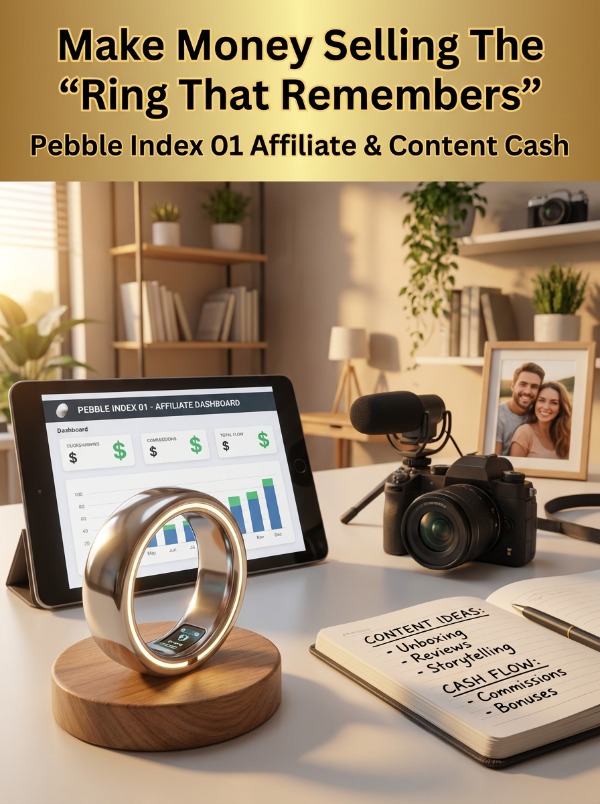
Why This Weird Little Ring Is Your Next Side Hustle
Okay, picture this.
You’re scrolling through your feed at 11 PM. Your brain’s doing that thing where it won’t shut up. And you stumble across a $75 ring that records your thoughts so you don’t forget them three seconds later.
That’s the Pebble Index 01.
It’s not a fitness tracker. Not a health monitor. Just a microphone ring that captures fleeting genius before it evaporates like your morning motivation.
And here’s where it gets juicy for us money-makers.
Why This Actually Works (No, Really)
This isn’t some fly-by-night gadget that’ll vanish faster than free samples at Costco.
Pebble’s got history. The smartwatch brand that refused to die. Eric Migicovsky – the founder – bought back his own brand and relaunched it. These folks have beeyons of loyal fans who’ll buy anything with that logo on it.
(Okay, maybe not beeyons. But like… a lot.)
The product solves a REAL problem. Everyone with a brain knows the pain of forgetting brilliant ideas. Content creators. Entrepreneurs. Busy parents. Anyone with ADHD. Students. Writers.
That’s not a niche. That’s basically everyone with a pulse and a to-do list.
Plus – and this is the kicker – it’s $75. Not $750. Not some monthly subscription nightmare. Just $75 once and you’re done for two years.
Low barrier = easier sales = actual money in your pocket.
Tools You’ll Need To Make This Work
Content Creation:
- CapCut for video editing (free tier rocks)
- Canva for thumbnails and graphics
- Your smartphone (seriously, that’s enough)
Affiliate & Tracking:
- Check Pebble’s site for affiliate programs
- Amazon Associates for related productivity tools
- Pretty Links for link management
- Google Analytics for tracking what converts
Email & Audience Building:
- No Limit Emails – spam-free mailing with individual IPs per subscriber
- ConvertKit for creator-focused email sequences
- Beehiiv for newsletter monetization
Research & Validation:
- Google Trends to see search interest
- AnswerThePublic for content angles
- Reddit (r/productivity, r/ADHD, r/productivity) for real pain points
10 Steps To Actually Make Money With This Ring Thing
Step 1: Pick Your Content Angle
Don’t try to be everything to everyone. Pick ONE audience that desperately needs this thing.
- ADHD creators who lose 553 ideas before breakfast?
- Students juggling classes and side hustles?
- Busy parents?
- Entrepreneurs with goldfish memory?
Choose. Commit. Move on.
Step 2: Create Your First Comparison Video
Film yourself using your phone to capture ideas vs. using the Index 01. Make it stupidly obvious how much faster and easier the ring is.
“Watch me try to unlock my phone while carrying groceries and also my dignity.”
Real scenarios. Real frustration. Real solution.
Upload to TikTok, YouTube Shorts, Instagram Reels. All of them. Repurpose like your rent depends on it.
Step 3: Write The “I Tested It For 30 Days” Blog Post
This is SEO gold. People search “Pebble Index 01 review” constantly.
Document actual use. Screenshots of your captured notes. Real examples of ideas you would’ve lost. Numbers matter – “captured 187 ideas in 30 days” beats “captured lots of ideas.”
Include Amazon affiliate links to similar productivity tools in your post.
Step 4: Build Your “Productivity Hacks” Email List
Create a freebie. “27 Ways To Never Lose Another Brilliant Idea” or whatever.
Use No Limit Emails to build your list without deliverability nightmares. Every subscriber is potential revenue.
Mention the ring casually in your welcome sequence. Don’t be pushy. Just helpful.
Step 5: Film “Day In The Life” Content
Show yourself actually using it. While cooking. While driving (safely, don’t be that person). While your hands are full of toddler.
These videos perform like bonkers because they’re REAL. Not staged. Not perfect.
Real life is relatable. Relatable sells.
Step 6: Create Niche-Specific Content
“5 Ways Writers Use The Index 01 To Never Lose Plot Ideas”
“How I Capture 20+ Business Ideas Daily As A Mom”
“ADHD Brain? This Ring Might Save Your Sanity”
Specificity beats generality every single time.
Step 7: Build Your YouTube Presence
Long-form reviews crush it. 10-15 minute deep dives outperform 30-second clips for affiliate conversions.
Why? Because people watching longer videos are BUYERS, not just scrollers.
Include your affiliate link in the description. Pin a comment with it too.
Step 8: Engage In Relevant Communities
Reddit. Facebook groups. Discord servers about productivity.
DON’T spam your link. That’s gross.
DO answer questions helpfully. Mention you use the ring if relevant. Let people ask YOU for the link.
Step 9: Create Comparison Content
“Pebble Index 01 vs. Voice Memos on iPhone”
“Smart Rings Compared: Oura vs. Samsung Galaxy Ring vs. Pebble Index 01”
“Is $75 Worth Never Forgetting Ideas Again? I Tested It”
Comparisons get massive search traffic. And they position you as the expert.
Step 10: Launch Your “Productivity Bundle” Course
Once you’ve got 3-5 videos and blog posts performing well, package everything into a mini-course.
$27-$47 for “The Complete Guide To Capturing Every Brilliant Idea You Have.”
Include your ring review, productivity systems, note-taking strategies. The ring is just ONE tool in your arsenal.
Sell it to your email list. Boom. Real money.
5 Ways To Stand Out In This Crowded Space
1. Show The Failures
Everyone shows perfect product demos. Show yourself forgetting to press the button. Show bad transcriptions. Show real life.
Film the moment when the ring records “buy milk” as “bye elk” and you spend ten minutes wondering why you needed to say goodbye to wildlife. Document the day you wore gloves and couldn’t click the button properly. Share the time your kid grabbed your hand mid-recording and you ended up with a voice note that’s just “business idea for- MOM THE DOG ATE MY LEGO.”
This stuff is GOLD for engagement. People trust mess more than perfection. When viewers see you struggling with the same stuff they’d struggle with, they think “okay, this person gets it” instead of “this is obviously a paid shill reading a script.”
Create a “Fails Compilation” after your first month. It’ll probably be your most-watched video. Authenticity is the secret sauce nobody wants to admit works because it’s not sexy or glamorous.
2. Create “Before/After” Data Visualizations
Track how many ideas you captured before vs. after. Make it visual. Charts. Graphs. (People love charts even if they don’t admit it.)
But don’t just make boring bar graphs in Excel like it’s 1997. Use Canva to create eye-catching infographics. Show actual screenshots from your notes app – before the ring (3 ideas captured per week) vs. after the ring (47 ideas captured per week).
Track EVERYTHING for at least 30 days. How many ideas? What times of day? Which ones turned into actual money? Create a Pinterest-worthy graphic showing your productivity journey. Make it shareable.
Here’s the kicker – most people won’t track this stuff because it feels tedious. That’s exactly WHY you should do it. The data makes you credible. It transforms you from “person with opinion” to “person with PROOF.”
Add personality to your charts. Label data points with real examples: “Tuesday 3 PM – genius Etsy idea while folding laundry” or “Saturday 6 AM – half-asleep babbling that somehow became profitable.” Make data fun, not corporate.
3. Interview Other Users
Find people on Reddit or Twitter using the ring. Film quick interviews. “Real users, real results” content crushes generic reviews.
Search Twitter for “Pebble Index 01” daily. Find people who just got theirs. Ask if they’d do a 5-minute Zoom call for your YouTube channel. Most people will say yes because humans love talking about stuff they just bought.
Create a recurring series – “Index 01 Users: Real Talk.” Interview a writer, then an entrepreneur, then a busy parent. Show how different people solve different problems with the same tool. This gives your content massive range without you having to fake expertise in 17 different fields.
Pro tip: Don’t script these interviews. Let them ramble. The messy, unrehearsed moments are what viewers remember. When someone says “honestly, I forgot to charge my phone for three days but the ring just kept working” – that’s better than any marketing copy you could write.
Cross-promote with your interviewees. They share their episode, you get new audience. You share their projects, they appreciate you. Everybody wins. This is how you build a real network instead of just screaming into the void.
Record these on Zoom or StreamYard. Edit out dead air in CapCut. Post to YouTube, extract clips for TikTok. One interview becomes 8-10 pieces of content.
4. Build A “Ring Hacks” Series
“10 Unexpected Ways I Use My Pebble Index 01” – grocery lists, gift ideas, parenting notes, business inspiration.
This is where you get WEIRD with it. Show yourself using the ring for stuff nobody thought of. Capturing dreams the second you wake up. Recording your toddler’s hilarious quotes before you forget them. Noting weird sounds your car is making so you can describe them to the mechanic later.
Create themed episodes. “Ring Hacks for Content Creators” where you capture video ideas, thumbnail concepts, and angry rants about the algorithm. “Ring Hacks for Side Hustlers” featuring product ideas, competitor research notes, and pricing strategies you thought of at 2 AM.
The weirder, the better. “I Used My Ring To Track Every Time My Husband Said He’d Take Out The Trash” – that’s click-worthy AND relatable. Document experiments. “30 Days of Recording Every Complaint I Had” then analyze the data to find patterns.
Make mini-tutorials. “How To Use Your Ring For Meal Planning Without Looking Like A Weirdo At The Grocery Store.” These specific, actionable hacks get shared like crazy because they solve micro-problems people didn’t know they could solve.
Partner with other productivity tool creators. “Ring + Notion Integration Ideas” or “Ring + Bullet Journal: The Analog-Digital Hybrid System.” Collaboration = exposure to new audiences = more potential buyers.
5. Create Printable Companion Guides
“How To Organize Your Captured Ideas” worksheet. Give it away free. Build trust. Mention the ring naturally.
Design actual worksheets people can print and use. “Weekly Idea Review Template” with spaces to sort captured thoughts into categories: Money Ideas, Content Ideas, Life Admin, Random Genius, and Absolute Garbage (be honest, not everything you think is brilliant).
Create a “90-Day Idea Tracker” spreadsheet. People download it free from your site, use it for three months, and your brand stays top-of-mind the entire time. That’s 90 days of subtle marketing without being annoying.
Build a “Quick Start Guide” PDF. “Your First Week With The Index 01: What To Expect, How To Build The Habit, Avoiding Common Mistakes.” This positions you as THE expert resource, not just another reviewer.
Make cheat sheets. “10 Voice Commands That Actually Work” or “How To Transcribe Like A Pro: Speaking Tips For Better Accuracy.” People love reference materials they can stick on their desk or fridge.
Offer these as lead magnets for your email list. “Download the free Index 01 Productivity Planner” in exchange for an email address. Now you’ve got a warm audience to sell affiliate products to forever. The worksheet costs you zero dollars to create and generates infinite value.
Use Canva templates for professional-looking PDFs. Make them pretty but functional. Nobody wants to print 47 pages of your life story – keep it to 1-3 pages max per resource.
5 Ways To Find Customers Who Actually Buy
1. Target Productivity YouTubers’ Comment Sections
People watching productivity videos are ALREADY interested. Answer questions. Be helpful. Drop your link when relevant.
But here’s the strategy nobody talks about – sort comments by “Newest First” not “Top Comments.” You want to catch people RIGHT when they comment, within the first hour. That’s when they’re most engaged and most likely to click through to your profile.
Look for specific pain points in comments. Someone says “I keep forgetting my best ideas in the shower”? Reply with “I had the same problem until I started using [specific solution]. Here’s what worked for me: [link to your blog post].” You’re not spamming. You’re solving.
Target videos that are 6-12 months old with 10K-50K views. These have proven engagement but aren’t so massive that your comment gets buried in 10,000 others. Sweet spot for visibility.
Create a spreadsheet. Track which channels you’ve commented on, what you said, and which comments drove traffic. Double down on what works. This isn’t guessing – it’s data-driven marketing that costs zero dollars.
Set a timer for 20 minutes daily. Find 5-10 relevant comments. Leave genuinely helpful replies. Include your link ONLY when it actually helps. This compounds over months into serious traffic.
Don’t just comment once and vanish. Reply to replies. Build actual conversations. Some of my best partnerships started in YouTube comments where I actually gave a crap about helping someone.
2. Search “#productivitytools” On Instagram
Find creators in your niche. Engage genuinely. Build relationships. Cross-promote.
But don’t just like and comment with “Great post!” like every other desperate marketer. Actually READ their content. Leave thoughtful comments that add value. “This is brilliant – I’d add that combining this with [specific tool] gives even better results because [actual reason].”
Use Later or Buffer to track hashtags. Set up alerts for #productivitytools, #workfromhometips, #ADHDproductivity, #busyparent, #contentcreatortools. Comment within the first hour of posts going live for maximum visibility.
Follow micro-influencers (5K-50K followers) not mega-influencers. They actually READ their DMs. Message them: “Hey, I’m creating content about productivity tools – would love to collaborate or share audiences.” Many will say yes.
Create Instagram Stories showing YOUR productivity setup with the ring prominently featured. Tag brands you use (including Pebble). Sometimes they’ll repost you, exposing you to thousands of targeted potential buyers.
Engage with at least 20 accounts daily. That’s 140 per week. 600 per month. If just 5% check out your profile and 10% of THOSE convert? That’s 3 new customers monthly from 20 minutes daily of strategic engagement.
Post carousels showing your productivity journey. “Before vs. After Getting Organized” with the ring featured as one tool in your system. People save carousels like crazy, which boosts your algorithm ranking.
3. Join “Notion” and “Bullet Journal” Facebook Groups
These people are productivity FANATICS. They’ll buy anything that helps them get organized.
But Facebook groups have rules about self-promotion. Read them FIRST. Most allow links in comments but not posts. Adapt your strategy accordingly.
Become the helpful person everyone recognizes. Answer questions religiously for 2-3 weeks before mentioning your content. Build reputation first, monetize later. People buy from people they trust.
Search within groups for phrases like “I keep forgetting” or “how do you capture ideas” or “what tools do you use.” These are BUYING SIGNALS. Respond thoughtfully with your experience and a soft mention of the ring.
Create value posts that aren’t promotional. “Here’s my entire productivity system [detailed breakdown].” At the end, casually mention “I use the Index 01 for capturing quick thoughts, but honestly any voice recording method works.” See what you did there? Helpful FIRST, promotional BARELY.
Join 10-15 active groups. Engage in 3-5 daily. That’s 15-25 touchpoints per day with your exact target audience. Consistency matters more than volume.
Screenshot great discussions and turn them into content. “I asked 500 Bullet Journal users what their biggest struggle was – here’s what they said.” You’re mining gold from these groups while simultaneously building authority.
4. Create Pinterest Pins
“Never Lose Another Idea: The $75 Ring That Changed Everything”
Pinterest drives insane traffic to blog posts. Long-term passive income machine.
But most people use Pinterest wrong. They create one pretty pin and wonder why nothing happens. You need VOLUME. Create 10-15 different pin designs for the SAME blog post. Test different headlines, images, and color schemes.
Use Canva’s Pinterest templates – they’re already sized correctly. Create vertical pins (1000×1500 pixels). Bright colors perform better than muted tones. Text overlay should be readable on mobile.
Pin consistently. Not 50 pins today and nothing for three weeks. Schedule 10-15 pins daily using Tailwind or Pinterest’s native scheduler. Consistency tells Pinterest’s algorithm you’re serious.
Target these exact keywords in your pin descriptions: “productivity tools for ADHD,” “best smart ring,” “how to remember ideas,” “voice recording device,” “productivity hacks for busy moms.” Be SPECIFIC.
Join group boards in your niche. Search for “productivity group boards” and request to join 20-30 of them. When you pin to group boards, your content reaches thousands of new eyeballs instantly.
Create lead magnet pins. “Download the Free Productivity Planner” that links to your email signup page. Build your list WHILE building Pinterest traffic. Double win.
Track your pins in Pinterest Analytics. Double down on whatever’s working. If “productivity tools for writers” pins are crushing it, create 10 more variations on that theme.
5. Partner With ADHD Coaches
They’ve got audiences who desperately need this. Offer them affiliate commissions. Win-win.
But don’t cold-email 100 coaches with a generic pitch. Research 10-15 who actually align with your values. Watch their content. Understand their audience. Then craft personalized outreach.
Your pitch: “Hi [Name], I’ve been following your ADHD productivity content for [specific timeframe]. I created a comprehensive review of the Pebble Index 01 specifically for ADHD folks who struggle with idea capture. Would you be open to sharing it with your audience? I’m happy to offer [20-30%] affiliate commission for any sales.”
Provide EVERYTHING they need. Pre-written social posts. Graphics sized for their platforms. Email templates. Make promoting you easier than making coffee.
Create co-branded content. “ADHD Coach [Name] + Me: Our Favorite Productivity Tools.” Split the affiliate revenue. They provide authority, you provide content creation skills.
Offer to be a guest on their podcast or YouTube channel. Talk about productivity tools broadly, mention the ring as ONE solution among many. You get exposure, they get free content.
Follow up without being annoying. If they don’t respond in a week, send ONE friendly follow-up. If still nothing, move on. There are thousands of coaches who might say yes.
Build actual relationships. Share their content. Comment on their posts. Support their launches. When you genuinely care about someone’s success, collaboration happens naturally. This isn’t transactional – it’s relationship-building that happens to generate income.
Track which partnerships drive results. Some coaches have engaged audiences, others have large but dead followings. Focus energy on partnerships that actually convert, not just impressive follower counts.
Mistakes That’ll Kill Your Income
Mistake 1: Overselling The Magic
Don’t promise this ring will make someone a millionaire. It won’t. It captures ideas. That’s it.
I see this constantly in the make-money space. Some guru claims their product will “10X your income in 30 days” or “replace your job by next Tuesday.” Then buyers get disappointed, demand refunds, and leave nasty reviews everywhere.
Here’s what actually happens when you oversell: Initial sales spike because FOMO is real. Then reality hits. The ring doesn’t magically turn someone into a productivity superhero overnight. It just helps them remember stuff. That’s valuable but not life-changing in week one.
Disappointed customers become your worst nightmare. They blast you on social media. They warn others not to buy through your link. They tank your reputation faster than you can say “affiliate commission.”
Be boringly honest about what the ring does. “It records your voice notes hands-free so you don’t lose ideas.” That’s it. No hyperbole. No “revolutionary” or “game-changing” unless you’re being sarcastic for comedic effect.
The people who buy based on realistic expectations? They become RAVING FANS. Because the product does exactly what you said it would. They tell their friends. They buy your other recommendations. They’re worth 10X more than the hype-buyers long-term.
Set expectations like this: “This won’t organize your entire life. But if you’re tired of losing ideas between the grocery store and your car, it’s pretty handy.” Honest. Helpful. Boring. Profitable.
When someone asks “Will this help me finally finish my novel?” your answer should be “It’ll help you capture plot ideas when they pop up. Actually writing the novel? That’s still on you, friend.” Truth builds trust. Trust builds income.
Mistake 2: Only Talking About The Product
If every post is “BUY THIS RING,” you’ll sound like a used car salesman at 3 AM.
Nobody follows someone who only promotes products. That’s not content – that’s a walking billboard. And billboards don’t build relationships or trust.
The magic ratio is 90% value, 10% promotion. For every 9 posts about productivity tips, idea capture methods, organization systems, and general helpfulness, you get ONE post where you mention the ring.
But here’s what most people miss – even in your VALUE content, you can casually mention the ring. “Here are 10 ways I organize my captured ideas [detailed list]. I use the Index 01 to capture them, but voice memos work too.” See? Helpful first, promotional barely.
Create content people would consume even if they never bought anything. Productivity hacks. Time management strategies. Note-taking systems. Content creation tips. Your audience wants HELP, not sales pitches.
Think about your favorite YouTuber or blogger. Why do you follow them? Probably not because they constantly shill products. You follow them because they’re entertaining, educational, or both. And when they DO recommend something? You actually consider it because they’ve earned your trust.
Build a content library that serves your audience. “How To Actually Implement The Ideas You Capture” – that’s valuable whether someone owns the ring or not. But guess what? Ring owners will watch it, appreciate it, and trust your next recommendation.
The people who only promote products burn out fast. Because nobody engages. Nobody shares. Nobody cares. Creating actual value is harder but infinitely more sustainable. It’s also way more fun, if we’re being honest.
Mistake 3: Ignoring Email
Social media platforms can vanish tomorrow. Your email list? That’s YOUR audience.
TikTok could ban you. Instagram could change the algorithm and tank your reach. YouTube could demonetize your channel. Twitter could… well, who knows what Twitter’s doing these days.
Your email list belongs to YOU. Nobody can take it away unless you do something spectacularly illegal. That’s power in an uncertain digital world.
But most creators ignore email because it feels old-school. They’d rather chase TikTok followers. Then TikTok changes something and their income evaporates overnight. Meanwhile, people with email lists barely notice because their revenue comes from a source they control.
Start building your list from DAY ONE. Not “when I have more followers” or “when I’m more established.” Today. Right now. Your first freebie can be a simple PDF. Nothing fancy required.
Use No Limit Emails so you’re not fighting deliverability issues. Set up a basic welcome sequence. Email your list weekly with valuable content. Train them to actually OPEN your emails by making the content worth reading.
Your email list converts 10-50X better than social media for affiliate sales. Why? Because people who gave you their email address are INTERESTED. They’re warm leads, not random scrollers who might see your post for 0.3 seconds.
Here’s the money math: 1,000 Instagram followers might generate 2-3 sales per promotion. 1,000 email subscribers might generate 20-50 sales. Same promotion. Wildly different results. Email wins every single time.
Treat your list like gold. Don’t spam them. Don’t sell constantly. Provide value consistently. Then when you recommend something? They actually buy it. That’s the entire business model.
Mistake 4: Making Content That’s Too Polished
Raw and real beats perfect and boring. Film on your phone. Edit minimally. Just be genuine.
I’ve seen creators spend 40 hours editing a 10-minute YouTube video. Perfect lighting. Flawless cuts. Zero personality. It performs worse than the 30-minute rambling video they filmed in their kitchen with terrible lighting.
Why? Because people can SMELL over-production. It signals “I’m trying to sell you something” instead of “I’m showing you something cool.” The resistance goes up immediately.
Your messy kitchen is FINE. Your dog barking in the background is FINE. Your kid interrupting is FINE. These things make you human. Humans trust other humans, not polished corporate productions.
Look at the top creators in any niche. Most of them have decent but not spectacular production quality. What they have instead is PERSONALITY. Genuine enthusiasm. Real reactions. Actual opinions.
Film a review on your phone in natural light. Don’t script it. Just talk like you’re telling a friend about something cool. Edit out the dead air and the “ums” if you want, but leave the personality intact.
The algorithm favors ENGAGEMENT over production quality. A perfectly edited video that people watch for 30 seconds and bounce? That tanks. A messy video that people watch all the way through? That goes viral.
Stop waiting until you have better equipment. Stop waiting until you “figure out” editing. Stop waiting for perfect conditions. Start creating NOW with what you have. Improvement comes from repetition, not from planning.
Your authenticity IS your competitive advantage. Every perfectly polished video looks the same. YOUR unique personality, quirks, humor, and perspective? Nobody else has that. Use it.
Mistake 5: Giving Up After Two Weeks
This isn’t lottery tickets. It’s planting seeds. Some sprout fast, some take months.
Most people quit right before it would’ve worked. They create content for two weeks. Get 47 views total. Decide it’s not working. Give up. Meanwhile, the algorithm was JUST starting to figure out who their audience is.
Content compounds like interest. Your first video gets 20 views. Your tenth video gets 20 views BUT some people find video #1. Your twentieth video gets 20 views BUT now people are binge-watching your back catalog. Suddenly you’re getting 500 views per video because the PREVIOUS videos are still working.
I’ve had blog posts sit at 10 views per month for six months. Then Google figures out they’re valuable and suddenly they’re getting 1,000 views per month. For YEARS. That one blog post has generated thousands in affiliate income over time. If I’d deleted it at month two? Zero dollars.
Set a minimum commitment. “I will create 3 pieces of content weekly for 6 months before I evaluate if this is working.” That’s 72 pieces of content. THAT’S when you can make an informed decision about whether to continue.
Track the right metrics. Views and followers are vanity metrics in the beginning. Track: Did I create consistently? Did I improve my skills? Did I learn what my audience wants? These matter more than numbers in months 1-3.
Most “overnight successes” worked in obscurity for 12-24 months first. You just didn’t see them until they blew up. That grind period is NORMAL. It’s not evidence that you’re failing – it’s evidence that you’re early in the process.
The difference between people who make this work and people who don’t? The successful ones didn’t quit when it was boring and unrewarding. They showed up consistently when nobody was watching. That’s the entire secret.
Comparison kills momentum. Don’t measure your month one against someone else’s month 24. That’s not fair to you. Compare your month three to your month one. THAT shows real progress.
Consistency beats intensity every single time. Three videos per week for a year beats daily videos for two weeks then nothing. Sustainable pace wins the marathon. And this IS a marathon, not a sprint.
Scaling This Into Real Money
Month 1-2: Build Foundation
Create 10-15 pieces of content. Build your email list to 100-200 people. Make your first $50-200 in affiliate commissions.
(Yes, I said $50-200. Not $5,000. Be realistic.)
Okay, let’s get granular about what “building foundation” actually means. Because most people hear this and create three blog posts then wonder why they’re not rich yet.
Week 1-2: Set Up Your Infrastructure
Get your website live. Use WordPress with a simple theme. Don’t spend three weeks customizing fonts nobody cares about. Good enough beats perfect here.
Set up your email service provider. ConvertKit or No Limit Emails both work great. Create your first lead magnet – a simple PDF with 10 productivity tips. Use a Canva template so it looks decent without hours of design work.
Register for affiliate programs. Check if Pebble has one. Sign up for Amazon Associates for related productivity tools. Get your Pretty Links plugin set up so you can track which content drives sales.
Create your social media profiles. TikTok, Instagram, YouTube, Pinterest. Don’t try to master all of them yet. Just get them live so you can start posting. Use the same username everywhere for brand consistency.
Week 3-4: Create Your First Content Batch
Write 3-5 blog posts. “Pebble Index 01 Review: 30 Days of Testing,” “10 Ways To Never Lose Another Idea,” “Best Productivity Tools for ADHD,” “Voice Note Organization Systems That Actually Work.”
Film 5-7 short videos (30-60 seconds). Show the ring in action. Demonstrate common use cases. Film your actual daily routine. Post these to TikTok, Instagram Reels, and YouTube Shorts. Same video, three platforms. Work smarter.
Create your first YouTube long-form video. 10-15 minutes reviewing the ring. Don’t overthink it. Film in one take if possible. Basic editing only. Include your affiliate link in the description and pinned comment.
Design 10-15 Pinterest pins for your blog posts. Different designs, same content. Schedule them using Tailwind or Pinterest’s native scheduler. 3-5 pins per day going forward.
Week 5-8: Refine and Expand
Analyze what’s working. Check your Google Analytics to see which blog posts get traffic. Look at your social media insights to see which videos get engagement. Do more of whatever’s working.
Engage in communities. Spend 20-30 minutes daily in relevant Facebook groups, Reddit threads, and YouTube comment sections. Answer questions. Be helpful. Mention your content only when genuinely relevant.
Send your first emails. You should have 50-100 email subscribers by now (if not, create better lead magnets and promote them more aggressively). Send a weekly email with ONE valuable tip and ONE soft product mention.
Create comparison content. “Pebble Index 01 vs. Apple Watch Voice Memos” or “Smart Rings Compared: Which One’s Worth It?” Comparison content gets massive search traffic and positions you as the expert who’s tested everything.
Expected Results Month 1-2:
Realistically? You’ll make $50-200 in affiliate commissions if you’re consistent. That’s 2-8 sales. Not impressive, but it PROVES the system works. You’ve confirmed people will buy through your links.
Your email list will hit 100-200 people if you’re actively promoting your lead magnets. These are your most valuable asset long-term. They’re worth more than your follower count on any platform.
Your content library will have 10-15 blog posts, 20-30 short videos, and 2-3 long YouTube videos. This seems like nothing but it’s actually a LOT of content that will continue working for months.
Your social media following will be small – maybe 200-500 followers across platforms. That’s normal. You’re building authority, not chasing viral moments (those come later if you stay consistent).
Don’t get discouraged by these “small” numbers. You’ve built something from nothing. You’ve proven the business model works. Now you scale it.
Month 3-4: Expand Platforms
Add YouTube long-form. Launch Pinterest. Create your first digital product. Aim for $200-500/month.
Most people try to be everywhere at once and burn out. You’ve spent two months mastering short-form content and blogging. NOW you expand strategically.
YouTube Long-Form Strategy:
Commit to 2-3 videos weekly. 10-20 minutes each. Don’t obsess over equipment – phone footage is fine if the audio is decent. Get a $20 lapel mic if your audio sucks.
Create series instead of random videos. “Productivity Tools I Actually Use,” “30-Day Challenges” (test different productivity methods), “Productivity Tool Comparisons,” “Behind The Scenes of Building a Side Hustle.”
The long-form advantage? Videos rank in search FOREVER. My 2-year-old YouTube videos still generate affiliate income monthly. That’s passive income while you sleep, shower, and binge-watch Netflix.
Optimize for search, not just virality. Use keyword research with TubeBuddy or VidIQ. Target questions people are actually searching: “is Pebble Index 01 worth it,” “best smart ring for productivity,” “how to remember ideas.”
Engage with EVERY comment in the first 48 hours. This signals to YouTube that your content drives engagement. More engagement = more reach = more views = more sales. Also, you build actual relationships with viewers who might become customers.
Pinterest Power Move:
Pinterest is the most underrated traffic source for affiliate marketers. People literally go there looking for product recommendations. It’s shopping disguised as inspiration.
Create 5-10 pin designs for EVERY blog post. Use Canva templates to speed this up. Test different headlines, images, and color schemes. Pinterest loves variety.
Schedule 10-15 pins daily. Sounds like a lot but it’s 30 minutes of work if you batch-create. Use Tailwind to schedule weeks in advance. Set it and forget it.
Join 20-30 group boards in your niche. This instantly multiplies your reach. One pin can reach thousands through group boards vs. just your followers.
Target seasonal content. “Best productivity gifts for students” in August. “New Year productivity tools” in December. Pinterest users plan ahead, so create content 45-60 days before holidays.
First Digital Product Launch:
You’ve got 2-3 months of content and audience-building under your belt. Now monetize that expertise with your first digital product.
Create a simple mini-course or guide. “$27 Productivity System: How To Capture and Implement Every Idea You Have.” Include your best tips, templates, systems, and workflows. The ring is featured as ONE tool but not the entire focus.
Keep it simple. 5-10 video lessons (10-15 minutes each) or a comprehensive PDF guide (20-30 pages). Don’t overthink this. Your audience wants RESULTS, not perfection.
Price it at $27-$47. Low enough to be an impulse buy, high enough to be taken seriously. Test pricing – if it sells well at $27, try $37 next month.
Launch to your email list first. They’re warmest audience. “I created something for you” performs better than “BUY MY COURSE.” Give them early-bird pricing. Create FOMO with limited-time bonuses.
Promote on social media AFTER your email list gets first crack. Create a launch sequence: teaser content, behind-the-scenes, testimonials (ask early buyers), launch day, last-chance reminders.
Expected Results Month 3-4:
Affiliate income: $200-500/month. That’s 8-20 sales. You’re seeing consistent traction now. Some months will be higher, some lower. Seasonal fluctuations are normal.
Digital product income: $200-800 from your first launch. If you have 200 email subscribers and 10% buy at $37, that’s $740. Not life-changing but VERY encouraging. This proves you can create and sell digital products.
Email list: 300-500 subscribers. Growth accelerates as your content library expands and search traffic increases. Every new blog post and video is a lead magnet.
Social media: 1,000-2,000 followers across platforms. Some videos might hit 10K+ views if you’re consistent and lucky. But don’t chase virality – chase consistency.
You’re now making $400-1,300/month from this side hustle. Still not quitting-your-job money, but it’s paid for groceries, utilities, or a car payment. Real money doing work you (hopefully) enjoy.
Month 5-6: Create Systems
Batch content creation. Hire a VA for $8-12/hour to handle editing. Focus on income-generating activities. Target $500-1,000/month.
This is where most side hustles die. You’re busy. Content creation feels overwhelming. You start skipping weeks. Momentum dies. Income evaporates.
Systems save you. Systems turn chaos into consistency. Systems are boring and beautiful and absolutely essential.
Batch Content Creation (The Game-Changer):
Stop creating content daily. That’s exhausting and unsustainable. Batch-create instead. Dedicate ONE day per week or month to creating ALL your content.
Film 8-12 videos in one afternoon. Set up once, film everything, clean up once. Way more efficient than setting up equipment daily. Your energy stays high when you batch similar tasks.
Write 4-6 blog posts in one sitting. Get in the writing zone and STAY there. Context switching kills productivity. Batch writing is 3X faster than spreading it across multiple days.
Design 30-50 Pinterest pins in one session. Open Canva, load your templates, and crank them out assembly-line style. This becomes almost meditative once you’re in the flow.
Schedule everything at once. Load up your social media scheduler, email platform, and Pinterest tool. Schedule 2-4 weeks of content in one hour. Now you can focus on OTHER aspects of your business.
Hire Your First VA:
You don’t need to do everything yourself. Video editing, Pinterest pin creation, social media scheduling – these are PERFECT for delegation.
Find VAs on Upwork, Fiverr, or OnlineJobs.ph. Start with 5-10 hours per week at $8-12/hour. That’s $40-120 weekly to buy back 5-10 hours of your time.
Delegate the repetitive tasks first. Video editing (you film, they edit). Pin creation (you give them content, they design pins). Social media posting (you create content, they schedule it).
Create clear SOPs (Standard Operating Procedures). Record Loom videos showing exactly how you want tasks done. “Here’s how I edit videos.” “Here’s how I schedule pins.” Crystal-clear instructions = better results.
Start small and scale. Hire for one task first. If they’re great, expand their role. If they’re terrible, you’ve only wasted $40-50 finding out. Much cheaper than hiring wrong for a full-time role.
The ROI is obvious: You pay $100/week for VA help. That frees up 10 hours. You use those 10 hours to create more content, build partnerships, and improve your funnel. Your income increases $300-500/month. You’ve 3X-5X your investment.
Focus on Income-Generating Activities:
Not all tasks are equal. Editing videos? Not income-generating (delegate this). Creating content? Income-generating. Designing Instagram graphics? Not income-generating (delegate). Building partnerships? Income-generating.
Your time should focus on: Creating content, building partnerships, improving your email sequences, launching products, optimizing your funnel, engaging with your audience. These directly impact revenue.
Stop doing: Editing, scheduling, graphic design, repetitive admin tasks. These are necessary but they don’t require YOUR specific skills. Anyone can do them with proper training.
Track your time for one week. Write down every task and how long it takes. Identify what’s eating your time that doesn’t move the needle. Delegate, automate, or eliminate those tasks.
Set boundaries. You’re not available 24/7. Respond to comments and emails during designated times (maybe 20 minutes morning and evening). Don’t let “building community” become endless doomscrolling disguised as work.
Expected Results Month 5-6:
Affiliate income: $300-600/month. You’re seeing consistent sales now. Some products sell better than others. Double down on what converts.
Digital product income: $200-400/month. You’ve probably launched a second product or refined your first one. Maybe you’re running sales or creating bundles. Experimentation pays off.
Email list: 600-1,000 subscribers. Growth is accelerating as your content ranks better in search and your social media reach expands. Your list is becoming a real asset.
Social media: 2,500-5,000 followers across platforms. Some of your content is hitting bigger numbers. The algorithm is figuring out who your audience is.
Total income: $500-1,000/month. You’ve crossed the magical $500 mark. This feels REAL now. You’re generating meaningful side income that covers real expenses. The business model is validated.
You’re working smarter, not harder. Your VA handles 5-10 hours of work weekly. You’re focusing on high-leverage activities. The business feels sustainable instead of exhausting.
Month 7-12: Build The Ecosystem
Launch your productivity course. Create companion products. Partner with other creators. Scale to $1,500-3,000/month.
You’ve spent six months building foundation, systems, and momentum. NOW you build the ecosystem that generates serious income.
Launch Your Comprehensive Productivity Course:
Not a $27 mini-guide. A REAL course. $97-$297 price point. This is your flagship offer that transforms browsers into buyers and generates meaningful revenue.
Validate demand first. Survey your email list: “What’s your biggest struggle with productivity?” Create content around top answers. When people engage heavily, you’ve found your course topic.
Outline your course structure. 6-10 modules. Each module has 3-5 lessons. Each lesson is 10-20 minutes. Total course length: 5-10 hours. That sounds daunting but remember – you’ve already created MOST of this content. Now you’re organizing and refining it.
Record over 2-3 weeks. One module per week. Don’t try to film everything in one weekend – you’ll burn out. Steady progress beats exhausting sprints.
Use Teachable, Thinkific, or Kajabi to host your course. They handle payments, delivery, and student management. Don’t build custom solutions – use existing platforms.
Price testing matters. Launch at $197. If it sells well, test $247 next quarter. If it doesn’t sell, maybe it’s $97. Price is part messaging – too low and people don’t value it, too high and they can’t justify it.
Create a launch sequence. Pre-launch content (build excitement), launch week (open cart), last-chance reminders (create urgency), close cart. Scarcity and urgency work because they’re REAL – you’re only opening enrollment periodically.
Companion Products (The Upsell Strategy):
Your course buyers are your hottest audience. They’ve proven they’ll pay for your expertise. Create companion products that complement your course.
Templates and worksheets ($17-47). Productivity planners. Weekly review templates. Goal-setting frameworks. These are EASY to create and sell consistently.
One-on-one coaching ($150-300/session). Offer 2-3 coaching slots monthly. Help people implement what they learned. This is highest-dollar-per-hour work and builds incredible testimonials.
Group coaching or mastermind ($47-97/month). Monthly calls where members support each other. You facilitate but the community does heavy lifting. Scalable income without proportional time investment.
Premium product reviews ($297-497). Comprehensive reviews with templates, implementation guides, and bonuses. Position these as “complete systems” not just information.
Annual membership or subscription ($27-47/month). Access to all your courses, monthly content, private community, and live Q&As. Recurring revenue is the holy grail of online business.
Strategic Partnerships (The Multiplier):
You can’t grow alone forever. Partnerships multiply your reach exponentially.
Find 5-10 creators in adjacent niches. They serve the same audience but aren’t direct competitors. You’re productivity, they’re time management. You’re idea capture, they’re project implementation. You complement each other.
Propose collaboration: “Let’s create a co-branded resource. I’ll promote to my 1,000 subscribers, you promote to yours. We both grow.” Most creators say yes because it’s win-win.
Guest post on established blogs. Reach out to productivity blogs with 10K+ monthly visitors. Offer to write detailed, valuable content. Include your lead magnet in author bio. One guest post can generate 100-300 new subscribers.
Podcast interviews. Search “productivity podcast” and pitch yourself as a guest. You bring value (your expertise + audience), they bring platform (their listeners). Every interview reaches new potential customers.
Bundle collaborations. Team up with 5-10 creators. Everyone contributes a product. Sell the bundle for $97 where individual products cost $500+ separately. Everyone promotes. Everyone profits. Leveraged reach at scale.
Affiliate partnerships with tool creators. Reach out to productivity software companies. Offer to create comprehensive tutorials in exchange for higher affiliate commissions or recurring revenue share. Your content becomes their marketing.
Expected Results Month 7-12:
Affiliate income: $500-1,000/month. Your content library is massive now. Old blog posts and videos generate passive income while you sleep. Search traffic compounds beautifully.
Digital products: $500-1,500/month. You’ve launched your flagship course (1-3 launches brought in $2K-8K total). You’re selling smaller products consistently. Your ecosystem is humming.
Course launches: $2K-8K per launch depending on list size and price point. With 1,000 subscribers and 5% conversion at $197, that’s $9,850. More likely you’ll see 2-3% which is still $3,940 per launch.
Partnerships and collaborations: $200-500/month. Revenue from joint ventures, affiliate deals, and sponsored content. This grows as your platform grows.
Total income: $1,500-3,000/month. You’ve built something REAL. This is mortgage money. Car payment money. “Quit my job in 6-12 more months” money.
Your email list: 1,500-3,000 subscribers. This is a serious asset. Every 1,000 subscribers generates $200-500 monthly in product sales. Do the math.
Your content library: 50+ blog posts, 100+ short videos, 20+ long YouTube videos, 300+ Pinterest pins. This is a MOAT. New competitors can’t replicate this overnight. You’ve built serious authority.
You’re working 10-15 hours weekly on the business (down from 20-30 hours in early months). Your systems work. Your VA handles repetitive tasks. You focus on strategy and growth.
Is this guaranteed? Nope. Will everyone hit these numbers? Also nope.
But these are ACHIEVABLE targets if you actually do the work consistently, learn from failures, and adapt based on data. This isn’t fantasy – this is realistic progression for someone who commits to building something sustainable.
5 Key Takeaways
1. The product is legitimately useful.
That makes selling easier. You’re not scamming people.
Look, I’ve been in marketing for 30 years (yes, I’m old enough to remember dial-up modems and the sound they made when your mom picked up the phone mid-download). I’ve seen approximately 739 “revolutionary” products launch and die faster than mayflies in summer.
This one’s different because it solves an ACTUAL problem that real humans have. It’s not solving a problem marketers INVENTED so they could sell the solution. That’s rare. Treasure it.
When you promote products that genuinely help people, your conversion rates are higher. Your refund rates are lower. Your conscience is clearer. You sleep better at night. All good things.
Plus – and this matters – when you genuinely believe in what you’re promoting, it shows in your content. People can smell fake enthusiasm from three states away. Authentic recommendation beats polished sales pitch every single time.
The fact that the product is $75 instead of $750 means you’re not asking people to mortgage their house. Lower barrier = easier yes. It’s impulse-buy territory for many people, especially if you’ve built trust through valuable content first.
2. Low price point = easier conversions.
$75 isn’t a major financial decision for most people.
Think about it – that’s less than dinner for two at a decent restaurant. Less than new running shoes. Less than that streaming service subscription people forgot they’re paying for but somehow never cancel.
At this price point, you’re not competing with mortgage payments and car insurance. You’re competing with “should I get takeout tonight or cook?” That’s a WAY easier mental hurdle for buyers to clear.
Higher-priced products require more convincing, more trust-building, more testimonials, more proof. With $75? Your review, a few specific use cases, and basic credibility is often enough. The customer’s internal dialogue shifts from “can I afford this?” to “will I actually use this?”
This means your content doesn’t need to be a 47-point dissertation on why this product will change their life. Show it working in real scenarios. Demonstrate quick wins. Let the low price remove friction.
Your affiliate commission might be smaller per sale, but you’ll make MORE sales. Would you rather make $20 from 50 sales ($1,000) or $100 from 2 sales ($200)? Volume at this price point wins.
Also – and this is strategic – lower-priced products have lower refund rates. People don’t bother refunding $75 purchases unless something is genuinely broken. Your effective commission rate stays higher.
3. Multiple income streams matter.
Affiliate + course + email list = sustainable business.
Don’t put all your eggs in the Pebble basket. The ring is your ENTRY POINT, not your entire business model. Use it to build an audience interested in productivity, then serve that audience in multiple ways.
Your affiliate commission from the ring might be $10-20 per sale. That’s nice but not retirement money. Your $47 mini-course on capturing and implementing ideas? That’s $47 minus payment processing. Your $297 comprehensive productivity system course? Now we’re talking.
The email list you build while promoting the ring becomes an asset worth MULTIPLE TIMES your affiliate income. A list of 5,000 engaged productivity enthusiasts is worth thousands in future revenue from other products, courses, and partnerships.
Think like a media company, not just an affiliate marketer. Your content about the ring attracts an audience. That audience has OTHER needs you can serve. Notion templates. Productivity planners. Coaching. Workshops. Mastermind groups.
Diversification protects you. If Pebble discontinues the ring (unlikely but possible), you’re not screwed. You’ve built a brand and audience around PRODUCTIVITY, not just one product. You pivot to the next useful tool and keep serving your people.
Recurring revenue beats one-time commissions. Email list with regular valuable content → trust → ability to recommend other tools → monthly affiliate income from multiple sources. That’s how you build something sustainable instead of a flash-in-the-pan campaign.
4. Authenticity sells better than perfection.
Show real use, real results, real you.
Polish makes people suspicious. When everything looks TOO good, viewers think “this person is reading a script someone paid them to read.” When your dog barks in the background or your kid yells “MOM WHERE’S MY LEGO??” mid-review, people think “okay, this is a real human.”
The most successful content creators I know film on their phones with natural lighting and ZERO production value. Why? Because it feels REAL. It feels like a friend showing you something cool, not a commercial trying to separate you from your money.
Show yourself fumbling with the ring the first few times. Show the learning curve. Show the day the transcription hilariously misunderstood what you said and you ended up with nonsense in your notes. These moments are comedy gold AND they build trust.
Your “flaws” are your differentiation. Every slick marketing video looks the same. YOUR messy kitchen, YOUR actual daily routine, YOUR genuine frustration with forgetting ideas – that’s unique. That’s memorable. That’s what people share with friends.
Perfection is intimidating. When viewers see someone with perfect lighting and flawless delivery, they think “well, I could never do that.” When they see you being authentically imperfect? They think “oh, this is for regular people like me.”
The algorithm loves authentic engagement too. When people watch your video all the way through because it’s genuinely entertaining? When they comment with their own stories instead of just “nice video”? That signals to platforms that your content matters. More reach. More sales. All from being yourself.
5. Patience is your secret weapon.
This isn’t overnight riches. It’s consistent, boring, profitable work.
I know you want to quit your job in 30 days. I know you saw some guru on TikTok claiming they made $10K in their first week. I know you’re tired of your boss and dreaming of freedom.
Here’s the truth nobody wants to hear: sustainable online income takes 6-12 months of consistent effort to build. Sometimes longer. The people making fast money either got lucky (not replicable) or are lying (surprisingly common).
Your first month might generate $23. That’s TWO sales after creating 15 pieces of content and spending 40+ hours on the project. Discouraging? Absolutely. Normal? Also absolutely.
Month six might generate $800. Not because you suddenly got good at this – because your PREVIOUS work finally got discovered by the algorithm, compounded through search traffic, and reached critical mass. That’s how it works.
The creators who succeed aren’t the most talented. They’re not the most charismatic. They’re just the ones who DIDN’T QUIT when month two generated $47 and felt like a waste of time.
Think about it like planting a fruit tree. You water it daily for TWO YEARS before you get your first apple. Does that make it not worth doing? Only if you’re starving tomorrow. If you can supplement with other income while building, the tree eventually feeds you forever.
Compound interest applies to content too. Your first video gets 100 views. Your twentieth video gets 100 views PLUS some people find your first video. Your fiftieth video gets 100 views PLUS people binge your back catalog. Growth isn’t linear – it’s exponential, but only after you push through the boring middle part.
Set milestones that aren’t just money. “Create 50 pieces of content” is more controllable than “make $5,000.” “Build email list to 500 people” is achievable through consistent effort. “Post 3x weekly for 6 months” is within your control. Money follows when you hit these process goals.
The secret? Start TODAY, commit to 12 months, and evaluate progress quarterly instead of daily. Daily evaluation makes you crazy. Quarterly evaluation shows actual trends. Most people quit at month three when success was waiting at month seven.
The Real Talk Finale
Look, I’m not gonna tell you this is some magical money printer.
It’s not.
But it IS a legitimate product that solves a real problem for a massive audience. That’s rare in the make-money-online space where half the products are digital snake oil.
Will you get rich? Probably not.
Could you build a solid $1,000-3,000/month side income over 6-12 months? Absolutely.
The ring launches in March 2026. You’ve got time to build your content library NOW. Be ready when it ships. First movers win.
Plus – and here’s the bonkers part – even if the affiliate thing doesn’t pan out exactly as planned, you’ll have built an audience around productivity and organization. That audience buys LOTS of stuff over time.
You’re not just selling a ring. You’re building a media business.
Start small. Stay consistent. Don’t inflate your earnings. Help people genuinely.
The money follows!
Now go capture some ideas before they float away like helium balloons at a toddler’s birthday party.
(And if you forget what you were gonna do next, well… maybe, like me, you need that ring after all. 🙂 )
Enjoy!