Introduction
Soap making is part science, part creativity, and part crossing your fingers while hoping today’s lavender swirl actually looks like lavender instead of mashed potatoes. Every batch can teach you something, but only if you remember what you did. Otherwise, that brilliant recipe from three months ago can become a mystery wrapped in fragrance oil and buried somewhere under a stack of curing soap.
That’s why soap making batch record printables can solve a very real problem. Makers need places to record recipes, oils, lye information, fragrance choices, colorants, additives, temperatures, trace notes, mold details, curing observations, testing results, and changes between batches. A good record system helps them stop relying on memory and start building their own collection of repeatable recipes and production notes.
That practical problem also creates room for a $7 to $77 product ladder. Start with a simple batch record, expand it into a recipe and testing toolkit, turn that into a complete soap-making production system, and then create a premium editable version for makers who want customization or business-use resources. The key is making every price jump more useful, not simply making the PDF longer.
Quick Answer
A $7 soap making batch record can give makers a simple place to document one recipe or batch. A $17 to $27 toolkit can add recipe libraries, ingredient logs, fragrance trackers, curing records, testing pages, and inventory tools.
The $37 to $47 level can become a complete soap-making production and business system, while the $67 to $77 version can add editable Canva templates, specialty editions, customization instructions, promotional resources, and clearly defined licensing options when appropriate.
The real value isn’t the number of pages. It’s helping makers remember what worked, compare experiments, organize production, and find important information later without digging through notebooks like an archaeologist looking for the lost recipe of Lavender Batch #7.
Now let’s look at why this niche gives you plenty of room to build several useful products instead of stopping with one printable.
Why Soap Making Batch Record Printables Work As A Product Ladder
Soap makers have a lot of variables to track. A change in oils, percentages, fragrance, colorants, additives, temperatures, water content, mold, or curing conditions can change the finished result. When a maker finds a recipe they love, having accurate records can make it much easier to understand how that result was created and what they want to repeat or change.
That makes record keeping useful for both hobbyists and small handmade businesses. A beginner may simply want to remember the details of a favorite batch. A more experienced maker may want to manage dozens of recipes, fragrance combinations, production batches, inventory items, customer favorites, seasonal collections, and products prepared for craft fairs.
There’s also a natural opportunity to specialize. You can create cold-process soap records, melt-and-pour journals, fragrance testing logs, recipe libraries, curing trackers, production planners, inventory systems, and handmade soap business planners. You’re not forcing customers to buy unrelated products. You’re helping the same customer solve the next problem.
Before creating all those thingees, let’s put some sensible boundaries around the pricing.
The Reasonable Pricing Rule
$7 is for a quick win. The starter should solve one clear problem. A simple batch record with recipe details, ingredient information, production notes, curing observations, and final results can be enough.
$17 to $27 is for a better kit. This level should provide more templates, examples, instructions, and ways to organize repeated projects. Think recipe logs, ingredient trackers, fragrance records, curing pages, testing sheets, and simple inventory tools.
$37 to $47 is for a working bundle. Now you’re helping the maker manage more of the process. Combine recipe development, production records, inventory, testing, pricing, product planning, and business organization into one connected system.
$67 to $77 is for a premium small offer. The premium version needs meaningful additional value. Editable Canva templates, finished PDFs, specialty editions, customization instructions, promotional assets, setup guidance, and appropriately licensed commercial-use or resale options can all contribute.
And here’s the important part: don’t force the $77 price. If your product is too narrow to justify it, $47 or $67 may be the better price. A fair $47 product that customers actually use is much better than a $77 PDF that makes them wonder why they just purchased a small digital encyclopedia of blank boxes.
With the pricing boundaries in place, let’s build the first product.
The $7 Starter Product For Soap Making Batch Records
Your first offer could be called a Soap Making Batch Record Printable. Its job is simple: help a soap maker document one batch from recipe preparation through finished-product review.
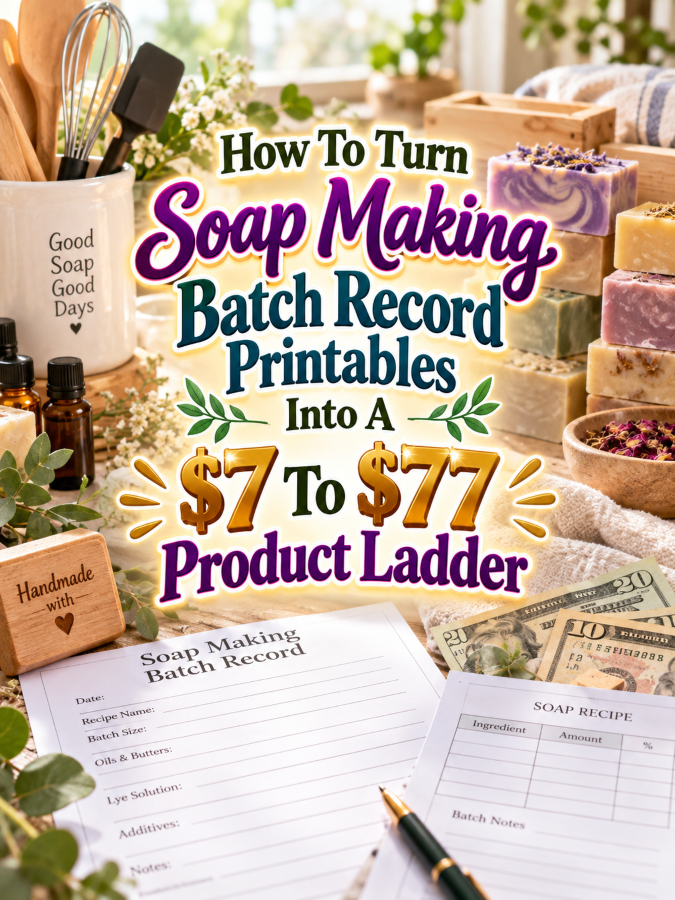
Include fields for batch name, date, soap type, recipe name, batch size, oils and percentages, lye information, water details, fragrance, colorants, additives, mold, temperatures, mixing notes, trace observations, pour notes, curing information, final weight, and general observations.
Add a small section for “What I’d Change Next Time.” This is one of those deceptively useful thingees that can turn a basic record into an actual learning tool. The maker isn’t just recording what happened. They’re building a personal knowledge base with every batch.
At $7, keep the offer focused. Don’t include a complete business planner, 15 specialty editions, social-media templates, and every possible inventory worksheet yet. Those additions are what create room for the next levels.
Once the maker sees how useful a single organized batch record can be, the expanded toolkit becomes a natural next step.
The $17 To $27 Expanded Kit For Soap Making Batch Records
The next offer can become a Soap Making Recipe & Batch Record Toolkit. Instead of documenting one batch at a time, the buyer gets a collection of resources designed for ongoing soap-making experiments and production.
Include reusable batch records, recipe development sheets, ingredient logs, fragrance trackers, colorant records, additive notes, curing calendars, testing logs, supplier pages, recipe index sheets, project queues, and basic inventory pages. Add several examples showing how a completed batch record might look.
You can also create specialty pages for different soap-making workflows. A cold-process maker may want detailed trace and cure information, while a melt-and-pour maker may care more about bases, additives, molds, colors, fragrance, and finished designs.
A short QuickStart guide can explain which page to use at each stage. This matters because buyers aren’t purchasing the kit just to admire it. They want help using the idea.
That added structure makes $17 to $27 reasonable because the customer now has a reusable system rather than a single worksheet.
Now let’s turn that toolkit into a more complete working bundle.
The $37 To $47 Working Bundle For Soap Making
At $37 to $47, create a Complete Soap Making Production & Business Planner. This should bring recipe development, batch records, testing, inventory, production planning, and basic business organization together.
Include everything from the lower levels, then add a master recipe library, ingredient inventory, fragrance inventory, supplier directory, production calendar, batch schedule, testing records, finished-product tracker, product collection planner, pricing worksheet, cost-recording page, customer order tracker, craft-fair preparation pages, and seasonal collection planner.
You can also add a troubleshooting section. Keep it focused on documentation rather than pretending the planner is a substitute for proper soap-making education or safety guidance. Provide spaces for the maker to record observations, changes, and questions they need to investigate.
A QuickStart implementation plan can show a simple workflow: choose a recipe, document the batch, record observations, track curing, evaluate the finished soap, archive the results, and decide whether the recipe should be repeated or changed.
That’s what makes this level worth more. It saves the buyer from stitching together five different notebooks and spreadsheets. It becomes a practical working bundle, not a refrigerator-sized business university.
And now we can make the highest level genuinely premium.
The $67 To $77 Editable Or Reseller Kit For Soap Making
The premium offer could be a Premium Editable Soap Making Business Planner Kit. Instead of giving buyers only finished PDFs, give them editable assets they can customize when the licensing and template setup allow it.
Include editable Canva versions of the batch record, recipe planner, ingredient tracker, fragrance log, curing tracker, inventory pages, production planner, pricing worksheets, collection planner, craft-fair pages, and business records. Also include finished PDF versions so customers can start using the system immediately without editing anything.
You can add specialty editions for cold-process soap, melt-and-pour soap, beginner makers, seasonal collections, handmade businesses, and craft-fair sellers. A customization guide can show buyers how to change colors, fonts, headings, branding, and selected fields.
Premium promotional resources can include sample product descriptions, Pinterest title ideas, social-media captions, short promotional emails, mockup prompt ideas, and a setup checklist. These resources can save a creator significant time when turning the planner into a branded product.
If you offer commercial-use, resale, or PLR rights, make the license extremely clear. State what can be edited, what can be sold, whether the original files can be redistributed, and whether buyers may include the pages inside another product. Don’t make licensing sound like a treasure hunt.
The $77 version isn’t more expensive because it’s longer. It’s more expensive because it gives the buyer more control, saves implementation time, and provides useful assets they can customize or use in their own business.
Let’s put the entire ladder into one simple view.
Example $7 To $77 Ladder For Soap Making Batch Records
| Price | Product | What Is Included |
|---|---|---|
| $7 | Soap Making Batch Record | Recipe, ingredient, production, curing, and results tracking |
| $17-$27 | Soap Making Recipe & Batch Record Toolkit | Multiple templates, recipe library, fragrance logs, testing, inventory, and examples |
| $37-$47 | Complete Soap Making Production & Business Planner | Recipe development, production, testing, inventory, pricing, products, orders, and planning |
| $67-$77 | Premium Editable Soap Making Business Planner Kit | Editable templates, specialty editions, customization resources, promo assets, and appropriate licensing options |
The $7 version gives a quick win. The $17 to $27 version gives more help. The $37 to $47 version creates a working system. The $67 to $77 version gives the buyer more flexibility and implementation support.
That’s why the ladder feels reasonable. Each step solves a larger problem rather than simply adding another pile of paper.
Next, let’s look at the tools that can help you create all of this without building a full software company.
Tools You Can Use To Create This Ladder
Canva is the obvious starting point for printable batch records, recipe pages, inventory trackers, planner covers, specialty editions, and editable premium templates.
Google Docs can be useful for written guides, recipe-development instructions, product descriptions, and customization instructions. Google Sheets can support optional digital inventory trackers or recipe indexes.
ChatGPT can help brainstorm planner fields, customer questions, product names, content ideas, FAQ topics, and promotional angles. It can also help organize the structure of different editions before you spend hours designing them.
For selling, Payhip and Gumroad can be useful for digital delivery. Etsy can help you reach shoppers already searching for printable craft resources, while Systeme.io can be useful for building a simple funnel around free resources and paid products.
You don’t need every tool listed on the internet. Pick the few that help you create, package, sell, and deliver the product.
Once you’ve created the ladder, it’s time for the uncomfortable but useful question: is it actually worth what you’re charging?
How To Know If Your Price Is Fair
Ask whether the product saves the buyer time. Does it make it easier to recreate a successful recipe? Does it reduce forgotten details? Does it help organize experiments? Does it make production easier to plan?
Next, check the differences between levels. Does the $17 to $27 version provide something the $7 version doesn’t? Does the $37 to $47 bundle connect enough pieces to save meaningful effort? Does the $67 to $77 version actually provide editable assets, customization, or implementation resources?
Look at examples too. A buyer should be able to see how the planner works before purchasing. Clear examples reduce uncertainty and help the customer understand the transformation.
Finally, ask yourself the simplest question: Would I feel good buying this at this price? If you wouldn’t, fix the offer before raising the price.
A higher price is easier to justify when the product helps the buyer finish faster, avoid mistakes, customize quickly, or use the result in their own business.
Now let’s turn the strategy into five practical steps.
5-Step Action Plan For Soap Making Batch Records
Step 1: Pick One Buyer Problem
Start with one clear problem. Maybe makers forget recipe details. Maybe they can’t find their successful batches. Maybe their experiments are scattered across notebooks.
Choose the problem that’s easiest to understand and easiest to solve with a printable.
Step 2: Create The $7 Quick Win
Build a focused batch record that captures the information a maker actually needs. Test it against a real batch and remove anything that feels unnecessary.
The first product should be useful before it is impressive.
Step 3: Expand It Into A Kit
Add recipe libraries, ingredient records, fragrance trackers, curing pages, testing logs, supply pages, examples, and better instructions.
Now the customer can manage more than one batch.
Step 4: Build The Premium Version
Add editable templates, specialty editions, customization instructions, promotional resources, and appropriate licensing options.
Focus on saving the buyer time instead of simply adding more pages.
Step 5: Test The Ladder
Put every version side by side. Make sure the customer can understand the difference between $7, $27, $47, and $77 almost immediately.
If the products feel too similar, improve the offers before changing the prices.
A good ladder is easier to sell when the differences are obvious. It also helps prevent some common mistakes.
Common Pricing Mistakes To Avoid
Charging $77 for a thin PDF: A premium price needs premium value. If the product is small, either lower the price or add meaningful resources.
Adding pages instead of usefulness: Ten useful worksheets can be more valuable than 100 repetitive ones. Every page should have a reason to exist.
Making every version too similar: If customers can’t see why they’d upgrade, they won’t. Give every level a distinct job.
Offering resale rights without clear license terms: If you provide resale, PLR, or commercial-use rights, define exactly what customers may do.
Forgetting editable files: If your premium audience includes digital-product sellers or branded businesses, editable templates can be a major value driver.
Using fake income claims: Don’t promise that a planner will make customers a specific amount of money. The product can help organize a business, but no printable guarantees income.
Giving unsafe technical advice: Soap making involves ingredients and processes that require appropriate knowledge and safety practices. A record-keeping planner should support documentation, not pretend to replace responsible soap-making education.
Making the ladder confusing: Your customer shouldn’t need a detective badge to understand which product to buy.
With those mistakes out of the way, let’s talk about finding the people who actually need the product.
3 Nifty Ways To Find Customers
Way 1. Soap-Making Communities
Soap-making groups, handmade-business communities, craft forums, and social groups are useful places to learn what makers struggle with. Pay attention to recurring questions about recipes, batch records, fragrance combinations, curing, inventory, and production organization.
Offer genuinely useful free resources first, such as a one-page batch record or recipe index. Trust is a much better marketing strategy than link confetti.
Way 2. Pinterest
Soap-making content is highly visual, which makes Pinterest a natural place to promote related printables. Create pins around recipe organization, batch tracking, soap business organization, fragrance testing, curing calendars, and handmade-product planning.
Show actual planner pages whenever possible. A pretty cover catches attention, but a filled-in batch record demonstrates usefulness.
Way 3. Handmade Business Educators
YouTubers, bloggers, craft-business educators, soap-making instructors, and handmade-business coaches already have audiences interested in improving their processes. Collaborations or affiliate relationships can put your planner in front of people who understand why good record keeping matters.
Focus on partners whose audience matches your product. Five strong relationships are more useful than 50 random promotional messages.
Once you have buyers, their questions can become your next source of product ideas.
3 Takeaways You Won’t Find Elsewhere!
These aren’t just organization tips. They’re ways to turn one useful batch record into a much larger digital-product opportunity.
Takeaway 1. You’re Selling Confidence
Customers aren’t buying blank worksheets. They’re buying a way to remember what they did, compare batches, troubleshoot more clearly, and return to successful recipes without relying on memory.
That confidence can become one of the strongest benefits of your planner.
Takeaway 2. Every Batch Creates New Knowledge
No two batches have to be identical to be useful. A change in fragrance, color, ingredient, temperature, design, or process can teach the maker something worth remembering.
Your planner helps preserve those lessons so they don’t disappear into the notebook graveyard.
Takeaway 3. One Planner Can Become An Entire Handmade Business Brand
A soap batch record can naturally lead into recipe journals, fragrance trackers, inventory systems, production planners, candle-making journals, skincare formulation records, bath bomb planners, handmade business organizers, and craft-fair preparation kits.
That means your first product can become the foundation for a connected collection instead of a lonely printable sitting on the shelf by itself.
Speaking of expanding the collection, here’s where the opportunity gets even more interesting.
Scaling Your Results
Create specialty editions once the core system works. You could build planners for cold-process soap, melt-and-pour soap, beginners, experienced makers, seasonal collections, gift makers, craft-fair sellers, or small handmade businesses.
You can also create tiny add-on packs. A fragrance testing pack, curing calendar, supplier tracker, craft-fair pack, or soap inventory mini-pack could work as a low-cost standalone product, an order bump, or a bundle bonus.
Another strong option is a customizable business edition. Give creators editable Canva pages they can brand with their business name, colors, product categories, and preferred fields. That customization can be more valuable than another stack of generic worksheets.
Eventually, you could build a broader handmade-maker library or membership with seasonal production pages, inventory resources, product-development worksheets, and business planning tools. The goal isn’t to create bazillions of products. It’s to create connected products that solve the next problem for the same audience.
Now let’s turn the ladder into promotional messages you can use right away.
Simple Promo Angles For Soap Making Batch Records
“Stop Forgetting What You Did In Your Last Soap Batch” focuses on the most obvious problem.
“Build A Soap Recipe Library You Can Actually Find Again” highlights long-term organization.
“Keep Your Recipe, Fragrance, Color, And Batch Notes In One Place” focuses on convenience.
“Turn Your Soap Experiments Into Organized Records” appeals to makers who test different formulas and designs.
“Use The Templates Instead Of Starting From Scratch” works well for the premium editable version.
“Create A Soap-Making System That Grows With Your Business” connects the planner with the maker’s larger workflow without making unrealistic promises.
These angles can become Pinterest titles, product descriptions, emails, social posts, or headlines for individual planner pages.
Let’s bring the entire ladder together.
Final Ladder Summary
The $7 Soap Making Batch Record gives makers a quick win by helping them document individual recipes and batches. The $17 to $27 Soap Making Recipe & Batch Record Toolkit adds recipe libraries, ingredient logs, fragrance tracking, curing records, testing pages, examples, and inventory resources.
The $37 to $47 Complete Soap Making Production & Business Planner connects recipe development, production, testing, inventory, pricing, products, orders, collections, and business planning into one working system.
The $67 to $77 Premium Editable Soap Making Business Planner Kit adds editable Canva templates, specialty editions, customization resources, promotional assets, finished PDFs, and clearly defined licensing options where appropriate.
The pricing works because every level adds something meaningful. The $7 version gives a quick win. The $17 to $27 version gives more help. The $37 to $47 version gives a working bundle. The $67 to $77 version gives editable assets, customization, or implementation support.
That’s a product ladder. Not a stack of increasingly expensive pages.
And that’s exactly what you want.
Conclusion
Soap making batch record printables solve a practical problem that grows with the maker. The more recipes someone creates, the more useful accurate records become. A simple journal can help preserve the details of successful batches while giving makers a better way to learn from experiments and organize future production.
Start small with the $7 product. Make it genuinely useful. Then expand into a toolkit, build a complete production and business system, and add editable premium resources only when they provide enough additional value to justify the higher price.
You don’t need to create the whole printable empire tomorrow. Start with one batch record that makes a soap maker say, “Finally. I know exactly what I did.” That’s a pretty good place to begin.
So here’s what you discovered today. If something sparked your interest, take it as your sign to start moving toward that goal now. Even one small step counts.
Enjoy!