Introduction
You don’t need a huge backyard to grow something useful. A few containers on a balcony, patio, porch, windowsill, rooftop, or tiny backyard can become a surprisingly productive little garden.
The problem is that container gardening can get messy fast. Which pot has the tomatoes? When did you last fertilize the peppers? Which container needs more sunlight? Did you plant basil three weeks ago or three months ago? And why does that one lonely plant look like it’s filing a formal complaint?
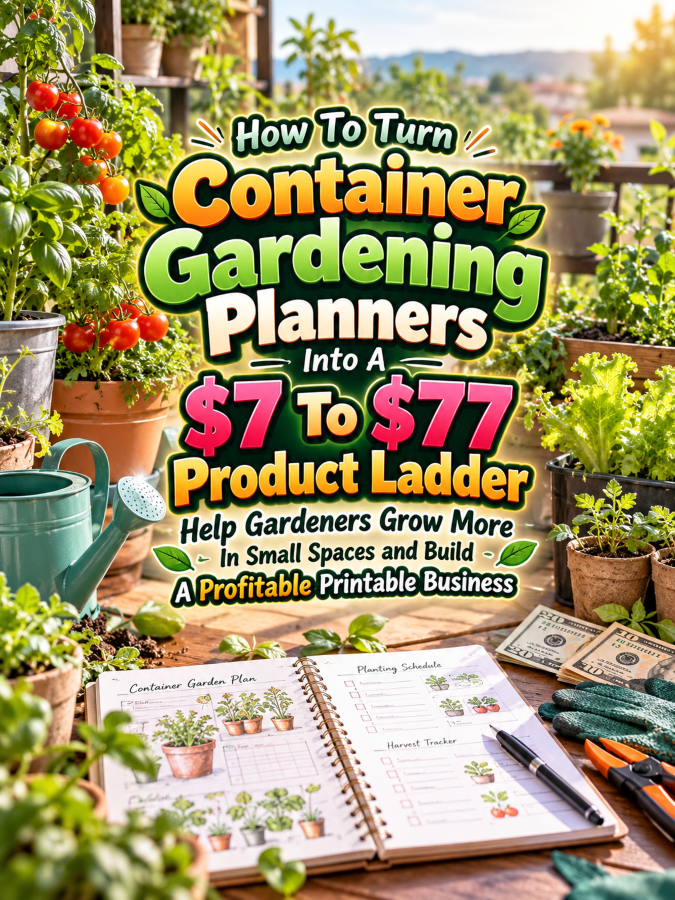
That’s where Container Gardening Planners can become useful. A well-designed planner can help gardeners organize containers, choose crops, track planting dates, manage watering and feeding, record harvests, and learn what works from one growing season to the next.
For a printable creator, that creates a natural product ladder. Start with a focused $7 planner, expand it into an organization kit, turn that into a complete container gardening system, and eventually offer a premium command center with editable templates and digital tracking tools.
Quick Answer
Create a Container Gardening Planner that helps people plan what to grow, organize their pots and containers, track planting dates, manage watering and feeding, monitor plant health, and record harvests.
Start with a $7 Container Garden Planner. Expand it into a $17-$27 Container Gardening Organization Kit. Build a $37-$47 Container Gardening Management System. Then create a $67-$77 Ultimate Container Garden Command Center with editable templates, digital trackers, seasonal planning tools, crop records, and premium resources.
The secret is to increase usefulness at every level. You’re not selling more pages. You’re helping the gardener manage more of the growing process.
Why Container Gardening Planners Work As A Product Ladder
Container gardening naturally creates information that people need to remember. Gardeners have different pots, different plants, different sunlight conditions, different watering needs, and different planting dates. Even a small collection of containers can become difficult to manage once several crops are growing at the same time.
That makes organization valuable. A gardener may want to know which container holds each crop, what soil or growing medium was used, when it was planted, what fertilizer was applied, how often it needs water, and whether the plant produced a useful harvest.
There’s also a wide range of buyers. A complete beginner may only need a simple planting planner. A balcony gardener may want a space-saving container layout. A serious home gardener may want seasonal records and harvest tracking. That gives you plenty of room to build different levels of value.
The Reasonable Pricing Rule
Your pricing should reflect the problem your product solves, not how many sheets you can cram into a PDF. A $7 product can provide a focused solution. A $27 product can organize several related tasks. A $47 product can create a repeatable gardening system. A $77 product can bring the entire process together.
For example, a $7 planner might help someone decide what to plant in ten containers. A $27 kit could help them manage those containers throughout the season. A $47 system could help them plan, maintain, harvest, and review an entire growing cycle.
At the premium level, you can add editable files, digital dashboards, seasonal editions, specialized trackers, and other resources that make the system easier to customize. That’s a much stronger reason to pay more than simply saying, “Look! There are 150 pages!”
The $7 Container Gardening Planner
Your $7 product should deliver one quick win. Help the gardener organize a small container garden without making the process complicated.
A simple planner could include a container inventory, planting plan, crop information page, sunlight tracker, watering log, feeding record, and harvest tracker. You can also include a simple garden map where the buyer sketches where each pot is located.
Keep this version approachable. Someone who has six pots on a balcony should be able to open the planner and immediately understand how to use it.
What To Include
- Container inventory
- Planting planner
- Container garden map
- Crop information sheets
- Sunlight observation log
- Watering tracker
- Feeding and fertilizing log
- Plant health notes
- Harvest tracker
- Weekly garden review
The goal isn’t to document every possible gardening detail. The goal is to make container gardening easier to organize.
The $17-$27 Container Gardening Organization Kit
Once the basic planner works, you can solve a larger problem: keeping the entire container garden organized throughout the season.
Your $17-$27 kit can include separate planning sheets for vegetables, herbs, flowers, fruiting plants, seedlings, and seasonal crops. You can add container size records, pot location tracking, supply inventories, seed inventories, planting schedules, and harvest records.
This is also a good place to introduce different garden layouts. A balcony gardener may need a vertical arrangement. A patio gardener may need a compact grid. Someone with a small backyard may want a combination of pots, grow bags, and raised containers.
Possible Kit Components
- Container Garden Master Planner
- Container Inventory Tracker
- Planting Calendar
- Pot and Grow Bag Tracker
- Seed Inventory
- Seedling Tracker
- Watering Log
- Fertilizer and Feeding Log
- Pest and Plant Health Tracker
- Harvest Record
- Garden Supply Inventory
- Weekly Garden Checklist
- Monthly Garden Review
Now you’re not just selling a planner. You’re giving the gardener a small management kit.
The $37-$47 Container Gardening Management System
At $37-$47, your product should become a complete gardening workflow. The buyer should be able to move from planning to planting, maintenance, harvesting, and review without needing to invent their own system.
Build the product around the actual gardening cycle. Start with available space and containers. Choose crops. Assign plants to containers. Record planting dates. Track care. Record problems. Track harvests. Then review what worked.
Build The System Around A Gardening Cycle
- Assess your available space and containers.
- Choose crops that fit the growing conditions.
- Plan where each crop will be planted.
- Track watering, feeding, growth, and plant health.
- Record harvests and review the season.
You can also add a seasonal planning section that helps buyers decide what to grow next based on what they learned from the previous season.
That’s where the product starts becoming a gardening system instead of a collection of attractive worksheets.
The $67-$77 Ultimate Container Garden Command Center
The premium product should bring everything together in one flexible system. Think of it as the gardener’s central control panel, minus the blinking lights and mysterious buttons.
Include printable PDFs plus editable versions. You could offer Canva templates, Google Sheets trackers, digital garden logs, seasonal planning pages, crop records, harvest dashboards, container inventories, and specialized editions for different types of small-space gardening.
You could also create versions for balcony gardens, patio gardens, apartment gardens, herb gardens, vegetable container gardens, and beginner container gardens. That gives the buyer flexibility without simply dumping more generic pages into the package.
Premium Features Could Include
- Editable Canva Container Gardening Planner
- Printable Master Garden Planner
- Digital Container Inventory
- Planting Calendar
- Seasonal Crop Planner
- Container Placement Planner
- Watering and Feeding Dashboard
- Plant Health and Pest Tracker
- Seed and Supply Inventory
- Harvest Tracking Dashboard
- Garden Expense Tracker
- Garden Review Worksheets
- Balcony Garden Edition
- Patio Garden Edition
- Herb Garden Edition
- Vegetable Container Garden Edition
- Promotional graphics and mockup templates
If you include commercial-use, resale, or PLR rights, make sure every included asset is properly licensed for that purpose. A premium product is not improved by accidentally creating a licensing headache.
Example $7 To $77 Container Gardening Product Ladder
Here’s one practical way to structure the ladder:
| Price | Product | Main Value |
|---|---|---|
| $7 | Container Gardening Planner | Plan containers, crops, planting dates, care, and harvests. |
| $17-$27 | Container Gardening Organization Kit | Organize plants, pots, seeds, supplies, watering, feeding, and garden tasks. |
| $37-$47 | Container Gardening Management System | Manage the complete growing cycle from planning through harvest and review. |
| $67-$77 | Ultimate Container Garden Command Center | Combine printable, editable, digital, seasonal, and specialized gardening resources. |
Each level solves a bigger problem. That’s what makes the ladder work.
Tools You Can Use To Create This Ladder
You don’t need a greenhouse full of expensive software to create a gardening printable business. A few simple tools can handle the design, organization, research, and selling.
Canva is useful for creating printable planners, garden maps, checklists, worksheets, covers, product mockups, and editable templates.
Google Docs can help you create text-heavy garden guides and worksheets, while Google Sheets can be used for digital plant inventories, harvest tracking, expenses, planting schedules, and container databases.
ChatGPT can help you brainstorm worksheet ideas, organize product sections, develop marketing angles, write instructions, and create customer-friendly prompts. Review gardening information carefully, especially when your product includes crop-specific or location-specific growing guidance.
Google Trends can help you explore interest around container gardening, balcony gardening, patio gardening, herb gardening, vegetable gardening, grow bags, small-space gardening, and related topics.
For selling, you can research marketplaces such as Etsy or use digital-product platforms such as Payhip and Gumroad.
How To Know If Your Container Gardening Product Price Is Fair
Start by looking at the outcome. What can the buyer do with your product that they couldn’t easily organize before?
A $7 planner that helps someone organize a small balcony garden can be useful. A $27 kit that manages the garden throughout the season provides more value. A $47 system that connects planning, maintenance, harvest, and review gives the buyer an even bigger workflow.
Compare competing products to understand what buyers already see in the market, but don’t simply copy their page count or feature list. Look for opportunities to make the product clearer, easier to use, more specialized, or more flexible.
If you can clearly explain the problem your product solves and why the next tier gives the buyer more useful capability, your pricing becomes much easier to communicate.
5-Step Action Plan
Now let’s turn the idea into something you can actually build.
Step 1: Choose One Container Gardening Problem
Start with one clear problem. It could be planning pots, tracking watering, organizing crops, managing a balcony garden, or recording harvests. A focused problem makes a better first product than a giant gardening encyclopedia.
Step 2: Build The $7 Version First
Create a simple planner that gives the buyer a quick win. Test it yourself by planning a small container garden from beginning to end.
Step 3: Expand Into A $17-$27 Kit
Add related tools that naturally belong with the starter product. Include inventories, schedules, plant records, care logs, and seasonal planning pages.
Step 4: Build The Complete Management System
At $37-$47, connect the individual pieces into a repeatable workflow. Help the gardener move from planning to planting, maintenance, harvest, and review.
Step 5: Create The Premium Command Center
Add editable templates, digital trackers, specialty editions, dashboards, seasonal resources, and promotional assets. Make the premium version more flexible and useful, not simply bigger.
3 Ways To Stand Out From The Thundering Herd
There are plenty of generic garden planners out there. So don’t create another product that simply says “Monday: Water Plants” and calls it innovation.
1. Design For Small Spaces
Make the planner specifically useful for balconies, patios, porches, rooftops, windowsills, and small yards. Space limitations are part of the problem your product can solve.
2. Track The Container, Not Just The Plant
This is an important distinction. Gardeners may move plants, reuse pots, change soil, or grow several crops in different containers. Give them a way to track the container itself, including size, location, crop, and current use.
3. Turn Garden Records Into Future Decisions
Don’t stop at recording information. Help the gardener answer questions such as “Which crops performed well?” “Which containers dried out quickly?” “Where did plants get the best light?” and “What should I change next season?”
That’s where your planner becomes a learning tool instead of just a record book.
3 Nifty Ways To Find Customers
Once your product is ready, put it in front of people who already care about growing food, herbs, flowers, or useful plants in small spaces.
1. Create Small-Space Gardening Content
Share useful content such as “10 Vegetables You Can Grow In Containers” or “How To Organize A Balcony Garden.” Connect the educational content naturally to your planner.
2. Target Specific Gardening Communities
Look for communities focused on balcony gardening, container vegetables, herbs, apartment gardening, patio gardening, urban gardening, and beginner gardening. Give useful advice first. Nobody enjoys being chased around the internet by a printable salesperson with a megaphone.
3. Use Pinterest And Marketplace Search
Create content around specific search phrases such as container gardening planner, vegetable container garden planner, balcony garden planner, herb garden tracker, container garden watering log, and small-space garden planner.
3 Takeaways You Won’t Find Elsewhere
Here are three ways to make your container gardening products more useful and memorable.
1. Make The Container A Character In The Story
Instead of tracking only the plant, let buyers record the container’s size, location, material, crop, soil mix, and performance. Over time, they can learn which containers work best for their space.
2. Add A “What Worked?” Review
At the end of each growing cycle, give gardeners a simple review. Which crops performed well? Which containers were difficult to manage? Which locations worked? Which plants needed more attention?
3. Build A Seasonal Memory
Gardeners often forget what they did last season. Your journal can become a record of planting dates, harvests, problems, experiments, and lessons. That makes next season easier to plan.
Common Pricing Mistakes To Avoid
One mistake is putting every possible gardening worksheet into the $7 product. That makes the starter offer harder to understand and gives you little room to build the higher tiers.
Another mistake is creating four versions that are basically identical. If the $7 planner already contains nearly everything in the $77 product, your ladder has a problem.
Don’t confuse page count with value. A well-designed digital dashboard or editable garden system may be far more useful than dozens of repetitive worksheets.
Also avoid making gardening claims that are too broad. Growing conditions vary by climate, plant variety, container size, light, soil, and local conditions. If your product contains specific growing guidance, make it clear when recommendations are general rather than universal.
Scaling Your Results
Once your first Container Gardening Planner gains traction, you can build related products from the same design system.
Consider creating a Balcony Garden Planner, Vegetable Container Garden Planner, Herb Garden Planner, Patio Garden Planner, Container Harvest Tracker, Seed Starting Planner, Garden Expense Tracker, or Small-Space Garden Journal.
You can also create seasonal editions. Spring Container Garden Planner, Summer Patio Garden Planner, Fall Container Garden Planner, and Indoor Herb Garden Planner can all become related products without forcing you to reinvent the entire business.
Then bundle complementary products together. That’s how one simple planner can grow into a small gardening printable ecosystem.
Simple Promo Angles
Your marketing should focus on the practical problem you’re solving rather than promising that someone will suddenly become a master gardener.
- “Plan Your Container Garden Without The Guesswork”
- “Finally Know What’s Growing In Every Pot”
- “Keep Your Balcony Garden Organized All Season”
- “Track Your Plants From Seedling To Harvest”
- “Stop Forgetting When You Watered, Fed, or Planted”
- “Turn Your Small Space Into A Better-Planned Garden”
- “Remember What Worked Before You Plant Again”
These angles can become Pinterest pins, marketplace graphics, short videos, email content, blog posts, and social media posts.
Affiliate Opportunities
Container gardening can also connect naturally with relevant affiliate products, depending on the programs available to you.
Potential categories include containers, grow bags, gardening tools, plant labels, watering equipment, seed-starting supplies, gardening books, trellises, and organizational products.
Keep the recommendations relevant to the content. If you’re teaching someone how to organize a balcony garden, recommending useful containers or plant supports makes sense. Random affiliate links thrown into a gardening article just because they pay a commission? That’s not a good thing.
Internal Link Ideas
If you’re building a website around printable gardening products, connect your content naturally with related topics.
- Container Gardening Planners
- Vegetable Garden Planners
- Herb Garden Planners
- Seed Starting Planners
- Garden Harvest Trackers
- Garden Expense Trackers
- Small-Space Gardening Printables
- Seasonal Garden Planners
These links can help visitors discover related products while giving your website a stronger content structure.
Pinterest Ideas
Container gardening is naturally visual, which makes it a strong topic for Pinterest-style content.
- “Container Gardening Planner For Small Spaces”
- “Balcony Garden Planning Printable”
- “Vegetable Container Garden Planner”
- “Track Every Plant In Your Garden”
- “Container Garden Watering Tracker”
- “Small-Space Garden Planning Ideas”
- “Container Garden Harvest Tracker”
- “Herb Garden Planner Printable”
Create multiple designs for the same product and test different angles. One pin can focus on organization while another focuses on small-space gardening, harvest tracking, or seasonal planning.
FAQ
Who Is A Container Gardening Planner For?
It can work for beginners, balcony gardeners, patio gardeners, urban gardeners, herb growers, vegetable growers, families, and anyone managing plants in containers or grow bags.
What Should A Container Gardening Planner Track?
Useful fields can include container size, location, crop, planting date, sunlight, watering, feeding, plant health, pests, harvests, expenses, and seasonal notes.
Can I Sell Container Gardening Printables On Etsy?
You can research Etsy’s current marketplace rules and digital-product requirements before listing. Make sure your content is original or properly licensed and follows the platform’s policies.
Should I Make The Planner Printable Or Digital?
You can offer both. Printable PDFs work well as an entry product, while editable Canva templates and digital trackers can create additional value at higher tiers.
How Can I Make The $77 Product Worth More?
Build a complete system rather than simply adding pages. Include editable templates, digital tracking, seasonal planning, container inventories, garden dashboards, specialty editions, and resources that help buyers use the system throughout the growing season.
Your Next Steps
Start with one problem. Maybe your first product helps a gardener plan ten containers. Maybe it tracks watering and feeding. Maybe it organizes an entire balcony garden.
Build the $7 version first and make it genuinely useful. Then listen to what buyers need next. Those needs can become your $17-$27 kit, your $37-$47 management system, and eventually your $67-$77 command center.
Before you publish, test the planner with a real container garden scenario. Pretend you have several pots in different locations and different crops with different care routines. If you can use the planner without constantly wondering where to write something down, you’re on the right track.
Final Product Ladder Summary
| Tier | Product | What The Customer Gets |
|---|---|---|
| $7 | Container Gardening Planner | Plan containers, crops, planting dates, care, and harvests. |
| $17-$27 | Container Gardening Organization Kit | Organize pots, plants, seeds, supplies, watering, feeding, and garden tasks. |
| $37-$47 | Container Gardening Management System | Manage the full growing cycle from planning through harvest and seasonal review. |
| $67-$77 | Ultimate Container Garden Command Center | Editable templates, digital trackers, seasonal tools, specialty editions, dashboards, and premium resources. |
Conclusion
Container gardening may happen in small spaces, but the product opportunity doesn’t have to be small.
Gardeners have plants to plan, pots to organize, watering to remember, feeding schedules to track, harvests to record, and lessons to carry into the next growing season. A good planner turns all of that scattered information into something useful.
Start with the $7 quick-win product. Expand it into an organization kit. Turn that into a complete management system. Then build the premium command center for gardeners who want everything in one place.
You’re not really selling blank pages. You’re helping someone make better use of every pot, grow bag, balcony, patio, or tiny patch of space they have.
And when a gardener can look at their little collection of containers and actually know what’s going on in every single one?
That’s always a good thing.
So here’s what you’ve discovered today – if anything excites you, why not start working towards that goal today?
Enjoy!