Board game collecting sounds simple until you actually start collecting board games.
One game becomes five. Five becomes twenty. Then you discover expansions, deluxe editions, different player counts, games you’ve lent to friends, games still in shrink wrap, games you’ve played exactly once, and that one game you bought because everyone online said it was amazing.
Suddenly, “I know what games I own” becomes a surprisingly ambitious statement.
That’s where a Board Game Collection Tracker can become incredibly useful.
A good tracker can help collectors record what they own, track expansions, remember who owns what, organize games by category, record play history, manage wish lists, and even keep track of games they’ve traded or sold.
And for a digital-product seller, that creates a very nice product-ladder opportunity.
You can start with a simple $7 collection tracker, expand it into a $17 to $27 board game organization kit, build a $37 to $47 complete collection management system, and finish with a $67 to $77 premium Board Game Collection Command Center.
The trick is making every level genuinely more useful rather than creating one enormous spreadsheet and calling it premium.
Introduction
Board game collectors have a problem that many hobbyists secretly understand: the collection grows faster than the memory.
You might remember your favorite games, but what about every expansion? Which games work well with two players? Which ones are suitable for family game night? Which games have you never played? Which games are currently at a friend’s house?
And then there’s the classic collector question: “Do I already own this?”
A collection tracker gives the hobbyist one place to answer those questions.
That makes this niche interesting for digital products because the buyer isn’t simply purchasing a spreadsheet. They’re buying a better way to understand and manage a growing hobby collection.
You can also create different versions for casual collectors, serious hobbyists, families, board game groups, reviewers, and people who buy and sell games.
Quick Answer
Quick Answer
You can turn Board Game Collection Trackers into a $7 to $77 digital product ladder by increasing the depth of collection management at each level.
- $7: A simple Board Game Collection Tracker for recording owned games and basic details.
- $17-$27: A Board Game Organization Kit with collection, expansion, wishlist, lending, and play-history trackers.
- $37-$47: A complete Board Game Collection Management System with collection analytics, game-night planning, lending, trades, purchases, and play tracking.
- $67-$77: An Ultimate Board Game Collection Command Center with editable templates, digital trackers, specialty sections, collection dashboards, and premium planning tools.
The more expensive product should help the buyer manage more of the hobby, not simply contain more rows.
Why Board Game Collection Trackers Work As A Product Ladder
Board games have a natural collection structure. Each game has information such as title, publisher, player count, play time, genre, complexity, ownership status, and sometimes expansions or related editions.
Collectors also have activities around the collection. They buy games, sell games, trade games, lend games, play games, rate games, organize game nights, and maintain wish lists.
That gives you multiple problems to solve without leaving the niche.
A $7 product can handle ownership tracking. A $27 product can organize the collection. A $47 product can manage the collector’s broader hobby workflow. A $77 product can bring everything into one command center.
That’s a much stronger ladder than simply selling four versions of the same list.
The Reasonable Pricing Rule
The value of a collection tracker isn’t determined by how many games it can hold.
It’s determined by how much easier it makes the collector’s life.
A simple tracker that lets someone quickly answer “Do I own this?” can be useful. A complete system that also tracks expansions, play history, lending, trades, wish lists, purchases, and game-night planning solves a much larger problem.
Think about the buyer’s growing needs. The $7 version handles the collection. The $27 version handles the organization. The $47 version handles the hobby workflow. The $77 version brings everything together.
That progression gives the buyer a reason to move upward.
Build The $7 Board Game Collection Tracker
Your starter product should solve the simplest problem: keeping track of what the buyer owns.
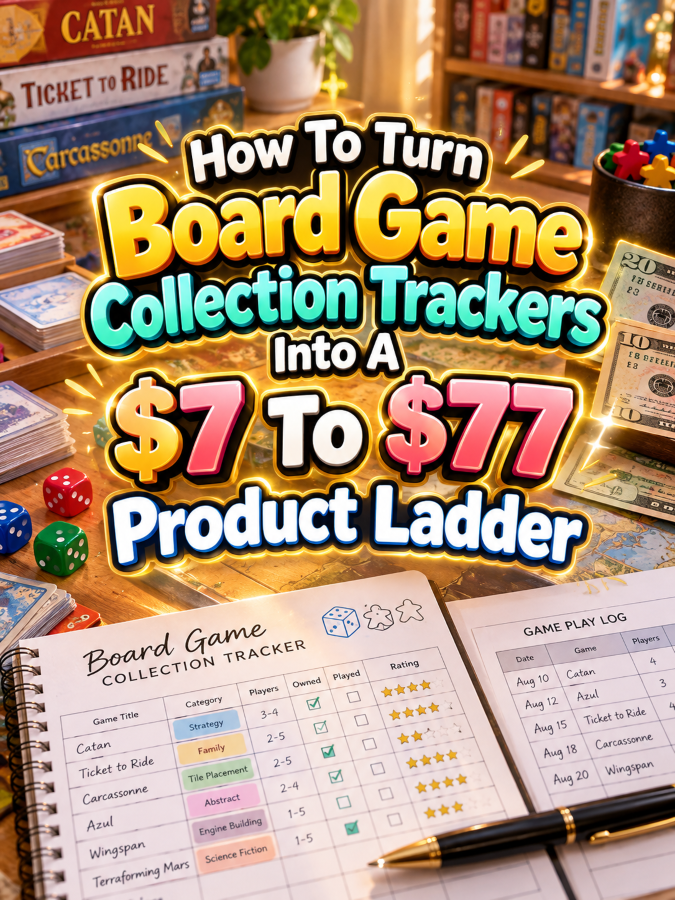
Create a clean collection sheet with fields for game title, publisher, edition, category, player count, play time, complexity, purchase date, condition, and notes.
You can offer both a printable version and a simple digital spreadsheet version if your product format allows it.
- Board Game Collection List
- Game Details Sheet
- Player Count Tracker
- Play Time Tracker
- Genre or Category Tracker
- Purchase Record
- Collection Notes
- Simple Wishlist
Keep the $7 version focused. Someone should be able to start entering their collection immediately.
Turn It Into A $17 To $27 Board Game Organization Kit
Now you can start solving the problems that appear after the collection gets bigger.
Add an expansion tracker, lending tracker, play-history log, wishlist, trade list, and storage-location tracker. These features make the product more useful for serious collectors.
A storage-location tracker can be especially handy for people with shelves, cabinets, closets, storage bins, or multiple locations. Nobody wants to excavate the entire house looking for a game they vaguely remember owning.
- Complete Collection Tracker
- Expansion Tracker
- Wishlist
- Play History Log
- Lending Tracker
- Trade Tracker
- Purchase Tracker
- Storage Location Tracker
- Games To Sell List
- Games To Play List
- Collection Notes
You can also add a “last played” field. That can help collectors discover which games are actually getting table time and which ones are quietly becoming shelf decorations.
Build The $37 To $47 Board Game Collection Management System
At this level, you’re moving beyond collection records into hobby management.
The system can help the buyer plan game nights, manage lending, track purchases, review their collection, organize games by player count, and identify games that haven’t been played recently.
This is where you can add useful dashboards or summaries if you’re creating a digital spreadsheet version.
- Complete Collection Database
- Expansion Management
- Game-Night Planner
- Play History Tracker
- Game Rating Log
- Lending Manager
- Trade Manager
- Purchase Tracker
- Wishlist Manager
- Games-To-Sell Tracker
- Storage Location Database
- Collection Review Worksheet
You could also add a “choose a game” worksheet where users filter their collection by player count, estimated play time, genre, or personal rating.
That turns the collection from a list into something the buyer can actually use.
Create The $67 To $77 Ultimate Board Game Collection Command Center
The premium package should feel like the collector’s central headquarters.
Combine collection management, play history, purchasing, lending, trading, game-night planning, and collection review into one connected system.
If you’re offering digital versions, editable spreadsheets and templates can add useful functionality. If you’re offering printable versions, make sure the sections are clearly organized and easy to update.
- Ultimate Board Game Collection Database
- Expansion Library
- Play History Dashboard
- Game Rating System
- Game-Night Planner
- Wishlist Manager
- Purchase History
- Collection Budget Tracker
- Lending Tracker
- Trade Tracker
- Games-To-Sell Manager
- Storage Location System
- Collection Review Dashboard
- Unplayed Game Tracker
- Favorite Games List
- Digital and Printable Versions
- Setup Guide
You can also create specialty sections for board game groups, family collections, game reviewers, and collectors who regularly buy and trade games.
Example $7 To $77 Board Game Product Ladder
Here’s one practical structure:
| Price | Product | Core Value |
|---|---|---|
| $7 | Board Game Collection Tracker | Record owned games and basic collection information |
| $17-$27 | Board Game Organization Kit | Track expansions, play history, lending, trades, purchases, and wish lists |
| $37-$47 | Board Game Collection Management System | Manage the collection, game nights, purchasing, storage, and play activity |
| $67-$77 | Ultimate Board Game Collection Command Center | Complete digital and printable collection-management ecosystem |
Now the ladder makes sense. Each level adds another layer of usefulness instead of simply adding more games to a list.
Tools You Can Use To Create This Ladder
Canva is useful for designing printable collection pages, covers, game-night planners, checklists, and promotional graphics.
Google Sheets is particularly useful for a digital collection tracker because you can create sortable columns, filters, categories, and simple dashboards.
Google Docs can be useful for setup guides, printable instructions, collection policies, and game-night planning documents.
ChatGPT can help brainstorm tracker fields, collection categories, product descriptions, promotional angles, and niche variations. Review any factual game information before including it in a product.
Google Trends can help explore broader interest around board games and related hobby topics. Etsy can provide marketplace research into how collection trackers and hobby printables are presented.
For selling digital products, Payhip and Gumroad are possible platforms to consider. Check their current pricing and features before choosing one.
How To Know If Your Price Is Fair
Start with the buyer’s problem. If your $7 tracker helps someone organize 200 games, it can already provide useful value. But the $47 product needs to do more than hold 500 games.
Maybe it lets the buyer filter by player count. Maybe it tracks play history. Maybe it manages lending and trades. Maybe it helps plan game nights. Those are meaningful additions because they change what the buyer can actually do.
For the premium version, think about convenience and connectedness. If the buyer can manage the collection, purchases, game nights, lending, trading, and play history from one organized system, that’s a much stronger premium offer.
Price according to usefulness, not spreadsheet size.
5-Step Action Plan
You can build this niche without owning a board game convention’s worth of cardboard yourself.
- Choose your collector. Decide whether you’re targeting casual collectors, serious hobbyists, families, board game groups, reviewers, or buyers and sellers.
- Build the $7 tracker. Create a clean system for recording games and basic collection information.
- Add collection organization. Add expansions, play history, lending, trades, purchases, wish lists, and storage for the $17 to $27 level.
- Add hobby management. Build game-night planning, collection reviews, ratings, budgeting, and activity tracking for the $37 to $47 level.
- Create the command center. Connect the best tools into a premium $67 to $77 system with editable digital resources, printable pages, dashboards, and setup guidance.
Build the basic database first. Once that works, everything else becomes an expansion rather than a giant guessing game.
3 Ways To Stand Out From The Thundering Herd
1. Track how games are actually used. Many collection lists stop at ownership. Add fields for last played, number of plays, favorite player count, rating, and notes. Now the tracker tells a story about the collection.
2. Build a “What Should We Play?” feature. Help users filter their collection based on player count, time available, genre, complexity, or personal rating. That’s much more useful than simply scrolling through hundreds of titles.
3. Create collector-specific editions. A family game-night tracker can be different from a serious hobby collector’s system. A game reviewer may need review notes, while a frequent trader may need trade records and purchase history.
3 Nifty Ways To Find Customers
1. Create board game organization content. Share ideas about organizing shelves, tracking expansions, choosing games for different group sizes, and managing a growing collection. Your content can naturally lead to the tracker.
2. Target hobby communities. Look for board game groups, tabletop communities, local gaming clubs, and collector communities. Participate helpfully and learn what collectors actually struggle to track.
3. Show the tracker solving a real problem. Demonstrate how someone can go from “We have 200 games. What should we play?” to a filtered shortlist based on player count and available time.
That’s much more interesting than showing a screenshot of a blank spreadsheet and saying, “Available now!”
3 Takeaways You Won’t Find Elsewhere
First, the collection isn’t the whole product. The real opportunity is everything that happens around the collection. Buying, playing, lending, trading, storing, reviewing, and planning game nights can all become useful tracker features.
Second, unplayed games are useful data. A tracker that identifies games someone hasn’t played recently can help them make better use of the collection. It can also help collectors think about whether future purchases are actually filling a gap.
Third, the “choose a game” function may be more valuable than the inventory list. Collectors don’t only want to know what they own. They often want help deciding what to play right now.
Common Mistakes To Avoid
One mistake is creating a simple list and calling it a complete collection-management system. A list records ownership. A system helps someone manage the hobby.
Another mistake is making the tracker too complicated. A collector should be able to add a game without filling out 37 fields every time. Make advanced information optional.
A third mistake is including inaccurate game information. If your template contains pre-filled details about specific games, verify those details. Better yet, design the tracker so the buyer can enter their own information.
Also avoid making unsupported claims about the value of a collection. A tracker can record purchase prices and notes, but it isn’t automatically an appraisal service.
Scaling Your Results
Once the core tracker is working, you can create versions for different audiences.
A Family Board Game Planner could focus on age ranges, player counts, game-night planning, and favorites. A Serious Collector Edition could emphasize collection analytics, expansions, purchases, trades, and storage.
A Board Game Club Edition could include member lending, game-night schedules, attendance, and shared game libraries. A Reviewer Edition could include play notes, ratings, review ideas, and content planning.
You can also create bundles around specific needs. Combine the collection tracker with a game-night planner, board game wishlist, trading tracker, and shelf-organization planner.
One database can become a surprisingly useful little product ecosystem.
Simple Promo Angles
Don’t just say “Track your board games.” Show the collector what becomes easier.
- “Do I Own This Game? Check Before You Buy.”
- “Finally Know What’s Sitting On Your Board Game Shelf.”
- “Track Your Games, Expansions, Plays, Trades, And Wish List.”
- “Stop Buying Games You Already Own.”
- “Find The Right Game For Your Group In Minutes.”
- “Turn Your Board Game Collection Into An Organized Library.”
You can also create content around common collector problems. “How to track expansions,” “How to organize a 100-game collection,” and “How to decide what to play” can all lead naturally into your product.
Affiliate Opportunities
A board game collection audience can naturally connect with products and services related to organization, storage, tabletop accessories, gaming tables, shelving, sleeves, inserts, and other hobby supplies.
If you participate in affiliate programs, create useful content around products you genuinely recommend. A board game storage guide, for example, can naturally connect to a collection-tracking article.
Keep recommendations relevant and disclose affiliate relationships where required. The goal is to help the collector, not turn the article into one giant shopping cart.
Internal Link Ideas
This topic can connect with other hobby and organization printables.
- How To Turn Hobby Collection Trackers Into A $7 To $77 Product Ladder
- How To Turn Craft Collection Trackers Into A $7 To $77 Product Ladder
- How To Turn Photography Gear Inventory Trackers Into A $7 To $77 Product Ladder
- How To Turn Comic Book Collection Trackers Into A $7 To $77 Product Ladder
- How To Turn Book Collection Trackers Into A $7 To $77 Product Ladder
- How To Turn LEGO Collection Trackers Into A $7 To $77 Product Ladder
These related topics can help you build a broader collection-management content cluster.
Pinterest Ideas
Board game collecting is naturally visual, so Pinterest can be a useful discovery channel for this type of product.
- Board Game Collection Tracker
- Board Game Organization Ideas
- Board Game Collection Spreadsheet
- Board Game Wishlist Tracker
- Board Game Shelf Organization
- Board Game Night Planner
- Board Game Inventory Tracker
- Board Game Collection Printable
Show screenshots of your tracker alongside attractive board game shelves or game-night setups. The visual should make the organization benefit immediately obvious.
Frequently Asked Questions
What should a Board Game Collection Tracker include?
A basic tracker can include game title, publisher, edition, player count, play time, category, purchase information, condition, and notes. Expanded versions can include expansions, play history, ratings, lending, trades, wish lists, and storage locations.
Can I sell a board game collection tracker as a digital product?
Yes. You can create printable PDFs, spreadsheets, or other digital formats. If you include information about specific games, make sure your product doesn’t imply endorsement or affiliation with publishers or brands unless you have permission.
Should I include a list of every board game?
Not necessarily. A better approach may be to create a flexible tracker where customers enter their own collection. That makes the product easier to maintain and useful for a wide range of collectors.
Can I make a board game tracker for families?
Yes. A family version could include age ranges, favorite games, player counts, game-night planning, play history, and family ratings.
Can I create a tracker for board game clubs?
Yes. A club edition could include member information, shared game libraries, lending, game-night schedules, attendance, and event planning.
Can I include game values in my tracker?
You can include fields for buyers to record their own purchase prices or estimated values. Be careful about presenting your own figures as authoritative valuations because market prices can change and vary by edition, condition, location, and demand.
Your Next Steps
Start with the simplest question a collector needs answered: “What do I own?”
Build the $7 tracker around that problem. Then ask what happens next. The buyer wants to know where the game is. What expansions do they own? When did they last play it? Who borrowed it? Is it on their wishlist? Should they sell or trade it?
Those questions become your product ladder.
Start small, build the system, test it with real users, and let their questions guide the next version.
Final Product Ladder Summary
| Level | Product | What The Buyer Gets |
|---|---|---|
| $7 | Board Game Collection Tracker | Basic collection records and game information |
| $17-$27 | Board Game Organization Kit | Expansions, play history, lending, trades, purchases, wish lists, and storage |
| $37-$47 | Board Game Collection Management System | Collection management, game nights, budgeting, ratings, and activity tracking |
| $67-$77 | Ultimate Board Game Collection Command Center | Complete digital and printable collection ecosystem with dashboards and specialty tools |
The $7 tracker records the collection. The $27 kit organizes it. The $47 system helps manage the hobby. The $77 command center brings the entire collection experience together.
Conclusion
Board Game Collection Trackers solve a surprisingly practical problem for a hobby that can grow very quickly.
Collectors don’t just need to remember what they own. They may need to track expansions, play history, purchases, storage, lending, trades, wish lists, ratings, and game-night options.
That gives you plenty of room to build a digital-product ladder around a single idea.
Start with ownership. Add organization. Add hobby management. Then build the premium command center.
And if your tracker eventually prevents someone from buying their third copy of a game they already own because it was hiding behind twelve boxes on the shelf, well, that’s a pretty useful little spreadsheet.
So here’s what you’ve discovered today – if anything excites you, why not start working towards that goal today?
Enjoy!