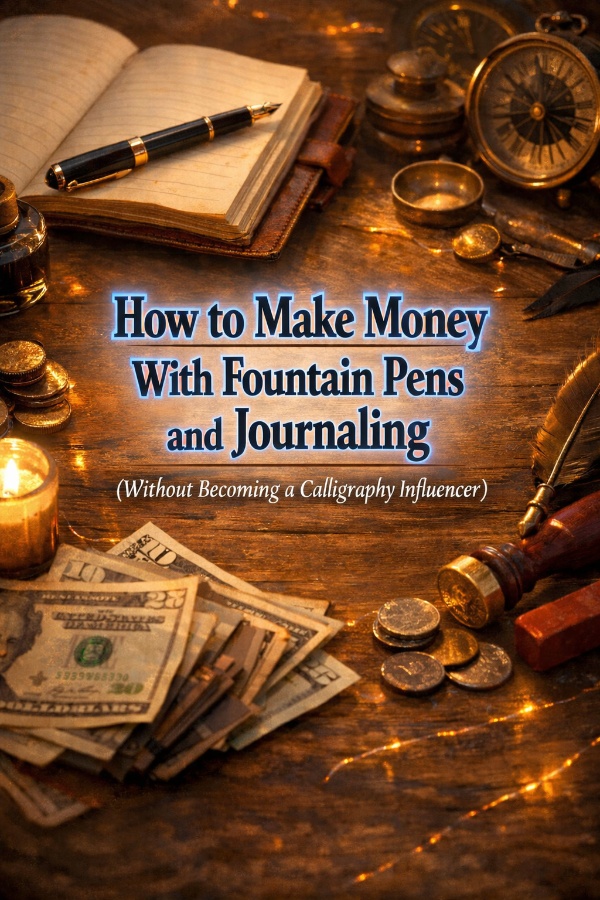
Picture this. You are sitting at your kitchen table at 11pm. Your coffee went cold 47 minutes ago. You have got a Pilot Metropolitan in your hand, a fresh Leuchtturm notebook open in front of you, and absolutely no idea that you are sitting on a goldmine.
That is the thing about the fountain pen and journaling world. The people in it spend money. Serious money. Like, “I just bought my 23rd ink bottle and I regret nothing” kind of money. And almost nobody has figured out how to package that passion into a real online income.
Almost nobody. Until now.
This is not a “become a YouTube star” plan or a “go viral on Instagram” scheme. It is a steady, buildable system for turning a niche you already love into something that actually pays. Realistic income. Real steps. Zero calligraphy skills required.
Why This Fountain Pen and Journaling Crossover Actually Works
Here is what most people miss. Fountain pen fans and journaling fans are basically the same person wearing different hats. They love beautiful writing tools. They love the ritual. They love the community. And they will happily spend $40 on a single bottle of shimmer ink without needing a convincing sales pitch.
The crossover audience is enormous and deeply underserved online. Search “best fountain pen for journaling” and you get scattered Reddit threads and outdated blog posts from 2019. Nobody is owning this space. That is the opportunity sitting right there in plain sight.
Three reasons this works right now. First, the affiliate programs are genuinely good – JetPens and Goulet Pens both pay commissions on products people buy anyway. Second, the digital product gap is real – there are almost zero journaling prompt packs designed specifically for fountain pen users. Third, the community is already gathered on Reddit at r/fountainpens (over 300,000 members) and waiting for someone to lead them somewhere useful.
Why has nobody done this well yet? Because “fountain pens and journaling” sounds unsexy to most marketers. They chase crypto and dropshipping and AI tools. Fine. Let them. You are going to quietly build something in a niche where the audience is passionate, the competition is low, and the spending is real.
Tools You Will Need (The Honest List)
Nothing fancy. Nothing expensive. Here is what actually matters at the start.
- WordPress – Your home base. Free software, about $5-10/month for hosting through somewhere like SiteGround. This is where your blog and product pages live.
- Etsy – For selling digital products like journaling prompt packs and ink pairing guides. Free to open a shop, $0.20 per listing. Start here before building your own store.
- Gumroad – Simpler than Etsy for digital downloads. Free plan available. Good for selling directly to your email list later.
- Canva – Free tier is plenty to start. Use it to create your PDF guides, prompt packs, and ink pairing cheat sheets. It is not rocket science. It is rectangles with pretty fonts.
- No Limit Emails – This is your email tool. Spam-free mailing, individual IPs per subscriber, built-in CRM. When your list starts growing, you will thank yourself for starting with something that actually delivers.
- Amazon Associates – For linking pens, notebooks, and inks that people buy anyway. Easy passive add-on income.
- JetPens Affiliate Program and Goulet Pens Affiliate Program – Apply to both. These are the two biggest specialty fountain pen retailers. Link to specific products in your reviews and guides.
Total realistic startup cost: $60 to $120 for your first three months. That includes hosting. Everything else starts free.
The 10-Step System
Step 1: Spend One Hour on Reddit Before You Do Anything Else
Open r/fountainpens and r/journaling. Set a timer for 30 minutes on each. Read the questions people ask over and over.
“What pen should I use in my Leuchtturm?” “Which inks don’t bleed through Moleskine?” “I want to start journaling but I don’t know where to begin.” Write down every repeated question you see. That list is your content calendar for the next six months.
This is not market research in a boring business-school way. This is just listening. The community will tell you exactly what they want. Your job is to show up and answer.
Step 2: Pick Your Micro-Angle Within the Crossover
The crossover is your niche. But even within that, you want a lane. Three solid options:
Option A: “Beginner’s guide” angle – best pens and inks for new journalers, no intimidation allowed. Option B: “Ink and paper geek” angle – reviews, pairings, deep dives for the obsessive crowd. Option C: “Journaling with intention” angle – prompts, rituals, and the perfect pen to write them with.
Pick one. You can expand later. Starting wide is how people publish four posts and quit forever.
Step 3: Set Up Your WordPress Blog in an Afternoon
Get hosting at SiteGround. Install WordPress. Pick a clean, readable theme – something like GeneratePress (free version works fine). Do not spend three weeks making it perfect. Imperfect and live beats perfect and invisible.
Your about page matters more than your homepage right now. Write one paragraph about who you are and why you love fountain pens and journaling. Be specific. “I have filled 11 Leuchtturm notebooks since 2019 and I have strong opinions about Diamine ink” is better than “I am passionate about writing.” Specificity builds trust faster than anything.
Step 4: Write Your First Three Anchor Posts
These are the posts that will bring in search traffic for years. Not trendy posts. Anchor posts. Things people search for constantly.
Post one: “Best Fountain Pens for Journaling Beginners (Tested on 6 Different Notebooks)” Post two: “Which Inks Work Best in a Leuchtturm1917 – and Which Ones Bleed Through” Post three: “How to Start a Journaling Practice When You Have 17 Unfinished Notebooks Already” (that last one will get clicks because it is painfully relatable – not that I am speaking from experience or anything).
Affiliate link every pen, ink, and notebook you mention. Naturally. Like you are recommending something to a friend, not pitching a timeshare.
Step 5: Create Your First Digital Product
This is the money step that most people skip because it feels scary. Do not skip it.
Start simple. A journaling prompt pack. Thirty prompts written specifically for fountain pen users – prompts about the writing experience itself, not just “write about your feelings.” Something like “Describe the exact feeling of a wet noodle flex nib on Tomoe River paper” is perfect for this audience. They will love it.
Make it in Canva. Export as PDF. Price it at $4.97 on Etsy. That is it. That is your first product. Done.
Step 6: Open Your Etsy Shop and List That Product Today
Not tomorrow. Today. The longer it sits in a folder on your desktop, the more it becomes a “someday” project.
Go to Etsy Sell. Open your shop. Upload your PDF. Write a description that uses the exact words people search – “fountain pen journal prompts,” “journaling prompts for pen lovers,” “writing prompts for ink enthusiasts.” Those are your keywords. Use them without being weird about it.
Take a nice photo of a fountain pen on an open notebook for your listing image. Your phone camera is fine.
Step 7: Start Your Email List the Same Week
Here is the thing about building on Etsy and affiliate links alone – you do not own any of it. Etsy can change their algorithm tomorrow. Amazon can cut commissions again (they have done it before). Your email list is yours forever.
Set up No Limit Emails. Create a simple freebie – a one-page “5 Best Beginner Fountain Pens Under $30” PDF works great. Put a link to it in your blog posts and your Etsy shop bio. Start collecting emails from day one, even if it is just 3 people a week at first.
Step 8: Publish One Review Per Week With Affiliate Links
This is where the passive income actually builds. Pick one pen, one ink, or one notebook each week. Write an honest review – 600 to 900 words. Link to buy it through JetPens, Goulet Pens, or Amazon.
Honest is the key word here. If a pen skips, say it skips. If an ink feathers on cheap paper, say that. Your audience is not looking for cheerleading. They are looking for someone they can trust. Trust converts to clicks. Clicks convert to commissions.
Realistic expectation: after three to four months of consistent weekly reviews, you might see $50 to $150 per month in affiliate income. Not life-changing yet. But it grows while you sleep, which is a wonderful thing.
Step 9: Expand Your Digital Product Line
Once your first Etsy product has a few sales, build the next one. An ink color pairing guide. A “which paper for which ink” cheat sheet. A 30-day journaling challenge designed around trying different pen and ink combinations.
Each product is a new income stream that costs you nothing to deliver after you make it. That is the beauty of digital products. You make it once at 11pm on a Tuesday and it sells on a random Wednesday six months later while you are eating breakfast. That is not hype. That is just how it works.
Step 10: Build a Content Schedule You Can Actually Keep
One blog post per week. One email to your list every two weeks. One new digital product per month. That is the whole system.
Write it on a sticky note and put it somewhere you will see it. Not because you are a productivity robot. Because having a simple repeatable schedule is what turns a hobby into income. The people who build real online businesses are not smarter than you. They just kept showing up on the weeks when it felt pointless. Stick to the schedule and let the system do its thing.
5 Ways This Stands Out From Every Other Method You Have Tried
Before we talk about what makes this different, let us be real for a second – you have probably tried other things. Most people in the MMO space have a course graveyard and a collection of half-built Shopify stores. This is not that.
Way 1: You Are Serving a Community That Already Exists and Already Spends
Most online business methods start with “find your audience.” This one skips that step entirely. The fountain pen and journaling community is already there, already organized, and already handing money to people who serve them well.
You are not creating demand. You are walking into a room full of people who are actively looking for what you are building. That is a fundamentally different starting point.
The financial upside is real too. This audience regularly spends $30 to $150 on a single pen, $8 to $40 on a single bottle of ink, and $20 to $60 on notebooks. They are not looking to be convinced. They are looking for a guide they trust.
Way 2: No Face. No Camera. No Performing Required.
This entire system can be built without ever appearing on camera. Not once. Your blog posts, your digital products, your email list – all text and PDF based.
If you want to add video later, great. YouTube reviews of fountain pens do well. But it is completely optional here. Most people who quit online business quit because they freeze up the moment someone says “just start a YouTube channel.” This system does not require that.
You can be a complete mystery person behind a great blog and still build something real. Introverts, rejoice. Quietly.
Way 3: Multiple Income Streams That Build on Each Other
This is not a one-trick system. You have affiliate income from reviews. You have digital product sales on Etsy and Gumroad. You have email list monetization down the road. Each piece feeds the others.
A blog post brings in search traffic. That traffic buys your Etsy product or clicks your affiliate links. Some of them join your email list. Your email list buys your next product. It compounds over time without requiring you to constantly hustle for new eyeballs.
That compounding effect is what makes this sustainable. It is not glamorous on day 14. It is very satisfying on month 8.
Way 4: The Content Basically Writes Itself
You are writing about something you already know and love. That matters more than most people realize. Burnout kills more online businesses than bad strategy does.
When you are writing your 47th ink review and you still find it genuinely interesting, the words come out differently than when you are grinding out content about a niche you picked from a spreadsheet. Readers feel the difference. So does Google.
Authentic enthusiasm is an unfair advantage. Use it.
Way 5: Low Startup Cost With a Clear Path to Real Income
You are not dropping $2,000 on inventory or $500 on ads. Sixty to one hundred twenty dollars gets you started. That covers hosting. Everything else is free at the beginning.
The income path is also clear and measurable. Affiliate commissions start small and grow. Digital product sales start at $4.97 and you add more products over time. After six months of consistent effort, $300 to $600 per month is a realistic target. After a year, the ceiling is much higher than that. Not “quit your job tomorrow” money at first. But real, trackable progress.
5 Excellent Ways to Find Customers
Having a great system means nothing if nobody finds it. Here are five customer-finding tactics that are not the obvious ones – because you have already heard the obvious ones.
Way 1: Answer Questions in the Goulet Pens Community
Goulet Pens has one of the most active fountain pen communities online. Their YouTube comments section and their customer Q and A on product pages are read by thousands of real buyers every day.
Find questions you can genuinely answer. Give a real, helpful answer. Include your blog link only when it is actually relevant – not as spam, but as “hey, I wrote a whole thing about this.” That is not self-promotion. That is being useful.
Two to three genuine helpful comments per week can drive surprisingly consistent traffic. These are buyers, not browsers. They already have their wallets out.
Way 2: Participate in Ink Swap Communities
Ink swap groups exist all over the internet – on Reddit, on Facebook, in email form. People trade samples of fountain pen inks they want to try. It is delightfully nerdy and completely normal in this community.
Participate as a real community member. When you send someone an ink sample, include a tiny card with your blog URL. Not a sales pitch. Just “I write about pens and ink at [yoursite.com] – come say hi.” That card will get looked at because it arrives with something they were excited about.
This builds genuine community goodwill while putting your name in front of highly targeted potential readers and customers.
Way 3: Submit Guest Posts to Stationery and Planner Blogs
There is a huge adjacent audience in the planner and stationery blog world. These readers love beautiful writing tools but may not have discovered the fountain pen rabbit hole yet. You are the guide who introduces them.
Find stationery blogs with active readerships. Offer to write a guest post – something like “The One Pen That Changed My Entire Planning System” or “Why I Ditched My Felt Tips for a Fountain Pen.” Make it a story, not a product review.
A single guest post on a mid-size stationery blog can bring in 200 to 400 new readers in a week. Some of them will buy your Etsy product the same day.
Way 4: Create a Niche Newsletter Swap With Another Micro-Creator
Find someone who runs a small email newsletter in a related but non-competing niche – maybe a paper and stationery newsletter, a bullet journaling newsletter, or a calligraphy newsletter. Propose a simple swap: you mention them to your list, they mention you to theirs.
This works even when both lists are small. 200 warm, relevant subscribers swapped is worth more than 2,000 cold followers on any social platform. These people already opted in to receive emails about topics close to yours.
One swap per month and your list can grow meaningfully without spending a dollar on advertising.
Way 5: List Your Digital Products on Creative Market
Creative Market is where designers, bloggers, and content creators go to buy digital goods. Journaling prompt packs, printable templates, and writing guides all sell there regularly.
Set up a seller account and list your products alongside your Etsy shop. Creative Market has its own built-in traffic. You are not fighting for visibility – you are just showing up where buyers already are.
Pricing on Creative Market can be slightly higher than Etsy because the buyer demographic skews toward people who use digital products professionally. A prompt pack priced at $4.97 on Etsy might sell for $7.97 there. Same product. Different room.
5 Super Secret Creative Tips
Finding customers is one thing. Keeping them, delighting them, and turning them into repeat buyers is where the real money lives. These tips are the ones most articles skip entirely.
Tip 1: Build an Ink of the Month Email Feature
Once a month, feature one specific ink in your email newsletter. Not a full review – just a love letter. Two paragraphs about why this ink is your current obsession, what paper it sings on, and who should buy it. Include your affiliate link.
This is the email your subscribers will actually look forward to. It is personal, it is specific, and it gives them permission to buy something they were already thinking about. It is not selling. It is sharing.
Affiliate commissions from a well-written “ink of the month” email to even a small list of 500 people can generate $30 to $80 per send. Monthly. For writing two paragraphs you enjoyed writing.
Tip 2: Create a “Pen Hospital” Mini-Guide
Fountain pens sometimes need maintenance – cleaning, nib adjustments, fixing a hard start. Most beginners are terrified to touch their pen when something goes wrong. They either put it in a drawer forever or pay someone to fix it.
A simple “Pen Hospital” guide – how to clean, soak, and troubleshoot a fountain pen in plain English – would be incredibly popular with beginners. Price it at $7.97. Link to the cleaning supplies on Amazon with your affiliate tag. That is a product that answers a painful question people have right now.
Painful questions make great products. Always.
Tip 3: Use Your Journal Pages as Content
Photograph real pages from your actual journal. Not perfect calligraphy. Real handwriting, real ink, real smears and personality. Post those photos with your blog posts and in your Etsy listings.
Here is why this works: everyone else is using stock photos or flat lays. Real journal pages with real handwriting feel completely different. They feel human. They feel like proof that the thing works for a real person.
Authenticity in photos converts better than perfection in photos. Every single time. Your messy handwriting is an asset here, not a liability.
Tip 4: Partner With Small Independent Ink Makers
There are dozens of small independent ink companies – Pennonia, Colorverse, Organic Studio, and many others. They make beautiful, unusual inks that the big retailers do not carry.
Reach out and ask if they would like a review in exchange for a sample. Most small makers will say yes immediately. You get free ink to review. They get exposure to your audience. You link to where people can buy it.
This gives you content without spending money, builds relationships in the community, and positions you as someone with genuine insider access. That perception is worth a lot over time.
Tip 5: Create a “Paper Test Kit” Digital Product
One of the biggest frustrations for fountain pen users is not knowing which paper to buy. Does this notebook bleed? Does it feather? Will my flex nib shred it? These are real, urgent questions with no easy answer – unless you have tested everything.
Create a downloadable “Paper Test Results” PDF. Test 12 to 15 popular notebooks with 6 to 8 common inks. Rate each combination. Present your results in a simple table. Price it at $6.97.
This is the kind of product that sells itself through word of mouth. People share it in Reddit threads and Discord servers because it solves a problem they all have. One share in r/fountainpens can move a surprising number of copies in a single weekend.
Common Mistakes (And How to Avoid Them)
Nobody talks about the mistakes people make in this specific niche. Let us fix that.
Mistake 1: Reviewing Every Popular Pen Instead of Going Deep on One Category
It is tempting to review every pen you can get your hands on. More reviews means more affiliate opportunities, right? Not exactly. A blog that reviews everything becomes a blog that is known for nothing.
The blogs that build loyal audiences pick a lane. Best pens under $50. Best pens for left-handed writers. Best pens for daily carry. That specificity makes you the go-to person for that question instead of one of a thousand general reviewers.
Pick your angle in Step 2 and stick with it for at least three months. Depth beats breadth at the beginning every single time.
Mistake 2: Waiting Until Your Blog Looks Perfect to List on Etsy
This one is very common and very expensive in terms of lost time. People spend six weeks tweaking their blog header and never list a single product.
Your Etsy shop does not need your blog to be finished. It does not even need your blog to exist yet. Etsy has its own search traffic. List your first product this week regardless of where everything else stands.
Imperfect and published earns money. Perfect and unfinished earns nothing. Post it now and improve it later.
Mistake 3: Ignoring the Journaling Side of the Crossover
Some people come at this from the fountain pen angle and forget that half their audience is primarily journalers who are just now discovering pens. That audience needs different content than the pen enthusiasts do.
Journalers want prompts, rituals, consistency strategies, and the emotional side of keeping a journal. They want to know which pen feels good for morning pages, not which pen has the best nib grind options.
Write content for both sides of the crossover. Alternate between pen-focused posts and journaling-focused posts. That balance is what makes this niche different from every other fountain pen blog out there.
Mistake 4: Setting Up Email Marketing Way Too Late
Most people treat email as a “later” project. I will set that up after I have real traffic. That thinking costs you months of list growth you can never get back.
Set up No Limit Emails in week one. Create a simple freebie. Put the signup link in your blog sidebar, your blog posts, and your Etsy shop bio. Even if only three people sign up in month one, those three people are yours. You own that relationship.
An email list of 200 warm subscribers who love fountain pens and journaling is worth more than 2,000 Instagram followers who tapped the heart button once and forgot about you.
Mistake 5: Over-Complicating the Digital Products
First-time digital product creators often spend three weeks building a 47-page ultimate guide when a two-page cheat sheet would sell better and faster. More pages does not mean more value. Solving a specific problem means value.
Your first product should be something you can build in an afternoon. Thirty prompts. A one-page ink pairing chart. A beginner checklist. Something clean, useful, and done.
You can build the 47-page guide later when you know exactly what your audience wants. Start with simple and add complexity only when the market asks for it.
Scaling This Up (When You Are Ready)
Nobody scales on day three. That is not pessimism. That is just how real businesses work. But once you have a few sales, a small list, and some traffic coming in? Here is what is next.
Scale option one: A paid membership or subscription. A “Pen and Ink of the Month” email club at $7 per month is surprisingly buildable once you have an engaged list. Fifty members is $350 per month recurring. One hundred members is $700. Those are real numbers that do not require going viral.
Scale option two: A bundled product collection. Take your individual Etsy products and bundle them into a “Complete Fountain Pen Journaling Starter Kit” at a higher price point – $19.97 to $29.97. Bundles convert well because buyers feel like they are getting more for less.
Scale option three: A simple online course. A seven-day “Start Your Fountain Pen Journaling Practice” course taught via email or a platform like Teachable. This is a bigger lift but also a bigger return. Priced at $47 to $97, you only need a handful of students per month for it to matter.
If you want help building any of this out, I teach exactly this kind of daily monetization system inside the E1K Skool community. No pressure. Just mentioning it is there.
Next Steps (Do This Now)
Three things. Not ten. Three.
- Spend 30 minutes on r/fountainpens right now. Write down every repeated question you see. That list is your first three months of content. Do this today before you do anything else.
- Open a free account on Etsy and Canva. Start sketching your first journaling prompt pack. It does not have to be pretty. It has to exist.
- Set up your email and create your first freebie – “5 Best Fountain Pens for Beginners Under $30” as a simple PDF. This is the thing that starts building your list from day one. Do not skip it. Do not defer it. Do it this week.
Final Thoughts
You have probably tried other things. Maybe a lot of other things. Maybe there is a folder on your computer called “Online Business Ideas” that has not been opened since 2022. That is okay. Most people get here the same way.
Here is what I know about the fountain pen and journaling crossover: the audience is real, the spending is real, and the competition is genuinely low. That combination does not come along every day.
This works if you work it. Not all at once. Not perfectly. Just consistently – one post, one product, one email at a time. Go make yourself a fresh cup of coffee (unlike mine, which is currently cold again), open Reddit, and write down those questions. That is all step one asks of you.
You have got this! Now go make it happen today.
Enjoy!