Good morning, fellow entrepreneur!
So you’re getting a colonoscopy tomorrow. (Been there, survived the prep, now passing along wisdom like a budget-saving fairy godmother.)
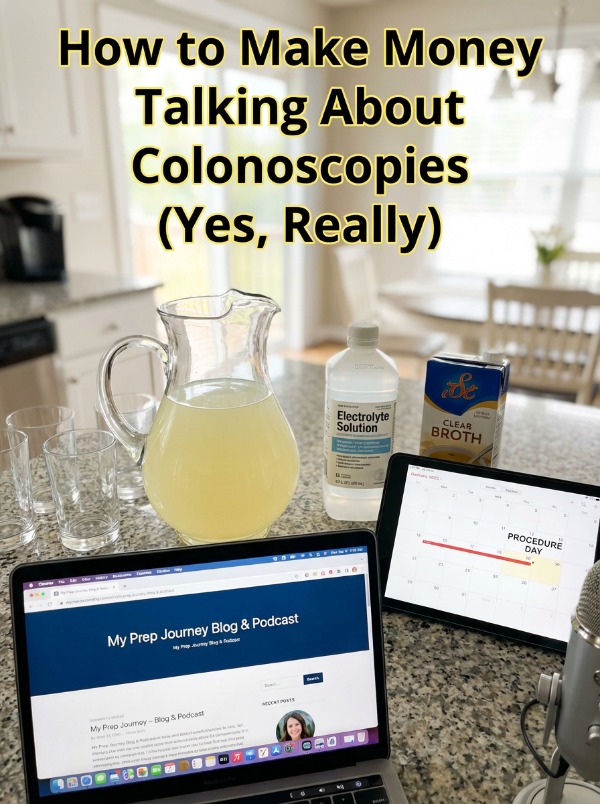
Here’s the thing nobody tells you: there’s actual money in colonoscopy content. Not because it’s glamorous. Because 19 million Americans get one every year, and they’re all Googling the same panicked questions at 2am while drinking that delightful lemon-flavored nuclear waste.
This isn’t about being gross or weird. It’s about helping people while building a micro-income stream that runs while you’re, y’know, recovering on your couch with crackers.
Let’s turn your medical adventure into cash.
Why This Niche Actually Works
Most people won’t touch medical content with a ten-foot pole.
That’s your advantage right there. Low competition, high search volume, desperate audience. The perfect trifecta for anyone who doesn’t mind getting slightly personal.
People need real talk about colonoscopy prep. They want to know if they can survive on bone broth. Whether the prep tastes like sadness mixed with cleaning products. (Spoiler: yes.) If their boss will understand why they need the day off.
The search volume is bonkers. “Colonoscopy prep tips” gets 18,000 searches monthly. “What to eat before colonoscopy” pulls 12,000. “Colonoscopy prep drink flavoring” brings in 8,000 desperate souls looking for salvation.
You’re providing genuine value. And getting paid for it.
The Tools You’ll Actually Use
You don’t need fancy equipment. Just the basics and maybe some caffeine.
- WordPress or Medium – Where you’ll publish your content. Medium pays writers directly through their Partner Program based on reading time. WordPress gives you full control and lets you run ads.
- Amazon Associates – Link to prep kits, heating pads, and comfort items. Sign up at Amazon Associates to get your affiliate tag. Approval takes 24-48 hours if you already have a website or blog.
- Canva – Create infographics about prep schedules people can actually follow. The free version gives you everything you need for social media graphics and Pinterest pins.
- Google Docs – Draft everything here first because your brain works better caffeinated. Plus it auto-saves, which matters when you’re writing between bathroom trips tomorrow.
- Email tool like No Limit Emails – Build a list of people preparing for procedures. Spam-free mailing with individual IPs per subscriber. The built-in CRM tracks who opens what, so you know which topics resonate.
- Heating pads – For the inevitable stomach cramping. Commission on a $25 heating pad = $1-2.50. Link to both electric and microwaveable options because some people have weird outlet situations in their bathrooms.
- Flushable wet wipes – Trust me on this one. Your readers will thank you profusely. A $15 multi-pack earns you $0.60-1.50 per sale, and people buy these in bulk.
- Ultra-soft toilet paper – Because regular TP becomes your enemy around hour three of prep. The premium quilted stuff makes a difference to your posterior and your commission rate.
- Prep drink flavor packets – Makes the prep solution slightly less like drinking sadness. Cherry and lemonade are the most popular according to actual colonoscopy survivors.
- Cozy throw blankets – For camping out near the bathroom in comfort. Recommend washable ones because, well, accidents happen during prep.
- Lip balm multi-packs – Dehydration is real and chapped lips are miserable. A $12 pack of Chapstick earns you about $0.50, but people appreciate the reminder.
- Entertainment magazines – Distraction devices that don’t require Wi-Fi or concentration. Because staring at your phone while feeling terrible gets old fast.
- Comfortable loungewear – Elastic waistbands only. No buttons, no zippers, no dignity required. A $30 pajama set = $1.20-3.00 in your pocket.
- Anti-nausea wristbands – The acupressure kind that actually help some people. Worth mentioning for the readers who get queasy easily.
- Electrolyte drink mixes – For after the prep when you feel like a deflated pool float. Pedialyte powder packets are popular with the over-45 crowd.
Each product link in your blog post? Potential passive income while you sleep.
10 Steps to Turn Colonoscopy Content Into Cash
Step 1: Write Your Honest Prep Experience
Document everything tomorrow. The good, the terrible, the “why did I think orange Gatorade was a good idea” moments.
Raw honesty beats polished medical-speak every single time.
Start a note on your phone right now. During prep tomorrow, jot down timestamps. “3:47pm – first gulp of prep drink tastes like someone liquified Smarties and regret.” “4:23pm – why did I position myself so far from the bathroom.” “6:15pm – found new appreciation for wet wipes.”
These real-time observations become your content gold. People don’t want a sanitized medical journal entry. They want to know what actually happens, minute by minute, so they can mentally prepare.
Write about what you ate the day before. How you prepped your bathroom station. What entertainment you queued up. The exact moment you realized your prep timeline was overly optimistic.
This single honest account becomes three blog posts: “What Really Happens During Colonoscopy Prep,” “My Colonoscopy Prep Timeline (The Unfiltered Version),” and “Things I Wish Someone Told Me Before Prep Day.”
That’s three pieces of content from one experience. Not bad for a Tuesday.
Step 2: Create a Colonoscopy Prep Survival Guide
Turn your notes into a downloadable PDF. Price it at $7. People will pay for real-world advice that doesn’t sound like a textbook wrote it.
Use Canva to design a professional-looking guide with actual personality. Include your prep timeline, shopping list, bathroom setup tips, and entertainment recommendations.
Add sections on “What Your Doctor Didn’t Mention” and “Mistakes I Made So You Don’t Have To.” Real talk about the prep drink temperature (ice cold is crucial), the optimal distance from toilet to entertainment setup (closer than you think), and why you should absolutely prep your bathroom the night before.
Create a checklist people can print. Include affiliate links to every product mentioned. Make it genuinely useful so people feel good about spending $7.
Sell it on Gumroad or Payhip. Both platforms handle payments and deliver digital products automatically. You set it up once, it sells while you sleep.
Ten sales = $70. That’s your first month of coffee paid for by talking about your colonoscopy. (Not that I’m calculating my coffee budget in colonoscopy content sales or anything.)
Step 3: Start a Health Blog
Pick a name. “The Colonoscopy Chronicles.” “Scope There It Is.” (That last one would make an awesome poster!)
Post twice weekly about digestive health topics.
Register a domain on Namecheap for $8.88 yearly. Set up WordPress hosting on Bluehost for $2.95 monthly. You’re operational for under $50 total.
Your first ten posts write themselves: colonoscopy prep, recovery tips, what to expect during the procedure, how to talk to your doctor about symptoms, fiber supplements that don’t taste like sawdust, digestive health myths, when to schedule your screening, what polyps actually mean, colonoscopy vs other screening methods, and follow-up care.
Each post includes Amazon affiliate links to relevant products. Heating pads in the prep post. Fiber supplements in the digestive health piece. Comfortable recovery clothing in the post-procedure article.
Write like you’re texting a worried friend. Short paragraphs, conversational tone, zero medical jargon unless you immediately explain it. Think “Your colon is basically a really long tube that gets grumpy sometimes” instead of “The large intestine experiences inflammatory responses.”
Publish consistently. Tuesday and Thursday mornings work well because people Google health stuff during work hours when they’re procrastinating.
Step 4: Build Amazon Affiliate Links
Every prep kit, heating pad, wet wipe, and comfort item you mention? Link it. Commission ranges from 1-10% depending on category.
One $50 prep kit sale = $2-5 in your pocket.
Sign up for Amazon Associates right now. You need a website or blog with published content to get approved. Your three colonoscopy posts from Step 1 count.
Learn the SiteStripe tool – it’s the little toolbar that appears at the top of Amazon when you’re logged into Associates. You can create affiliate links for any product in three clicks without leaving the Amazon page.
Create a “Colonoscopy Prep Kit” page on your blog that lists everything someone needs: prep drink, flavor packets, wet wipes, toilet paper, heating pad, lip balm, entertainment options, comfortable clothes, and electrolyte replacements.
Write a brief description for each item explaining why it matters. “These wet wipes will save your life around hour four when regular toilet paper feels like sandpaper made of broken dreams.”
Link each item with your affiliate tag. When someone buys that $25 heating pad, you earn $1-2.50. When they add the $15 wet wipes and $12 lip balm to their cart? You’re up to $3-4 total.
Five people buying your recommended kit weekly = $15-25. Not retirement money, but definitely “my streaming subscriptions are covered” money.
Step 5: Join Health Affiliate Programs
ShareASale has health product merchants. CJ Affiliate connects you with pharmaceutical companies. ClickBank offers digestive health supplements.
Apply to 3-5 programs. Get approved. Start linking.
ShareASale approval takes 2-3 business days. Search their merchant directory for “digestive health,” “wellness,” “medical supplies.” Companies like Vita Living and Health Products For You offer 8-15% commission on sales.
CJ Affiliate (formerly Commission Junction) works with bigger brands. Their approval process is stricter – you need established traffic. Wait until you’ve got 500 monthly visitors before applying.
ClickBank is immediate approval but pickier about quality. Look for digestive health supplements with gravity scores above 20 (that means other affiliates are making sales). Commission rates hit 50-75% on digital products.
Create a “Resources” page on your blog. List the products and supplements you genuinely recommend. Include both Amazon and direct affiliate links so readers have options.
Write individual review posts for products that deserve them. “I Tried 5 Fiber Supplements So You Don’t Have To” becomes a comparison post with affiliate links to each product tested.
One supplement sale at $40 with 50% commission = $20 in your pocket. Find three customers monthly and you’ve covered your hosting costs.
Step 6: Write for Health Sites
Healthline, Verywell Health, and WebMD pay $150-500 per article for experienced writers.
Pitch your colonoscopy prep angle. They need real patient perspectives.
Start with smaller health sites first to build clips. The Mighty accepts personal health stories. Patient publishes patient experiences. Both give you bylines you can use when pitching bigger sites.
Your pitch email for Healthline: “I recently underwent a colonoscopy and documented the entire prep process with brutal honesty. I’d like to write ‘The Colonoscopy Prep Guide Your Doctor Didn’t Give You’ – 1,500 words covering practical tips, common mistakes, and real-world advice from someone who just survived it. My perspective would complement your existing clinical content with patient experience.”
Include links to your three best blog posts as writing samples. Keep your pitch to four sentences maximum. Editors are busy humans who appreciate brevity.
Healthline pays $200-300 for first-time contributors. Verywell Health starts at $150-250. These aren’t get-rich assignments, but they build your portfolio and credibility.
Write two articles monthly for health sites = $400-600 while establishing yourself as a go-to source for digestive health content.
Plus every published article includes an author bio with a link back to your blog. Free traffic that converts.
Step 7: Create YouTube Videos
“What I Wish I Knew Before My Colonoscopy” will get views. People watch videos while drinking their prep because misery loves company.
Monetize with ads once you hit 1,000 subscribers.
Film yourself tomorrow explaining the prep process in real time. Not the gross parts – just you sitting there with your prep drink, explaining what’s happening and offering tips.
Use your phone camera. Natural lighting from a window. Speak directly to the camera like you’re FaceTiming a nervous friend. Zero fancy production needed.
Your first five videos: “Colonoscopy Prep Hour-by-Hour Timeline,” “Products That Made My Colonoscopy Prep Bearable,” “What Actually Happens During a Colonoscopy,” “Recovery Tips Nobody Tells You,” and “When to Schedule Your First Screening.”
Edit using CapCut (free) or iMovie (free on Mac). Add text overlays with key tips. Keep videos under 10 minutes – YouTube’s algorithm loves that sweet spot.
Include your Amazon affiliate links in the video description. YouTube allows affiliate links as long as you disclose them.
Upload twice weekly. Tuesday and Friday work well for health content. Consistency matters more than perfection.
At 1,000 subscribers and 4,000 watch hours, you qualify for YouTube Partner Program. Ad revenue runs $2-5 per 1,000 views depending on viewer demographics. Health content typically hits the higher end because advertisers pay more.
Five videos getting 5,000 views each monthly = $50-125 in ad revenue, plus Amazon affiliate commissions from description links.
Step 8: Build an Email List
Offer a free “Colonoscopy Prep Checklist” in exchange for emails. Send helpful tips weekly.
Every email includes relevant product recommendations.
Set up No Limit Emails and create a simple signup form. Embed it on every blog post, in your YouTube descriptions, and on a dedicated landing page.
Your free checklist should be legitimately useful. One-page PDF with timeline breakdown, shopping list, bathroom prep tips, and entertainment suggestions. Create it in Canva, make it pretty, solve a real problem.
Write your welcome email sequence: Email 1 delivers the checklist, Email 2 shares your personal prep story, Email 3 recommends essential products (with affiliate links), Email 4 answers common questions, Email 5 offers your paid survival guide at a discount.
After the sequence, send weekly emails with digestive health tips, new blog posts, product recommendations, and personal updates. Keep it conversational and genuinely helpful.
“Subject: The heating pad that saved my prep day” leads to an email about why heating pads matter, links to your top three recommendations on Amazon, and a brief personal story about cramping relief.
A list of 100 subscribers converting at 2% on a $25 product with 4% commission = $2 per email. Send one product email weekly and you’re making $8-10 monthly per hundred subscribers.
Grow to 500 subscribers and suddenly you’re looking at $40-50 monthly just from email recommendations.
Step 9: Write eBooks for Kindle
“The Colonoscopy Survival Guide” on Amazon Kindle Direct Publishing. Price it at $2.99-4.99.
You get 70% royalty on each sale.
Take your blog content, organize it into chapters, expand each section, and boom – you’ve got a book. Your prep experience, shopping lists, timeline, product recommendations, recovery tips, and FAQs become 50-80 pages of legitimately useful information.
Format it in Google Docs first. Use heading styles for chapters. Add a clickable table of contents. Keep paragraphs short and readable.
Upload to Kindle Direct Publishing – it’s free to publish. Create a cover using Canva’s book cover templates. Write a compelling book description that addresses reader pain points.
Price at $3.99 for maximum royalty. You earn $2.79 per sale. Sell ten copies monthly and you’ve made $27.90 for work you did once.
Promote your Kindle book in your blog posts, YouTube videos, and email newsletters. “Want everything in one convenient guide? Grab my Kindle book for less than a fancy coffee.”
A hundred sales over six months = $279. Not life-changing, but definitely “that’s a nice little passive income stream” money.
Step 10: Partner with Medical Practices
Gastroenterology offices need patient education materials. Offer to create custom prep guides for $200-500 per practice.
One client gets you ten more through referrals.
Find local GI practices on Google. Call their office managers (not the doctors directly). Pitch a customized prep guide that includes their specific prep instructions, office information, and patient-friendly explanations.
“Hi, I’m a writer who specializes in patient education content. I’ve created colonoscopy prep guides that practices give to patients before their procedures. Would Dr. Smith’s office be interested in a custom guide that includes your specific protocols and contact information? Investment is $300 for a professionally designed PDF your office can email or print.”
Most practices say yes because they’re already creating this content themselves (badly) or buying generic materials that don’t match their protocols.
Create the guide in Canva. Include their logo, office hours, doctor bios, specific prep instructions they provide, shopping list, timeline, tips, and FAQs. Make it beautiful and useful.
Deliver a print-ready PDF and an email-friendly version. Give them unlimited usage rights.
Five practices at $300 each = $1,500 for work you can replicate quickly since you’re customizing a template.
Each happy practice refers you to colleagues. Medical professionals talk to each other constantly. Your best marketing is doing excellent work.
5 Ways to Stand Out From Other Health Writers
Be Hilariously Honest About the Unglamorous Parts
Nobody wants sanitized medical speak. They want “here’s why you should stock up on wet wipes and prepare to become best friends with your toilet.”
Humor makes terrible topics bearable.
Most health writers treat colonoscopy prep like it’s a solemn medical procedure requiring dignified language. Screw that. It’s you drinking a gallon of liquid that tastes like disappointment while your digestive system throws a tantrum.
Write with the same energy you’d use texting your best friend at 2am during prep. “Currently on hour three and I’ve officially given up all pretense of dignity. The cat is judging me. I’m judging me. We’re all just judging each other while I camp next to this toilet like it’s a luxury vacation destination.”
People remember humor. They share funny articles with friends facing the same procedure. They bookmark honest content because it feels like actual help instead of corporate health-speak.
Your colonoscopy prep post shouldn’t sound like every other colonoscopy prep post. It should sound like YOU survived this mildly terrible experience and lived to tell the hilariously honest tale.
Make people laugh while giving them genuinely useful information. That combination is rare enough to build an audience around.
Focus on the Prep, Not the Procedure
Everyone writes about the colonoscopy itself. You’re writing about the 24 hours before, which is honestly the harder part.
That’s your angle. Own it.
The actual colonoscopy takes 20-30 minutes and you’re blissfully unconscious. The prep? That’s a 12-16 hour ordeal of drinking terrible liquid and visiting the bathroom 47 times. (Okay, maybe not 47, but it feels like 47.)
Most medical content focuses on the procedure because that’s what doctors care about. Patients care about surviving the prep without losing their minds or their dignity.
Write the content patients actually need. Hour-by-hour breakdown of what to expect. How to make the prep drink less awful (spoiler: ice cold with Crystal Light packets). When to start clearing your schedule (earlier than you think). How to set up your bathroom station (wet wipes, phone charger, entertainment, heating pad within arm’s reach).
Answer questions like “Can I sleep through any of this?” (no) and “Will I make it to work the day before?” (maybe, if your procedure is late afternoon and you’re brave).
Position yourself as the prep expert, not the procedure expert. There are a million articles about polyps and cancer screening. There are way fewer about the practical reality of drinking a gallon of colonoscopy prep.
Create Actual Checklists People Can Print and Use
Timeline breakdowns. Shopping lists. What to watch on Netflix during prep. (General Hospital marathons work surprisingly well for distraction.)
Practical beats theoretical every time.
Don’t just write about what people need. Give them the actual checklist they can print, stick on their fridge, and follow step-by-step.
“Colonoscopy Prep Shopping List” with checkboxes: prep drink (get from pharmacy), flavor packets, wet wipes (two packs minimum), extra toilet paper, heating pad, lip balm, clear liquids (approved list), entertainment options, comfortable clothes, phone charger.
“Hour-by-Hour Prep Timeline” they can follow: 2pm – start drinking prep, 2:30pm – first bathroom visit likely, 3pm-6pm – peak bathroom frequency, 6pm – finish prep drink, 7pm-10pm – continued bathroom visits, 10pm – things start calming down, 11pm – finally safe to be more than 10 feet from toilet.
“Bathroom Setup Checklist” so they’re prepared: wet wipes in easy reach, phone charger nearby, heating pad plugged in, extra TP stocked, entertainment queued up, comfortable seating situation arranged, dignity abandoned at door.
People print these checklists. They share them with friends. They bookmark your site because you made an annoying medical requirement slightly less annoying with actual helpful organization.
Create downloadable PDFs of your checklists. Offer them free in exchange for email signups. Now you’ve got content AND list-building happening simultaneously.
Interview Real Patients and Share Their Stories
Ask friends, family, random people on Facebook groups about their experiences. Compile the best tips into roundup posts.
Real voices beat one expert opinion.
Post in r/colonoscopy asking “What’s the one thing you wish you knew before your first colonoscopy prep?” You’ll get 30+ responses with pure content gold.
Join Facebook groups like “Colon Cancer Support Group” and “Digestive Health Support.” (Get permission before mining for content – be respectful and transparent.) Ask what tips people would share with first-timers.
Compile answers into “20 Real Patients Share Their Best Colonoscopy Prep Tips” articles. Quote people (with permission), give credit, and organize tips by category: comfort items, timing advice, mental preparation, product recommendations.
Interview a gastroenterologist about common patient questions. Email local GI doctors asking for 15 minutes of their time. Most are happy to be quoted as experts. Turn that interview into “A Gastroenterologist Answers the Top 10 Colonoscopy Questions.”
Real patient stories create trust. “Here’s what worked for Janet, Mike, and Sarah” feels more believable than “Here’s what I think you should do.”
Plus, featuring other people’s stories means you’re not constantly writing about your own colonoscopy. There’s only so much mileage in “that time I drank terrible liquid and visited the bathroom a lot.”
Make Everything Ridiculously SEO-Friendly
Use phrases people actually type. “How bad is colonoscopy prep really.” “Can I work the day before a colonoscopy.” “Best flavor for colonoscopy prep drink.”
Google loves specific answers to specific questions.
Open Google and start typing “colonoscopy prep” into the search bar. Google’s autocomplete shows you actual phrases people search: “colonoscopy prep tips,” “colonoscopy prep without nausea,” “colonoscopy prep products,” “colonoscopy prep timeline.”
Use AnswerThePublic (free version) to find questions people ask. Enter “colonoscopy” and get hundreds of actual searches: “what can I eat before colonoscopy,” “when should I start prep,” “why is colonoscopy prep so bad.”
Write blog posts that answer these specific questions. Your title should literally be the question: “What Can I Eat the Day Before a Colonoscopy? (Complete Food List)”
Use the question as your H1 heading. Answer it in the first paragraph. Then expand with details, tips, product recommendations, and personal experience.
Include the question phrase naturally throughout your post. Not keyword stuffing – just writing like a normal human who’s answering a question.
Link to authoritative sources like Mayo Clinic and Cleveland Clinic. Google rewards content that cites reputable medical sources.
Add FAQ sections at the end of posts using the exact questions people search. Google often pulls these into featured snippets, giving you prime real estate on search results.
5 Ways to Find Customers Who’ll Actually Pay
Join Health-Focused Facebook Groups and Help People First
Search “colorectal cancer support,” “colonoscopy prep,” “digestive health.” Offer free value first. Link to paid products second.
Help first, sell later.
Join 10-15 Facebook groups related to digestive health and colonoscopy. Read the group rules first – many ban promotional content. That’s fine. You’re not there to spam.
Answer questions genuinely. When someone posts “Getting my first colonoscopy next week and I’m nervous,” respond with actual helpful advice. Share what worked for you. Mention specific products that helped.
“I just had mine last month! My biggest tips: get the wet wipes BEFORE prep day, keep your prep drink ice cold, and set up a whole bathroom station so you’re not making 47 trips back and forth. The heating pad helped way more than I expected for cramping.”
Include your blog link in your profile, not in every comment. People check out profiles of helpful group members. They click. They read your content. They buy your recommended products.
Participate for a month before mentioning any paid products. Build trust first. Be the person who gives great advice, not the person who’s always selling something.
When you do share your paid survival guide, frame it as “I created this after my colonoscopy to help other people – it’s everything I wish I’d known. Only $7 if anyone wants it, but happy to answer questions here too.”
Genuine helpfulness converts better than pushy sales pitches.
Comment on Reddit and Health Forums Daily
r/colonoscopy exists. So does Inspire.com for various health conditions.
Answer questions. Build trust. Include your blog link in your profile.
Set a timer for 15 minutes daily. Scroll r/colonoscopy and answer two questions with genuinely helpful responses. No links in comments – just useful information.
“The grape-flavored prep isn’t too bad if you mix it with white grape juice instead of water. Game-changer for me.”
“Start your prep earlier than the instructions say. I waited until the recommended time and was up until 2am still dealing with effects.”
Your Reddit profile includes a bio section. Put your blog link there: “Colonoscopy survivor sharing prep tips and digestive health content at [yourblog].com”
People check comment histories of helpful Redditors. They see your consistently useful advice. They click your profile. They visit your blog.
Same strategy on Patient.info forums, HealingWell digestive disorders forum, and Crohn’s Forum.
One forum comment daily = 30 monthly opportunities for people to discover your content. Some will. Some won’t. The ones who do become email subscribers and customers.
Reddit specifically hates promotional content, so be extra careful there. Provide value, let people find you naturally through your profile.
Partner with Health Coaches for Commission-Based Sales
Nutritionists and wellness coaches have clients getting colonoscopies. Offer them 30% commission for promoting your prep guide.
They help their clients, you make sales, everyone wins.
Find health coaches on Instagram using hashtags like #nutritionist, #healthcoach, #digestivehealth, #guthealth. Look for coaches with 1,000-10,000 followers (they’re accessible and often looking for additional revenue).
Send a DM: “Hi! I noticed you work with clients on digestive health. I’ve created a colonoscopy prep guide that several nutritionists share with their clients. Would you be interested in a 30% affiliate commission for any sales through your link? My guide covers practical prep tips, product recommendations, and real-world advice from someone who’s survived it.”
Set up affiliate tracking through Gumroad or Payhip. Both platforms let you create custom affiliate links that track sales.
Your $7 guide at 30% commission = $2.10 per sale for the health coach. If they have 5 clients annually getting colonoscopies and recommend your guide to all of them, that’s $10.50 for basically zero effort on their part.
Partner with 10 health coaches and suddenly you’re getting steady referral sales without running ads or doing active promotion.
Give coaches the freedom to share genuinely. Don’t demand they push your product. Just make it available if it fits their client’s needs.
Genuine partnerships based on mutual value creation last longer than transactional affiliate relationships.
Run Cheap Facebook Ads to Build Your Email List
Target people 45-75 interested in health topics. Spend $5 daily. Link to your free checklist that builds your email list.
Three sales from one ad campaign pays for a month of coffee.
Set up a Facebook ad account. Create a simple ad: image of your checklist, headline “Free Colonoscopy Prep Checklist – Everything You Need to Know,” description “Get my complete prep timeline, shopping list, and survival tips delivered instantly.”
Target: Ages 45-75, United States, interests in health and wellness, Mayo Clinic, Cleveland Clinic, WebMD, digestive health.
Budget: $5 daily = $150 monthly.
Link to a landing page with your checklist signup form. “Enter your email and I’ll send you my complete colonoscopy prep checklist immediately – plus weekly digestive health tips.”
At $0.50-1.00 per email subscriber (typical for health content), your $150 monthly ad spend gets you 150-300 new subscribers.
Those subscribers receive your email sequence promoting your $7 guide. If 2% buy, that’s 3-6 sales = $21-42. Not covering your ad spend yet, but building a list that generates sales monthly.
After three months, you’ve got 450-900 subscribers generating ongoing sales, Amazon affiliate revenue, and future product sales.
Run ads for 90 days. Evaluate results. If you’re profitable (including long-term subscriber value), continue. If not, adjust targeting or pause while you grow organically.
$5 daily won’t make you rich, but it will systematically build an audience of people interested in exactly what you’re selling.
Pitch Guest Articles to Health Newsletters
The Skimm, Well+Good, local hospital newsletters. Offer a free article in exchange for author bio with links.
Exposure beats immediate payment sometimes.
Research health newsletters with 10,000+ subscribers. Local hospitals, health systems, and wellness brands all have newsletters desperate for engaging content.
Email their editors: “Hi! I’m a writer specializing in patient-friendly health content. I’d love to contribute a free article on colonoscopy prep for your newsletter – something that demystifies the process and helps readers feel prepared. In exchange, I’d appreciate an author bio with a link to my digestive health resources. Would this fit your editorial needs?”
Include links to your three best blog posts so they can see your writing style.
Many smaller newsletters accept quality content for free because producing content is expensive and time-consuming.
Your 800-word article gets sent to 10,000 subscribers. Your author bio includes “Sarah writes about digestive health at [yourblog].com where she offers free colonoscopy prep resources.”
Even a 0.1% click-through rate = 10 new visitors to your site. Some subscribe. Some buy. Some share with friends.
Write guest articles for 5-10 newsletters over three months. That’s potentially 50,000-100,000 people exposed to your content and expertise.
Guest posting builds authority faster than almost any other strategy. You’re borrowing someone else’s audience credibility.
Mistakes That’ll Kill Your Colonoscopy Content Business
Giving Medical Advice You’re Not Qualified to Give
Share your experience. Don’t diagnose conditions or contradict doctors. That’s a lawsuit waiting to happen.
Stick to “here’s what worked for me” territory.
Never write “You should take this medication” or “You don’t need that test.” Always frame advice as personal experience: “My doctor recommended X, and here’s how it worked for me.”
Include disclaimers on every piece of content: “This content is based on personal experience and research. Always consult your healthcare provider before making medical decisions.”
Don’t recommend specific prep medications unless quoting a doctor or linking to official medical sources. Share brand names of comfort products (wet wipes, heating pads) all day long. Avoid medical recommendations.
If someone asks “Should I be worried about this symptom?” in comments or emails, your answer is always “I’m not qualified to assess symptoms – please contact your doctor or gastroenterologist.”
The line between sharing experience and giving advice can blur quickly. Stay firmly on the experience side.
You can write “My doctor said clear liquids include broth, juice, and Jell-O” but not “You can eat solid food the day before as long as it’s bland.” The first quotes a medical professional. The second contradicts standard prep protocols.
Stay helpful. Stay honest. Stay safely within the bounds of personal storytelling.
Writing Like a Medical Textbook
If I wanted medical jargon, I’d read my doctor’s handout. (Which I definitely won’t because it’s 47 pages of tiny print.)
Write like you’re texting a friend who’s nervous.
Bad: “The colonoscopy preparation involves consuming a bowel-cleansing solution that induces multiple bowel movements to achieve adequate visualization of the colonic mucosa.”
Good: “You’re gonna drink a bunch of terrible-tasting liquid that makes you poop a lot so the doctor can actually see inside your colon. That’s literally the whole thing.”
Skip phrases like “utilize” when “use” works fine. Avoid “individuals” when you mean “people.” Delete “facilitate” and write “help” instead.
If you can’t explain it to your grandmother in plain English, rewrite it.
Medical content doesn’t need to sound medical. It needs to be understood by scared people who barely remember high school biology.
Read your draft out loud. If it sounds like a robot wrote it, start over. If it sounds like you explaining something to a friend over coffee, you’re getting close.
Your audience isn’t doctors. It’s regular humans who just want to know what’s going to happen and how to survive it without losing their minds.
Ignoring SEO Completely
Your brilliant article means nothing if nobody finds it. Use keywords naturally. Write compelling titles. Link to reputable sources like Mayo Clinic and Cleveland Clinic.
Google rewards helpful content that people actually read.
Every blog post needs a keyword focus. What phrase are people searching that your post answers?
“Colonoscopy prep tips” is searched 18,000 times monthly. “What to eat before colonoscopy” gets 12,000 searches. “Colonoscopy prep drink flavoring” pulls 8,000.
Pick one primary keyword per post. Use it in your title, first paragraph, at least one heading, and naturally throughout the content.
But don’t stuff keywords awkwardly. “Colonoscopy prep tips for colonoscopy prep success with colonoscopy prep drinks” sounds robotic and ranks poorly.
Write for humans first, search engines second. Google’s algorithm is smart enough to recognize naturally helpful content.
Link to 2-3 authoritative medical sources per article. Mayo Clinic, Cleveland Clinic, American Cancer Society, National Institutes of Health. These outbound links signal to Google that your content is well-researched.
Add alt text to images describing what they show: “colonoscopy prep timeline checklist printable” rather than “image-1.jpg”
Use short, descriptive URLs: yourblog.com/colonoscopy-prep-tips instead of yourblog.com/2026/01/11/post-47-updated-version-2
SEO isn’t magic. It’s just organizing your helpful content so Google understands what it’s about and who it helps.
Only Promoting One Product
Diversify. Amazon links, your own products, affiliate programs, sponsored posts. Multiple income streams mean you’re not screwed when one dries up.
Never put all your eggs in one colonoscopy prep basket.
If you only promote Amazon products, you’re vulnerable to commission rate changes. (They’ve dropped rates before, they’ll do it again.)
If you only sell your $7 guide, you’re limited by how many new colonoscopy patients discover you monthly.
If you only write for Healthline, you’re dependent on one editor continuing to assign you work.
Build multiple revenue sources: Amazon affiliates, your own digital products, freelance writing, YouTube ads, sponsored content, consulting with GI practices, Kindle books, course sales.
When Amazon has a slow month, your freelance writing covers the gap. When freelance is quiet, your Kindle royalties keep flowing. When everything’s slow, your evergreen blog posts keep generating small Amazon commissions.
Diversification protects you from algorithm changes, policy updates, market shifts, and random bad luck.
Plus, multiple income streams from one niche means you’re maximizing the value of every piece of content you create.
That colonoscopy prep blog post? It generates Amazon commissions, promotes your paid guide, builds your email list for future promotions, demonstrates writing samples for freelance work, and attracts YouTube viewers to your channel.
One piece of content, six revenue opportunities.
Quitting After Two Weeks
This isn’t a get-rich-quick scheme. It’s a build-trust-and-help-people scheme that generates income over time.
Realistic timeline? Three months to see your first $100. Six months to hit $500-1,000 monthly.
Week 1: You publish three blog posts. Zero visitors. Zero sales. This is normal.
Week 2: Google starts indexing your content. You get 12 visitors. No sales. Still normal.
Week 4: You’re up to 50 weekly visitors. Someone clicks an Amazon link. No purchase. Progress!
Week 8: First Amazon commission – $1.47 from someone buying wet wipes. You’re officially a professional colonoscopy content creator.
Week 12: You’re getting 200 weekly visitors. Made $47 in Amazon commissions this month. Sold two copies of your guide. Total income: $61. Not quitting your day job, but definitely buying celebratory tacos.
Week 24: Traffic steady at 800 weekly visitors. Amazon commissions hit $180. Sold 12 guides. Published two freelance articles for $400. Total monthly income: $664. Now we’re talking.
Most people quit at week 3 when they’ve “only” made $4 and decide it’s not worth it.
The people who stick around for six months build sustainable income streams that compound over time.
Your content doesn’t expire. That blog post you wrote in week 2 keeps generating traffic and sales in month 6, month 12, month 24.
Show up consistently. Publish helpful content. Promote ethically. Give it six months before evaluating success.
One client leads to three more. Three leads to ten.
How to Scale This Into Actual Recurring Money
Expand Beyond Colonoscopies to Other Procedures
Once you’ve got traffic, cover other procedures. Endoscopies. Mammograms. Blood work. Any medical thing that makes people anxious needs content.
Same formula, different topic.
Your colonoscopy content proves you can make medical topics approachable and helpful. Apply the same strategy to related procedures.
Write “The Endoscopy Survival Guide” using your colonoscopy template. Different prep, same anxiety-reducing approach.
Create “What to Expect During Your First Mammogram” for the readers who found you through colonoscopy content but also need mammogram info.
Cover “How to Survive Fasting for Blood Work” because your audience is probably dealing with various medical tests.
Each new procedure topic expands your potential audience while using the same content creation system you’ve already refined.
Someone searching for mammogram tips finds your site, reads that content, then notices your colonoscopy guide and shares it with their partner who needs one.
Cross-pollination between topics multiplies your reach without multiplying your effort.
You’ve already done the hard work of figuring out your voice, your monetization strategy, and your content templates. Now you’re just applying them to adjacent topics.
Create a Membership Site for Ongoing Access
Charge $9.99 monthly for access to all your prep guides, checklists, and exclusive tips. Get 20 members and you’re making $200 monthly on autopilot.
Patreon or Memberful make this stupid easy.
Set up a Patreon with three tiers:
Coffee Supporter ($4.99/month): Access to all checklists and guides, monthly Q&A thread, supporter-only updates.
Wellness Insider ($9.99/month): Everything above plus exclusive prep guides for various procedures, early access to new content, monthly video tips.
Health Champion ($19.99/month): Everything above plus personalized prep consultations (15-minute calls), custom checklist creation, priority answers to questions.
Create content specifically for members. Monthly videos answering common questions. Exclusive guides for less-common procedures. Behind-the-scenes prep tips you don’t publish publicly.
Twenty members at $9.99 = $199.80 monthly. Fifty members = $499.50. A hundred members = $999 monthly.
Membership income is predictable and recurring. Unlike one-time product sales or affiliate commissions that fluctuate, you know roughly what you’ll make each month.
Promote membership in your email sequences, blog posts, and YouTube videos. “Want access to all my guides plus exclusive monthly content? Join my Wellness Insider membership for less than two fancy coffees.”
Deliver consistent value monthly. Members stick around when they’re getting ongoing help and exclusive access to someone who makes medical stuff less scary.
License Your Content to Medical Practices
Hospitals pay for patient education materials. Package your guides, sell them for $500-2,000 to medical practices.
One sale equals a hundred blog post earnings.
Create a “Medical Practice Package” with licensing rights: colonoscopy prep guide, endoscopy guide, general digestive health patient education materials, customizable templates with their branding.
Price it at $1,500 for a single practice or $3,500 for a hospital system with multiple locations.
Practices pay because creating good patient education materials internally costs them more in staff time than buying professionally created content.
Your package includes: PDF guides they can email or print, customization with their logo and contact info, unlimited usage rights for patient distribution, professional design that reflects well on their practice.
Pitch to practice managers and patient care coordinators, not doctors. They’re the ones who handle patient materials and budgets.
Email pitch: “I’ve created patient-friendly colonoscopy prep materials that reduce anxious patient calls and improve prep compliance. Would [Practice Name] be interested in licensing these materials? Investment is $1,500 for customized versions you can use indefinitely with all patients.”
Include samples of your work. Offer a free consultation call to discuss their needs.
Three practices at $1,500 each = $4,500. That’s more than most people make from six months of blog affiliate commissions.
Plus practices refer you to other practices. Medical professionals network constantly.
Teach Other Writers Your System
Create a course on “How to Make Money Writing About Medical Topics.” Price it at $97. Sell it to aspiring health writers.
You’ve done the work. Now monetize teaching it.
Your course includes: How to find profitable medical niches, creating patient-friendly content that ranks in Google, building Amazon affiliate income from health products, pitching health publications, creating digital products people buy, scaling from side income to real revenue.
Record video lessons using Loom (free). Host the course on Teachable or Thinkific ($39-49/month).
Your curriculum writes itself based on what you’ve already learned: finding your niche, creating your first blog posts, SEO basics for health content, monetization strategies, freelance pitching, scaling systems.
Include templates: blog post outlines, email sequences, product descriptions, pitch letters to health sites, checklist formats.
Sell it for $97. Twenty students = $1,940. Fifty students = $4,850.
Promote through your blog, email list, and social media. “I’ve made $X writing about medical topics over the past year. Want to learn exactly how I did it?”
Create an affiliate program where students earn 30% commission for referring other writers. Your students become your sales force.
Teaching what you know turns your experience into a different income stream while helping other writers build their own businesses.
Build a Product Line Beyond Digital Guides
Colonoscopy prep kits on Amazon FBA. Comfort packages on Etsy. Digital planners on Gumroad.
Turn your expertise into physical products people can buy.
Create a “Colonoscopy Comfort Kit” with heating pad, wet wipes, lip balm, Crystal Light packets, and your printed prep guide. Sell on Etsy for $39.99.
Source products wholesale from Alibaba or buy retail from Costco until you’re moving volume. Package everything nicely with your branding.
Each kit costs you maybe $18 in products and packaging. Sell for $40. Profit = $22 per kit (minus Etsy fees).
Sell three kits weekly = $264 monthly. Not world-changing, but another income stream from your existing audience.
Create print-on-demand items on Printful: “I Survived Colonoscopy Prep” t-shirts, coffee mugs with prep timeline graphics, tote bags with funny colonoscopy quotes.
Zero upfront cost – Printful prints and ships when orders come in. You earn the markup.
Design digital planners for procedure prep: fillable PDFs with timeline trackers, symptom logs, question lists for doctors, recovery journals.
Sell on Gumroad or Creative Market for $12-15 each.
Physical and digital products diversify revenue while serving your existing audience in new ways.
5 Key Takeaways You Can Actually Use
Real Voices Matter More Than Perfect Medical Accuracy
People are drowning in sterile medical information. Your honest, slightly absurd take? That’s what they’re craving.
Share your real experience – the good, awkward, and hilariously terrible. That authentic voice builds trust faster than any perfectly polished medical content.
Medical accuracy still matters (don’t give dangerous advice), but personality matters more for connecting with nervous patients who just want to feel less alone.
Three well-researched blog posts written in your real voice beat ten perfect-but-boring articles written like a medical textbook.
People remember stories and humor. They forget generic health tips that sound like every other health tip.
Document Everything Tomorrow for Immediate Content
You’re getting a colonoscopy tomorrow. Document it. That’s your first blog post, YouTube video, and email newsletter content right there.
Your phone becomes your content creation tool. Voice memos during prep. Photos of your bathroom setup (nothing gross, just your clever organization system). Timestamps of what’s happening when.
That raw documentation transforms into: blog post about your experience, YouTube video with tips, email sequence for new subscribers, checklist based on what you wish you’d known, social media content, podcast episode if you start one later.
One experience, documented well, creates 10+ pieces of content across multiple platforms.
Start creating today, not “eventually when you feel ready.” Tomorrow is content creation day whether you planned it that way or not.
Multiple Small Income Streams Beat One Big Bet
Affiliates plus products plus writing gigs plus ads. Diversify like you’re building an investment portfolio made of digestive health content.
$50 from Amazon affiliates plus $30 from Kindle sales plus $200 from freelance articles plus $15 from YouTube ads plus $70 from your guide sales = $365 monthly.
None of those individually feels impressive, but together they’re meaningful income.
When Amazon changes commission rates, you’re annoyed but not destroyed. When YouTube has a slow month, your other streams compensate.
Build at least five revenue sources from your content. More is better. Diversification protects you.
Set Realistic Goals That Keep You Motivated
Don’t expect $10,000 your first month. Expect $50-200 if you work consistently. Build from there.
First month: $20 in Amazon commissions if you’re lucky. Maybe one guide sale. Total: $27. Buy yourself tacos to celebrate starting.
Third month: $150 in various income. Sold a few guides, got some affiliate clicks, maybe landed one small freelance gig. Buy better tacos.
Sixth month: $500-800 across all income streams. Now you’re covering a car payment or student loan with colonoscopy content.
Twelve months: $1,500-2,500 monthly if you’ve stayed consistent and scaled strategically. That’s legitimately life-changing money for most people.
Celebrate small wins. Track every dollar earned. Remember that $5 from Amazon today came from content you created weeks ago that keeps working.
One client leads to three more through word of mouth and referrals. Three leads to ten. Growth compounds when you stick around long enough to see it happen.
Help First, Profit Second (They’re Not Mutually Exclusive)
Create genuinely useful content. The money follows naturally when you solve real problems for real people.
Your first priority is making someone’s colonoscopy prep less terrible. That’s the mission.
Your second priority is getting paid fairly for solving that problem. Also valid.
These goals don’t conflict. Helping people and earning money from that help creates a sustainable business where everyone wins.
Create your free checklist genuinely useful – not just a lead magnet you made in 10 minutes. Make your $7 guide actually worth $20. Provide real value in every blog post, not just thinly disguised product promotions.
When you prioritize being helpful, people trust you. When they trust you, they buy your recommendations, share your content, and tell friends about you.
Good karma and good income work together when you’re solving real problems with genuine expertise.
Final Thoughts (And Your Next Move)
Tomorrow you’re getting a colonoscopy.
Next week you could have your first blog post published, your Amazon affiliate account set up, and your email list started. Not with 1,000 subscribers – maybe with three. That’s fine.
Three people who trust you beats 1,000 who ignore you.
This isn’t about exploiting medical procedures for profit. It’s about helping scared people navigate an uncomfortable experience while building a side income that respects everyone’s dignity.
Your action steps for today:
Register a domain name. Something simple like PrepGuide.com or ColonoscopyHelp.com or DigestiveHealthTips.com.
Set up basic WordPress hosting on Bluehost or SiteGround. Takes 20 minutes and costs less than lunch out.
Write down every question you have about tomorrow’s procedure. Those questions? Other people are asking them too.
Start answering them. Add affiliate links using your virtualcoach-20 tag. Build your email list with No Limit Emails.
Watch what happens when you combine genuine helpfulness with smart monetization.
Now go drink your prep, survive tomorrow, and turn the whole experience into content gold.
You’ve got this.
(And hey – good luck tomorrow! May your IV go in on the first try, your Netflix queue be properly loaded, and your heating pad be pre-warmed to perfect comfort temperature.)