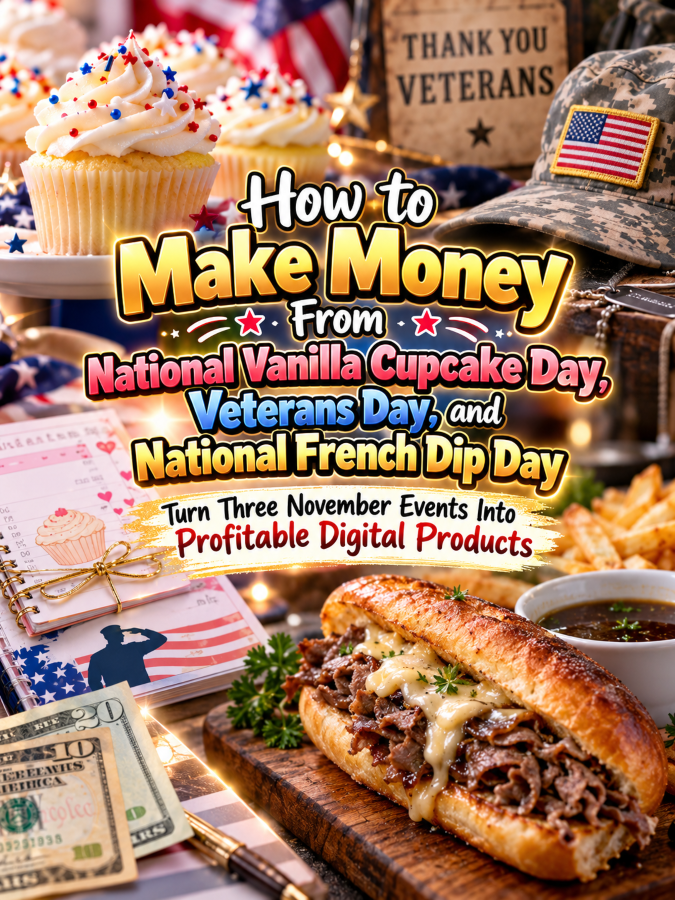
National Vanilla Cupcake Day – Turn a Simple Cupcake Into a Sweet Digital Product Business (November 10, 2026)
Here’s a funny thing about vanilla.
It gets called “basic” all the time.
But vanilla is one of those flavors that quietly shows up everywhere. Cakes. Cookies. Frosting. Ice cream. Coffee. Holiday desserts. Birthday parties. Wedding tables. And, of course, cupcakes.
That makes National Vanilla Cupcake Day a surprisingly useful make-money-online niche.
National Vanilla Cupcake Day is celebrated every November 10 in the United States. National Day Calendar notes that cupcakes have been associated with small individual cakes for centuries and that modern cupcakes have become a popular option for celebrations such as birthdays, weddings, and anniversaries.
And that is exactly where we want to look.
Not at the cupcake itself.
At the problems surrounding the cupcake.
People need recipes. They need decorating ideas. They need party planning help. They need recipe cards. They need baking trackers. They need shopping lists. They need gift ideas. Small bakeries need marketing materials. Parents need activities for kids. Home bakers need ways to organize their recipes.
See where this is going?
The cupcake is merely the hook.
Why This Niche Works for Digital Products
A single cupcake can create a surprisingly large collection of digital-product ideas because it connects several different audiences.
You have home bakers who want recipes.
You have parents planning birthday parties.
You have people organizing bake sales.
You have hobby bakers experimenting with frosting and decorations.
You have small bakeries that need social media content and promotional templates.
You have teachers and parents looking for baking-themed activities.
You also have people who simply love pretty food printables.
And pretty printables are where things can get interesting.
A customer may initially buy a $7 recipe card pack. If the product solves a problem and looks good, you can introduce a larger baking journal, party planner, recipe organizer, or complete cupcake-business bundle.
That’s the product ladder.
And that’s where the money-making opportunity becomes much more interesting than selling one lonely cupcake recipe.
Start With Google Research
Before designing anything, spend a few minutes researching what people already search for.
Try searches such as:
- National Vanilla Cupcake Day
- vanilla cupcake recipes
- vanilla cupcake recipe cards
- cupcake decorating ideas
- cupcake party printables
- cupcake baking planner
- cupcake business planner
Don’t just look at the first page.
Look for repeated questions.
Look at autocomplete suggestions. Look at image results. Look at related searches. Look at the language people use when describing what they need.
Those phrases can become product ideas.
How People Can Celebrate National Vanilla Cupcake Day
National Day Calendar suggests activities such as baking vanilla cupcakes, decorating them, hosting a cupcake bake-off, sharing cupcakes, and even using cupcakes for charitable activities.
That gives digital-product creators several marketing hooks.
You could create a:
- Vanilla Cupcake Baking Challenge
- 30-Day Cupcake Decorating Challenge
- Cupcake Party Planner
- Kids’ Cupcake Decorating Activity Pack
- Vanilla Cupcake Recipe Journal
- Cupcake Recipe Card Collection
- Cupcake Gift Planner
- Bake Sale Planning Kit
- Home Bakery Planner
- Cupcake Business Starter Kit
And remember: you don’t have to become a professional pastry chef.
You are creating organizational tools, planning resources, templates, journals, trackers, and useful digital experiences.
That’s a much easier business model.
3 Ways to Make Money From National Vanilla Cupcake Day
1. Sell Cupcake Recipe Organization
Recipe organization is an evergreen category.
Create printable recipe cards specifically designed for cupcakes.
Include sections for:
- Recipe name
- Ingredients
- Instructions
- Prep time
- Baking time
- Yield
- Frosting
- Decorations
- Variations
- Personal rating
- Notes
Then expand the product into a complete Cupcake Recipe Journal.
Now you’re not selling one page.
You’re selling a system.
2. Sell Cupcake Party Planning
Cupcakes are naturally connected to celebrations.
Birthday parties. Baby showers. School events. Office celebrations. Bake sales. Family gatherings. Holiday parties.
Create a printable cupcake party planner containing:
- Guest list
- Flavor planner
- Quantity calculator worksheet
- Ingredient shopping list
- Decoration checklist
- Party supply checklist
- Budget tracker
- Preparation schedule
- Serving table planner
- Thank-you note tracker
Now you’ve moved from “cupcake printable” to “party organization product.”
3. Sell Tools for Aspiring Home Bakers
This is where the niche can become a little more interesting.
Some people aren’t baking cupcakes just for fun.
They’re testing recipes because they eventually want to sell baked goods.
You could create a simple Home Cupcake Business Planner with pages for:
- Product ideas
- Flavor testing
- Recipe notes
- Ingredient inventory
- Packaging ideas
- Customer orders
- Content ideas
- Social media planning
- Customer feedback
- Monthly sales tracking
Now the same cupcake theme has entered the business-planning market.
That’s a much bigger pond.
Money-Making Tip #1: Sell the Cupcake Experience, Not Just the Recipe
Here’s the important lesson.
Don’t build a product that only answers:
“How do I make a vanilla cupcake?”
Build products that answer the questions surrounding the cupcake.
What should I bake?
How should I organize my recipes?
How many cupcakes do I need?
How do I plan the party?
What decorations should I use?
How do I track my baking experiments?
How do I organize a bake sale?
How do I turn my baking hobby into a small business?
Every question can become a product.
That’s how one tiny niche starts growing.
Build the $7 to $77 Product Ladder
Here’s a simple ladder you could build around the niche.
$7 – Vanilla Cupcake Recipe Card Set
Create a beautiful collection of printable recipe cards for vanilla cupcakes and variations.
$12 – Cupcake Baking Journal
Add recipe-testing pages, frosting notes, decoration ideas, ratings, and baking logs.
$17 – Cupcake Decorating Planner
Add decorating themes, color planning, frosting ideas, topping checklists, and design sketches.
$27 – Cupcake Party Planning Kit
Combine recipes, shopping lists, guest planning, decoration planning, budget pages, and preparation schedules.
$47 – Complete Cupcake Lover’s Bundle
Bundle the recipe cards, baking journal, decorating planner, party planner, shopping lists, and cupcake challenges.
$77 – Ultimate Cupcake Baking & Small Business Collection
Add a home bakery planner, order tracker, content planner, product-development pages, customer tracker, inventory sheets, and promotional planning templates.
Notice what happened?
You didn’t need seven completely different businesses.
You created seven levels of the same customer journey.
Who Could Buy These Products?
Think beyond “people who like cupcakes.”
Your potential audiences include:
- Home bakers
- Beginner bakers
- Parents planning children’s parties
- Birthday party planners
- Teachers
- Homeschooling families
- Food bloggers
- Baking-content creators
- Cupcake hobbyists
- Small bakery owners
- Aspiring home bakers
- People creating family recipe collections
- Gift buyers
Each audience gives you a slightly different product angle.
Research Etsy Before You Design
Now head over to Etsy and search cupcake printables.
Don’t copy listings.
Study them.
Look at:
- What types of products are being offered
- How sellers package their products
- Which words appear repeatedly in titles
- What kinds of mockups they use
- Whether buyers appear to want individual pages or bundles
- Which products have strong visual appeal
Then ask the million-dollar question:
“What problem isn’t being solved very well?”
That’s where your opportunity may be hiding.
Use Canva to Build the Products
Canva is enough for creating many of these products.
Start with a simple visual system.
Choose two or three fonts. Create a consistent color palette. Build your recipe card once. Then duplicate it.
Create your journal pages as a matching collection.
Then turn those pages into a larger bundle.
You don’t need to reinvent the design for every product.
That’s how you avoid spending three hours designing one cupcake checklist while earning approximately enough to buy half a cupcake.
Use Pinterest for Product Research
Pinterest can help you discover visual demand.
Search for:
- cupcake party ideas
- cupcake decorating ideas
- cupcake recipe organization
- birthday cupcake ideas
- home bakery ideas
- cupcake business ideas
Look for themes that keep appearing.
If you repeatedly see people searching for cupcake party decorations, create a party-planning product.
If you see endless recipe organization content, build a recipe journal.
If home bakery content dominates your research, create business organization tools.
Find Real Buyers in Communities
You can also research customer language in communities where bakers and party planners gather.
Look for:
- Baking Facebook groups
- Cake decorating communities
- Home bakery groups
- Birthday party planning groups
- Parent communities
- Food blogger communities
- Small business groups
Pay attention to questions people repeatedly ask.
Those questions can become your next printable.
Amazon Can Help With Market Research Too
Search Amazon for cupcake recipe journals, baking planners, recipe books, party planning books, and baking organizers.
You’re not necessarily looking for products to copy.
You’re looking for evidence that people already spend money around the problem.
If people buy physical recipe journals, planners, cookbooks, baking organizers, and party books, that’s useful market information.
You can then ask:
“What could I turn into a convenient digital version?”
Make It Evergreen
Here’s the part I really like.
You don’t have to stop selling cupcake products on November 10.
National Vanilla Cupcake Day gives you a marketing hook.
The products can live all year.
Promote them for:
- Birthday parties
- Baby showers
- Bridal showers
- Christmas baking
- Valentine’s Day
- Mother’s Day
- School celebrations
- Office parties
- Bake sales
- Family baking weekends
- Home bakery businesses
That’s what we want from an MMO product.
A holiday can bring attention.
The underlying problem keeps the product selling.
The Bigger Lesson
National Vanilla Cupcake Day isn’t really about vanilla cupcakes.
It’s about recognizing that a tiny topic can lead to a much larger customer problem.
Cupcakes lead to recipes.
Recipes lead to organization.
Organization leads to parties.
Parties lead to planning.
Planning leads to business tools.
And business tools can lead to higher-priced digital products.
That’s the ladder.
Start tiny.
Solve something specific.
Then keep building around the same customer.
Final Takeaway
If you’re looking for a simple November niche to test, National Vanilla Cupcake Day gives you a surprisingly flexible starting point.
Start with a $7 recipe card collection.
Turn it into a $12 baking journal.
Add decorating tools.
Build a party planner.
Bundle everything.
Then create a higher-value collection for people who want to organize a home baking business.
You don’t need a massive audience.
You need a useful product, a specific customer, and a reason for that customer to care.
And apparently, sometimes that reason is a cupcake.
Veterans Day – Create Useful Products Around Appreciation, Remembrance, and Community (November 11, 2026)
Some holidays are perfect for cupcakes.
Some are perfect for sandwiches.
And some require a completely different approach.
Veterans Day is one of them.
Veterans Day is observed every year on November 11 in the United States. The U.S. Department of Veterans Affairs explains that the day honors all who have served in the U.S. military, living or deceased, while Memorial Day specifically honors those who died while serving. (U.S. Department of Veterans Affairs)
That distinction matters if you’re creating digital products around the observance.
This isn’t the place for a cheap “slap a flag on it and sell it” strategy.
Instead, think about usefulness, appreciation, education, remembrance, and community activities.
Those themes create opportunities for thoughtful digital products that can be used by families, teachers, schools, community organizations, event planners, and people who simply want a meaningful way to recognize veterans.
The Real Opportunity Is Around the Activities
Here’s the important business lesson.
You’re not selling Veterans Day.
You’re creating tools that help people do something meaningful for Veterans Day.
That difference changes everything.
A teacher may need a classroom activity.
A school may need an event-planning checklist.
A community organization may need a ceremony program template.
A family may want a veteran appreciation card.
A student may need a simple interview worksheet for learning about a veteran’s experiences.
A community group may need volunteer coordination pages.
Someone may want to preserve a family member’s military memories in a private keepsake journal.
Those are problems you can solve with digital products.
Start With Research
Before designing anything, research how Veterans Day is observed and what organizations already provide.
Useful starting points include:
- U.S. Department of Veterans Affairs – Veterans Day
- Google: Veterans Day classroom activities
- Google: Veterans Day event ideas
- Google: Veterans Day printable activities
- Google: Veterans Day student interview questions
- Google: veteran appreciation card printables
- Google: Veterans Day school program templates
Look for repeated needs.
Are teachers searching for worksheets?
Are schools looking for ceremony materials?
Are families looking for appreciation activities?
Are organizations looking for event checklists?
Those searches can point you toward products people actually need.
Why This Can Work as a Digital Product Niche
Veterans Day creates several different audiences.
You can build products for education.
You can build products for families.
You can build products for community organizations.
You can build products for event planning.
You can build keepsake products.
You can also create general appreciation and remembrance resources that may be useful beyond a single date.
That last part is important.
If you make a product that only works on November 11, you have created a very narrow seasonal product.
But if you create a Family Service & Military Memory Journal, for example, the product can potentially be useful whenever a family wants to document a loved one’s stories.
The holiday becomes the marketing hook.
The underlying need becomes the evergreen product.
3 Ways to Make Money From Veterans Day
1. Create Educational Printables
Teachers and parents often need age-appropriate ways to introduce historical and civic topics.
You could create a classroom-friendly Veterans Day activity pack containing:
- Vocabulary pages
- Reflection worksheets
- Research prompts
- Writing activities
- Interview question sheets
- Thank-you card templates
- Classroom discussion prompts
- Simple history activities
- Student project planning pages
The key is to keep the material respectful, age-appropriate, and factually grounded.
You don’t have to create a 50-page history textbook.
A teacher-friendly collection of useful worksheets can be much easier to produce and use.
2. Create Appreciation and Event Planning Products
Schools, community groups, churches, civic organizations, and local clubs may organize Veterans Day activities.
That creates a planning problem.
And planning problems are excellent digital-product opportunities.
Create a Veterans Day Event Planner with pages for:
- Event goals
- Guest list
- Speaker information
- Program schedule
- Volunteer assignments
- Venue checklist
- Supplies checklist
- Communication plan
- Promotion checklist
- Event-day timeline
- Thank-you follow-up
You’re not selling a political opinion.
You’re selling organization.
And organization is something people happily pay to avoid having to create themselves.
3. Create Family Memory and Storytelling Products
This may be the most evergreen direction.
Families sometimes want to preserve stories about relatives who served.
You could create a Military Family Memory Journal designed to help someone record personal stories, photographs, memories, milestones, and family history.
Possible sections could include:
- Family member profile
- Service branch
- Years of service
- Places remembered
- Important milestones
- Family stories
- Memorable sayings
- Photograph pages
- Letters and keepsakes
- Lessons and memories
- Family reflections
That turns a one-day observance into a product with a much longer useful life.
Money-Making Tip #2: Sell the Tool for the Meaningful Moment
Here’s the strategy.
Don’t try to monetize the emotion itself.
Monetize the organizational problem surrounding the activity.
Someone wants to organize an event?
Give them an event planner.
A teacher wants a classroom activity?
Give them a ready-to-use activity pack.
A family wants to preserve stories?
Give them a memory journal.
A student wants to interview a veteran?
Give them an organized interview worksheet.
A school wants students to create appreciation cards?
Give them printable templates.
That’s a much more useful business approach.
Build the $7 to $77 Product Ladder
$7 – Veterans Day Appreciation Card & Activity Pack
Create printable appreciation cards, simple reflection pages, thank-you prompts, and classroom-friendly activities.
$12 – Veterans Day Classroom Activity Kit
Add writing prompts, vocabulary pages, research worksheets, interview questions, and student project pages.
$17 – Veteran Story Interview Journal
Create a structured journal for recording a veteran’s stories, memories, service information, photographs, and family reflections.
$27 – Veterans Day Event Planning Kit
Add event schedules, volunteer checklists, speaker information pages, supply lists, promotion planning, and event-day worksheets.
$47 – Complete Veterans Day Community Bundle
Combine classroom activities, appreciation cards, event planning pages, interview worksheets, and family memory resources.
$77 – Ultimate Military Family Memory & Community Collection
Expand beyond the holiday with a larger collection of family-history journals, storytelling pages, keepsake templates, event-planning resources, appreciation materials, and organizational worksheets.
Again, the $77 product isn’t necessarily one gigantic complicated document.
It can be a collection of related tools.
That’s an important distinction.
Who Could Buy These Products?
Think about the person who has a problem to solve.
- Teachers
- Homeschooling parents
- Parents of school-age children
- School administrators
- Community organizations
- Civic groups
- Event organizers
- Families preserving military history
- Genealogy enthusiasts
- Students
- Veteran-support organizations
- People looking for meaningful appreciation resources
Different audiences mean different products.
And different products mean more opportunities to test what people actually want.
Research Etsy for Product Gaps
Visit Etsy and search for Veterans Day printables.
Look at the categories sellers are targeting.
Study:
- Classroom worksheets
- Thank-you cards
- Event templates
- Patriotic printables
- Memory journals
- Military family products
- Educational resources
Then look for gaps.
Maybe the market has plenty of generic posters but fewer useful planning tools.
Maybe there are many classroom worksheets but fewer family storytelling journals.
Maybe the products are visually busy when teachers really need simple print-and-use pages.
That’s where you can differentiate.
Use Canva to Build Respectful Designs
Canva can be used to create clean, professional resources without requiring advanced graphic-design skills.
For this niche, don’t go crazy with decorative elements.
Clarity matters.
Use readable fonts, good spacing, clear headings, and restrained patriotic visual elements where appropriate.
For classroom materials, prioritize readability.
For journals, prioritize writing space.
For event planners, prioritize checklists and organization.
In other words, make the product easy to use.
Pretty is nice.
Useful pays the bills.
Use Pinterest to Find Visual Demand
Pinterest can help you research how people visually approach Veterans Day activities.
Search for:
- Veterans Day classroom activities
- Veterans Day crafts
- Veterans Day bulletin boards
- Veterans Day school activities
- military family keepsake ideas
- veteran appreciation ideas
- military memory books
Don’t just look at the pictures.
Look at the activity behind the picture.
If you see a classroom display, ask whether teachers might need a planning worksheet.
If you see a student interview activity, ask whether teachers might want a printable interview journal.
If you see a community ceremony, ask whether organizers need a checklist.
That’s how visual research becomes product research.
Research Amazon for Evergreen Ideas
Amazon can also reveal broader product categories.
Search military memory journals, family history journals, interview journals, genealogy notebooks, classroom activity books, and event-planning books.
You’re looking for the larger customer need.
For example, a military memory journal may point toward the broader category of family storytelling and legacy preservation.
That’s much more evergreen than a single November holiday.
Don’t Limit the Product to November
This is where your product strategy matters.
Veterans Day gives you a seasonal marketing opportunity.
But the underlying products can sometimes serve broader needs.
A family memory journal can be used throughout the year.
An interview journal can be used for family history projects.
A storytelling workbook can be used for genealogy.
A classroom interview template can potentially work for other social studies or history projects.
An event-planning checklist can be adapted for other community observances.
That’s how you turn a seasonal product into a broader product ecosystem.
One Product Can Become Five
Here’s a simple example.
Start with a Veteran Story Interview Worksheet.
Then expand it into a Veteran Interview Journal.
Turn that into a Military Family Memory Book.
Bundle the journal with photograph pages.
Then create a larger Family Legacy Collection.
One small idea.
Five products.
That’s the beauty of digital products.
You can build outward instead of starting from zero every time.
Avoid the Biggest Mistake
The biggest mistake would be trying to make the product overly commercial or treating Veterans Day as just another cute seasonal theme.
Respect the purpose of the observance.
Focus on appreciation, education, remembrance, organization, and meaningful participation.
That approach also makes the products more useful.
And useful products have a much better chance of being recommended, reused, and bundled.
The Bigger MMO Lesson
Veterans Day teaches a different lesson from National Vanilla Cupcake Day.
The cupcake opportunity comes from fun and planning.
The Veterans Day opportunity comes from meaning and organization.
Different emotional context.
Different customer problem.
Same digital-product principle.
Find something people want to accomplish.
Create a tool that makes it easier.
Package that tool beautifully.
Then create a ladder of increasingly useful products.
Final Takeaway
Veterans Day can inspire thoughtful digital products when you focus on what people actually need to do: teach, remember, appreciate, organize, document, and participate.
Start with a simple $7 appreciation or classroom resource.
Expand into journals and activity kits.
Add event-planning tools.
Bundle the resources.
Then look for the evergreen category underneath the holiday.
In this case, that category could be family stories, legacy preservation, education, and community organization.
And that’s the real trick.
The holiday gets attention.
The useful product gives people a reason to buy.
National French Dip Day – Turn One Classic Sandwich Into a Profitable Food Printable Business (November 12, 2026)
Okay, we’re back to food.
And this time, we’re talking about a sandwich that sounds like it needs its own little bowl.
National French Dip Day gives digital-product creators another great example of how a very specific food observance can become the starting point for a much bigger product niche.
The French dip sandwich is traditionally associated with a roast beef sandwich served with a dipping sauce or jus. That simple idea opens the door to recipes, meal planning, entertaining, restaurant marketing, recipe collections, and food-themed printables.
And there’s our opportunity.
Don’t sell “a French dip.”
Sell the experience surrounding the French dip.
That’s where the printable business gets interesting.
Why a Sandwich Can Become a Digital Product
At first glance, French dip sounds like a very narrow niche.
One sandwich.
One food holiday.
How many products could you possibly create?
Quite a few, actually.
Because people don’t just eat sandwiches.
They plan meals.
They collect recipes.
They host game-day gatherings.
They create shopping lists.
They organize family recipes.
They look for dinner ideas.
They experiment with variations.
And some people run businesses selling food.
That means French Dip Day can act as a doorway into several larger categories.
Start With Google Research
Before creating your product, research what people are already looking for.
Try searches such as:
- National French Dip Day
- French dip recipe
- French dip slow cooker recipe
- French dip party ideas
- French dip meal planner
- sandwich recipe cards printable
- game-day food planner printable
Look for patterns.
Maybe people are searching for slow-cooker versions.
Maybe they’re looking for easy family dinners.
Maybe they want party food.
Maybe they’re searching for sandwich variations.
Those searches are clues.
Your goal isn’t to become the world’s leading French dip expert.
Your goal is to discover what people want help organizing.
The Bigger Niche Is Meal Planning
Here’s where things get interesting.
You could create a French dip recipe card and sell it as a tiny seasonal product.
Or you could use French dip as the entry point into a much bigger niche: meal planning and recipe organization.
That’s a much larger market.
A customer who downloads one sandwich recipe might also want:
- Weekly meal planners
- Recipe cards
- Grocery lists
- Freezer meal planners
- Family dinner planners
- Slow-cooker recipe organizers
- Game-day food planners
- Recipe journals
- Family cookbook templates
Now the sandwich has done its job.
It brought the customer through the door.
3 Ways to Make Money From National French Dip Day
1. Sell Recipe Organization
Create a printable Sandwich Recipe Card Collection.
Instead of focusing only on French dip, create space for customers to record their favorite sandwich recipes.
Include sections for:
- Recipe name
- Ingredients
- Preparation time
- Cooking time
- Serving size
- Sauce or condiment
- Side dishes
- Ingredient substitutions
- Family rating
- Notes
Now the product can be used long after November 12.
2. Sell Meal Planning
Create a Sandwich Night Meal Planner or broader Family Dinner Planning Kit.
You could include:
- Weekly meal planner
- Recipe selection pages
- Grocery shopping lists
- Ingredient inventory
- Meal-prep checklist
- Leftover tracker
- Family favorites page
- Budget worksheet
French dip becomes one example inside a larger meal-planning system.
3. Sell Entertaining and Game-Day Products
French dip also fits naturally into casual entertaining.
Create a Game-Day Food Planning Kit with:
- Guest list
- Menu planner
- Food shopping list
- Serving schedule
- Food-preparation checklist
- Party budget tracker
- Drink planning page
- Snack planner
- Cleanup checklist
You don’t even have to make French dip the entire product.
It can simply be one of the menu ideas that brings customers into your larger party-planning niche.
Money-Making Tip #3: Sell the Bigger Food Problem
This is the money-making lesson I want you to take from National French Dip Day.
Don’t get trapped by the holiday.
The holiday is the hook.
The problem is the business.
French dip is the hook.
Meal planning is the business.
Recipe organization is the business.
Party planning is the business.
Family cookbook creation is the business.
That’s a much more powerful way to think about seasonal content.
Build the $7 to $77 Product Ladder
$7 – French Dip Recipe Card Collection
Create a small printable collection for recording French dip recipes, variations, side dishes, sauces, and family ratings.
$12 – Sandwich Recipe Journal
Expand the concept into a journal for collecting favorite sandwich recipes.
$17 – Family Meal Planning Kit
Add weekly meal planners, grocery lists, meal-prep pages, leftover trackers, and family favorites.
$27 – Game-Day Food Planning Kit
Add guest planning, menus, shopping lists, food-preparation schedules, budgets, and cleanup pages.
$47 – Complete Family Meal & Recipe Bundle
Combine recipe cards, recipe journals, weekly planners, grocery lists, meal-prep worksheets, and entertaining resources.
$77 – Ultimate Recipe Organization & Meal Planning Collection
Create the big bundle with recipe management, family meal planning, freezer planning, grocery organization, party food planning, recipe preservation, and cookbook-building templates.
Now we’re talking about a product ecosystem instead of a single sandwich printable.
Who Could Buy These Products?
Think about the people who already have food-related organizational problems.
- Busy parents
- Home cooks
- Meal planners
- Recipe collectors
- Food bloggers
- Game-day hosts
- Party planners
- Families creating cookbooks
- Home entertainers
- Meal-prep enthusiasts
- Small food businesses
- People buying gifts for food lovers
That audience is much larger than people specifically searching for French dip.
And that’s exactly what we want.
Research Etsy for Ideas
Visit Etsy’s meal-planner printable category and study what customers are already buying.
Then look at:
Study the products rather than copying them.
Look for underserved combinations.
Maybe there are lots of meal planners but few that combine meal planning with recipe organization.
Maybe there are plenty of recipe cards but few complete family cookbook systems.
That’s where you can create something different.
Use Canva to Create a Matching Collection
Canva makes it relatively easy to build a complete product family.
Create one visual style.
Use the same fonts.
Use the same spacing.
Use matching headers.
Then create individual pages that can be sold separately or bundled together.
This gives you another useful advantage.
You can make one design system work across several listings.
Instead of designing a brand-new product every time, you’re building a reusable product library.
Use Pinterest to Discover Food Planning Trends
Pinterest is particularly useful for food-related research because so much of the platform is visual.
Search for:
- family meal planning
- sandwich ideas
- game-day food ideas
- recipe organization
- meal prep printables
- family cookbook ideas
- party food planning
Pay attention to recurring themes.
Are people creating recipe binders?
Are they organizing freezer meals?
Are they planning weekly menus?
Are they preparing food for sports parties?
Each repeated behavior can become a product category.
Turn One Recipe Into Content
Here’s another trick.
One recipe doesn’t have to produce one product.
It can produce an entire content ecosystem.
For example:
- Blog post about French dip
- Pinterest pin about French dip meal planning
- Recipe card printable
- Meal-planning worksheet
- Game-day food checklist
- Social media post
- Email newsletter
- Recipe journal page
- Bundle promotion
One topic.
Multiple pieces of content.
Multiple opportunities to send people toward your product.
That’s much more efficient than constantly searching for completely new ideas.
Amazon Can Reveal the Bigger Market
Search Amazon for meal planners and recipe journals.
Look at the types of physical products people buy.
Recipe binders.
Meal planners.
Cookbooks.
Kitchen organizers.
Food journals.
Party-planning books.
These products can give you ideas for digital versions.
The question becomes:
“What would make this easier to use as a printable or digital download?”
Build Around Evergreen Food Problems
French Dip Day is November 12.
But your products don’t need to disappear on November 13.
Meal planning is needed all year.
Recipe organization is needed all year.
Family dinners happen all year.
Game days happen throughout sports seasons.
Parties happen all year.
And families keep collecting recipes.
That’s the sweet spot.
Use the observance to create attention.
Build the product around an evergreen problem.
Create a Seasonal Content Calendar
Once you have your recipe and meal-planning products, you can connect them to multiple food-related events throughout the year.
Think about:
- Super Bowl season
- Family gatherings
- Summer cookouts
- Back-to-school meal planning
- Thanksgiving
- Christmas entertaining
- New Year’s gatherings
- Game nights
- Birthday parties
- Weekend family dinners
Your product doesn’t have to be rebuilt every time.
You simply change the marketing angle.
That’s a very useful MMO strategy.
The Three Holiday Lessons So Far
Look at what we’ve covered in this three-part series.
National Vanilla Cupcake Day teaches us to sell the experience surrounding a fun topic.
Veterans Day teaches us to create respectful tools around meaningful activities such as education, appreciation, remembrance, and organization.
National French Dip Day teaches us to look beyond the specific food and identify the larger evergreen problem.
Three different holidays.
Three different customer motivations.
One digital-product strategy.
Find the activity. Find the problem. Build the tool.
Final Takeaway
National French Dip Day may sound like one of those wonderfully random calendar events that exists mainly to make us hungry.
And yes, it does that job rather effectively.
But for a digital-product creator, it can also be a research doorway into meal planning, recipe organization, family cooking, entertaining, and food-related business tools.
Start with a small $7 recipe product.
Turn it into a journal.
Add meal-planning tools.
Add entertaining resources.
Bundle everything.
Then keep selling the larger solution long after November 12 has passed.
That’s how you turn a sandwich into a product ladder.
And thankfully, nobody said we had to eat every prototype.
Turn Three November Observances Into One Repeatable Digital-Product Business
We’ve gone from cupcakes to veterans to sandwiches.
Which sounds like the beginning of a very strange lunch meeting.
But underneath these three very different November observances is a surprisingly useful make-money-online lesson.
National Vanilla Cupcake Day gives you fun, celebration, baking, and party-planning opportunities.
Veterans Day gives you opportunities around education, appreciation, remembrance, family stories, and community organization.
National French Dip Day gives you opportunities around recipes, meal planning, entertaining, and food organization.
Three completely different topics.
Yet they can all be approached using the same digital-product framework.
Find the occasion. Find the activity. Find the problem. Create the solution. Then build the ladder.
Don’t Try to Monetize the Holiday
This is probably the biggest lesson from this entire three-part series.
The holiday itself isn’t necessarily the product.
It’s the attention trigger.
People are already searching for the topic.
They’re already talking about it.
They’re already planning activities around it.
They’re already looking for recipes, classroom ideas, party ideas, gift ideas, activities, checklists, and resources.
Your job is to identify what they need and create something useful.
That’s a much more sustainable way to use seasonal content.
Look at the Three Customer Ecosystems
Let’s break down the three opportunities.
National Vanilla Cupcake Day
The customer ecosystem includes:
- Home bakers
- Parents
- Party planners
- Kids
- Teachers
- Food bloggers
- Cupcake hobbyists
- Small bakery owners
The core problems include recipe organization, baking planning, decorating, party preparation, and small-business organization.
Veterans Day
The customer ecosystem includes:
- Teachers
- Parents
- Students
- Schools
- Community organizations
- Event planners
- Families preserving stories
- Genealogy enthusiasts
The core problems include education, event planning, appreciation activities, interviews, storytelling, and memory preservation.
National French Dip Day
The customer ecosystem includes:
- Home cooks
- Busy families
- Meal planners
- Recipe collectors
- Party hosts
- Food bloggers
- Game-day hosts
- Home entertainers
The core problems include meal planning, recipe organization, grocery planning, entertaining, and food preparation.
See the pattern?
We’re not really selling holidays.
We’re selling solutions to everyday problems that happen to become more visible during a holiday or observance.
Build Three Product Ladders
Now let’s put the ideas together.
Cupcake Product Ladder
- $7: Vanilla Cupcake Recipe Card Set
- $12: Cupcake Baking Journal
- $17: Cupcake Decorating Planner
- $27: Cupcake Party Planning Kit
- $47: Complete Cupcake Lover’s Bundle
- $77: Ultimate Cupcake Baking & Small Business Collection
Veterans Day Product Ladder
- $7: Appreciation Card & Activity Pack
- $12: Veterans Day Classroom Activity Kit
- $17: Veteran Story Interview Journal
- $27: Veterans Day Event Planning Kit
- $47: Complete Veterans Day Community Bundle
- $77: Ultimate Military Family Memory & Community Collection
French Dip Product Ladder
- $7: French Dip Recipe Card Collection
- $12: Sandwich Recipe Journal
- $17: Family Meal Planning Kit
- $27: Game-Day Food Planning Kit
- $47: Complete Family Meal & Recipe Bundle
- $77: Ultimate Recipe Organization & Meal Planning Collection
You now have three separate product ecosystems.
But here’s where things get even better.
The $7 Product Is Your Door Opener
Don’t underestimate the little $7 product.
It doesn’t have to make you rich by itself.
Its job is to give a customer an easy way to say yes.
Someone sees a $7 cupcake recipe card collection.
They buy it.
Then they discover your $17 baking journal.
Then they see your $27 party planner.
Then they discover your $47 bundle.
The same basic process can work with meal planning or family-history products.
You’re building a path instead of trying to convince someone to spend $77 immediately.
Bundle Products Instead of Constantly Creating New Ones
Here’s where digital products become much more efficient.
Suppose you’ve already created:
- Recipe cards
- Shopping lists
- Meal planners
- Party checklists
- Journals
- Trackers
You don’t necessarily need to design another 50-page product.
You can combine existing assets into a new bundle.
For example:
Recipe Organization Bundle
Recipe cards + recipe journal + grocery list + meal planner.
Party Food Bundle
Menu planner + shopping list + guest list + preparation checklist + budget tracker.
Family Memory Bundle
Interview journal + family story pages + photograph pages + keepsake pages.
This gives your existing work more earning potential.
Repurpose One Product Into Multiple Formats
A single printable can also become multiple pieces of content.
For example, your cupcake recipe planner could become:
- A blog post
- A Pinterest pin
- An Instagram carousel
- A short-form video
- An email newsletter
- A free sample
- A paid printable
- A bundle component
The Veterans Day interview journal could become an article about preserving family stories.
The French dip meal planner could become an article about organizing game-day meals.
That’s how one product starts feeding your entire content system.
Create a November Marketing Calendar
You don’t need to wait until the exact holiday arrives.
Start promoting early.
7–10 Days Before
Start educational content.
Explain the observance.
Share planning tips.
Introduce the problem your product solves.
3–5 Days Before
Start showing the product.
Share previews.
Show how the printable works.
Use Pinterest pins and social posts to drive traffic.
The Day Before
Use urgency carefully.
Remind people that the observance is tomorrow.
Show how quickly they can use the product.
The Day Of
Publish celebration-focused content.
Show the product in use.
Invite customers to share their experiences.
The Week After
This is where the evergreen strategy begins.
Move the messaging away from the holiday.
Start promoting the larger category.
For example:
“Veterans Day may be over, but preserving family stories can happen all year.”
“French Dip Day may be over, but family meal planning never stops.”
“Cupcake Day may be over, but birthday parties aren’t going anywhere.”
Now you’re selling the underlying problem instead of the calendar date.
Use Etsy as Your Marketplace Research Lab
Etsy can be useful not only as a place to sell but also as a place to research.
Search your three niches.
Look at:
- Product titles
- Thumbnail styles
- Price ranges
- Bundle structures
- Customer reviews
- Frequently mentioned features
- Questions buyers ask
Reviews are especially valuable.
When customers say things like “I wish it included…” or “I would have loved…” you’ve just received free product research.
That’s better than guessing.
Use Pinterest as Your Traffic Engine
Pinterest is particularly useful for printable businesses because the products are visual.
Create multiple pins for the same product.
For example, a cupcake planner could have pins around:
- Cupcake party planning
- Birthday baking
- Cupcake decorating
- Recipe organization
- Kids’ baking activities
A family memory journal could have pins around:
- Family history
- Military family stories
- Memory keeping
- Interview questions
- Legacy journals
A meal planner could have pins around:
- Weekly meal planning
- Family dinner ideas
- Recipe organization
- Game-day food planning
- Grocery organization
One product can therefore target several search themes.
Use Canva to Build Faster
Canva can become your production system rather than just your design tool.
Create reusable templates for:
- Recipe cards
- Journals
- Checklists
- Trackers
- Planners
- Workbooks
- Social media graphics
- Pinterest pins
Once you’ve built your master templates, future products become much faster.
Change the title.
Change the prompts.
Change the examples.
Change the graphics.
Keep the underlying design system.
That’s how you start moving from “I make printables” to “I have a printable production system.”
Find Customers Outside Etsy
You don’t have to depend on one marketplace.
Look for communities where your buyers already gather.
For cupcakes:
- Baking groups
- Birthday-party communities
- Parent groups
- Home bakery communities
For Veterans Day resources:
- Teacher communities
- Homeschooling groups
- School organizations
- Community groups
For meal-planning products:
- Meal-prep groups
- Family organization communities
- Recipe groups
- Food blogger communities
Don’t spam.
Help first.
Answer questions.
Share useful ideas.
Then make your product available when it genuinely solves the problem.
Build an Email List Around the Problem
If you have a website or blog, don’t let visitors disappear forever.
Create a simple freebie.
For example:
- Free Cupcake Party Checklist
- Free Veteran Story Interview Questions
- Free Weekly Family Meal Planner
Offer the free resource in exchange for an email signup.
Then introduce related paid products.
This gives you something more valuable than a one-time visitor.
You have a potential returning customer.
Track the Numbers
Don’t judge a product solely by whether it “looks cute.”
Track what actually happens.
- Views
- Clicks
- Saves
- Downloads
- Sales
- Average order value
- Bundle sales
- Repeat purchases
If a $7 product gets lots of attention but few purchases, examine the listing.
If a $17 product converts well, consider building more products around that customer need.
If a bundle consistently outperforms individual products, create more bundles.
Let customer behavior guide your next move.
Don’t Chase Every Holiday
Here’s another important lesson.
You don’t need to create a product for every single holiday on the calendar.
That way lies madness.
And approximately 4,000 Canva files named “FINAL-final-v2-really-final.”
Instead, choose observances that connect to niches you can build around.
Look for:
- A clear audience
- A recurring problem
- Strong visual potential
- Multiple product possibilities
- Evergreen extensions
- Opportunities for bundles
That’s a much better filter than simply asking whether the holiday sounds funny.
Create Your Own Holiday-to-Product Formula
Here’s the formula you can reuse with future observances:
- Find the holiday.
- Research what people search for.
- Identify the audience.
- Find the problem around the celebration.
- Create a $7 entry product.
- Add a $12–$17 deeper solution.
- Create a $27 planning or transformation product.
- Bundle everything into a $47 offer.
- Create a $77 premium collection.
- Repurpose the products into content.
- Promote before, during, and after the holiday.
- Turn the seasonal buyer into an evergreen customer.
That is a repeatable system.
The Three-Market Strategy
You can also use these three observances to experiment with three different markets.
Market #1: Celebration
National Vanilla Cupcake Day lets you test party, baking, kids, and food-related products.
Market #2: Meaning
Veterans Day lets you test educational, family-history, remembrance, and community-organization products.
Market #3: Convenience
National French Dip Day lets you test meal planning, recipe organization, and entertaining products.
Pay attention to which market produces the strongest response.
That information can help you decide where to build a larger product catalog.
The Real Goal Isn’t One Sale
The goal isn’t to sell one $7 printable and celebrate like you’ve conquered Wall Street.
The goal is to create a customer journey.
A customer discovers your free content.
They download something useful.
They purchase a $7 product.
They discover a $17 product.
They buy a $27 planner.
Eventually, they see a $47 or $77 bundle.
Now you have a business model rather than a random collection of files.
Final Thoughts
National Vanilla Cupcake Day, Veterans Day, and National French Dip Day may seem like three completely unrelated November events.
And they are.
That’s actually what makes them useful for research.
They demonstrate that profitable digital-product ideas can come from very different corners of the calendar.
The trick isn’t finding the “perfect” holiday.
The trick is learning how to look underneath the holiday.
For cupcakes, look at celebration and baking.
For Veterans Day, look at education, appreciation, remembrance, and organization.
For French dip, look at recipes, meals, and entertaining.
Then turn those needs into products.
Start small.
Build the $7 entry product.
Expand the solution.
Create bundles.
Repurpose your work.
Market the seasonal hook.
Keep selling the evergreen solution.
That’s how a strange little holiday on the calendar can become a surprisingly useful business research tool.
And that’s the real secret to this whole holiday-product strategy.
Enjoy!