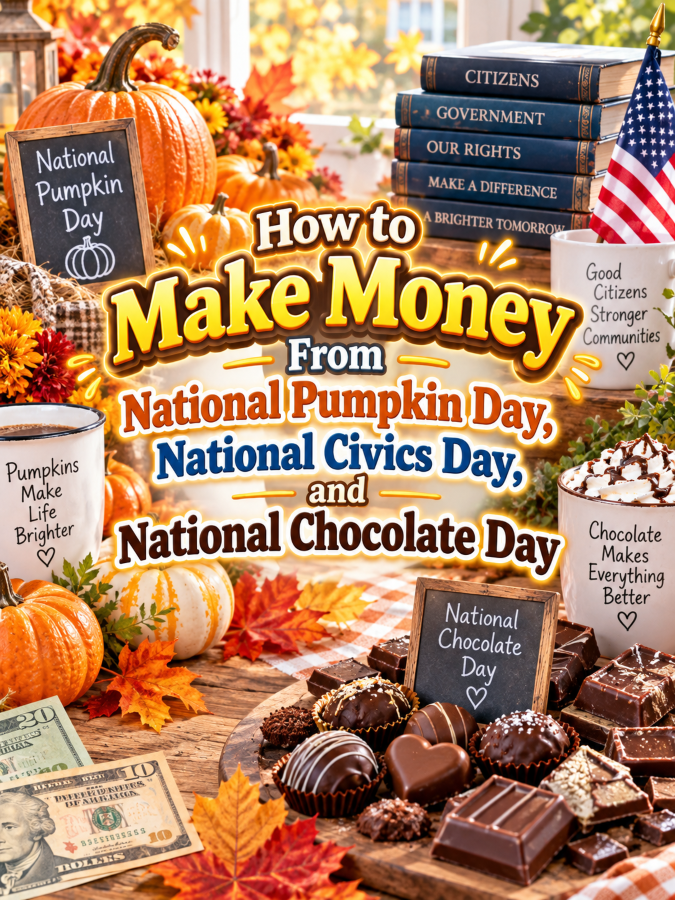
Turn Three October Observances Into Seasonal, Educational, and Delicious Digital Product Opportunities!
There are some holidays where the product ideas practically jump out of the calendar and start waving at you. National Pumpkin Day is one of those. Pumpkins already have a built-in visual identity, a strong seasonal association, and an audience that loves decorating, baking, crafting, celebrating, photographing, and generally turning every available surface into an autumn display.
Then we have National Civics Day, which takes us into education and learning, followed by National Chocolate Day, which takes us straight into recipes, baking, gifting, parties, and indulgence. Three very different audiences, but that’s exactly what makes this trio useful. We’re going to look at how each observance can become a doorway into products that solve problems, create experiences, or make someone’s life a little more organized.
The goal isn’t to create a printable that becomes useless the minute October ends. The goal is to use the holiday as a marketing hook while building products that can continue earning long after the calendar moves on. That’s the secret sauce in this whole holiday-product strategy.
National Pumpkin Day — October 26, 2026
Let’s start with the pumpkin because pumpkins are basically the unofficial celebrities of October. They show up on porches, tables, coffee-shop menus, classroom bulletin boards, craft projects, recipes, signs, shirts, social posts, and approximately every other square inch of the internet during fall.
That makes National Pumpkin Day particularly interesting for digital-product creators. You don’t have to limit yourself to pumpkin recipes or pumpkin carving. The pumpkin can be the theme for family activities, classroom resources, party planning, decorating, journaling, fall bucket lists, crafts, photography challenges, and seasonal organization.
Start Your Research
- Google Search: National Pumpkin Day October 26
- Google Search: National Pumpkin Day Activities and Ideas
- Google Search: Pumpkin Carving Ideas and Activities
- Google Search: Pumpkin Fall Party Ideas
What Is National Pumpkin Day?
National Pumpkin Day is observed on October 26 and celebrates one of the most recognizable symbols of the fall season. Pumpkins are associated with autumn decorating, Halloween, harvesting, cooking, baking, crafts, family activities, and seasonal traditions.
For us, that means a giant creative playground. And because pumpkins have such strong visual appeal, they are especially suited to products that are promoted through Pinterest, Etsy, blog posts, social media, and attractive product mockups. A pumpkin-themed printable can be cute, practical, educational, decorative, or all four.
How Is National Pumpkin Day Celebrated?
People can celebrate by visiting pumpkin patches, carving pumpkins, decorating with pumpkins, cooking pumpkin recipes, baking pumpkin desserts, participating in fall crafts, taking seasonal photographs, or enjoying pumpkin-themed activities with family and friends.
Teachers and homeschoolers can incorporate pumpkins into science, math, writing, art, and seasonal learning activities. Families can create pumpkin scavenger hunts or fall bucket lists. Party planners can build pumpkin-themed gatherings. Food creators can develop recipes and recipe collections. In other words, there is no shortage of ways to turn this orange seasonal superstar into a digital-product opportunity.
3 Ways to Make Money From National Pumpkin Day
1. Create Pumpkin-Themed Family and Fall Activity Packs
A printable fall activity pack is an excellent entry-level product. Include pumpkin scavenger hunts, pumpkin-themed coloring pages, fall bingo, family activity lists, pumpkin observation pages, seasonal writing prompts, simple games, and a fall bucket list.
You can create separate versions for families, classrooms, homeschoolers, and younger children. You can also build age-specific versions so the activities don’t feel like they were designed for a six-year-old and accidentally handed to a teenager. That’s not a good thing.
2. Build Pumpkin Carving and Decorating Planners
Pumpkin carving is another product opportunity because people often want ideas before they start cutting into the pumpkin. Create printable carving planners where users can sketch designs, record tools needed, plan patterns, list supplies, and rate the finished pumpkin.
You can also create pumpkin decorating planners for families, classrooms, businesses, and parties. Add design inspiration pages, supply checklists, theme planners, voting sheets, pumpkin contest certificates, and photography prompts. Suddenly you’ve gone from “pumpkin printable” to a complete pumpkin experience.
3. Create Pumpkin Recipe Journals and Fall Food Planners
Pumpkin and food are practically inseparable during autumn. Create recipe journals specifically for pumpkin recipes, with pages for soups, breads, pies, muffins, desserts, drinks, side dishes, and family favorites. You could also create a broader fall recipe journal where pumpkin is one featured category.
A pumpkin recipe journal can become an evergreen seasonal product that returns every year. You can promote it during National Pumpkin Day, Halloween, Thanksgiving, pumpkin-patch season, and the broader fall cooking season. One product can have several marketing windows.
Money-Making Tip #1: Build Around the Pumpkin Lifestyle, Not Just the Pumpkin
This is where the opportunity gets much bigger. Don’t ask, “What printable can I make with a pumpkin picture?” Ask, “What are people actually doing with pumpkins?” They’re decorating, cooking, carving, photographing, celebrating, learning, entertaining, and making memories.
Those activities are the product opportunities. The pumpkin is simply the visual and seasonal theme that ties everything together. When you think this way, you stop making random themed pages and start creating products that help people accomplish something.
Build a National Pumpkin Day Product Ladder
Once you have one good product, expand it into a small product family. A $7 activity pack can become part of a larger fall collection. A pumpkin carving planner can lead to a pumpkin party kit. A recipe journal can lead to a complete autumn cooking bundle.
- $7: Pumpkin Day Family Activity Pack
- $12: Pumpkin Carving and Decorating Planner
- $17: Pumpkin Recipe Journal
- $27: Fall Family Activity and Celebration Bundle
- $47: Complete Pumpkin Season Planning Collection
- $77: Ultimate Fall Family and Pumpkin Printable Bundle
The larger bundle could combine pumpkin activities, carving planners, decorating pages, recipe journals, scavenger hunts, fall bucket lists, party resources, and seasonal memory pages. Now you’ve got a complete experience instead of one isolated printable.
National Pumpkin Day for Teachers and Homeschoolers
Pumpkins are also fantastic teaching tools because they can be connected to multiple subjects. Students can estimate pumpkin weight, count seeds, measure circumference, observe decomposition, write descriptive stories, study plant life cycles, create pumpkin art, or research the history and cultural significance of pumpkins.
This gives you opportunities to create interdisciplinary learning packs. A pumpkin STEM workbook could combine measurement, observation, data recording, simple experiments, and student reflections. A pumpkin writing pack could include creative prompts, descriptive-writing exercises, vocabulary activities, and illustration pages.
National Pumpkin Day for Fall Party Planners
Pumpkin-themed parties are another excellent digital-product category. Create invitations, welcome signs, food labels, activity cards, pumpkin-carving contest sheets, voting cards, scavenger hunts, thank-you cards, and printable decorations.
You could target families, classrooms, community organizations, neighborhood gatherings, or even small businesses hosting autumn events. The product can be sold as a coordinated party kit, which generally gives customers more value than a collection of unrelated individual pages.
Other Ways to Make Money Around National Pumpkin Day
- Fall bucket lists: seasonal activities for families, couples, or individuals.
- Pumpkin journals: pumpkin-patch memories, carving records, recipes, and seasonal reflections.
- Photography challenges: fall and pumpkin photography prompts.
- Classroom decor: pumpkin-themed signs, labels, bulletin-board resources, and certificates.
- Pumpkin contests: voting cards, certificates, judging sheets, and scorecards.
- Recipe collections: pumpkin baking and cooking journals.
- Fall planners: seasonal event and activity organization pages.
Research Pumpkin Products Before You Design
Before creating anything, research what customers are already purchasing. Look at pumpkin carving templates, fall activity books, pumpkin recipe journals, classroom printables, party kits, fall planners, and seasonal bucket lists. Look for gaps rather than simply creating another version of what already dominates the marketplace.
- Research Pumpkin Printables on Etsy
- Research Fall Activity Printables on Etsy
- Research Pumpkin Carving Templates on Etsy
- Design Pumpkin and Fall Printables in Canva
- Research Pumpkin Printable Ideas on Pinterest
- Research Pumpkin Activities on Google
Amazon Research for Pumpkin and Fall Products
Amazon can help you research the physical-product market surrounding pumpkin season. Look at carving books, fall activity books, pumpkin cookbooks, recipe journals, seasonal planners, and party supplies. Customer reviews can reveal what people love and what they wish products included.
- Pumpkin Carving Books on Amazon
- Pumpkin Recipe Books on Amazon
- Fall Activity Books on Amazon
- Fall Planners on Amazon
Promote Your Pumpkin Products Early
Pumpkin products are highly seasonal, so timing matters. Start publishing your content before the peak of the season. Create blog posts about pumpkin activities, fall bucket lists, carving ideas, pumpkin recipes, family traditions, and seasonal celebrations. Each article can point naturally toward a relevant printable.
Pinterest is particularly valuable here because people begin searching for fall ideas well before the actual holiday. Create multiple pins for different audiences rather than putting all your eggs—or pumpkins—in one basket.
Make Your Pumpkin Products Return Every Year
The wonderful thing about seasonal products is that they can become annual sellers. If you create a strong pumpkin activity bundle this year, you don’t have to reinvent it next October. You can improve the product, update the listing, refresh the graphics, add complementary products, and promote it again.
That gives seasonal digital products a useful compounding effect. Your catalog can become larger every year, while the amount of work required to maintain your existing products can become smaller. That’s a very nice combination.
The Pumpkin Product Opportunity in One Sentence
Use pumpkin season to sell experiences, organization, learning, celebration, and memories—not merely pumpkin pictures.
That one shift can take you from making a $3 novelty printable to building a complete fall product collection with multiple price points and multiple audiences.
National Civics Day — October 27, 2026
Now let’s move from pumpkins to something considerably more serious: civics. And before your eyes glaze over because you just remembered a high-school textbook with approximately 900 pages of tiny print, stay with me. National Civics Day creates an excellent digital-product opportunity because teachers, homeschoolers, parents, and students are constantly looking for ways to make government, citizenship, history, and civic participation easier to understand.
The beauty of this niche is that the holiday can be seasonal while the products themselves remain useful all year. A National Civics Day worksheet might be used in October, but a Constitution study guide, government vocabulary workbook, election-literacy resource, civic engagement journal, or classroom activity can potentially sell throughout the school year. That’s exactly the kind of holiday strategy we want.
National Civics Day Research Note
National Civics Day is observed on October 27. The date is connected with the publication of the first Federalist Paper in 1787, making it a natural occasion for exploring civic education, government, citizenship, and American political history.
Start Your Research
- Google Search: National Civics Day October 27
- Google Search: National Civics Day Activities and Ideas
- Google Search: Civics Classroom Activities for Middle School
- Google Search: Civics Activities for High School Students
- Google Search: Federalist Papers Classroom Activities
What Is National Civics Day?
National Civics Day is an observance designed to highlight the importance of civic education and participation. It offers an opportunity to explore how government works, how citizens participate in civic life, the structure of American government, the Constitution, civic responsibilities, and the historical development of American political institutions.
For digital-product creators, the important word here is education. Teachers need ready-to-use resources. Homeschoolers need organized activities. Parents may want age-appropriate ways to discuss government and citizenship. Students need study aids that don’t make every concept feel like it was written by a committee determined to eliminate fun.
How Is National Civics Day Celebrated?
Schools, homeschool families, and civic organizations can use the day for discussions, lessons, government activities, Constitution studies, historical research, debates, writing assignments, mock-government exercises, and other educational experiences. The exact activity can vary depending on the age and setting.
This variety gives creators plenty of room. You can create a simple one-day classroom pack or build a much larger civics curriculum companion. You can create games for younger students, study guides for high-school students, research organizers for homeschoolers, or reference materials for teachers. The key is to keep the resources educational, factual, age-appropriate, and nonpartisan.
3 Ways to Make Money From National Civics Day
1. Create Civics Classroom Activity Bundles
A classroom activity bundle can be your entry product. Include government vocabulary cards, Constitution-related activities, matching exercises, timeline activities, civic terminology worksheets, discussion prompts, student reflection pages, and simple review games.
You can create differentiated versions for elementary, middle-school, and high-school learners. That gives you a much clearer customer and makes the product easier to position. “Civics Activities” is broad. “Middle School Civics Review Pack” immediately tells a teacher who the product is for.
2. Build Civics Study Guides and Student Workbooks
Study guides can become strong evergreen products because students need review resources throughout the school year. You could create workbooks covering branches of government, checks and balances, constitutional principles, civic vocabulary, landmark concepts, government structure, and historical documents.
You can also include note-taking templates, review questions, vocabulary pages, concept maps, comparison charts, and study trackers. The product doesn’t have to replace a textbook. It can function as a companion resource that helps students organize what they’re already learning.
3. Create Citizenship and Civic Engagement Journals
A civic engagement journal offers a different angle. Instead of focusing entirely on memorization, create pages that encourage students to think about community, government, citizenship, volunteering, public issues, local institutions, and civic responsibilities.
For older students, you could include research prompts, community observation pages, interview questions, project-planning sheets, reflection pages, and service-learning logs. For younger learners, simplify the prompts and focus on community helpers, classroom responsibilities, kindness, rules, and participation.
Money-Making Tip #2: Sell Clarity, Not Complexity
Civics can become complicated very quickly. That’s why clarity is valuable. A teacher doesn’t necessarily need another enormous resource containing every fact about American government ever printed. They may need one clear worksheet that explains a concept, one organized review activity, or one visual chart that helps students understand how two ideas connect.
When creating educational printables, ask yourself whether the student can understand the task quickly and whether the teacher can use the resource without spending another hour figuring out what you intended. If the answer is yes, you’re solving a real problem. And solving real problems is where digital products become much more valuable.
Build a National Civics Day Product Ladder
Educational products are particularly well suited to product ladders because teachers and homeschoolers often need resources at different levels of depth. You can start with a focused activity and gradually expand into larger resource collections.
- $7: National Civics Day Activity Pack
- $12: Civics Vocabulary and Review Bundle
- $17: American Government Study Workbook
- $27: Constitution and Government Activity Collection
- $47: Complete Civics Teacher Resource Bundle
- $77: Ultimate American Civics Printable Collection
The premium collection could include classroom activities, vocabulary cards, study guides, government diagrams, Constitution resources, timelines, student journals, research organizers, review games, and teacher planning pages.
Create Age-Specific Civics Products
One of the biggest mistakes in educational-product design is trying to make one resource suitable for everybody. A worksheet designed for an elementary student and a worksheet designed for a high-school government class should not feel like the same product with a different title pasted on top.
- Elementary: community, rules, citizenship, symbols, simple government concepts, and age-appropriate civic activities.
- Middle school: branches of government, Constitution basics, vocabulary, civic responsibilities, and structured review.
- High school: constitutional principles, government structure, civic participation, historical documents, research, and analysis.
- Homeschool: flexible lesson companions, project-based activities, research organizers, and family discussion prompts.
- Teachers: ready-to-use activities, answer keys, lesson companions, classroom games, and visual reference materials.
Create Products Around the Constitution
The Constitution provides a particularly rich educational category, but accuracy matters. If you create resources involving historical documents, government structure, constitutional concepts, or historical events, research your material carefully and consider using authoritative sources as your starting point.
Government and history resources should also remain educational rather than partisan. You can teach how institutions work, explain historical documents, compare governmental structures, and encourage students to research and think critically without turning the printable into a political campaign flyer wearing a worksheet costume.
Useful Research Sources
- U.S. National Archives — Constitution
- Library of Congress
- USA.gov — Branches of Government
- Congress.gov
National Civics Day for Homeschool Families
Homeschool families can be an excellent audience because parents often appreciate resources that combine several activities into a flexible unit. Create a civics study pack that includes reading prompts, research activities, vocabulary, discussion questions, writing assignments, and project-planning pages.
You can also create family civics discussion cards. Each card could contain a neutral question about how communities work, how government responsibilities are organized, how citizens participate, or how students can contribute to their communities. This creates a product that can be used at home without requiring a full classroom setup.
National Civics Day for Teachers
Teachers often need resources that can be used immediately. Consider including teacher instructions, student pages, answer keys where appropriate, extension activities, and optional differentiation suggestions. A teacher should be able to open the PDF and understand what to do next without needing an archaeological expedition through your file structure.
You can also create classroom displays such as branches-of-government posters, civic vocabulary cards, Constitution timelines, classroom discussion prompts, and student certificates. These smaller products can act as low-cost entry points into your larger civics collection.
Other Ways to Make Money Around National Civics Day
- Government vocabulary cards: printable terminology references.
- Constitution study packs: educational worksheets and review materials.
- Civic engagement journals: reflection, community research, and service-learning pages.
- Government diagrams: visual reference posters and classroom displays.
- History timelines: structured historical learning resources.
- Mock-government kits: classroom planning and role-based activities.
- Research organizers: student worksheets for civic and historical projects.
Research Existing Civics Products
Before designing your products, research the education marketplace carefully. Look at grade levels, resource sizes, customer reviews, recurring topics, and common complaints. Pay attention to what teachers say saves them time and what they wish educational resources included.
- Research Civics Printables on Etsy
- Research Government Worksheets on Etsy
- Design Educational Printables in Canva
- Research Civics Activities on Pinterest
- Research Civics Teacher Resources on Google
Amazon Research for Civics and Government Education
Amazon can help you research physical educational products such as civics workbooks, Constitution books, government study guides, American history resources, and educational activity books. Pay attention to the topics, grade levels, and formats that appear repeatedly.
- Civics Workbooks on Amazon
- American Government Workbooks on Amazon
- Constitution Workbooks on Amazon
- Civics Activity Books on Amazon
Promote Civics Products Before October 27
Educational products benefit from early promotion because teachers and homeschool families often plan lessons ahead of time. Create content several weeks before the observance. You could publish articles about civics activities, Constitution lessons, government study tips, classroom organization, civic engagement projects, or age-appropriate ways to introduce government concepts.
Pinterest can then drive people toward those articles and your related products. Your holiday-specific content gets attention while your evergreen civics resources remain available for the rest of the school year.
Keep Educational Products Evergreen
National Civics Day should be the promotional event, not the expiration date. A government study guide can be useful for months. A Constitution activity can be used during history units. A civic engagement journal can become part of a broader social-studies curriculum. A government vocabulary pack can support ongoing review.
That gives your product a much longer commercial life. You can promote it around National Civics Day, Constitution Day, election-related educational periods, American history units, back-to-school season, government courses, homeschool planning, and other relevant moments.
The Civics Opportunity in One Sentence
Use National Civics Day to make government and citizenship easier to teach, easier to study, and easier to organize.
When you solve that problem clearly, you don’t need to rely on the holiday alone. You’ve created an educational resource with a year-round audience.
National Chocolate Day — October 28, 2026
Now we get to the holiday that practically sells itself.
National Chocolate Day on October 28 is the kind of observance that gives digital product creators a delicious advantage because chocolate is visual, emotional, giftable, recipe-friendly, party-friendly, and incredibly easy to turn into an experience.
And that last word matters.
You are not limited to selling a recipe sheet that says, “Here is how to make brownies.” You can create a chocolate experience around tasting, baking, gifting, entertaining, journaling, experimenting, or celebrating.
That gives you a much bigger product playground.
Research National Chocolate Day Before You Create
Before designing your products, spend a few minutes researching what people are already searching for. You want to discover the language buyers are using, the types of activities they enjoy, and the gaps you may be able to fill.
- Google: National Chocolate Day October 28
- Google: National Chocolate Day activity ideas
- Google: Chocolate tasting party ideas
- Google: Chocolate recipe ideas
Look for repeated themes. Are people interested in chocolate tasting? Homemade candy? Baking? Chocolate gifts? Kids’ activities? Dessert parties? Recipe collections?
Those repeated searches are clues.
And clues are always a good thing when you’re trying to figure out what people might actually buy.
How Do People Celebrate National Chocolate Day?
Celebrations can be wonderfully simple. People may enjoy their favorite chocolate, bake something special, try unfamiliar varieties, host a tasting, share chocolate with friends, make homemade treats, or use the day as an excuse to create a chocolate-themed gathering.
For a digital product creator, every one of those behaviors represents a possible product.
A chocolate lover might want a tasting journal. A home baker might want a recipe organizer. A party host might want games and tasting cards. A parent might want chocolate-themed activities for children. A gift buyer might want printable tags and packaging inserts.
See what happened there?
One holiday suddenly became five different customer segments.
3 Ways to Make Money From National Chocolate Day
1. Create Chocolate Recipe Journals and Recipe Collections
Recipe products are a natural fit because chocolate appears in everything from cookies and cakes to truffles, brownies, bark, hot chocolate, candy, cheesecakes, and desserts that mysteriously disappear from the kitchen before anyone admits eating them.
A printable Chocolate Recipe Journal could include sections for recipes to try, favorite recipes, ingredients, preparation notes, baking results, substitutions, ratings, photographs, and ideas for future experiments.
You could also create niche versions such as:
- Chocolate Baking Recipe Journal
- Chocolate Dessert Recipe Planner
- Chocolate Candy-Making Journal
- Family Chocolate Recipe Book
- Chocolate Cookie Recipe Collection
- Hot Chocolate Recipe Journal
- Chocolate Holiday Baking Planner
The beauty here is that you are creating a reusable framework rather than betting everything on one recipe.
2. Create Chocolate Tasting Trackers and Experience Printables
This is where the opportunity gets particularly interesting.
A chocolate tasting printable can transform an ordinary snack into an activity. Customers could record the chocolate brand, variety, cocoa percentage, origin, flavor notes, texture, sweetness, aroma, overall rating, and favorite pairings.
You could turn that concept into a complete Chocolate Tasting Journal with tasting scorecards, comparison pages, favorites lists, tasting challenges, pairing ideas, and space for notes.
You could even create a printable chocolate tasting party kit with cards that guests can use while sampling different chocolates.
Suddenly, someone isn’t just eating chocolate.
They’re conducting Very Serious Chocolate Research.
Obviously, this is extremely important scientific work.
3. Create Chocolate-Themed Party, Baking, and Gift Printables
Chocolate works beautifully as a party theme because the visual possibilities are enormous.
You can create printable invitations, chocolate tasting cards, dessert labels, favor tags, recipe cards, party games, gift tags, chocolate bar wrappers, treat bag labels, and celebration signs.
You can also package several of these together into a Chocolate Party Printable Kit.
That gives you another advantage: instead of selling one $3 printable, you can create a more substantial product that feels like a complete solution.
Money-Making Tip #3: Sell the Experience, Not Just the Chocolate
The strongest opportunity with National Chocolate Day isn’t necessarily another generic chocolate-themed printable.
It is the experience surrounding chocolate.
Think about what customers want to do.
They want to bake.
They want to taste.
They want to entertain.
They want to give gifts.
They want to try something new.
They want to organize their recipes.
They want something fun to do with friends or family.
Those desires give you much stronger product concepts than simply putting a chocolate illustration on a page and calling it a product.
Build a Chocolate Product Ladder
Here’s one simple way to turn the idea into a product ladder:
| Price | Product | Purpose |
|---|---|---|
| $7 | Chocolate Tasting Cards & Recipe Card Set | Easy entry product |
| $12 | Chocolate Recipe Journal | Recipe organization |
| $17 | Chocolate Tasting Journal | Experience-focused product |
| $27 | Chocolate Party & Baking Kit | Complete activity solution |
| $47 | Complete Chocolate Lover’s Bundle | Multi-purpose collection |
| $77 | Ultimate Chocolate Celebration Collection | Premium product bundle |
The numbers aren’t magic, of course. Test your pricing against your audience, product quality, competition, and perceived value.
But the ladder gives customers somewhere to go.
And that’s important because your goal isn’t simply to make one sale.
Your goal is to create a small ecosystem of related products where one purchase naturally leads to another.
Who Could Buy Chocolate-Themed Digital Products?
Don’t make the mistake of thinking your only customer is someone who simply loves chocolate.
That’s a huge audience, but there are several smaller audiences hiding inside it.
- Home bakers: Recipe journals, baking planners, ingredient trackers, and baking logs.
- Chocolate enthusiasts: Tasting journals, comparison charts, flavor notes, and tasting challenges.
- Party hosts: Tasting games, party kits, invitations, signs, and food labels.
- Gift buyers: Gift tags, chocolate-themed cards, printable packaging, and gift planners.
- Food bloggers: Recipe planners, content planners, photography shot lists, and recipe organization templates.
- Small chocolate businesses: Product tasting sheets, customer feedback forms, flavor-development trackers, and market-event materials.
That last audience is particularly interesting because you can move beyond consumer printables and create tools for small businesses.
A chocolatier, baker, candy maker, or dessert seller may need printable systems for tracking flavors, testing recipes, gathering customer feedback, preparing markets, and organizing product launches.
Now we’re talking about business-to-business digital products instead of only hobby products.
Research the Marketplace Before Designing
Before you open Canva and start throwing chocolate illustrations everywhere, research the market first.
- Etsy: Chocolate Printables
- Etsy: Chocolate Tasting Journals
- Canva for design research and product creation
- Pinterest: Chocolate Party Ideas
- Google: Chocolate Printable Planner
Pay attention to the products that repeatedly appear, the language used in titles, the types of pages included, and the visual styles that seem popular.
Then ask yourself one very important question:
What could I make that is more useful, more specific, more complete, or easier to use?
That’s where your product opportunity usually lives.
Use Amazon for Product and Content Research
Amazon can also give you useful clues about what chocolate lovers and home bakers already buy.
- Amazon: Chocolate Cookbooks
- Amazon: Chocolate Tasting Books
- Amazon: Baking Journals
- Amazon: Candy-Making Books
Don’t simply copy what you see.
Instead, use physical products as research clues. Look at the kinds of information people organize, the problems the books solve, and the audiences being served.
Then create your own original digital solution.
Turn Chocolate Into an Evergreen Product
Here’s where this holiday gets even better.
Chocolate is not really a one-day topic.
National Chocolate Day can be your marketing hook, but the underlying product can continue selling throughout the year.
A Chocolate Recipe Journal could be promoted for Valentine’s Day, Christmas baking, Easter, birthdays, anniversaries, Mother’s Day, holiday parties, bridal showers, girls’ nights, baking challenges, or simply because Tuesday happened and somebody wanted chocolate.
That is exactly what you want from a seasonal product.
You use the holiday to create urgency, but you build the product around an evergreen interest.
Promote the Product Where Chocolate Lovers Already Gather
Pinterest is an obvious channel because chocolate recipes, desserts, party ideas, baking projects, and gift ideas are highly visual.
You can create multiple pins around the same product by changing the angle:
- Chocolate Tasting Party Ideas
- Chocolate Lover Gift Ideas
- Printable Chocolate Tasting Journal
- Fun National Chocolate Day Activities
- Chocolate Baking Planner
- Chocolate Recipe Organization Ideas
You can also participate in relevant Facebook communities, Reddit discussions, baking communities, recipe groups, food-planning communities, and hobby forums where appropriate.
The important part is to contribute something useful rather than marching into a community waving a giant digital-product sales flag.
Helpful first. Selling second.
Don’t Forget the Food-Safety Details
If you create chocolate recipe, tasting, or food-related products, keep your language responsible. Avoid unsupported medical or nutritional claims, and if your activities involve food, consider including simple reminders about allergies, ingredient labels, cross-contact, and safe food handling where appropriate.
Your printable doesn’t need to become a food-safety textbook. It simply needs to avoid making claims that could create unnecessary risk.
The Bigger Opportunity With National Chocolate Day
National Chocolate Day is a wonderful example of how a seemingly simple food holiday can become a complete digital-product ecosystem.
You can begin with a tiny $7 tasting-card set.
Then you can introduce a recipe journal.
Then a tasting journal.
Then a party kit.
Then a larger chocolate-lover bundle.
Then you can create business-focused products for bakers and chocolatiers.
And suddenly that little October 28 observance has become the doorway into an entire product category.
That’s the real strategy behind these holiday opportunities.
Don’t build one product for one day. Build a product that solves a real problem, then use the holiday to give people a reason to notice it.
And now that we’ve covered pumpkin, civics, and chocolate, we’re ready to pull the entire strategy together.
Turn Three October Observances Into a Repeatable Digital Product Business
We have now looked at three very different opportunities: National Pumpkin Day, National Civics Day, and National Chocolate Day.
And that variety is exactly what makes this trio so useful.
Pumpkin gives you seasonal excitement.
Civics gives you educational depth and evergreen potential.
Chocolate gives you food, gifting, entertaining, and experience-based opportunities.
In other words, you’ve got three completely different customer motivations sitting right next to each other on the calendar.
That is not a coincidence you should ignore.
The Holiday Is the Hook, Not the Entire Business
One of the biggest mistakes new digital-product creators make is treating an observance as if it needs to become the entire business.
It doesn’t.
The holiday is the hook.
The product should solve the underlying problem or satisfy the underlying desire.
For National Pumpkin Day, the deeper desire might be enjoying fall with family, decorating pumpkins, organizing autumn activities, or collecting seasonal recipes.
For National Civics Day, it might be helping a student understand government, helping a teacher organize a lesson, or helping a homeschool parent create an engaging learning activity.
For National Chocolate Day, it might be baking, tasting, entertaining, gifting, or keeping favorite recipes organized.
Once you understand that distinction, holiday-product creation becomes much easier.
Build Three Separate Product Ladders
Let’s put the three opportunities side by side.
| Holiday | Entry Product | Mid-Level Product | Premium Product | Evergreen Potential |
|---|---|---|---|---|
| National Pumpkin Day | Fall Activity Pack | Pumpkin Planner | Ultimate Fall Family Bundle | High during fall |
| National Civics Day | Civics Activity Pack | Government Study Workbook | Complete Civics Resource Bundle | Very high |
| National Chocolate Day | Tasting Cards | Chocolate Journal | Ultimate Chocolate Celebration Collection | Very high |
Notice something important.
You don’t need to create 50 unrelated products.
You can create a handful of core products, then expand them into collections and bundles.
That is much more manageable.
Repurpose One Idea Into Multiple Products
Let’s say you create a pumpkin activity pack.
You don’t necessarily need to stop there.
The same underlying design system can become a classroom pumpkin activity pack, a homeschool version, a family version, a pumpkin-carving planner, a fall bucket list, or a larger autumn activity bundle.
Likewise, one civics workbook can inspire vocabulary cards, government diagrams, Constitution activities, review sheets, quizzes, research organizers, and teacher planning resources.
And one chocolate journal can become a recipe journal, tasting journal, party kit, gift-planning printable, and baking collection.
That’s the magic of creating a product family instead of a random pile of PDFs.
A random pile of PDFs is a thingee.
A product ecosystem is a business.
Use the Three Holidays to Serve Three Different Buyer Intentions
Another smart strategy is to recognize that buyers aren’t shopping for the same reason.
Pumpkin Buyers Want Seasonal Fun
These customers are often looking for something timely, festive, family-friendly, decorative, or entertaining.
Your marketing should emphasize enjoyment, convenience, creativity, and seasonal memories.
Civics Buyers Want Learning Results
Teachers, homeschoolers, parents, and students are looking for organization and clarity.
Your marketing should emphasize educational usefulness, age appropriateness, engagement, structure, and time savings.
Chocolate Buyers Want Enjoyment and Experience
Chocolate customers may be motivated by recipes, entertainment, gifting, hobbies, or simply the desire to make something ordinary more fun.
Your marketing should emphasize experience, indulgence, creativity, sharing, and convenience.
Same basic business model.
Completely different emotional triggers.
And understanding those triggers can dramatically improve your product descriptions and promotional content.
Create a Simple October Promotion Calendar
Don’t wait until the actual holiday arrives before mentioning your product.
Use the weeks leading up to each observance.
| Timing | Promotion Focus |
|---|---|
| 3–4 weeks before | Research keywords, create products, prepare listings, and design promotional graphics. |
| 2 weeks before | Begin Pinterest posts, social content, blog promotion, and community participation. |
| 1 week before | Highlight the holiday, demonstrate the product, and promote bundles. |
| Holiday week | Use urgency, themed content, customer examples, and last-minute celebration ideas. |
| After the holiday | Remove the holiday urgency but continue promoting the evergreen use cases. |
This last step is especially important.
Don’t throw the product into a digital drawer on October 29 and forget it exists.
That’s Not a Good Thing.
Your product may have a much longer life than the holiday that introduced it.
Use Pinterest as a Long-Term Discovery Engine
For these three holidays, Pinterest can be particularly useful because the subjects are highly visual.
Create multiple pieces of content from the same product.
For a pumpkin planner, one pin could focus on family fall activities, another on pumpkin carving, and another on autumn organization.
For a civics workbook, pins could focus on homeschool government lessons, Constitution activities, civics vocabulary, or classroom resources.
For a chocolate journal, pins could focus on chocolate tasting parties, baking organization, chocolate gift ideas, or recipe planning.
You are not creating a new product every time you create a new pin.
You’re simply giving the same product several doors through which customers can discover it.
Use Communities for Research as Well as Promotion
Communities can help you discover customer language before you create your next product.
Look at relevant discussions on Reddit, Facebook groups, teacher communities, homeschool communities, baking communities, crafting communities, and hobby forums.
Pay attention to questions people repeatedly ask.
Those questions can become product ideas.
If teachers repeatedly complain that students struggle with government vocabulary, that could become a civics vocabulary resource.
If home bakers struggle to organize recipes and baking experiments, that could become a baking journal.
If parents are looking for screen-free fall activities, that could become a pumpkin and autumn activity pack.
The thundering herd of product ideas is usually already standing there.
You just have to listen to what people are asking for.
Combine Digital Products With Affiliate Content
You can also build content around these holidays and include relevant affiliate opportunities where appropriate.
For example, a chocolate-themed blog post could discuss chocolate cookbooks, baking tools, recipe books, or tasting accessories.
A pumpkin article could naturally discuss carving tools, decorating supplies, seasonal craft materials, or baking resources.
A civics article could point readers toward books and educational resources.
Your own digital product remains the primary offer, while relevant affiliate recommendations can create an additional revenue stream.
For Amazon research, you can start here:
- Amazon: Pumpkin Carving Books
- Amazon: Fall Activity Books
- Amazon: Civics Books for Students
- Amazon: American Government Workbooks
- Amazon: Chocolate Cookbooks
- Amazon: Baking Journals
Always make sure your affiliate disclosures and platform requirements are handled properly before publishing affiliate content.
Make Your Products Easier to Buy
When you publish a holiday product, don’t make customers work to understand what they’re buying.
Your product listing should quickly answer:
- Who is this for?
- What problem does it solve?
- What is included?
- How will the buyer use it?
- What makes it different?
- Is it printable, editable, or both?
- What file formats are included?
- What ages or audiences does it suit?
The clearer the product feels, the easier the purchase decision becomes.
And when customers don’t have to squint at your listing like they’re decoding an ancient treasure map, that’s always a good thing.
Bundle the Three Holidays Strategically
You probably don’t want to create one enormous bundle containing pumpkin pages, civics worksheets, and chocolate tasting cards.
That would be a little… enthusiastic.
Instead, bundle within related customer interests.
Create a Fall Family Activity Bundle around pumpkin and autumn products.
Create an American Civics Learning Bundle around educational products.
Create a Chocolate Lover’s Celebration Bundle around recipes, tasting, baking, and entertaining.
Then your individual products can lead naturally into the appropriate bundle.
Track What Customers Actually Want
Once your products are published, watch what happens.
Which product gets clicks?
Which one gets sales?
Which product receives questions?
Which listing gets saves or favorites?
Which pins generate traffic?
Which audience seems most interested?
That information is more valuable than guessing.
If the pumpkin carving planner performs better than your general fall activity pack, create more products around pumpkin carving.
If the civics vocabulary resource gets attention, build additional educational products around vocabulary and review.
If chocolate tasting generates interest, expand the tasting collection.
Let customer behavior tell you where to dig deeper.
The Repeatable Holiday Product Formula
Once you’ve done this a few times, the process becomes much simpler.
- Find the observance. Look ahead and identify upcoming holidays and awareness days.
- Research the audience. Discover who actually cares about the observance.
- Identify the desire. Determine what people want to do, learn, organize, celebrate, or solve.
- Create a small entry product. Give customers an easy way to try your work.
- Build a larger solution. Turn the idea into a journal, planner, workbook, kit, or collection.
- Create a bundle. Combine related products into a higher-value offer.
- Promote before the holiday. Give your content time to circulate.
- Keep the evergreen version alive. Continue marketing the underlying benefit after the holiday passes.
- Study the results. Let customer behavior guide your next product.
Your October Opportunity in One Picture
Think of these three observances as three different doors.
National Pumpkin Day opens the door to seasonal family activities, fall planning, decorating, carving, recipes, crafts, and celebrations.
National Civics Day opens the door to government education, Constitution studies, student workbooks, homeschool resources, classroom activities, and civic engagement.
National Chocolate Day opens the door to recipes, baking, tasting, entertaining, gifting, and food-related experiences.
Behind each door is a collection of potential products.
Your job isn’t to grab every idea at once.
Your job is to choose one promising customer, one useful problem, and one product that solves it beautifully.
Final Thoughts
National Pumpkin Day, National Civics Day, and National Chocolate Day may look like three completely unrelated October observances.
From a digital-product perspective, however, they demonstrate something incredibly valuable.
A holiday can give you the reason to create attention, but the customer’s underlying desire gives you the reason to make money.
Pumpkin gives you seasonal energy.
Civics gives you educational longevity.
Chocolate gives you an almost ridiculously flexible combination of recipes, hobbies, gifting, and entertainment.
Put those ideas into product ladders, promote them through visual content and relevant communities, connect smaller products to larger bundles, and keep the evergreen versions working long after the calendar page turns.
You don’t need to build a giant digital-product empire overnight.
You need to keep finding small opportunities, solving real problems, and turning successful ideas into product families.
That’s how a little holiday calendar can become a very interesting business-building tool.
And if October 26–28 can give you pumpkin, civics, and chocolate opportunities, imagine what the rest of the calendar is hiding.
That wraps up today’s discoveries. If anything caught your attention or made you feel excited, why not take the first step today and see where it leads?
Enjoy!