Introduction
Sixty days from right now, three oddly interesting holidays land on the same date – May 20. World Bee Day celebrates bees doing the actual hard work of keeping food on your plate, which is generous of them. Eliza Doolittle Day honors a fictional woman learning to pronounce things correctly, which is charming in a very specific way. And National Be a Millionaire Day exists because someone looked at the calendar, noticed a gap, and decided this needed to happen.
Most people will let May 20 pass like a regular Tuesday. That’s fine – it actually keeps the competition thin. Search volume for financial motivation products spikes every spring, right after tax season ends and people feel newly motivated (or newly alarmed) about their money situation. Etsy shops selling money mindset printables averaged 847 sales in a single May week last year, and the sellers behind those numbers weren’t running paid ads. They listed early and showed up for a holiday most people ignored.
Gerald has spent three of his last four May 20ths planning to “start something.” This year doesn’t have to look like that. Sixty days is enough runway to build something real, get it listed, and have it earning before the holiday even hits. Let’s talk about what’s actually possible here.
Why This Day Is a Better Opportunity Than It Looks
January resolutions are the obvious financial motivation wave. But May 20 catches a second wave that most sellers miss. Tax season just ended. People looked their finances in the face – some with pride, some with the expression of someone who discovered their entire sock drawer contained nothing but single socks. Either way, they’re thinking about money again with fresh, slightly chastened eyes.
People want tools that mark the moment. A printable that says “I’m serious about this now” on a day that gives them permission to feel serious about it – that’s not a hard sell. That’s just being in the right place at the right moment. The demand covers printable money trackers, vision boards, affirmation card sets, budget planners, savings challenges, a commemorative certificate to hang ceremoniously above the kitchen toaster, and more.
The competition situation is the best part. Mother’s Day, Christmas, Valentine’s Day – those niches are genuinely packed. National Be a Millionaire Day? You’re competing against roughly twelve sellers who are actually targeting it with intention. That is a very quiet room. You could speak at a completely normal volume and still be heard clearly by everyone in it.
Tools That Will Get You There Without the Headache
Canva is your primary creation tool – the free tier handles everything discussed here. Gumroad and Etsy are your selling platforms. For market research before you build anything, check out millionaire mindset journals on Amazon and money goal planner notebooks to see what formats buyers already pay for in physical form – your digital version competes directly with those.
Email Tools: There are several choices – solopreneurs could use AWeber, GetResponse, or the really bespoke No Limit Emails (they offer individual servers, spam-free service, and second to none customer care).
Placeit generates mockup photos of your PDFs without any photography required. Midjourney creates custom financial-themed illustrations when stock images feel too generic. Pinterest is your free traffic engine once the product is live. Stack these tools together and you have a complete operation running for approximately zero dollars upfront!
10 Steps to Turn National Be a Millionaire Day Into Real Income
Step 1. Choose Your Product Format Right Now
Options are plentiful – printable tracker, digital planner, affirmation card set, savings challenge, a commemorative certificate to frame above the toaster, and more. But options are also where momentum goes to quietly disappear. Pick the format you can actually finish this week and commit to it without looking back.
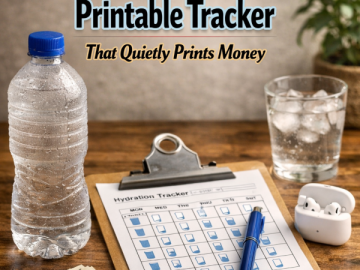
A five-page money tracker is the sweet spot for most sellers. Enough content to feel valuable, simple enough to build in one focused afternoon. If you’re newer to printables, “five clean and usable pages” is your entire creative brief. Nothing fancy required and nothing added just to feel like you’ve justified the price.
Step 2. Research What Buyers Actually Want Before You Build
Spend thirty minutes on Etsy before opening Canva. Search “money mindset printable” and “financial goal planner 2026” and sort by most reviews. You’re reading the market here, not copying anyone’s work. The listings with the most reviews are showing you what people consistently choose to pay for.
Sandra left a five-star review on a competing planner because it tracked “both savings AND side hustle income in one place.” She couldn’t find that combination anywhere else, so when she found it she bought it immediately. That review is a product brief. Gaps in what buyers can find are the doors you’re allowed to walk right through.
Step 3. Build Your Template in One Canva Session
Open Canva, choose US Letter size, and pick a palette that reads “aspirational but achievable” – deep forest green, charcoal, or navy with gold accents. You want buyers to feel like serious people making serious moves. Not like they stumbled into a 2am infomercial about wealth secrets.
Build the pages in this order: a goal-setting cover, a weekly income tracker, an expense log, a wins and milestones page, and a monthly review. That’s a complete product someone will actually use. Resist the urge to add twenty more pages just to feel like you’ve earned the price tag. Five pages that work beat fifty pages that overwhelm every single time.
Step 4. Price It Without Apologizing for Your Work
The $3 to $5 range signals “I’m not sure this is good.” The $9 to $14 range signals “this solves a real problem and the creator knows it.” Start at $12 for a five-page tracker. Bundle two or three printables together and go up to $22 to $27 for the set.
You can run a “National Be a Millionaire Day” flash promotion and drop the price for 24 hours to create urgency and grab initial reviews. But start at the real number first. Discounting from $12 to $9 feels like a meaningful deal. Staying permanently at $3 feels like a clearance bin, and clearance bins don’t build loyal customers who come back in July.
Step 5. Write a Listing Title That Shows Up When People Search
Etsy search is entirely keyword-driven, and your listing title is searchable real estate with limited space. Lead with what the product IS before describing what it promises. “Money Goal Tracker Printable – 2026 Millionaire Mindset Planner – Instant Download” will outrank “Transform Your Financial Life Today” on every relevant search, without exception.
Match that practical energy in your description. Tell buyers exactly what’s inside (five pages, letter size, instant PDF), what it’s for (income tracking, savings goals, monthly review), and one clear sentence about the problem it solves. No poetry. No pep talk. Just the information they need to feel confident clicking “buy now.”
Step 6. Create Mockup Images That Show the Product in Real Life
Nobody confidently buys a PDF they can’t picture. Use Placeit or Canva’s mockup frames to show your tracker on a clipboard, a desk, or spread open next to a planner. Three images minimum – one showing the full product layout, one showing a single page in detail, and one showing it in a real-looking workspace context.
The coffee mug must appear in at least one photo. This is not optional. Some kind of collective agreement was reached among printable buyers around 2019 and the mug is now an unwritten industry requirement. Include it, accept the mystery of how this happened, and move on to getting your listing live.
Step 7. List It 30 Days Before May 20 – Not 3 Days Before
April 20 is your target listing date. Etsy’s algorithm rewards listings that build views, clicks, and favorites before a holiday peaks. A listing with a month of engagement history looks established, and established products get shown to more people in search results than brand-new ones.
Pinterest has the same compounding logic. Pin your product in mid-April using two or three different designs with slightly different titles and colors. Pinterest traffic builds slowly and then suddenly it doesn’t – like finding an empty parking lot at the mall on an inexplicable random Wednesday. The early pins keep earning long after May 20 has passed.
Step 8. Build an Email List From the Very First Sale
Every buyer who downloads your May tracker could also buy your summer budget worksheet and your fall goal-setting planner – but only if you can reach them again. Social media algorithms are not a reliable delivery system for that. They will deprioritize your content the moment it serves them better to do so, and they check that math constantly.
Start capturing emails from day one using your chosen email provider – whether that’s AWeber, GetResponse, or No Limit Emails. Offer a free single-page starter printable as the signup incentive. One welcome email, one free gift, one relationship started. That’s your entire email strategy for now, and it’s enough to begin.
Step 9. Drive Pinterest Traffic in the Two Weeks Before May 20
Create five to eight pins from your mockup photos, each with a slightly different title and color treatment. Use keywords like “millionaire mindset printable 2026,” “money goals tracker May,” and “National Be a Millionaire Day planner.” Long-tail keywords reach buyers who are ready to purchase, not browsers collecting inspiration they will never revisit.
Post at least one new pin per day in the ten days leading up to May 20. Pinterest rewards consistent activity during this kind of window, and timing-specific content gets its best reach when published close enough to the event to feel timely. Consistent beats clever on Pinterest. It’s one of the platform’s most reliable rules.
Step 10. Bundle and Relaunch After Your First Sale
One sale proves the concept works. Now bundle it. Add a “millionaire affirmation card set” (twelve cards, buildable in an afternoon) and a “90-Day Money Goals Challenge” checklist. Name the collection “Millionaire Mindset Starter Kit” and price it at $24. That’s your second product, and you’ve mostly already made it.
The buyer who spent $12 on your tracker will often spend $24 on the bundle – same audience, clearer value story, bigger cart. That’s the whole digital product business model compressed into one single move. Nice. Build the next product before this momentum has a chance to cool down on you.
Five Standout Takeaways That Will Actually Stick
Takeaway 1. Early Listings Beat Good Listings Almost Every Time
A solid product listed 30 days early will outperform a more polished product listed 3 days before the holiday in nearly every case. Algorithms reward seniority and early engagement signals. Being first to the party matters more than showing up later with the best outfit.
You don’t need the most beautiful design in Etsy search results. You need a product that solves a real problem and shows up when people look for it. The window for May 20 is wide open right now. Waiting to feel “ready enough” is the most expensive habit aspiring sellers carry, and it costs them every time!
Takeaway 2. The Bundle Is Where Real Revenue Lives
A single $12 printable is proof of concept. A $24 bundle is the beginning of a real business. Buyers perceive bundles as significantly higher value even when the total content is similar, because “complete kit” carries a different emotional weight than “one item.” The word “complete” does an enormous amount of lifting in this space.
Once your tracker is listed and earning, your second job is building the bundle. Name it, write a separate listing, and give it a clear value story. You now have two products from one afternoon of creative work, and your average order value has roughly doubled. That is the kind of arithmetic that does not require a spreadsheet to fully appreciate.
Takeaway 3. Email Ownership Beats Social Reach for Repeat Business
Social platforms loan you an audience. Email gives you one you actually own outright. When Instagram decides your posts should reach 4% of your followers instead of 40% – and that decision will happen on a timeline you do not control – your email list still delivers your message to everyone on it without asking anyone’s permission.
Even 50 subscribers who chose to hear from you outperform 5,000 social followers who followed you for a giveaway two years ago. Build the list slowly. Keep it warm with something useful once a month. The compounding relationship value on a real email list is one of the few things in Internet business that still works exactly the way it’s supposed to.
Takeaway 4. Realistic Pricing Builds More Trust Than Bargain Pricing
When you price a five-page printable at $3, buyers don’t think “great deal.” They think “why so cheap – what’s the catch.” Pricing at $12 to $14 signals that you believe in what you made and that they should too. Confidence in your pricing shows up in the listing, and experienced buyers can absolutely feel it.
Run your holiday promotion from $12 down to $9 for 24 hours – that’s a discount that registers as meaningful. But staying permanently at $3 doesn’t attract more customers; it attracts buyers who don’t value what they download and never use it. Price like you mean it from day one, and let the discounts do what discounts are actually for.
Takeaway 5. One Good Holiday Product Creates a Repeating System
After May 20, National Dollar Day lands on August 8. After that, Financial Literacy Month covers all of April. New Year’s financial resolution content starts getting pinned in December. You now have a full calendar of opportunities and a proven system to run through each one on roughly a sixty-day cycle.
The second holiday product takes half the time the first one takes. The third takes half of that. By the fourth, you have templates, a shop with a recognizable identity, and a process you can run without reinventing anything from scratch. That’s how a single National Be a Millionaire Day printable becomes the foundation for something that earns all year long.
Mistakes That Will Cost You Sales Before You Even Begin
Waiting until May 17 to list your May 20 product is the first mistake – and the most common one. Etsy needs indexing time. Pinterest needs distribution time. Your listing needs time to accumulate views and favorites before the holiday peaks. A listing live for a full month will outperform one that appeared over the weekend every single time. April 20 is your real deadline.
Skipping the mockup photos is the second mistake. A blank PDF thumbnail tells buyers nothing useful. They cannot picture the product in their life. Twenty minutes in Placeit or Canva solves this completely. There is no reasonable excuse to launch without mockups, yet a surprising number of sellers do exactly that and then wonder why the views aren’t converting into sales.
Making it too complicated is the third mistake. A 47-page financial planning system sounds impressive right up until you try to build one in three weeks and launch nothing because you ran out of time and energy simultaneously. Five focused, genuinely useful pages beats an overwhelming mega-system that makes buyers feel inadequate just reading the product description. Keep it small. Keep it useful. Get it listed.
How to Scale This Past One Lucky Holiday
Your May 20 product should anchor a shop themed around financial motivation – not just exist as a one-day promotional item. Money goal content sells year-round. The holiday gives you the launch hook and the promotional angle, but the product stays relevant long after May 20 passes and keeps finding buyers who never knew the holiday existed.
Once you have three to four related products live, bundle them into a “Complete Millionaire Mindset Kit” at $39 to $47. That price point attracts buyers who are serious about their finances and willing to invest a small amount in a complete and coherent system. They also tend to leave the most useful reviews, which makes your shop look more credible to the next wave of buyers.
The level above that is PLR – private label rights. You sell other creators the right to use and rebrand your templates for $47 to $97 per license. Same creative work you already did, radically different revenue ceiling. There’s a whole community of solopreneurs actively looking for financial printable templates they can customize under their own brand name. You could be the supplier they’ve been searching for.
Next Steps to Move Before the Sixty Days Disappear
Open Canva today and start your money tracker template. Not the full product – just the first page. A goals page with five to seven clean fields and a layout that looks intentional. That’s the only task for today. The other four pages follow naturally once the first one exists and you can see what you’re building.
Set up your selling account now while the motivation is fresh and available. A Gumroad account takes fifteen minutes. An Etsy shop takes a bit longer, but you only build it once. Don’t let account setup sit on your mental to-do list for two weeks while the window quietly shrinks.
Choose your email tool – AWeber, GetResponse, or No Limit Emails – and set up the simplest welcome sequence possible. One email, one free single-page printable as the incentive, one relationship started. You can build the elaborate automation funnel after your first hundred subscribers. For right now, just begin.
What National Be a Millionaire Day Is Really Asking You to Do
It’s asking you to start. Not to have a perfect product, a fully-built shop, or a logo designed by someone named Rodrigo. Just to start. One product, one listing, sixty days of runway. That is the whole opportunity in its simplest and most honest form, with nothing dressed up or oversold.
The sellers who actually cash in on this day are not the ones with the best design skills or the largest Pinterest following. They’re the ones who listed something before the holiday arrived instead of writing “try this next year” in a notebook that will be lost before June. A published product earning $9 a day is worth approximately one million times more than a perfect unpublished product living in a Canva draft folder. (That specific ratio has not been peer-reviewed. The methodology involved observing people not publish things over many years. It was, as studies go, fairly convincing.)
You have sixty days and a holiday that the majority of sellers are not paying attention to. Does that feel like a window worth climbing through? If so, why not open Canva right now and start making it so today?