
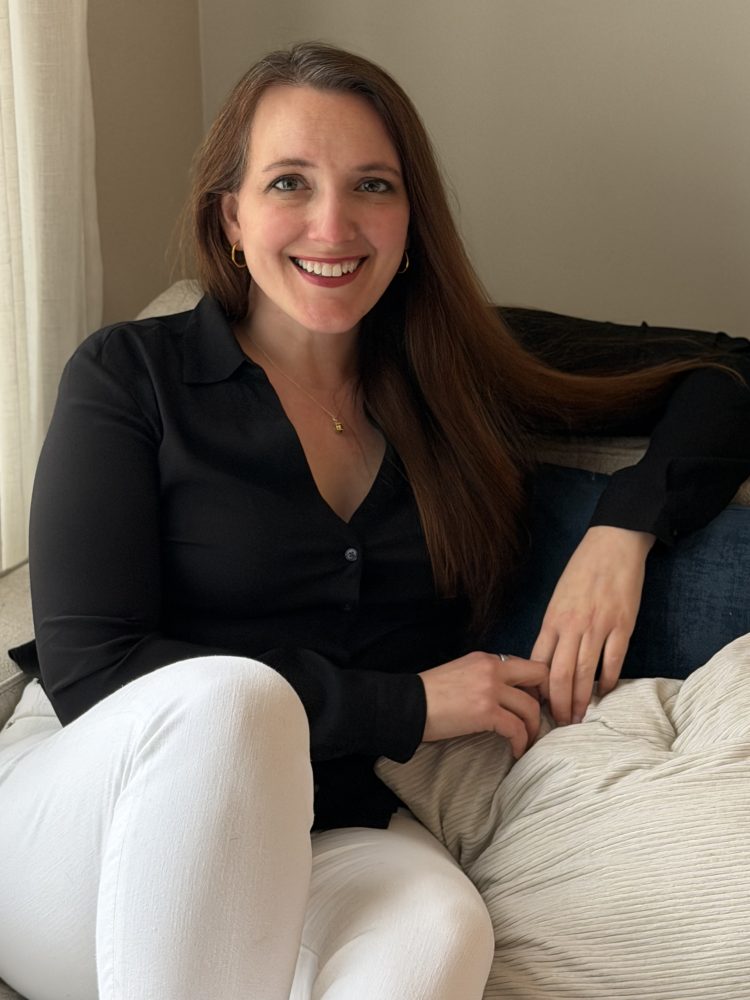
Megan Espinal, founder of Social Reject. (Credit: Social Reject)
Megan Espinal’s marketing company, Social Reject, is building other women’s small firms without using social media.
Modern-era marketing strategies are often fragmented, and hinge heavily upon engaging prospective customers via social media platforms like Instagram, TikTok and Facebook. When former corporate marketer Megan Espinal felt pulled to set out on her own in the industry, she vowed to offer services that fully avoided the apps. “It had already become a toxic waste of time in my personal life, and I wasn’t about to go back on the apps in my business,” she says. That’s how Social Reject, her marketing consultancy, came to be – and she now has a growing roster of clients who feel relieved to not resign themselves to endless social media campaigns in search of their target audiences.
Editor’s Note: Social Reject has been named to The Story Exchange’s 2026 list of 15 Brilliant Business Ideas. Here’s our lightly edited Q&A, with Espinal.
How is your business different from others in your industry?
Many creators and small businesses do their own marketing without formal training, but they’re only learning how to do social media campaigns by copying other influencers or social media hype gurus, which leaves companies dependent on platforms they don’t own, don’t control, and can’t measure in terms of return-on-investment. Social Reject asserts that social media is no longer built for everyone, doesn’t work for everyone, and isn’t even necessary – especially if it harms your mental health, violates your ethics, or makes you feel uncomfortable.
Tell us about your biggest success so far.
I know I’m supposed to talk about a big project or a financial-success outcome, but that’s not what comes to mind for me. Rather, I think about a conference I attended once where the morning session was about all the tips, tricks and gimmicks we should be doing on social media as entrepreneurs. While I was waiting in line for the bathroom afterwards, I started talking to the woman in front of me about what she’d thought of the training. It turned out she was really overwhelmed. She didn’t like social media; it made her anxious, and she knew it wasn’t a healthy space for her mentally. I started to share some counterpoints against social media and gave her some tips on other marketing tactics that she could use, and she said “You just brought my anxiety levels down so much.” Comments like that are my biggest success, and they are why I do what I do.
What is your top challenge and how have you addressed it?
The hardest part about being an entrepreneur in the early stages is that you’re doing everything yourself. I have to be my own client when I’m working on the website, doing SEO optimization, building email series, writing blog posts, and then I have to handle the sales and business development side as well. I could sit in my chair for hours on end and not feel like I’m getting enough done because the list is so long.
I’ve handled it by hiring work out when I can, so I remove myself as the bottleneck, and also by relying on exchanges of services from partners in my field. I do use AI, but in very limited cases, because I’m cautious about the socio-economical and environmental impacts of it, and I want to keep the human touch at the center of my brand.
Have you experienced any significant personal situations that have affected your business decisions?
As a writer and marketer, I’m keenly aware of the threat of having my skills and talents replaced by AI, so I’m really aware of not using it in places where I could pay someone else for their skills and talents, like graphic design or systems builders. I’m also really tired of being recorded on every call I join (and I have big privacy concerns with the AI layer of that), so I don’t record calls, I don’t use an AI notetaker, and I kick notetakers out if they join.
What is your biggest tip for other startup entrepreneurs?
Be really careful who you listen to, especially in the early stages. Who you partner with or listen to as you’re getting started can either propel you forward or set you up for struggle. Check their credentials, understand how they run their business, and make sure they’re the right partner or advisor for you based on what you need. Beware the person who claims to know how to do it all, and – please – get your marketing advice from a career marketer, not a business influencer.
How do you find inspiration on your darkest days?
I listen to a podcast from another woman who’s been where I am, and who kept going. I think we need reminders from real people who’ve walked our paths that it gets better, and that what we’re experiencing isn’t a reflection of a personal failure — it’s just part of the process.
What is your go-to song to get motivated on tough days?
I’m still loving “Shake it Off” by Taylor Swift. It’s upbeat, and it literally reminds me to shake off the haters and keep going.
Who is your most important role model?
My parents. My dad managed people for most of his career, and he built a small residential rental business on the side. In both cases, he put doing the right thing at the center of his work, and held himself to a high ethical standard. He let renters float when they lost their jobs or were dealing with cancer treatments. He would go in on Christmas Day morning to deliver packages so families would get their gifts. My mom, meanwhile, was a teacher’s aid in a special education classroom, and her patience and concern for each student’s well-being and success always impressed me. They both taught me to follow my moral compass, and I don’t think I’d have the confidence to pursue a business model that so counters the current narrative if I didn’t wholly believe it was the right thing to do.
Check out our Advice + Tips for entrepreneurs starting-up
Watch our latest videos
Subscribe to our podcast

![Best times to post on social media in Australia [Updated March 2026]](https://virtual-coach.com/wp-content/uploads/2025/05/model-7719270_960_720-360x270.jpg "Best times to post on social media in Australia [Updated March 2026]")