Introduction
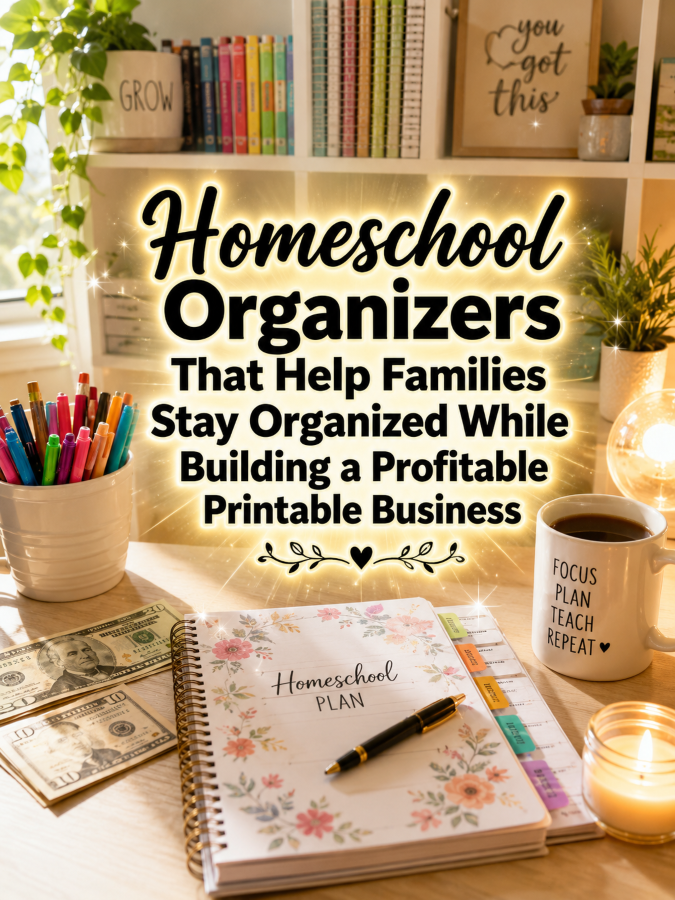
Running a homeschool can sometimes feel like managing an entire school from your dining room table. Between lesson planning, attendance records, reading logs, field trips, assignments, and household responsibilities, it’s easy for paperwork to pile up quickly. That’s exactly why homeschool organizers continue to be one of the most valuable printable products parents can buy.
Many printable creators overlook the homeschool niche because they assume it’s too small. The reality is quite different. Thousands of families choose homeschooling every year, while many existing homeschool families continue searching for better ways to organize their lessons, schedules, and educational records. That’s a growing opportunity instead of a shrinking one.
The best part is that homeschool organizers naturally expand into dozens of related printable products. Instead of creating one planner and hoping it continues selling forever, you can build an entire educational resource library that serves homeschool families throughout the entire school year. That’s a much smarter business strategy than constantly chasing brand-new niches.
Homeschool families value organization because it helps them spend less time managing paperwork and more time actually teaching. A thoughtfully designed organizer reduces stress, simplifies planning, and creates smoother learning days for both parents and students.
One well-designed Homeschool Organizer can quietly become the foundation of an educational printable business that generates income throughout every school year. That’s wonderful news for creators who enjoy making practical resources that genuinely help families.
Quick Answer
A Homeschool Organizer is much more than a planner. It can become the centerpiece of a growing digital product business that includes lesson planners, attendance records, reading journals, curriculum trackers, assignment planners, field trip logs, report card templates, educational portfolios, student planners, and homeschool management systems.
A starter organizer can comfortably sell for around $7. Expand it into premium homeschool planning bundles, complete educational management systems, and family organization libraries priced at $27, $47, and even $77.
Your customers aren’t simply buying printable pages. They’re investing in smoother homeschool days, better educational records, reduced stress, and more enjoyable learning experiences for the entire family.
Why This Niche Works
Homeschool families stay organized all year long. Unlike many seasonal printable markets, homeschooling continues through carefully planned schedules, lessons, projects, reading assignments, educational goals, and family activities. Parents constantly need systems that help them keep everything in one organized place.
Many homeschool parents also appreciate resources that save preparation time. Instead of creating planners from scratch every semester, they happily purchase printable systems that allow them to spend more time teaching and less time organizing paperwork. That’s always a Good Thing.
Once customers discover your Homeschool Organizer, they’ll naturally become interested in student planners, lesson plan templates, reading logs, educational portfolios, assignment trackers, habit journals, curriculum planners, field trip journals, and countless related thingees. One successful organizer can easily grow into a complete homeschool printable shop.
Unlike trendy products that disappear after a few months, homeschool organization remains valuable throughout every academic year. Prior to pouncing upon this opportunity, you should first know all about the:
Tools You’ll Need
You don’t need a teaching degree to create outstanding homeschool organizers. These dependable tools are more than enough to help you build printable products that homeschool families will happily use every week.
- Canva for designing homeschool planners, lesson organizers, reading journals, attendance sheets, and educational printables.
- Google Docs for organizing lesson content, printable instructions, educational worksheets, and planning notes.
- AWeber for building your email list with homeschool tips, printable updates, and educational resources.
- GetResponse for newsletters, homeschool promotions, product launches, and customer follow-up.
- Gumroad for selling downloadable homeschool organizers and educational bundles worldwide.
- Teachable if you’d eventually like to teach homeschool planning, educational organization, or printable design.
- Amazon Homeschool Planner Research for discovering which homeschool planning resources parents appreciate the most.
Don’t spend two weeks deciding whether your planner should use tiny apples or tiny pencils as page decorations while homeschool parents are searching for resources that simplify their daily routines. Your future customers care much more about practical organization than decorative details.
Next, move to:
Your 5-Step Action Plan
Follow these five steps unless you’d rather watch another printable creator build the homeschool brand that could have belonged to you. The smartest entrepreneurs don’t create isolated products. They build collections that naturally grow one useful resource at a time.
Step 1. Research Homeschool Challenges
Spend about 90 minutes exploring homeschool Facebook groups, Pinterest boards, homeschool blogs, educational forums, curriculum websites, and Amazon reviews. Look for recurring organizational problems because those repeated frustrations become the blueprint for your printable collection.
Create a master list containing at least 40 to 50 printable pages. Include lesson planners, attendance records, assignment trackers, curriculum schedules, reading logs, educational goals, field trip journals, report card templates, weekly schedules, chore charts, and portfolio pages. Your research becomes an X-ray machine that reveals exactly where homeschool families need the most help.
Step 2. Build Your Core Homeschool Organizer
Create a collection containing 50 to 70 printable pages that support an entire homeschool year. Include calendars, curriculum trackers, lesson planners, attendance sheets, grade records, assignment planners, reading logs, project planners, educational goals, and progress reports. Keep every page simple, practical, and easy to print because simplicity is always a Good Thing.
Parents already juggle teaching multiple subjects while managing everyday family life. Straightforward layouts and logical organization make your planner much more valuable than complicated designs that create unnecessary confusion.
Step 3. Expand Into Related Products
This is where your business begins growing rapidly. Transform sections of your organizer into standalone products such as reading journals, science planners, assignment binders, preschool activity planners, high school transcript organizers, educational portfolios, daily schedules, and curriculum planning systems. Every new printable naturally supports your original organizer while creating additional income opportunities.
Instead of constantly chasing new niches, continue expanding the homeschool ecosystem you’ve already started. That’s a much more efficient way to build a long-term printable business.
Step 4. Add High-Value Bonuses
This is where your organizer starts standing out from the thundering herd. Include educational goal certificates, printable bookmarks, reading challenges, family learning calendars, chore planners, educational milestone trackers, supply checklists, and subject planning worksheets.
Those bonus thingees require very little additional work yet dramatically increase the value families receive. Complete homeschool systems almost always outperform simple planners because every page contributes to a smoother educational experience.
Step 5. Build Your Product Ladder
Launch your starter Homeschool Organizer for $7 and let it become the foundation of a growing educational business. Expand into premium homeschool planning systems around $27, complete curriculum management libraries around $47, and comprehensive homeschool organization collections approaching $77. Every additional product naturally complements the others while encouraging repeat purchases.
Before long, your business won’t simply be selling homeschool planners. You’ll be helping families stay organized, reduce stress, simplify lesson planning, and create more enjoyable learning experiences throughout the school year.
Once you’ve figured out all of the above, the next step is implementing:
3 Ways to Stand Out From The Thundering Herd!
The homeschool printable market continues growing every year, but that doesn’t mean you have to compete on price alone. The Good Thing is that many printable shops create basic planners with very little thought about how homeschool families actually manage their daily routines. You can stand out by creating resources that solve real organizational challenges while making learning easier for the entire family.
Way 1. Build Complete Homeschool Systems
Don’t stop with a single homeschool planner. Create coordinated collections that include lesson planners, attendance logs, curriculum trackers, reading journals, assignment organizers, field trip planners, report card templates, student goal sheets, portfolio pages, and educational calendars. Families appreciate having one matching system instead of downloading planners from multiple shops.
Those connected thingees also encourage repeat purchases because every new printable naturally fits with the products customers already own. Instead of selling one planner, you’re creating an educational ecosystem that families can use year after year. That’s always a Good Thing.
Way 2. Design for Real Family Life
Homeschooling often means teaching multiple children at different grade levels while managing meals, household responsibilities, appointments, and extracurricular activities. Design organizers that are flexible enough to support busy family schedules instead of assuming every homeschool day follows a perfect routine.
Practical layouts, generous writing space, customizable pages, and flexible planning systems usually receive better reviews because parents can easily adapt them to fit their own teaching style. Useful always beats complicated.
Way 3. Serve Different Homeschool Styles
Every homeschool family teaches differently. Some follow structured curriculum programs, while others prefer unit studies, Charlotte Mason methods, unschooling, classical education, or eclectic approaches. Create printable versions that support different learning styles instead of expecting one planner to meet everyone’s needs.
Specialized organizers often feel more valuable because parents immediately recognize that the planner was created with their educational philosophy in mind. That’s one of the easiest ways to rise above the thundering herd.
Next, here’s the thing. You’re probably NOT the only person offering this service. So you now require:
3 Nifty Ways to Find Customers
Your ideal customers actively search for homeschool organization ideas throughout the entire year. The challenge isn’t finding homeschool families. The challenge is becoming the printable shop they trust before someone else earns their loyalty.
Way 1. Homeschool Facebook Communities
Thousands of homeschool parents participate in Facebook groups where they exchange curriculum ideas, organization tips, lesson planning advice, and educational encouragement. Offer a free weekly lesson planner or reading tracker before recommending your complete Homeschool Organizer. Helping first builds trust much faster than immediately asking people to buy.
Parents naturally recommend practical resources that simplify their homeschool routines. One helpful free printable can quietly introduce your products to an entire homeschooling community.
Way 2. Pinterest
Pinterest remains one of the largest sources of homeschool inspiration online. Parents search for lesson plans, educational activities, reading challenges, homeschool rooms, organization systems, and printable resources every day. Create beautiful pins featuring planner spreads, curriculum trackers, reading journals, and educational checklists that encourage families to save your content for later.
Pinterest content often continues generating traffic long after it’s published. Trust me, you’ll thank me later.
Way 3. Homeschool Bloggers and Curriculum Creators
Homeschool bloggers, educational YouTubers, curriculum developers, and family learning websites are constantly introducing new resources to their audiences. Reach out with affiliate partnerships or bundle opportunities that allow them to recommend your organizers alongside their educational content. Their recommendations often generate highly qualified customers because parents already trust their experience.
Strategic partnerships allow your printable business to grow steadily without depending entirely on paid advertising. Building relationships is one of the smartest investments you can make.
Speaking of long-term success, now let’s move to:
3 Takeaways You Won’t Find Elsewhere!
Many printable creators focus on selling pages. The most successful homeschool businesses focus on supporting families throughout their entire educational journey. That difference completely changes how customers view your products.
Takeaway 1. You’re Selling Peace of Mind
Your customers aren’t simply purchasing planners, calendars, and worksheets. They’re investing in smoother mornings, better lesson organization, simplified record keeping, and less daily stress. Those benefits are often worth far more than the printable pages themselves.
When writing product descriptions, highlight the problems your organizers solve instead of simply listing page counts. Families buy solutions that improve their daily lives.
Takeaway 2. Every School Year Creates New Opportunities
Children grow, curriculum changes, educational goals evolve, and family schedules adjust every year. That means homeschool families regularly need updated planners, new organizers, subject-specific journals, graduation planners, transcript systems, and educational portfolios. Your business naturally benefits from recurring demand.
Instead of chasing completely unrelated niches, continue serving the same families as their educational needs grow. Loyal customers often become your most valuable business asset.
Takeaway 3. One Organizer Can Become an Entire Educational Brand
Your Homeschool Organizer can naturally expand into preschool learning journals, high school planning systems, reading challenge kits, science notebooks, assignment planners, teacher planners, educational portfolios, family management binders, and curriculum planning libraries. Those connected thingees encourage customers to build complete collections rather than purchasing isolated products.
Before long, homeschool families won’t simply recognize one planner. They’ll know your shop as a dependable source of practical educational resources they can rely on throughout every stage of learning.
Now that you know the above, it’s time for:
3 Common Mistakes to Avoid
Many creators design planners that are too complicated. That’s Not a Good Thing. Parents already manage enough responsibilities without trying to understand confusing layouts or unnecessary tracking systems. Simplicity almost always wins.
Some sellers create products that only work for one grade level. Flexible organizers that can easily adapt for different ages usually appeal to a much larger audience. Simple customization dramatically increases the usefulness of your products.
Others stop after creating one homeschool planner. That’s like opening a bookstore with only one title on the shelf. Continue expanding into reading journals, lesson planners, curriculum trackers, field trip organizers, educational portfolios, and family management systems to build a much stronger printable business.
What else should you know? How about:
Scaling Your Results
Expand into a complete homeschool management ecosystem. Create lesson planners, subject journals, reading logs, assignment trackers, educational portfolios, graduation planners, transcript systems, preschool activity books, teacher planners, and family organization binders that naturally complement your original Homeschool Organizer. Every new printable strengthens your brand while encouraging repeat purchases from families who already trust your work.
Create a Homeschool Resource Membership. Release fresh printable pages every month featuring lesson plans, seasonal learning activities, educational challenges, reading logs, curriculum planners, attendance trackers, classroom resources, and exclusive homeschool printables. Members receive ongoing educational support while your business benefits from dependable recurring revenue.
Build an email list homeschool families genuinely appreciate. Share lesson planning tips, educational printables, organization advice, curriculum ideas, reading encouragement, family learning activities, and homeschool inspiration throughout the year. A collection containing 40 homeschool printable products could realistically generate an additional $700 to $2,200 each month through memberships, bundles, repeat customers, and affiliate partnerships. Trust me, you’ll thank me later.
Let’s now wrap up everything via the:
Your Next Steps
Start by identifying the biggest organizational challenges homeschool families face every week. Think about lesson planning, curriculum management, attendance, reading records, assignment tracking, educational goals, and field trip documentation. Those recurring needs will naturally guide the printable products you create.
Design your first Homeschool Organizer in Canva using clean layouts, practical planning pages, and consistent branding that can easily expand into future educational products. Focus on making everyday homeschool life easier instead of filling every page with decorative graphics. Practical resources almost always become customer favorites.
Then introduce your organizer to five homeschool Facebook groups, Pinterest boards, educational blogs, homeschool influencers, or curriculum creators. Remember, 5 good messages beats 50 generic ones every single time. One thoughtfully designed Homeschool Organizer can quietly become the beginning of a complete educational printable business.
Next, let’s finish with:
Final Thoughts
The best homeschool organizer isn’t the one with the prettiest cover. It’s the one families continue using because it makes teaching easier, keeps records organized, and helps children succeed throughout the school year. Your printable can become an important part of countless learning journeys while building a dependable business for yourself. That’s a wonderful combination.
So, begin by creating one organizer that solves one meaningful homeschool challenge exceptionally well. Continue listening to parent feedback while expanding your collection into matching educational resources that naturally work together. Before long, you’ll have a homeschool brand that families eagerly recommend to others.
You don’t need bazillions of unrelated printables to build meaningful income. You simply need one thoughtfully designed Homeschool Organizer that becomes the foundation of an entire educational printable business.
That’s it. That’s your beginning!
If you were creating your first Homeschool Organizer tomorrow morning, would you build it for elementary families, multiple-child households, high school students, preschool learners, or year-round homeschool programs?
Enjoy!