

keyword research
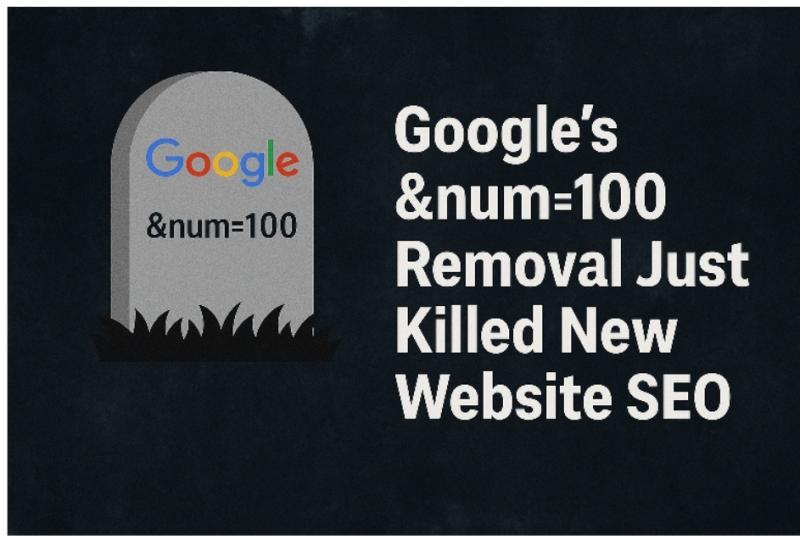
In September 2025, Google quietly removed the &num=100 parameter-a seemingly minor technical change that has fundamentally transformed Google Search Console from an insights resource into merely a performance dashboard. For years, this parameter has allowed third-party SEO tools and scripts to pull 100 results per page directly from Google, powering impression data within Google Search Console (GSC).
While the SEO industry has focused on impression drops and data corrections, the real story is far more troubling. Google has effectively blinded website owners to the keywords they’re actually ranking for, particularly devastating new and growing websites.
From Intelligence Platform to Rear-View Mirror
Search Console has fundamentally changed its nature. It’s no longer telling you what’s possible-it’s only confirming what already worked. The platform has transformed from a discovery engine that revealed untapped opportunities into a performance dashboard that reports yesterday’s wins.
This shift represents a philosophical change in how Google views webmaster tools. Rather than helping site owners understand Google’s perception of their content, Search Console now functions as a limited scorecard showing only top-tier performance.
The New Website Death Sentence
Before the update, GSC was like a radar. You could see the long-tail terms where Google was testing your pages, even if you were buried on pages 2-5. Those early impressions told you how the algorithm perceived your relevance – a priceless signal for improving content and chasing quick wins.
Now, that radar is gone. If your keyword isn’t already breaking into the top 10, GSC acts as if it doesn’t exist. This makes it nearly impossible for new sites to identify “low-hanging fruit” or validate whether their topical coverage aligns with Google’s understanding. New websites have lost all visibility into keyword discovery. They can no longer see:
Which keywords Google considers their site relevant for beyond the first page
Long-tail variations they’re starting to gain traction on positions 11-30
Semantic keyword opportunities they hadn’t targeted but are naturally ranking for
Quick win opportunities where they’re on page 2 and could push to page 1 with minor optimization
The full breadth of their topical relevance in Google’s index
For startups and growing websites, that’s catastrophic. They’ve lost the ability to track progress during the climb – the most critical phase of SEO. What remains is a rearview mirror showing success only after it has happened. They are flying blind, unable to see which of their content strategies are gaining traction below the fold.
At KeywordProbe, we’ve seen this shift first-hand through our keyword research https://keywordprobe.com/seo-services/keyword-research/ work. Many small businesses that once relied on Search Console to uncover unexpected keyword opportunities now face blind spots. Without that discovery layer, even the most sophisticated content strategies can feel like guesswork.
The Third-Party Trap
When GSC stops showing what Google actually sees, the obvious move is to rely more heavily on paid rank-tracking tools. But that approach comes with a serious flaw – you only see what you already expect.
Every third-party tool requires you to provide a list of target keywords. That means your visibility data becomes self-referential: you monitor what you think matters, not what Google organically associates with your content.
That’s what made GSC unique – it surfaced Google’s own perspective on your relevance. It revealed:
Variations you never thought to target
Long-tail queries that signaled new search intent
Early-stage rankings where a small tweak could push you to visibility
Without this first-party data, SEO has become more about confirmation than discovery. We’re left guessing which topics Google connects us to – until we finally appear on page one.
The Forced Migration to Paid Tools
Rank tracking tools now need multiple API calls to gather the same data, leading to slower reporting and potentially reduced tracking depth, with some providers moving from tracking the top 100 results to a more limited range like the top 50 or 20.
This creates a two-tier system: large enterprises can afford comprehensive rank tracking across thousands of keywords, while small sites and new websites must choose between limited visibility and significant costs.
The irony is painful-you now need to pay third-party tools to see a worse version of data Google was providing for free, and that data only covers keywords you already know to track.
What This Means for SEO Strategy in 2025 and Beyond
The implications force a fundamental strategy shift:
You must rank on page 1 before you can learn anything meaningful. This creates a chicken-and-egg problem for new sites: you need insights to improve, but you can’t get insights until you’ve already improved.
The strategic playbook has changed:
Broader keyword targeting is now riskier because you can’t validate if adjacent terms are gaining traction
Content experimentation is harder to measure since you can’t see preliminary signals of success
Topic cluster strategies lose their feedback loop-you can’t see which spoke content is building supporting relevance
Competitive analysis becomes reactive instead of proactive
Resource allocation becomes guesswork without performance signals from developing content
The AI Search Hypothesis
Some industry observers believe the change targets AI scrapers and LLMs that were using the num=100 parameter to build training datasets, with Google wanting control over AI access through licensed APIs.
If true, this represents Google choosing to constrain AI development at the expense of webmaster insights-a clear signal that Google’s priorities have shifted away from empowering website owners toward controlling data access and monetizing SEO intelligence.
A Call for Transparency
Google’s official statement was terse: “The use of this URL parameter is not something that we formally support”. Yet the parameter worked for many years and was removed abruptly without advance notice or guidance.
This lack of communication compounds the problem. Website owners deserve clarity about:
Will Search Console ever report keyword performance beyond page 1 again?
Is Google planning alternative ways to provide keyword discovery insights?
Should site owners expect further limitations to Search Console data?
What’s Google’s long-term vision for webmaster insights and transparency?
The September 2025 removal of &num=100 didn’t just change how we measure SEO performance-it fundamentally changed the relationship between website owners and Google, shifting from transparency and partnership toward opacity and dependence.
GSC now tells you when you’ve succeeded, not how to succeed. For SEOs who grew up using Search Console as their compass, the message is clear: the map has changed.
Keyword discovery now requires deeper analysis, smarter interpretation, and often – external tools.
The age of effortless, Google-provided visibility insights is over.
P.O Bagarji Town Bagarji Village Ghumra Thesil New Sukkur District Sukkur Province Sindh Pakistan 65200.
Wiki Blogs News always keeps careful online users to provide purposeful information and to keep belief to provide solution based information.
This release was published on openPR.