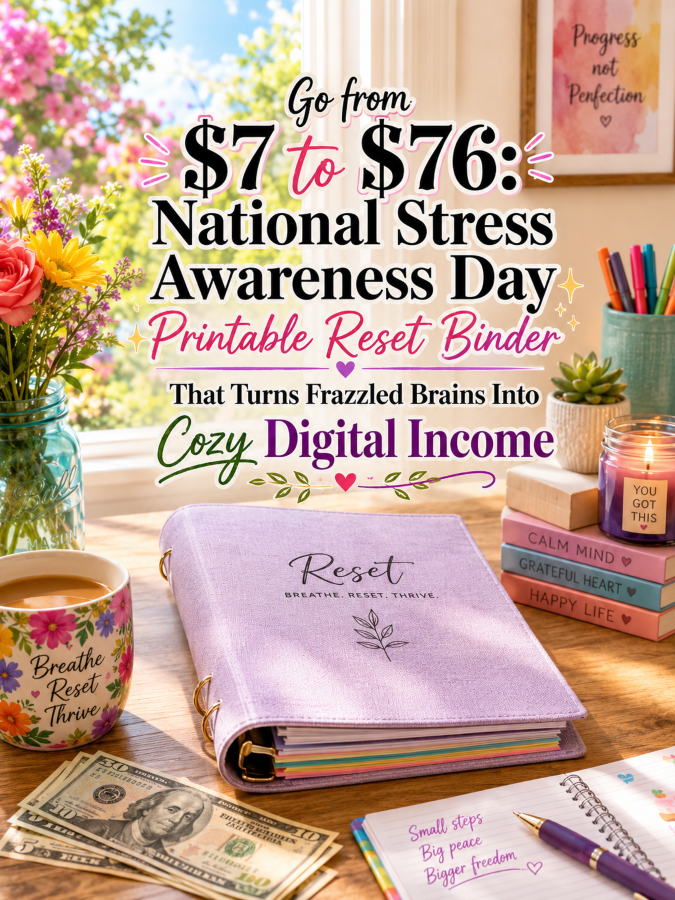
Introduction
National Stress Awareness Day on November 6 arrives right when many people start feeling the year tighten around them.
Work feels louder, schedules get messy, holiday planning starts waving from the corner, and even a basic to-do list can start looking like it joined a gym and doubled in size.
Ick!
That’s exactly why a stress-relief printable can be such a smart starter product! People aren’t usually looking for a giant life makeover, no. Instead, they want a simple tool that helps them calm their thoughts, organize the day, and feel juuuuuust a little more in control.
But! Think on the following. You don’t have to stop at a $7 PDF, no siree. You can build a full ladder from a simple printable into a $77 editable template and reseller-style kit! That makes the higher price more realistic because the buyer isn’t just getting more pages. They’re getting files they can edit, reuse, brand, package, and possibly sell if you include the right license.
That’s the difference between “Here is a nice printable” and “Here is a small product system you can actually use!” See? Same seed, bigger garden, more profit flowers.
Quick Answer
A stress-relief printable can start as a $7 personal-use PDF with mood trackers, reset checklists, calming routines, and daily planning pages. The other end, the $77 version, should not just be a larger PDF.
It should include editable Canva templates, multiple printable versions, mockups, product description swipes, usage instructions, and clear license terms if you want it to work as a reseller-style kit. That makes the pricing feel more fair, useful, and believable.
Now that the ladder makes sense, let’s look at the tools that help you build it without turning your own desk into a stress experiment.
Tools Required
You don’t need a complicated setup for this, not at all. You need tools that help you design the printable, package the offer, show it clearly, and create editable files for the premium level.
- Canva – Use Canva to create the $7 printable, the upgraded bundle pages, and the editable templates for the $77 reseller-style kit. This is the main tool for making the premium version worth the higher price.
- Placeit – Use Placeit to create warm mockups with planners, mugs, candles, desk scenes, and printable previews. Good mockups help buyers see the value faster.
- Creative Fabrica – Use Creative Fabrica for fonts, icons, page accents, and calming graphics. Always check the license before using any asset inside a product you sell.
- Pinterest – Use Pinterest to share stress-relief tips, printable previews, reset routines, and seasonal wellness ideas. This niche fits well because people already search Pinterest for calmer routines.
- Amazon Wellness Planners – Use Amazon for research. Study planner angles, buyer language, layout ideas, and common customer expectations, but don’t copy anyone else’s work.
Once the tools are ready, the next move is building the offer ladder with each price point doing a real job. Move to:
Your 5 Step Action Plan
Step 1: Build the $7 Stress-Reset Printable
Your $7 offer should be simple, useful, and easy to understand. Think of it as the fast-start version!
It might include 10 to 20 printable pages, such as a mood tracker, brain-dump sheet, daily reset checklist, calming routine planner, gratitude page, and “what matters today?” worksheet.
The goal isn’t to solve every stress problem the buyer has ever had. That would be a lot to ask from one PDF, and frankly, the PDF did not sign up to become a tiny therapist in a download folder, right?
The goal is to give the buyer one fast win.
The $7 product should feel affordable, clear, and immediately usable. A buyer should be able to download it, print it, and start using it the same day.
Step 2: Turn It Into a $27 Mini Kit
The $27 version should add more guidance. You can include the original printable, plus a cover page, a short getting-started guide, a 7-day stress reset plan, a weekly check-in page, and a simple routine builder.
This makes the product feel more complete without making it overwhelming. Buyers under stress don’t want to sort through a giant digital file jungle, y’know. They want a clear path that says, “Start here, then do this next.”
The $27 offer should feel guided. It gives buyers more structure than the $7 printable while still staying simple and friendly.
Step 3: Expand It Into a $47 Wellness Bundle
The $47 bundle should feel like a fuller personal-use system. Add multiple sections for daily planning, weekly planning, mood tracking, sleep tracking, habit tracking, self-care menus, calming prompts, routine planning, and reflection pages.
This is where the offer becomes more valuable because the buyer is receiving a complete system instead of a few stand-alone pages. The product helps them organize more parts of their day, which makes the price feel more reasonable.
The $47 version should save time and reduce decision fatigue. It should feel like a ready-made wellness binder the buyer can use again and again.
Step 4: Upgrade It Into a $77 Editable Template and Reseller-Style Kit
This is the level that needs the biggest value jump. The $77 product should include editable Canva templates, not just finished PDFs. That’s what makes the higher price make sense.
A strong $77 version could include the full PDF bundle, editable Canva links, multiple cover designs, seasonal page variations, bonus trackers, a 30-day guided reset challenge, printable affirmations, journal prompts, product mockups, and a simple getting-started guide.
(Say THAT 3 times fast!)
If you want it to be a reseller-style kit, add assets that help the buyer rebrand and use the product as their own offer. That could include:
- Editable Canva templates
- Finished PDF files
- Product mockup images
- Sales description swipe copy
- Email promo swipe copy
- Simple license terms
- Suggested product titles
- Bundle naming ideas
- Buyer usage instructions
Now the $77 price feels much more accurate. The buyer isn’t paying $77 for “more pages.” They’re paying for editable assets, faster setup, branding flexibility, and a product package they can use more creatively.
The $77 offer should feel like a shortcut. It helps the buyer save design time, create a polished product faster, and avoid starting from a blank screen while their coffee quietly judges them.
Step 5: Connect the Whole Ladder
Once each level is clear, connect the offers naturally. The $7 printable can introduce the $27 mini kit. The $27 mini kit can point to the $47 bundle. The $47 bundle can lead to the $77 editable template and reseller-style kit.
This works because some buyers only want a simple printable for personal use. Others want the full bundle. And some buyers, especially creators, coaches, bloggers, and marketers, may want the editable files so they can customize, brand, and use the product in bigger ways.
The ladder should feel natural, not pushy. Each level should make sense on its own while giving the right buyer a clear reason to upgrade.
Now that the product ladder is solid, let’s talk about how to get the offer in front of people who already want calmer routines, better planning, or ready-made wellness products.
3 Great Ways to Get In Front of Customers
Create Helpful Pinterest Content
Pinterest is a strong fit for stress-relief printables because people already search for wellness planners, reset routines, self-care pages, and calming ideas. Create pins around useful angles like “7-Day Stress Reset,” “Simple Daily Calm Checklist,” or “Printable Wellness Binder for Busy Weeks.”
Show the product in a calm setting with mockups. A warm desk scene, a printed page, a mug, and soft lighting can help buyers picture the product in their own life. That visual connection matters!
Lead with usefulness. A helpful pin earns attention, and the product link becomes the next easy step.
Write Blog Posts Around Real Stress Moments
Create blog posts that match what your buyers are already feeling. You could write about planning a calmer week, building an evening reset routine, reducing holiday stress, or organizing your day when everything feels too loud.
Inside each post, mention the printable as a helpful tool. Do not just say, “Buy my planner.” Show how it helps the reader move from scattered to calmer. That’s what makes the offer feel useful instead of random.
Good content helps the reader feel understood before it asks them to buy. That matters because stressed buyers need clarity, not sales noise.
Engage in Wellness, Planning, and Creator Communities
Before sharing your product in communities, become part of the conversation. Answer questions, share ideas, encourage people, and pay attention to what members are struggling with. Do not join and immediately drop a link. That’s not marketing – that is showing up to a quiet yoga class with a bullhorn and a checkout button.
When sharing is allowed, offer a free reset page, a simple checklist, or a helpful planning tip. If the group includes creators or marketers, you can also mention the editable reseller-style version when it fits the rules.
Warm participation builds better traffic than cold promotion. People respond more openly when they have already seen you be helpful.
Once traffic is coming in, the next step is increasing the value of the offer without making it harder for buyers to use.
3 Super Creative Tips to Make Money
Create Seasonal Versions
Stress changes throughout the year, so your product can change with it! Create holiday stress planners, New Year reset kits, back-to-school calm planners, winter wellness binders, spring refresh pages, and end-of-year reflection journals.
This gives you new angles to promote without starting from scratch every time. You can use the same core template system and create fresh versions for different seasons or buyer needs.
Seasonal products turn one idea into repeat selling moments. That’s especially useful when your $77 kit includes editable templates because updates become much easier.
Sell the Personal-Use Version and the Creator Version Separately
You can sell the $7, $27, and $47 levels to personal-use buyers who simply want help managing stress. Then you can position the $77 offer for creators, coaches, bloggers, or marketers who want editable files and a ready-made product package.
This keeps the pricing accurate because each buyer type is getting value that matches their needs. A personal-use buyer may not care about Canva templates or swipe copy. A creator absolutely might!
Different buyers value different pieces. When you separate the offer levels clearly, the pricing feels more logical.
Add Promo Assets to the $77 Kit
If the $77 version is a reseller-style kit, don’t stop with templates. Add product description copy, short email promos, social post starters, mockups, and title ideas. These extras help the buyer use the kit faster.
This increases the perceived value because the buyer isn’t only getting the product files. They’re getting help with packaging and promotion too. That can be the difference between “I bought this” and “I can actually use this.”
A premium kit should reduce setup time. That’s one of the biggest reasons a creator will pay more.
Now let’s turn this into action, because a clean ladder only helps if you actually build the first step.
Your Next Steps
Start with the $7 printable first. Create one clean stress-reset product that gives the buyer a useful win. Keep it simple, calm, and easy to use. The buyer should not need a training manual, a support group, and three snacks to figure it out.
Then outline the $27, $47, and $77 versions before you create everything. This helps you avoid giving away too much at the lowest price. Each level should add a meaningful upgrade.
For the $77 version, make the editable templates the main value point. Include Canva links, finished PDFs, mockups, simple license terms, and promotional helper copy. That’s what turns the offer from a printable bundle into a true premium kit.
Build small, but plan the ladder from the start. That’s how one simple printable can become a full product line without making the process messy.
And yes, the $77 version needs editable templates if you want that price to feel accurate!
Conclusion
National Stress Awareness Day gives you a strong seasonal hook because people already want relief, structure, and calmer routines. A $7 stress-relief printable can meet that need quickly and affordably.
But the bigger opportunity is in the ladder! The $27 version adds guidance. The $47 version adds a fuller wellness system. The $77 version adds editable templates, premium assets, and reseller-style value.
That’s what makes the pricing feel honest. You aren’t charging more for the same thing in a bigger digital envelope. You are giving each level a real reason to exist.
Start with the smallest useful version. Then build the upgrades carefully. One helpful printable can grow into a real product ladder when the premium offer gives buyers more flexibility, more speed, and more ways to use it.
That’s a much stronger way to turn one simple stress-relief idea into a practical income asset!
PS: Useful Resources!
Use these links to research the market, gather ideas, and build a stronger stress-relief printable ladder.
- Search stress-relief printables on Etsy
- Search wellness planner printables on Etsy
- Search wellness templates on Canva
- Explore stress-management planner ideas on Pinterest
- Research stress-relief printable ideas on Google
- Browse wellness planners on Amazon
What will you build first – the $7 printable, the $47 bundle, or the full $77 editable kit?