Introduction
Hosting a gaming tournament sounds incredibly exciting… right up until someone asks, “Who’s playing next?”
Suddenly, brackets are scribbled on notebook paper, team names are changing every four minutes, someone forgot to track the scores, and one player insists they already won a match nobody remembers happening. Before long, the tournament feels less like organized competition and more like trying to herd caffeinated squirrels carrying game controllers.
The games aren’t the problem. Organization is.
Whether it’s a neighborhood competition, a school esports club, a family game night, or an online tournament, someone has to keep everything running smoothly.
That’s exactly why Gaming Tournament Organizer Kits have become an exciting printable niche. They help organizers manage brackets, schedules, scores, teams, and prizes while giving digital creators an evergreen product that can be adapted for countless games and events.
One thoughtfully designed organizer can transform tournament chaos into an event everyone actually enjoys.
Quick Answer
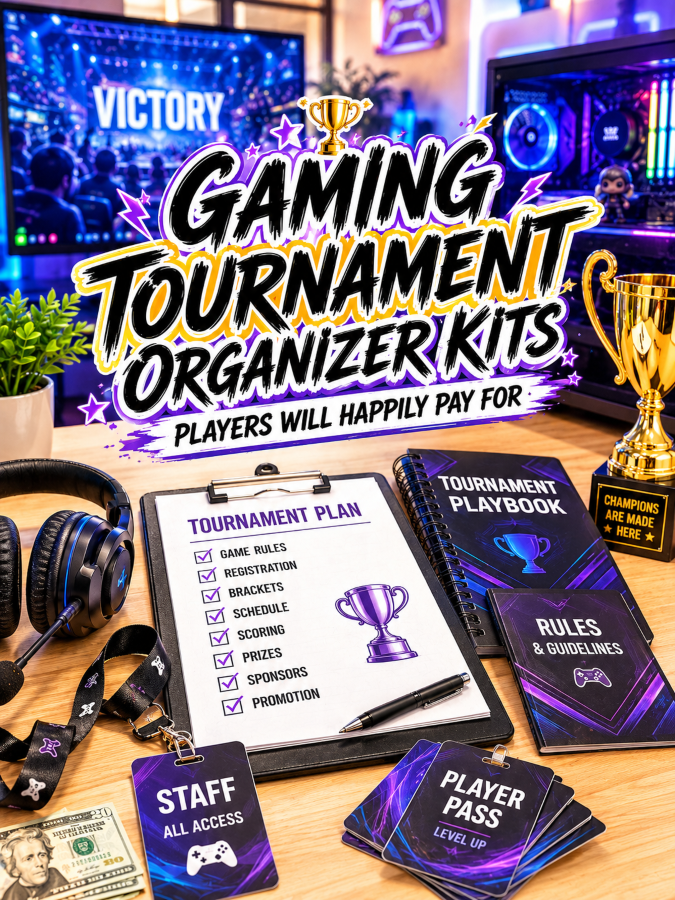
Gaming Tournament Organizer Kits are downloadable printable systems that include tournament brackets, player registrations, score sheets, schedules, team rosters, prize trackers, event checklists, rules pages, and planning guides for gaming competitions.
A basic tournament kit can comfortably sell for around $7. Expand it into esports bundles, family game night planners, editable tournament systems, and premium event management collections, and you’ve created a natural product ladder reaching $27, $47, and even $77.
Tournament organizers don’t need more confusion. They need a system that keeps every match running smoothly. That someone creating that solution could absolutely be you!
Why This Niche Works
Gaming continues growing every single year. Families, schools, community groups, gaming cafés, youth clubs, streamers, and esports communities regularly organize tournaments that require structure.
Many organizers rely on random spreadsheets, handwritten notes, or screenshots scattered across several devices. That’s a bit like opening a restaurant where every waiter remembers orders differently. It works… until it really doesn’t.
Once organizers discover a printable kit that keeps tournaments running smoothly, they’re much more likely to return for league planners, scorebooks, gaming journals, event checklists, streaming planners, and countless related thingees.
Unlike game-specific strategies that change with every update, good organization never goes out of style.
Prior to pouncing upon this opportunity, you should first know all about the:
Tools You’ll Need
You don’t need an esports arena to build this printable business. These dependable tools are all you need to get started.
- Canva for designing tournament brackets, score sheets, and planning pages.
- Google Docs for organizing tournament rules, instructions, and planning guides.
- AWeber for building your email list with gaming event tips and printable updates.
- GetResponse for automated launches, newsletters, and customer follow-up.
- Gumroad for selling downloadable tournament kits.
- Teachable if you’d eventually like to teach tournament planning or printable design.
- Amazon Tournament Planner Research for studying layouts and customer feedback.
Don’t spend weeks collecting software thingees you’ll rarely open. Spend that time creating organizer kits tournament hosts will use again and again.
Next, move to:
Your 5-Step Action Plan
Follow these five steps unless you’d rather spend 22 hours trying to figure out who advanced to the semifinals while three players confidently insist they already qualified.
Step 1. Research Different Tournament Styles
Spend about 93 minutes studying esports competitions, family game nights, tabletop tournaments, school gaming clubs, online competitions, and community events. Customer reviews and event photos often reveal exactly what organizers wish they’d prepared beforehand.
Create a master list containing 28 to 35 printable pages. Include tournament brackets, player registration forms, team rosters, score sheets, schedules, referee notes, prize trackers, attendance logs, event checklists, and winner certificates.
Your research becomes an X-ray machine that uncovers organizational gaps many tournament hosts don’t notice until game day.
Step 2. Design Your Core Tournament Kit
Create a printable collection containing 36 to 48 pages that naturally guide organizers from registration to the championship match.
Include easy-to-follow brackets, score trackers, player statistics, equipment checklists, event timelines, volunteer assignments, emergency contacts, and setup guides. Keep everything clean and intuitive because simplicity is always a Good Thing.
Step 3. Build Specialty Editions
Create separate kits for esports tournaments, board games, trading card competitions, family game nights, school clubs, youth organizations, fundraising events, and online competitions.
Specific organizer kits feel much more valuable than one generic planner trying to manage every possible event.
Your customers will appreciate having choices.
Step 4. Add High-Value Bonuses
This is where your printable starts pulling ahead of the thundering herd.
Include printable medals, participation certificates, livestream planning sheets, sponsor trackers, social media promotion planners, snack checklists, volunteer schedules, and tournament budgeting pages.
Those bonus thingees don’t require much extra work, yet they dramatically increase the value of your bundle.
People love discovering thoughtful extras that make their events even easier to manage.
Step 5. Build Your Product Ladder
Launch your starter organizer kit for $7. Expand into complete esports management systems around $27, then create premium tournament planning libraries approaching $77.
Before long, your business won’t simply be selling brackets. You’ll be helping communities organize memorable gaming events that players will look forward to attending again and again.
Once you’ve figured out all of the above, the next step is implementing:
3 Ways to Stand Out From The Thundering Herd!
Let’s be honest. Tournament brackets are everywhere. That’s about as surprising as finding controllers at a gaming event.
The Good Thing is that most organizers don’t need another blank bracket. They need a complete event system that keeps everyone on the same page from the opening match to the championship photo.
Way 1. Build Kits for Different Types of Games
Don’t create one generic organizer and hope it works for everything. Design separate kits for esports competitions, board game tournaments, trading card events, tabletop games, family game nights, school clubs, and community competitions.
When organizers immediately find a kit that matches their event, they’re much more likely to buy it. That’s far better than asking them to redesign everything themselves.
Way 2. Think Beyond Tournament Day
The event actually begins long before the first match starts.
Include registration forms, sponsor checklists, equipment inventories, volunteer schedules, promotional calendars, setup guides, prize planners, and post-event review pages. Those extra thingees transform your printable from a simple bracket into a complete tournament management system.
Way 3. Make Everything Easy to Follow
No organizer wants players crowding around one table asking who they’re playing next.
Use clean layouts, simple instructions, and clearly labeled sections so anyone can understand the tournament without needing a 45-minute explanation. Simplicity is always a Good Thing.
Next, here’s the thing. You’re probably NOT the only person offering this service. So you now require:
3 Nifty Ways to Find Customers
You don’t need paid advertising because tournament organizers practically shine the Bat Signal every time a new gaming event appears on the calendar.
Way 1. Gaming Facebook Communities
Gaming groups regularly organize online tournaments, LAN parties, tabletop competitions, and local events.
Become the helpful person who shares organizing tips before mentioning your printable. Helpful advice builds trust much faster than constant promotion.
Way 2. Discord Communities
Many gaming communities organize tournaments directly through Discord servers.
Share planning ideas, event checklists, and organizational tips where appropriate. People appreciate practical solutions that save time.
Way 3. Pinterest
Parents, teachers, youth leaders, and homeschool groups often search Pinterest for family game nights and tournament planning ideas.
Create attractive pins featuring tournament brackets, event planners, score sheets, and colorful organizer pages. Eye-catching visuals naturally encourage saves and clicks.
Speaking of completed projects, now let’s move to:
3 Takeaways You Won’t Find Elsewhere!
These aren’t feel-good reminders. They’re practical ideas that quietly turn one organizer kit into an expanding printable business.
Takeaway 1. You’re Selling Smooth Events
Organizers aren’t buying brackets because they enjoy filling in boxes.
They’re buying peace of mind. They want players focused on having fun instead of asking where they’re supposed to go next. That’s the real value of your printable.
Takeaway 2. One Event Leads to Another
Successful tournaments rarely stay one-time events.
Schools, gaming cafés, youth groups, libraries, and community centers often organize competitions throughout the year. One satisfied customer can become a repeat customer for many future events.
Takeaway 3. One Kit Can Become an Entire Gaming Collection
Your tournament organizer can naturally expand into gaming journals, streamer planners, esports practice logs, challenge trackers, achievement journals, team management binders, and event planning systems.
Those connected thingees work beautifully together and encourage customers to keep building their collection.
Now that you know the above, it’s time for:
3 Common Mistakes to Avoid
Many creators only include tournament brackets.
That’s Not a Good Thing. Organizers need registration pages, schedules, score trackers, prize planners, volunteer assignments, and event checklists just as much as they need brackets.
Some sellers forget different tournament formats.
Single elimination, double elimination, round robin, and team competitions all require different layouts. Including several options is always a Good Thing.
Others build one kit and never expand.
The biggest opportunity comes from creating a complete gaming event library that customers can use throughout the year.
What else should you know? How about:
Scaling Your Results
Expand beyond tournaments.
Create printable collections for gaming clubs, esports teams, tabletop campaigns, family game nights, classroom competitions, fundraising events, and convention organizers. One successful organizer kit can inspire dozens of related products.
Create complete event management bundles.
Bundle tournament planners, scorebooks, registration systems, certificates, promotional calendars, volunteer schedules, budgeting pages, and sponsor organizers into premium collections that save organizers even more time.
Build an email list that gaming communities actually enjoy.
Share tournament tips, event planning ideas, printable updates, and seasonal competition resources throughout the year. A collection containing 30 gaming event products could realistically generate an additional $486 to $1,394 each month through repeat buyers, memberships, bundle sales, and seasonal promotions. Trust me, you’ll thank me later.
Let’s now wrap up everything via the:
Your Next Steps
Start by listing 35 printable pages that would make tournament planning easier from beginning to end. Don’t try to organize every type of competition with one giant planner because that’s usually a Not a Good Thing.
Design your first organizer kit in Canva using clean layouts, clear brackets, and simple instructions that anyone can follow. If players can understand everything without asking questions every five minutes, you’ve done your job well.
Then introduce your printable to five gaming communities, Discord servers, school clubs, or esports groups. Remember, 5 good messages beats 50 generic ones every single time.
One thoughtfully designed tournament organizer can quietly become the beginning of an entire gaming printable business.
Next, let’s finish with:
Final Thoughts
The best tournaments aren’t remembered because the brackets looked perfect. They’re remembered because everyone had fun, the event ran smoothly, and players spent more time enjoying the competition than figuring out where they were supposed to be.
Your Gaming Tournament Organizer Kit helps make those experiences possible. It removes confusion, keeps everything organized, and gives event hosts the confidence to focus on creating memorable competitions instead of chasing paperwork.
Start with one practical organizer, listen carefully to your customers, and continue building products that make gaming events easier to manage. You don’t need bazillions of printables to build a successful digital business. You simply need one thoughtfully designed solution that tournament organizers are excited to use again and again.
That’s it. That’s your beginning!
If you were designing your first Gaming Tournament Organizer Kit today, would you build it for esports, board games, trading card tournaments, family game nights, or something completely different?
Enjoy!