Introduction
There is something magical about a well-organized family command center because it can turn household chaos into something that almost looks intentional. Instead of school papers disappearing under grocery receipts, appointments hiding inside three different calendars, and somebody yelling, “Who is supposed to pick up the kids?” from another room, everything can have a place. That makes family command center printables an especially useful digital product niche because busy households are always looking for simple ways to organize the beautiful circus they call daily life.
A family command center can include calendars, meal plans, chore charts, shopping lists, appointment trackers, school schedules, contact sheets, cleaning schedules, and dozens of other useful thingees. The best part is that customers do not necessarily need a giant organizational system with seventeen tabs, twelve color codes, and a user manual longer than a small novel. They need printable pages that are attractive, practical, easy to understand, and simple enough that the whole family can actually use them.
That creates a wonderful opportunity for a printable business because you are not selling paper. You are selling clarity, visibility, and that glorious feeling of knowing what is happening tomorrow before tomorrow actually arrives. Trust me, you’ll thank me later when you realize that one useful household printable can lead naturally into an entire product ladder. And when the thundering herd is busy creating generic planners, you can build a focused family command center system that solves a very specific everyday problem.
Quick Answer
Family command center printables are downloadable organizational pages designed to help households manage schedules, responsibilities, meals, errands, school information, household tasks, and important reminders in one convenient system. You can create individual printable pages for specific needs or combine them into complete command center bundles that customers can print and display in kitchens, entryways, home offices, or other family gathering areas. This makes the niche especially attractive because one customer can potentially need several complementary products rather than just one sheet.
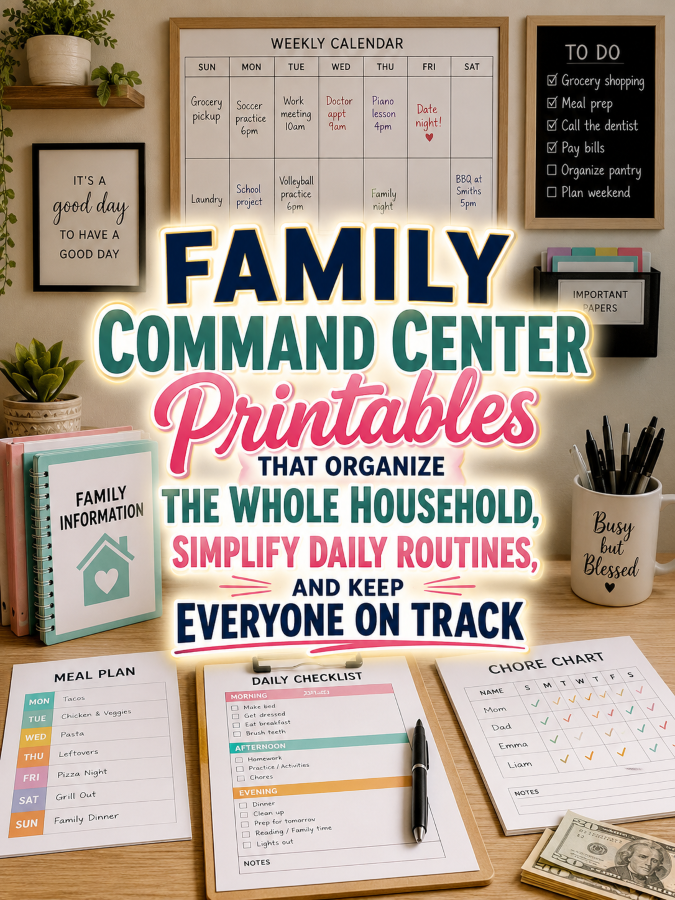
A strong starter product might include a weekly family calendar, chore chart, meal planner, shopping list, and important contacts page. A larger product can add cleaning schedules, appointment trackers, school planners, birthday reminders, bill trackers, home maintenance pages, and family goal sheets. The goal is to make the command center feel useful rather than overwhelming because nobody needs a household organizer that requires a household organizer to explain it.
Why This Niche Works
Families have an endless stream of information to manage, and much of that information changes constantly. School activities move around, appointments get added, sports practices appear on the calendar, grocery lists grow mysteriously, and somebody always seems to remember an important event approximately nine minutes before it happens. A family command center gives households a visible place to collect the information that matters most.
The niche also works because organization products are highly customizable. A family with young children may want chore charts and school schedules, while parents of teenagers may care more about transportation schedules, activities, appointments, and shared responsibilities. Grandparents helping with childcare may want emergency contacts and weekly routines, while busy couples may simply want meal planning, household tasks, and shared calendars.
That variety gives you room to build multiple product collections without abandoning the same core customer. You can create command centers for families with toddlers, school-age children, teenagers, homeschool households, large families, blended families, busy parents, and minimalist households. That’s a Good Thing because every new variation gives your shop another doorway through which customers can discover your other products.
Tools You’ll Need
You do not need an expensive design studio to create useful family command center printables because many of the basic tools are already affordable or free. Canva can help you create attractive layouts, calendars, trackers, checklists, labels, and printable pages without requiring advanced graphic-design skills. Google Docs can help you draft instructions, organize product ideas, write customer notes, and create simple text-based worksheets.
For building your audience, AWeber and GetResponse can help you create email marketing campaigns and communicate with people who are interested in household organization. You can sell individual downloads through Gumroad or create structured courses and organizational training through Teachable. You can also use Amazon Family Organization Research to study customer language, common organizational problems, competing product formats, and ideas that may inspire your own product development.
The most important tool, however, is not software because it is your ability to notice problems that families repeatedly experience. Look for moments when information gets lost, forgotten, duplicated, or misunderstood, and then ask whether a printable could make that problem easier. That’s where your best product ideas will usually come from, and that’s Not a Good Thing if you ignore those little everyday frustrations because they are often hiding your biggest opportunities.
Your 5-Step Action Plan
Step 1: Choose Your Family Command Center Audience
Start by deciding exactly who you want your first command center product to help. A broad product called “Family Organizer” can work, but a more specific product such as “Busy Mom Family Command Center” or “Large Family Weekly Command Center” gives shoppers a clearer reason to pay attention. Specificity makes your marketing easier because you can describe the customer’s problem in language that sounds like it came straight from their kitchen counter.
Think about the household’s daily reality rather than simply choosing a demographic label. A family with three children involved in sports has different organizational needs from a couple caring for one toddler, and a homeschool family may need entirely different scheduling pages from a family with children attending traditional schools. When you understand those differences, you can create products that feel genuinely useful instead of assembling random pages and hoping someone likes them.
You can even create a simple list of ten household problems your target customer experiences every week. Then turn the most common problems into printable solutions and organize those solutions into a cohesive command center. That’s it. That’s your beginning!
Step 2: Build Your Core Printable Pages
Your first command center should focus on the pages customers are most likely to use repeatedly. A weekly family calendar, daily schedule, chore chart, meal planner, grocery list, and family task list can create a strong foundation without making the product feel like a paperwork avalanche. The pages should work together visually so customers immediately understand that they belong to one system.
Consider creating both undated and dated-friendly versions where appropriate. Undated pages can be reused throughout the year, which increases their perceived value, while flexible spaces allow families to write names, activities, appointments, and responsibilities according to their own needs. You can also create versions that work in different household configurations rather than forcing every customer into the same family structure.
Pay close attention to printing because a beautiful screen design can become a very unhappy printer experience if it uses excessive ink, tiny text, or awkward margins. Use clear headings, readable fonts, generous writing spaces, and simple visual cues that help people understand each page immediately. Your goal is to make the product feel like a helpful assistant rather than another thingees-filled project waiting to be assembled.
Step 3: Create a Product Ladder
Once you have your basic pages, turn them into a product ladder instead of selling one giant bundle immediately. Your $7 starter product could include a basic weekly command center with a calendar, chore chart, meal planner, and shopping list, giving customers an inexpensive way to test your organizational style. Your $17 product could add school schedules, appointment tracking, cleaning routines, family contacts, and additional household pages.
Your $27 workbook could teach families how to set up their own command center while including worksheets for deciding what belongs on the wall, who manages each responsibility, and how often pages should be updated. Your $47 binder or complete command center system could combine the most useful pages into a larger household management collection, while a $77 comprehensive library could include multiple family configurations, seasonal pages, editable versions, labels, bonus trackers, and specialized command center collections.
This ladder gives customers somewhere to go after their first purchase. It also gives you a reason to keep creating because every useful addition can become another product, bundle, upgrade, or bonus. That is always a Good Thing because a printable business becomes much more interesting when one good idea starts producing several related ideas instead of forcing you to invent a completely new niche every Tuesday.
Step 4: Make the Product Visually Appealing
A command center is often displayed in a visible part of the home, so appearance matters more than it might with a private worksheet. Create several design styles such as minimalist, colorful family, modern farmhouse, neutral, playful kids, and clean monochrome so customers can choose something that fits their home. You can keep the underlying organizational structure similar while changing typography, decorative elements, and visual themes.
Remember that attractive does not mean complicated. Too many decorative elements can reduce the writing space and make important information harder to find, which defeats the entire purpose of the product. A beautiful command center should make a customer think, “Oh, I can actually use this,” rather than, “This is gorgeous, but where am I supposed to write the soccer practice?”
Create realistic mockups showing the printables in a kitchen, office, entryway, binder, clipboard, or wall display. Customers often understand the value of a printable much faster when they can visualize how it will fit into their homes. The thundering herd can copy product categories, but a thoughtful presentation can make your product feel more complete and more useful.
Step 5: Market the Problem You Solve
Do not market your command center simply by saying that it is “cute,” “printable,” or “organized.” Those words describe the product, but they do not explain why someone should care enough to buy it. Instead, show how the product helps a household see appointments, chores, meals, errands, school activities, and responsibilities in one place.
Create short social posts demonstrating specific problems and solutions. You could show a messy collection of sticky notes becoming a simple weekly family command center, or demonstrate how one chore chart can make responsibilities visible to everyone instead of leaving one exhausted person to remember everything. Those transformations are much more persuasive than simply posting a picture of a pretty printable and hoping the internet suddenly develops organizational enthusiasm.
Email marketing can work especially well because organization shoppers often have several related problems they want to solve. Send useful tips about setting up a command center, simplifying family routines, organizing school information, planning meals, and dividing household responsibilities before introducing related products. Remember, 5 good messages beats 50 generic ones every single time, and that principle can save you from becoming part of the thundering herd.
Once you’ve figured out all of the above, the next step is implementing the ideas one page, one product, and one customer problem at a time.
3 Ways to Stand Out From The Thundering Herd!
Way 1: Create Command Centers for Specific Family Situations
One of the easiest ways to stand out is to stop trying to create one command center that supposedly works perfectly for every household on the planet. Instead, create versions for specific situations, such as families with toddlers, families with school-age children, families with teenagers, large families, homeschool households, blended families, or households with very busy activity schedules. When shoppers see their actual situation reflected in your product, they are much more likely to think, “Finally, somebody gets it!”
You can keep your basic design system consistent while changing the pages and instructions for each audience. A toddler-family version might emphasize routines, meal planning, appointments, and childcare information, while a teen-family version could focus more heavily on transportation, activities, deadlines, chores, and shared responsibilities. This approach gives you multiple products without requiring you to reinvent the entire thingee every time.
You can also create specialized seasonal command centers for back-to-school, summer, holidays, vacations, and moving seasons. These products can work alongside your evergreen command center rather than replacing it, which gives customers another reason to return to your shop. That is a Good Thing because repeat customers are generally easier to serve than constantly chasing a brand-new audience.
Way 2: Build a Truly Modular System
Another way to separate your products from generic household planners is to make your command center modular. Instead of giving customers one enormous PDF where they have to print every page whether they need it or not, let them choose the pages that fit their household. This makes the product feel flexible and can also reduce the frustration of ending up with twenty pages that never leave the download folder.
For example, you could create a core command center containing the family calendar, weekly planning page, chore chart, meal planner, shopping list, and household task tracker. Then offer optional modules for school, pets, home maintenance, birthdays, finances, travel, cleaning, meal preparation, and family goals. Customers can mix and match their favorite thingees to create a system that feels like it was built specifically for their home.
Modular products also give you excellent opportunities for future launches. Once customers have purchased the basic system, you can introduce new modules that expand what they already own instead of asking them to start over. The thundering herd may sell a giant “ultimate family planner,” but you can build a living product ecosystem that keeps becoming more useful.
Way 3: Add Instructions That Make Setup Easy
A surprisingly powerful differentiator is including a simple setup guide with your printables. Many people love the idea of organization but become overwhelmed when they have to decide where everything goes, which pages to print, who updates them, and what information belongs on each sheet. If your product answers those questions, you are providing more than pages because you are providing a path to actually using them.
Your setup guide could explain how to choose a location, decide which information belongs in the command center, assign household responsibilities, establish a weekly update routine, and remove pages that are no longer useful. You could also include a “Start Here” checklist that helps customers set up their system in thirty minutes or less. The simpler the first experience feels, the more likely customers are to keep using the product rather than abandoning it beside the printer.
Consider adding examples showing how different families might use the same pages. One example could show a family with young children, another could show a household with teenagers, and another could show a busy couple managing work and home responsibilities. When customers can see themselves in the examples, the product becomes easier to understand and much easier to imagine using.
3 Nifty Ways to Find Customers
Way 1: Show Before-and-After Organization
Visual content is perfect for this niche because family organization is much easier to understand when people can see it. Create posts showing a chaotic collection of sticky notes, loose papers, calendars, and reminders transformed into one clean command center. You do not need to make the “before” picture genuinely horrifying, although a little exaggerated kitchen-counter chaos can certainly get attention.
Create short videos demonstrating how someone could use one page during a typical week. You might show a parent filling in appointments, assigning chores, planning meals, and creating a shopping list in just a few minutes. These demonstrations help customers understand the practical value of the printable rather than merely admiring the design.
Use multiple visual angles and settings so people can imagine the product in their own homes. Show it on a refrigerator, inside a binder, on a clipboard, beside a desk, or in a kitchen command station. When customers can visualize the finished setup, the distance between “That looks nice” and “I need that” becomes much smaller.
Way 2: Create Helpful Organization Content
Use your blog, Pinterest-style graphics, social posts, or email list to answer everyday household organization questions. Topics could include how to build a family command center, what information belongs on one, how to organize children’s schedules, how to create a family chore system, or how to keep meal planning visible. Every useful piece of content can naturally lead readers toward a related printable.
You can also create simple educational content around common organizational mistakes. Explain why putting too much information in one place can make a system harder to use, why responsibilities should be visible, or why a weekly reset can help keep a command center from becoming stale. This positions you as someone who understands household organization rather than someone who simply makes pretty PDFs.
Keep your content practical and approachable because your customer is probably already busy enough. Nobody needs a seventeen-step morning routine involving laminated charts, matching baskets, and a ceremonial organizational whistle. Give people small wins that they can implement immediately, and they will have a much stronger reason to trust your larger products.
Way 3: Build an Email List Around Household Organization
A free printable can be an excellent way to introduce potential customers to your brand. Consider offering a simple weekly family planning sheet, family meeting agenda, chore chart, or meal-planning page in exchange for an email signup. Once someone downloads the freebie, you can provide useful organization tips and introduce complementary paid products.
Your emails can follow a natural sequence that helps the customer solve one problem at a time. Start with a simple command-center setup lesson, follow with a weekly planning idea, then introduce a meal planner, chore system, or larger command-center bundle when the timing makes sense. This approach feels much more helpful than sending sales messages every other day while the customer is still trying to figure out where the printer paper went.
Keep your email content specific enough that readers can use it immediately. A short message explaining one household organization improvement can be more valuable than a giant newsletter containing twenty unrelated tips. Again, 5 good messages beats 50 generic ones every single time, and your subscribers will notice the difference.
3 Takeaways You Won’t Find Elsewhere!
Takeaway 1: Visibility Is Part of the Product
A family command center works because important information becomes visible. When a calendar is hidden inside someone’s phone, other household members may not know what is happening, but a clearly displayed family schedule creates a shared reference point. That visibility can be one of the strongest selling points for your product.
Think about how many household questions could disappear when information is placed somewhere everyone knows to check. “When is the appointment?” “Who is doing pickup?” “What are we having for dinner?” and “Did anybody put milk on the list?” are all examples of questions that can be addressed through simple visible systems. You are not promising to eliminate family chaos, because that would require actual wizardry, but you can make the chaos easier to see and manage.
Build your products around this idea of shared visibility. Give customers pages that are easy to read from a distance and simple enough for multiple people to update. That small design decision can make your product much more useful than a beautiful planner designed primarily for one person.
Takeaway 2: Design for Real Life, Not Pinterest Perfection
Your command center does not need to look perfect every day. Families are busy, papers get added, appointments change, children forget things, and somebody will eventually write “soccer???” in a space that was clearly intended for something else. Your product should be flexible enough to survive ordinary household life.
Use plenty of writing space and avoid requiring customers to enter information in tiny boxes. Make it easy to erase, update, replace, or rearrange pages so the system can change as the household changes. A product that looks slightly less fancy but remains useful for six months is far more valuable than a stunning product that becomes annoying after six days.
Consider including both structured and flexible pages. Structured pages help people who want guidance, while blank or lightly guided pages give customers room to adapt the system. That balance can turn a basic printable collection into something that feels much more thoughtful.
Takeaway 3: The Command Center Can Become a Business Ecosystem
Your first command center does not have to be the final product you ever create. It can become the foundation for meal planners, chore systems, cleaning schedules, school organizers, family meeting kits, home maintenance trackers, birthday planners, holiday organizers, and other household printables. Suddenly, one product idea has opened the door to an entire catalog.
You can also create themed bundles around particular customer needs. A “Busy Family Bundle” might combine scheduling, meals, chores, and errands, while a “New School Year Bundle” could focus on calendars, school contacts, routines, activities, and homework organization. These bundles allow you to reuse your best pages strategically while creating new combinations that feel fresh.
The real opportunity is learning to think in systems instead of individual files. Every time you create a useful page, ask what other page would naturally belong beside it, what problem comes before it, and what problem comes after it. That little habit can keep your product pipeline full without forcing you to chase every shiny new niche that wanders past your computer.
3 Common Mistakes to Avoid
Mistake 1: Making the Command Center Too Complicated
The biggest mistake is assuming that more pages automatically mean more value. A 150-page bundle might look impressive, but if customers only know how to use five pages, the other 145 pages are basically decorative luggage. Start with the pages customers genuinely need and make each one easy to understand.
You can always expand the product later with optional modules and bonus pages. This gives customers choices without forcing everyone to print an enormous stack. Remember that organization should reduce mental clutter rather than create a new pile of organizational clutter on the dining table.
Test the product yourself before selling it. Print the pages, fill them out, erase information, move them around, and imagine using them during a genuinely busy week. If something feels awkward to you, there is a good chance your customer will notice it too.
Mistake 2: Forgetting About Different Household Structures
Not every household looks the same, so avoid building your products around one narrow definition of family. Some households have young children, some have teenagers, some include grandparents, and some are couples without children who still have plenty of schedules, errands, projects, and responsibilities to manage. Inclusive design gives you a larger potential audience without making the product less useful.
Offer flexible labels where possible so customers can adapt pages to their own situation. Instead of forcing a section to say “Child 1” or “Mom,” you could use customizable spaces such as “Name,” “Person,” or “Responsible.” That makes the printable more adaptable while keeping the structure simple.
You can also create specialized editions later rather than trying to cram every possible household situation into one product. This keeps individual products focused and gives your catalog more opportunities to serve different customers. That’s a Good Thing for your customers and a Good Thing for your business.
Mistake 3: Selling the Printable Without Selling the Outcome
Customers do not wake up every morning thinking, “Today I would like to purchase a PDF containing six rectangular boxes.” They are looking for fewer forgotten appointments, smoother routines, clearer responsibilities, easier meal planning, and less household confusion. Your marketing needs to communicate those outcomes clearly.
Use product descriptions that explain what the customer can do with the pages. Show how the calendar helps everyone see the week, how the chore chart makes responsibilities visible, and how the meal planner connects naturally to the shopping list. The product becomes much more compelling when shoppers understand the complete workflow rather than seeing a collection of disconnected sheets.
Whenever possible, demonstrate the finished experience. Show a family using the command center, explain how the weekly reset works, or provide a quick setup example. You are selling the feeling of “We know what’s going on” just as much as you are selling the printable itself.
Scaling Your Results
Once your first command center is selling, start building around the customers who already showed interest. Create complementary products that solve the next household problem instead of immediately jumping into an unrelated niche. A successful family command center can lead naturally into meal-planning systems, cleaning planners, school organizers, home maintenance trackers, holiday planners, family meeting kits, and seasonal organization bundles.
You can also create different price points without constantly creating completely new products. A $7 starter kit can introduce the concept, a $17 expanded planner can provide more pages, a $27 workbook can teach the setup process, a $47 complete binder system can offer a broader solution, and a $77 comprehensive library can combine your strongest household organization products. This gives customers multiple entry points and lets your business grow around the same core audience.
A collection containing 40 well-designed family organization products could potentially generate an additional $700 to $2,200 per month through bundles, repeat customers, memberships, complementary products, and affiliate partnerships, although actual results will vary widely based on traffic, pricing, product quality, audience fit, and marketing. The important idea is not the exact number but the compounding effect of building a useful catalog around one strong customer need. Trust me, you’ll thank me later when you realize that one excellent product can become the seed for an entire little digital-product garden.
Your Next Steps
Start by choosing one family situation and creating a small command center around its most obvious organizational problems. Build six to ten genuinely useful pages, print them, test them, revise them, and make sure the system feels simple enough for a busy household to use. Then create attractive mockups that show exactly how the finished command center could look in a real home.
After that, publish your starter product and begin collecting customer questions. Those questions can become your next product ideas because customers will often tell you exactly what is missing from your current system. If several people ask for a teenager version, school module, meal-planning section, or home-maintenance tracker, congratulations because your customers just handed you your product roadmap.
Keep building slowly and intentionally rather than trying to create the world’s largest family organization store overnight. Every new product should connect logically to something you already sell, and every new product should make the customer’s life a little easier. The goal is not to create more thingees just for the sake of having more thingees; the goal is to create a useful collection that families can actually depend on.
Final Thoughts
Family command center printables are a terrific niche because they solve an everyday problem that almost every busy household understands. Families need places to organize schedules, chores, meals, appointments, school activities, errands, and responsibilities, and a thoughtfully designed command center can bring those moving pieces together. That makes this niche practical, expandable, and especially well suited to a product ladder.
The secret is to focus on usefulness before decoration. Create pages that are easy to read, easy to print, easy to fill out, and easy to adapt, then build specialized versions around the different households you want to serve. When you combine useful design with smart marketing, your little family command center can grow into a surprisingly large collection of digital products.
Do not worry about joining the thundering herd because your job is not to shout louder than everyone else. Your job is to understand one household problem better, create a simpler solution, and explain that solution clearly enough that the right customer recognizes it immediately. That’s it. That’s your beginning!
If you were creating your first family command center printable tomorrow morning, which household problem would you solve first, and which pages would make that problem dramatically easier to manage? What could you create that would make a busy family look at the product and immediately say, “Yep, we need that”?
Enjoy!