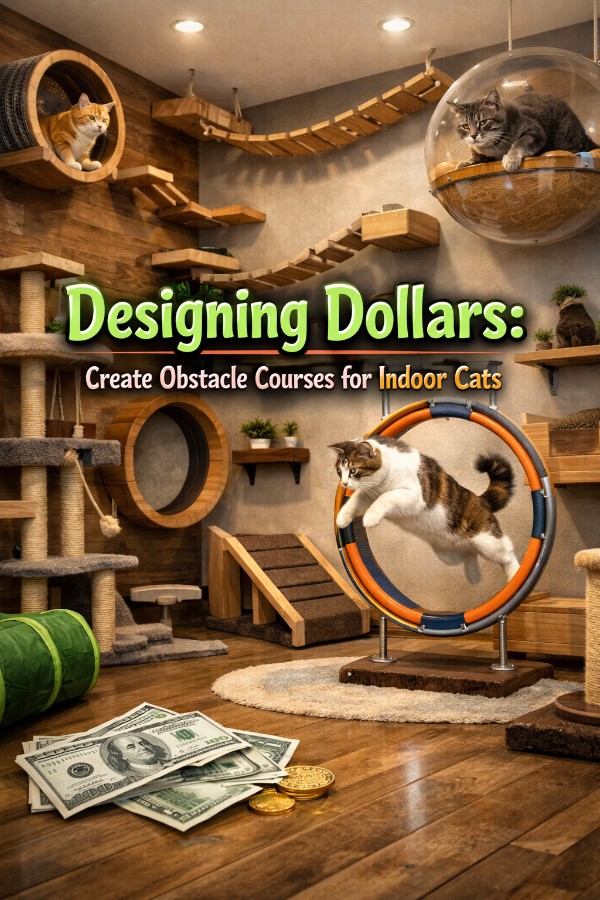
Introduction
Your cat is bored. Not “mildly understimulated” bored. We’re talking “knocked the water glass off the counter at 2 AM for the fourth time this week” bored. And honestly? That’s on us.
Indoor cats live longer than outdoor cats – sometimes ‘waay longer. But “longer” shouldn’t mean “more hours of staring at the wall like a tiny furry philosopher having an existential crisis.”
Cats need to move, hunt, climb, and conquer things that aren’t your ankles. Obstacle courses for indoor cats solve this problem beautifully – and they solve it in a way that happens to be monetizable, too, if that’s the kind of thing your brain lights up for.
This post is going to walk you through exactly how to design a course your cat will actually use, how to turn that expertise into digital products and content, and how to find the people who will happily pay you for it.
We’re talking realistic numbers here – not “make six figures by Thursday” – just a real system you can profit with.
Your cat is waiting. Let’s get started.
Why Indoor Cat Obstacle Courses Actually Work (And Why Most People Overlook Them)
Before we talk about what to build, it helps to understand why this works at all – because “my cat doesn’t do anything I want” is a legitimate concern, and you deserve a real answer before you invest in tunnels.
First: cats are hardwired hunters. Every domestic cat carries millions of years of predator programming that doesn’t go away just because someone installed central air conditioning. Obstacle courses tap directly into that hunting sequence – stalk, chase, pounce, catch – and when you trigger that sequence intentionally, cats engage with almost embarrassing enthusiasm.
Second: enrichment is now a veterinary recommendation, not just a fun idea. Vets are prescribing it for anxiety, weight management, and behavioral issues. That makes this a need-based purchase, not a luxury – which is very good news for anyone selling products in this space.
Third: the content angle is almost unfairly easy! Cat videos are their own economy on social media right now, and a cat running an obstacle course – bonus points if she looks mildly pained by Station 3 – generates views with zero paid advertising.
The reason most people overlook this niche? It seems too simple! Too cute. Not “serious” enough.
Meanwhile, the pet industry cleared $147 billion in annual spending in 2025. Enrichment products are one of the fastest-growing segments inside it, and the digital product space for cat owners is remarkably uncrowded.
You see, simple is not a problem.
Simple is an opportunity!
Tools You’ll Need
Good news: you don’t need a construction degree, a workshop, or a cat who is cooperating. Here’s what actually matters, with real prices attached.
- Cat Puzzle Feeders and Interactive Toys – The mental workout that makes physical movement feel like a reward. DIY cardboard box versions work to start. Paid versions run $12-35 and last much longer.
- Collapsible Cat Tunnels – Cats treat these like portals to a better dimension. $10-25 each. Buy two before you decide how many you need – the answer will be more.
- Wall-Mounted Cat Shelves and Climbing Perches – Vertical real estate doubles your course options without taking floor space. $25-80. Optional for beginners, essential for serious courses.
- Wand Toys and Feather Lures – Your secret weapon for guiding cats through stations. $8-18. You will go through several. That’s fine.
- Freeze-Dried Cat Treats – The currency of the entire operation. $12-20 per bag. Non-negotiable. One whiff and your couch potato becomes a focused athlete with a plan.
- Canva – Free tier works fine for creating printable course layouts to sell. Upgrade to Pro at $15/month when you’re ready for more templates.
- Email Tools: There are several solid choices here – solopreneurs could use AWeber, GetResponse, or the really bespoke No Limit Emails (they offer individual servers, spam-free service, and second to none customer care).
Total realistic startup cost: $50 to $120 for the physical course, plus free to $15/month for the digital tools. You can start at the low end and upgrade as things grow.
The 10-Step System for Building a Cat Obstacle Course That Actually Works
Ready to stop reading and start building? Here’s exactly what to do, in order, without the vague advice that makes you Google seventeen more things before you begin.
Step 1: Observe Your Cat for 48 Hours Before Buying Anything
This step costs nothing and saves you from buying stuff your specific cat will ignore. Watch what she jumps on voluntarily. Note what makes her sprint across the room at 11 PM for no visible reason. Track whether she’s a climber, a chaser, a stalker, or a “supervise from a distance and file silent complaints” type.
Every cat has a dominant hunting style, and your course should be built around hers – not around what looked cool on someone else’s TikTok.
Write down three things she does naturally; those become your course anchors. Everything else builds from there!
Step 2: Sketch Your Space on Paper Before Moving Furniture
Pick your zone – living room, hallway, bedroom, or some combination. Grab a piece of paper and sketch where existing furniture sits. Think of it like designing a tiny cat theme park, except the main attraction has complicated feelings about being watched and the concession stand is a freeze-dried treat you placed on a box.
Mark where your entry point, middle stations, and exit reward will go.
Leave clear escape routes at every station. Cats need exits the way toddlers need juice boxes – constantly and without negotiation. Plan around this from the start, not as an afterthought.
Step 3: Build One Embarrassingly Simple Starter Course
One tunnel. One perch. One treat at the end. That is your entire first course, and it is intentionally underwhelming.
If you start with a 14-station ninja warrior gauntlet, your cat will walk past it twice, sit down three feet away, and stare at you with the specific expression of someone who has been profoundly misunderstood.
This is NOT what you want.
Instead, start tiny. Get one win and then build momentum from there!
This is, incidentally, also exactly how profitable digital businesses get built – but your cat will demonstrate the principle first.
Step 4: Place Treats at Every Station Before Introducing the Cat
Do not carry your cat to the course and deposit her at the start like a package. Place treats at each station, then leave the room and let her discover the course on her own terms!
This is called voluntary exploration, and it works roughly 847% better than supervised introduction. (That’s not a real statistic. But it feels accurate based on available cat data.)
The treats do the convincing. You just set the stage.
Get out of the way and let the freeze-dried salmon do its job. You hired it for exactly this moment.
Step 5: Add Vertical Elements Once the Ground Course Is Working
After your cat has successfully run the ground course at least three times, add one vertical element. A wall shelf. A cat tree station. A window perch. Cats want height – they want a vantage point from which to survey the situation with restrained superiority.
Vertical stations also double your available course real estate without taking additional floor space. That’s a genuinely satisfying architectural achievement for a studio apartment.
Add one vertical element at a time. Give her 48 hours with each new addition before evaluating what to change next. Patience here pays dividends later.
Step 6: Build a Logical Flow With Escape Routes at Every Point
Now you’re connecting stations into an actual course sequence: entry point, first challenge, middle reward, final challenge, exit reward. Think of it like a story with a beginning, a complication, and a payoff.
Avoid dead ends at every station. Cats hate being cornered almost as much as they hate closed bathroom doors, being looked at wrong, and the sound of a plastic bag from three rooms away.
Keep the flow circular if your space allows it. Map the escape routes first, then build the course flow around them. Cats notice the exits before they notice anything else.
Step 7: Incorporate Hunting Mechanics Into Every Station
Your cat is a tiny predator with very strong opinions about this.
The obstacle course should tap into the full hunting sequence: stalk, chase, pounce, catch.
- Use a wand toy to guide her through tunnel entrances – that’s the “chase” trigger.
- Hide a crinkle toy at the end of a tube – that’s the “hunt” element.
- Set up a feather near a high perch so she has to earn the pounce.
When you build hunting mechanics into the course structure, it stops being an obstacle course and becomes an actual enrichment experience.
Your cat will treat it very differently. So will your content metrics when you film it and post it. Both audiences respond to the real thing.
Step 8: Time Your Sessions for Natural Activity Windows
Cats are most active at dawn and dusk. That’s not a coincidence – that’s predator programming that survived the invention of dry kibble and has no plans to retire.
Running your course sessions during those natural windows gets you a genuinely engaged participant instead of a cat who is technically present but has already mentally checked out to think about naps.
Sessions of 5 to 10 minutes are ideal. More than that and you’ve become the boring gym teacher, which is not the energy we’re going for here whatsoever. One solid session per day during the first two weeks, then perhaps every other day once the habit is established works great.
Step 9: Document Every Session and Build Your Iteration System
Ask yourself:
- Which station did she skip?
- Which one did she repeat seven times?
- Which treat location made her do that full-speed figure eight before engaging with the tunnel?
All of this is data, and data is how good courses get better over time.
Use a simple notebook or Notion if you prefer something searchable. Two minutes per session, maximum.
This documentation habit also becomes the foundation of your digital products. People pay real money for the figured-out version of what you’re exploring now. Your notes are future income! Take them seriously from day one.
Step 10: Rotate New Elements Every Two Weeks to Maintain Engagement
Cats operate on a roughly 11-day novelty cycle. After that, even the most exciting course becomes invisible furniture – something to walk past on the way to the actual important business of sitting in a sunbeam.
Swap one element every two weeks: a new tunnel configuration, a different perch height, a puzzle feeder instead of a free treat at the exit. This isn’t starting over. It’s maintenance, and it takes 15 minutes.
It’s also, conveniently, a steady content stream if you’re filming the process. New element, new video, new reason for your audience to keep watching. The rotation serves your cat and your content calendar simultaneously.
5 Ways This Stands Out From Every Other Cat Enrichment Method You’ve Tried
There are approximately beeyons of cat toys on the market, and most of them live in a drawer after two uses. Here’s why the obstacle course approach is genuinely different – in ways that matter to your cat and to your income.
Way 1. It Works With Your Cat’s Instincts Instead of Against Them
Most cat toys try to substitute for hunting. The obstacle course actually replicates it – the full sequence of stalk, chase, pounce, and catch that cats are hardwired to need.
That’s *not* a cosmetic difference. It’s why cats who ignore expensive interactive toys will run the same tunnel-and-perch course every single day without losing interest.
When you match the activity to the instinct, engagement isn’t something you have to manufacture. It shows up reliably on its own schedule.
That changes the whole experience – for your cat, and for you as the person who has to actually set the thing up. When it works consistently, you do it consistently. That’s the system you actually want running in your house.
Way 2. The Startup Cost Is Genuinely Low
A single cat tree from a big box store runs $80 to $200 and does exactly one thing in exactly one location forever. A starter obstacle course runs $50 to $80 and can be reconfigured into dozens of different layouts as your cat’s preferences evolve.
Thus, you’re not buying a piece of furniture. You’re buying a modular system.
That matters a lot when you’re not sure yet what your specific cat actually likes. You can experiment without feeling like you wasted a significant amount of money on something she stared at twice, scoffed and then regally walked away from.
You now have a low barrier to start and a high ceiling for expansion. That’s the combination that makes both cat parents and digital product buyers feel good about saying yes to something new.
Way 3. The Learning Curve Is Genuinely Shallow
You don’t need to understand animal behavior theory, complete a certification, or read a 400-page book before building your first course. You simply need a tunnel, a treat, and 48 hours of paying attention to your cat. That’s the entire prerequisite. Everything else is iteration.
This matters because the biggest obstacle to most enrichment methods isn’t cost – it’s complexity. When something feels like homework, it doesn’t get done. When it feels like playing with your cat, it happens every day without requiring willpower.
The 10-step system in this post is the steepest the learning curve ever gets. After that, you’re just adjusting based on what you saw last time. That’s a skill that builds itself.
Way 4. It Creates Content Almost Automatically
Cats running obstacle courses are inherently watchable. The concentration face. The miscalculated jump. The moment they figure out the puzzle and immediately act like they knew the whole time. You don’t need to manufacture content – you just need to film what’s already happening.
Most enrichment methods give you a happy cat and nothing else. But this?
This one gives you a happy cat and a steady stream of genuinely engaging social media content that drives people toward your products and your email list.
That’s two outcomes from one activity! That’s efficient in a way that feels almost suspicious, but it’s real and it’s repeatable every single week without burning yourself out creating new ideas from scratch.
Way 5. It Scales Into Real Income Without Requiring You to Be On Camera
The cat is on camera. You’re behind the camera. That’s an important distinction if being a video personality sounds like a nightmare worse than reliving 63 Tax Days on April 15th.
Your expertise shows up in the course design, the documentation, the printable layouts you sell, and the workshops you run. Your face is entirely optional in this business.
Printable course designs sell on Etsy for $7 to $14 each. Course bundles with shopping lists might sell for $27. Local workshops could bring in $25 to $50 per person. And a YouTube channel monetizes on ad revenue and affiliate commissions simultaneously!
None of these require you to build a personal brand around your own face. That’s not a workaround. That’s a genuine structural advantage for a specific type of person – and that person might be you.
5 Excellent Ways to Find Customers for Your Cat Obstacle Content and Products
Building great products is half the equation.
The other half?
The other half is getting those products in front of the 67 million US households that own cats – specifically the ones already spending money on enrichment. Here are five places to find them that most people completely overlook.
Way 1. Partner With Cat Rescues and Shelters as a Content Source
Shelters are desperate for enrichment programming, consistently underfunded for it, and sitting on a goldmine of content subjects – cats of every personality type, all genuinely needing the exact thing you’re building. Offer to design and demo one free obstacle course for a local rescue in exchange for filming rights and a mention in their newsletter.
This gives you high-quality content featuring cats other people are emotionally invested in, a credibility anchor, and an introduction to an audience that skews toward serious, spending cat owners. Rescue supporters often enthusiastically buy things for cats.
One shelter partnership can seed your content calendar for a month, add 50 to 200 email subscribers, and generate three to five product sales in the first week. It’s the least obvious tactic on this list and arguably the most effective one for building real trust fast.
Way 2. Show Up in Veterinary Waiting Rooms
Your local vet clinic has a waiting room full of cat owners who just spent money proving they care deeply about their cat’s wellbeing. That’s your exact customer, already self-selected! Ask the practice manager if you can leave a small stack of printed tip cards – “5 Signs Your Indoor Cat Is Bored (And What to Do About It)” – with your website URL at the bottom.
This is not advertising. It’s a genuinely useful handout that helps their clients and makes the vet look good for having it available. Most practices will say yes to that framing immediately.
A single vet clinic with 30 to 50 clients per week represents consistent warm traffic to your site from people who are already pre-qualified. Add three or four clinics and you have a reliable traffic source that costs nothing but printing and a five-minute conversation.
Way 3. Target Cat Boarding Facilities and Pet Hotels
Cat boarding facilities have a specific and underserved problem: keeping indoor cats engaged and calm during extended stays. They’re not enrichment experts, after all… You are! Reach out to local cat boarding businesses and offer a paid consultation to set up a basic obstacle course system they can run for boarding guests.
The facility gets a genuine value-add they can mention in their marketing. You get $75 to $150 for a 90-minute consultation, a case study for your website, and access to an owner who tells every client about the enrichment program their cat experienced.
Word of mouth inside a boarding facility is extraordinarily efficient. Clients who see their cat happier post-boarding ask what happened. The facility mentions you. That’s a warm referral with zero effort on your part after the initial setup. It runs itself.
Way 4. Create a Course Design Challenge in Cat Breed Subreddits
Specific cat breed communities on Reddit are genuinely passionate and deeply engaged. Maine Coon owners. Ragdoll people. Bengal enthusiasts. Each breed has distinct enrichment needs, and breed communities will engage intensely with content that speaks directly to their specific cat.
Post a “design challenge” in a breed-specific subreddit: share your course setup, invite others to post theirs, and offer to review three submissions with specific improvement suggestions. Communities like /r/bengalcats and /r/mainecoon respond very well to this kind of practical, generous content.
The best benefit?
You become known as the knowledgeable person who actually helps! When you mention your printable course designs three weeks later, people who remember your helpful posts click without hesitation. Trust first, sales second. Always in that order, and never the other way around.
Way 5. Pitch Your Expertise to Cat-Focused Subscription Box Companies
Companies like Meowbox and similar subscription services send curated cat products to thousands of subscribers every month and regularly include educational inserts in their boxes. Reach out with a pitch to include a “DIY Obstacle Course Starter Guide” card as a box insert – either free in exchange for exposure or paid as a content placement.
Their subscriber base is the most pre-qualified cat-owner audience you can access without building it yourself. These are people who pay monthly specifically to discover new things for their fur-kids! That is your exact customer, already assembled and paying attention.
One box insert reaching 5,000 to 10,000 subscribers can drive more email signups in a week than months of organic content creation. Start with smaller box companies who are more accessible, prove the concept, then scale up from there when you have the data to back a larger pitch.
5 Super Secret Creative Tips Most Cat Enrichment Articles Won’t Tell You
You’ve got the system and you know where to find your customers. Now here are coolio tips that separate people who make occasional sales from people who build something that actually sells – including a few that will genuinely surprise you. Behold!
Tip 1. Build Courses Specifically for “Failed” Cat Toy Personalities
There’s a massive underserved segment of cat owners whose cats ignore every toy they’ve ever bought. These owners feel vaguely embarrassed about this and have quietly concluded their cat is “just not playful.”
They’re wrong (so so wrong) but nobody has told them how to reach their specific cat personality yet. That means nobody has sold them the right solution yet either.
Create a product specifically for this audience: “The Obstacle Course for Cats Who Hate Everything.” Walk them through diagnosing their cat’s hunting style and building a course that matches it, rather than hoping a generic feather wand attached to the mailman does the job for a cat who is clearly a stalker, not a chaser.
This positioning is counterintuitive yet immediately interesting. “Cats who hate everything” is a phrase that makes cat owners laugh in instant recognition. That laugh is the sound of someone who just found their product (which you sold!). It converts exceptionally well as an Etsy listing title and an email subject line alike.
Tip 2. Use Course Failure as Your Best Content
The courses that go wrong – the tunnels your cat refused to enter, the perch she jumped off immediately, the treat station she somehow avoided for six days straight – make better content than the courses that go right. This is counterintuitive and consistently true across every platform.
Failure content is relatable, funny, and specific in ways that success content often isn’t. It also gives you the opportunity to troubleshoot publicly, which demonstrates expertise far more effectively than a smooth demonstration does.
“Here’s why my cat ignored Station 4 and what I changed” is a genuinely useful post that builds more trust than “here’s my perfect course” ever will.
Film the failures on purpose. Narrate what went wrong and what you’re going to try next!
Then post it before you have the solution, not after. The journey content outperforms the highlight reel because you’re showing a *real* person (you), a *real* cat (Fang) and a *real* “back to the drawing board!” that people love to watch.
Tip 3. Design Speed Run Courses for Competitive Cat Owners
Here’s a niche inside the niche that almost nobody has touched: timed obstacle course runs, tracked and logged, complete with a community leaderboard!
Cat owners who are wired competitively – and there are more of them than you’d expect – will engage obsessively with this format. “My Bengal ran the living room course in 47 seconds” is a sentence a certain type of cat owner desperately wants to be able to say at a dinner party.
Create a printable “Speed Run Score Sheet” for $4 on Etsy. Then build a simple community around logging times in a free Skool group. Post the weekly fastest time on your social media as a recurring feature.
This costs almost nothing to run but the best part? It creates an engagement loop that keeps people coming back weekly, talking about your brand constantly, and bringing their competitive cat-owner friends with them! The community does the marketing for you once it reaches critical mass, which is surprisingly small in a niche this specific.
Tip 4. Sell the Course Design Before You Build It
This one feels backwards yet works extremely well. Before you spend time designing a new printable course layout, post a description of it and ask your audience to vote.
“I’m thinking about designing an Apartment Course for Small Spaces with a full shopping list for under $60 – would you use this?”
takes 90 seconds to write and gives you real purchase intent data before you’ve done a minute of design work.
If 40 people say yes and you price it at $9, that’s a $360 product you know will sell before you create it. If nobody engages, you saved yourself several hours of design time on something the market doesn’t want right now.
Either answer is useful! The wrong answer is designing twelve products in isolation and hoping someone wants them – which is how most digital product creators end up with a full shop and zero sales. So remember: validate first. Build second. Always!
Tip 5. License Your Course Designs to Pet Product Companies
This is the tip nobody mentions in cat enrichment content, and it has the highest single-transaction income potential of anything on this list. Pet product companies – the ones making the tunnels, the shelves, the puzzle feeders – need content that shows their products in use in a compelling, educational context.
That’s *exactly* what a well-designed obstacle course provides.
Reach out to small-to-mid-sized pet product brands with a specific pitch: you’ll design three course layouts featuring their products and provide printable guides in exchange for a flat licensing fee of $300 to $800 per layout.
This is not an influencer deal. You’re not promoting – you’re providing a functional asset they can use in their marketing materials indefinitely. Even one licensing deal per quarter changes the income math of this niche completely!
Most course designers never think to perform this very basic step. That’s your competitive advantage, right there in one overlooked question.
Common Mistakes Cat Parents Make With Obstacle Courses
These are the things that turn a genuinely great idea into an expensive pile of tunnel fabric living in the corner behind the couch. None of them make you a bad cat parent – they make you a normal one. Let’s just skip them anyway.
Mistake 1: Expecting Immediate Enthusiasm
Imagine the following:
You spent an entire Sunday afternoon setting up a beautiful, treat-loaded, thoughtfully themed obstacle course.
Your cat walked past it once, sniffed a tunnel entrance, looked at you with the specific expression of someone who has been profoundly misunderstood, and went to sleep on top of your computer keyboard *before* you hit “Save” on your finally-finished report.
Wah!
But see, this is normal. This is *not* failure! This is a cat doing exactly what cats do with new things – ignoring them with great conviction until curiosity quietly wins.
Give it 24 to 48 hours before drawing any conclusions. Leave the course exactly as you set it up and let the treats stay in position.
Remember, the midnight course run you didn’t witness is going to happen whether you stress about it or not. Trust the process for two full days before making any adjustments at all.
Mistake 2: Making the First Course Too Difficult
If your cat has to make a leap she’s not confident about on the very first station, the course is permanently dead to her. Not “needs adjustment” dead, but “I have decided this does not exist” dead.
Cats don’t retry things that made them uncomfortable. They reroute permanently and you’re left with a perch nobody uses and a lot of unanswered questions.
Start with stations that are genuinely easy – low jumps, wide tunnels, obvious treat placement. Build difficulty slowly over weeks, not days.
Think “gentle incline,” not “Mount Everest base camp audition.” The goal for week one is one successful run, full stop!
Mistake 3: Skipping the Documentation Step
Most people build the course, run it a few times, notice it’s not quite working, change three things at once, and then have no idea which change made the difference. This is how you end up rebuilding from scratch every month instead of making small, effective adjustments that compound over time.
Not to mention…
It’s *also* how you lose all the knowledge that would have made your digital products genuinely useful and specific instead of generic and forgettable.
Write down what you observe after every session. Two minutes, maximum.
- What did she engage with?
- What did she skip?
- What did she repeat?
The people who document become the experts. The experts make the products people pay for. The chain starts with two minutes and a note in your phone.
Mistake 4: Treating All Cats Like They Have the Same Preferences
Following a generic “10 best cat enrichment stations” list without adjusting for your specific cat’s hunting style is… is….
It’s like following a generic workout plan without accounting for the fact that you have a fused ankle and a complicated relationship with mornings! It might technically be good advice, but!
It’s not useful advice for YOUR actual situation. Consider:
- A Bengal needs a course that makes her work hard and think fast.
- A Ragdoll needs gentle invitations and lower stakes.
- An anxious rescue cat needs escape routes at every single station and sessions that are shorter than you think are necessary.
The 48-hour observation period in Step 1 exists for exactly this reason. Don’t skip it to get to the “real” steps faster. It IS the real step. Everything else is just execution on what you learn there.
Mistake 5: Trying to Monetize Before the Course Is Proven
Some people read “this is monetizable” and immediately open an Etsy shop before their cat has successfully completed a single course run. The product they’re selling is an experience they haven’t yet experienced!! This makes the product vague, the guidance generic, and the reviews lukewarm – which kills the listing before it ever had a real chance.
Run the system for yourself first. Document it. Get 10 to 15 successful sessions with your own cat across at least two different course configurations. Then you have real experience, real data, and real stories to put in your product description.
- “My Bengal completed this exact course in 6 days and now runs it every morning at 6 AM whether I want her to or not” is a fantastic product description.
- “A helpful guide to cat enrichment” is not!
Experience first. Product second. Always in that order, and it always pays off more when you do it right.
Scaling This Up When You’re Ready
You don’t scale on day two. You scale when you have two or three documented wins, a small email list that actually opens your emails, and at least one product that has sold to someone who isn’t related to you. That’s the minimum viable proof. When you have that, here’s what’s next.
- Scale option 1 – The Product Ladder: Add a $47 video course above your $9 to $14 printables. Three to five modules, filmed in your actual home with your actual cat, showing the full system from observation through documentation. Realistic timeline: 4 to 6 weeks to build. Realistic first-month sales to your existing list: 3 to 8 units.
- Scale option 2 – The Workshop Circuit: Expand from one local pet store to three or four, plus one cat boarding facility. Run monthly workshops at each location. At $35 per person with 8 to 12 attendees, that’s $280 to $420 per workshop and real income that doesn’t require you to stare at a screen all day.
- Scale option 3 – The Licensing Play: Pitch your course designs as licensed assets to pet product companies as described in the Creative Tips section. One licensing deal per quarter at $300 to $800 changes the income math of the whole operation with almost no ongoing time investment after delivery.
If you want to go deeper on building the digital product side of this into something that actually runs, the E1K Skool community is where I teach this kind of system – not theoretical blueprints, but actual implementation with people doing it alongside you in real time.
Next Steps – Do This Now
Three actions. Not ten. Three.
Step 1: Tonight, spend 20 minutes watching your cat and writing down three things she does naturally – what she jumps on, what makes her run, what she investigates with genuine interest. That’s your course blueprint. Nothing to buy yet. Just observe and write.
Step 2: Tomorrow, order one collapsible tunnel and one bag of freeze-dried treats. That is your entire starter kit. Set up the tunnel in the zone you identified, place treats at both ends, and leave it alone for 24 hours. You’re done for day two. Seriously.
Step 3: Set up your email list account this week – whether that’s AWeber, GetResponse, or No Limit Emails – and create one simple signup form offering a free starter course layout. This is the beginning of the list that will eventually buy everything you create. Start it before you think you’re ready. You’re ready right now.
Final Thoughts
Your cat is an athlete who doesn’t know it yet. Your job is to build the arena, set the treats, and get out of the way while she figures out she’s been capable of this the whole time.
And if your brain is wired the way I think it is – creative, multi-passionate, perpetually suspicious that there’s a better system somewhere that actually fits how you work – this niche might be the one that fits!
Feline Moose enrichment in 2026 is real, growing, underserved in the digital product space, and genuinely enjoyable to work in. The person who shows up consistently with specific, practical, personality-driven content is going to win this one.
It might as well be you! Your cat is waiting, after all. But not only that….
Somewhere right now, there are 67 million American households with indoor cats, bored cat parents, and not nearly enough good information on what to do about it!
They are waiting for someone exactly like you to show up with the answer.
If this intrigues you, why not consider it today?
Enjoy!