Introduction
Board game collecting has a funny way of starting with one game.
Then somebody recommends another. Then you discover a game that looks perfect for game night. Then there is an expansion. Then another expansion. Then a cooperative game, a strategy game, a party game, a card game, a game that takes four hours to explain, and a game that has been sitting on the shelf for two years because everyone is still “totally going to play it.”
Suddenly, the collection needs its own organizational system.
That makes Board Game Collection Trackers a practical digital product niche with plenty of room for a $7 to $77 product ladder.
Board game enthusiasts need ways to catalog games, track expansions, record play history, organize storage, manage wishlists, track purchases, document favorite games, plan game nights, record player counts, and keep track of games they may want to trade or sell.
For digital product sellers, this creates a natural progression. Start with a focused $7 collection tracker. Expand it into a $17–$27 board game organization toolkit. Grow it into a $37–$47 complete board game hobby planner. Then create a $67–$77 premium Board Game Collection Command Center.
Quick Answer
A Board Game Collection Tracker can start as a $7 game catalog, expand into a $17–$27 board game organization toolkit, grow into a $37–$47 complete board game collection planner, and reach $67–$77 as a premium customizable board game command center.
The key is to increase usefulness rather than simply increase page count. The $7 product helps someone know what games they own. The $17–$27 product organizes the collection. The $37–$47 product manages game nights, play history, expansions, budgets, reviews, and trading. The $67–$77 product adds specialty editions, editable templates, digital formats, and advanced collection-management resources.
Quick Win
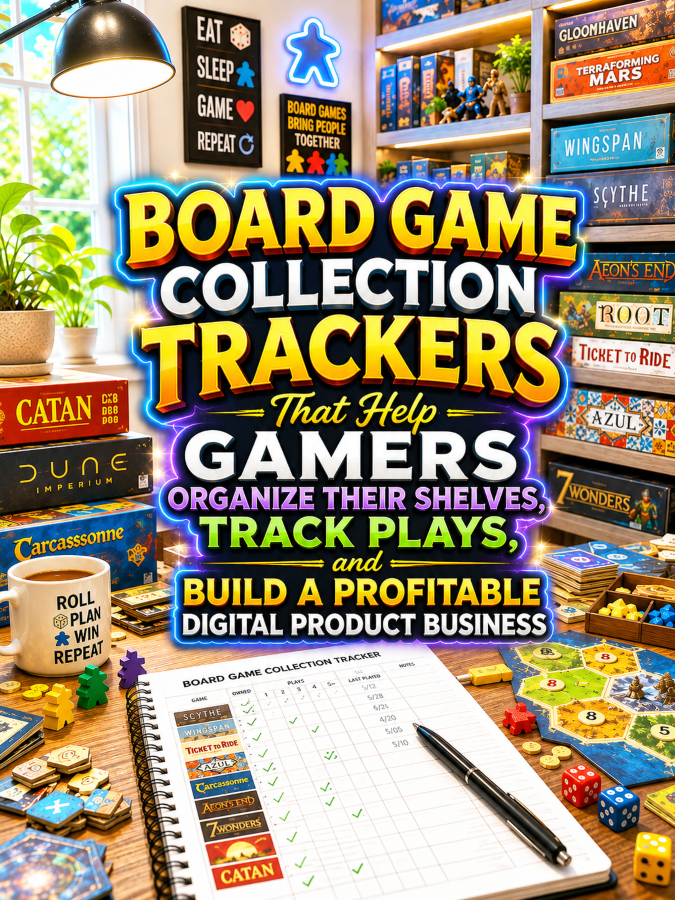
Create a Board Game Collection Tracker that records the game title, publisher, player count, play time, purchase date, price paid, storage location, ownership status, expansion information, play frequency, personal rating, and notes.
Why This Niche Works
Board game enthusiasts include casual families, dedicated hobby gamers, collectors, tabletop groups, couples, game-night hosts, board game reviewers, content creators, clubs, and people who buy, trade, or sell games.
Board games are naturally suited to cataloging because every game can have different player requirements, playing times, complexity levels, themes, mechanics, expansions, storage needs, and group preferences.
As a collection grows, remembering everything becomes difficult.
A tracker turns a crowded game shelf into an organized personal game library.
It can help answer practical questions:
- Which games do I own?
- Which games have I actually played?
- Which games have not been played in ages?
- Which games work best with two players?
- Which games are good for larger groups?
- Which expansions do I own?
- Where is a particular game stored?
- Which games are on my wishlist?
- Which games might I want to trade or sell?
There is also an opportunity to create specialized products for board game clubs, families, reviewers, content creators, collectors, tournament groups, and serious tabletop enthusiasts.
The Reasonable Pricing Rule
Do not turn a $7 board game tracker into a $77 product by adding 300 identical game-entry pages.
More pages do not automatically mean more value. Sometimes they just create a very large binder that looks suspiciously like another project the buyer will never finish.
The $7 product should solve one focused problem: cataloging a board game collection.
The $17–$27 product should organize the broader board gaming hobby.
The $37–$47 product should connect collecting, game nights, play history, budgeting, expansions, reviews, trading, and content.
The $67–$77 product should provide editable templates, specialty editions, digital options, and a complete board game collection management system.
Your $7 Starter Product
Create a printable called the Board Game Collection Tracker.
Include:
- Board Game Collection Catalog
- Game Title
- Publisher
- Game Category
- Theme
- Player Count
- Average Play Time
- Complexity Rating
- Purchase Date
- Purchase Price
- Storage Location
- Expansion Information
- Play Status
- Last Played Date
- Personal Rating
- Favorite Features
- Notes
The goal is simple: give gamers one place to document what they own, where it is stored, and how often they actually play it.
Grow It Into a $17 to $27 Board Game Organization Toolkit
Once a collection grows beyond a handful of games, the basic catalog can become a complete organization system.
Create a Board Game Collector’s Organization Toolkit priced between $17 and $27.
Include:
- Everything from the $7 starter product
- Unplayed Game Tracker
- Frequently Played Game Tracker
- Expansion Collection Tracker
- Missing Components Log
- Damaged Components Log
- Game Storage Location Map
- Shelf Inventory
- Game Wishlist
- Future Purchase Planner
- Game Night Favorites List
- Two-Player Game Tracker
- Family Game Tracker
- Large-Group Game Tracker
- Quick Game Tracker
- Long Game Tracker
- Game Lending Log
- Borrowed Game Tracker
- Game Trade Log
- Game Gift Tracker
- Monthly Game Night Planner
- Annual Collection Review
This transforms the product from a simple inventory sheet into a practical board gaming management system.
You can make this tier more useful by including sample pages that show how to organize games by player count, play time, genre, storage location, complexity, or frequency of use.
Build a $37 to $47 Complete Board Game Collection Planner
The next level should feel like a command center for serious gamers, collectors, game-night hosts, clubs, reviewers, and tabletop content creators.
Create a Complete Board Game Collection Planner priced between $37 and $47.
Include:
- Annual Board Gaming Planner
- 90-Day Gaming Challenge
- Collection Growth Tracker
- Board Game Spending Tracker
- Monthly Game Budget
- Collection Cost Worksheet
- Game Night Planner
- Game Night Guest Tracker
- Play History Log
- Game Rating Journal
- Game Review Planner
- Favorite Mechanics Tracker
- Game Difficulty Tracker
- Campaign Game Progress Tracker
- Legacy Game Progress Tracker
- Expansion Planning Worksheet
- Game Club Planner
- Tournament Planning Pages
- Game Swap Planner
- Used Game Sales Tracker
- Marketplace Listing Planner
- Product Photography Checklist
- Social Media Content Planner
- Board Game Review Content Planner
- Quarterly Collection Review
- Year-End Collection Review
This version moves beyond simply knowing what is on the shelf.
It helps buyers manage game nights, play history, collections, budgets, expansions, reviews, clubs, events, content, and occasional selling.
Create a $67 to $77 Premium Bundle
The premium version should provide flexibility and specialization rather than simply becoming an enormous binder.
Create a Board Game Collection Command Center priced between $67 and $77.
Include:
- Editable Canva Templates
- Fillable PDF Version
- Tablet-Friendly Digital Version
- Serious Board Game Collector Edition
- Family Game Night Edition
- Board Game Club Edition
- Board Game Reviewer Edition
- Tabletop Content Creator Edition
- Game Night Host Edition
- Campaign Game Edition
- Legacy Game Edition
- Tournament Edition
- Board Game Reseller Edition
- Collection Inventory System
- Marketplace Listing Workbook
- Game Review Content Calendar
- Social Media Promotion Templates
- Game Night Planning Kit
- Board Game Club Event Kit
- Collection Budget Workbook
- Storage Organization Workbook
- Quick-Start Setup Guide
- Customization Instructions
- Commercial Use Options Where Appropriate
The premium bundle should feel like a flexible system that can support a personal collection, serious hobby, family game nights, board game club, content project, review business, or small resale operation.
Example Product Ladder
$7 Starter: Board Game Collection Tracker
$17–$27 Toolkit: Board Game Collector’s Organization Toolkit
$37–$47 Bundle: Complete Board Game Collection Planner
$67–$77 Premium: Board Game Collection Command Center
Recommended Tools
- Canva for planner layouts, editable templates, covers, worksheets, and promotional graphics
- ChatGPT for game-night prompts, review questions, challenge ideas, organization categories, and marketing copy
- Google Sheets for larger collections and sortable game databases
- Creative Fabrica for commercial-use graphics, fonts, and design resources
- remove.bg for clean product mockups
- Google Trends for researching board game interests and seasonal demand
- Etsy for researching digital product demand
- Payhip or Gumroad for digital product delivery
Your 5-Step Action Plan
Step 1: Start With the Collection
Build the $7 tracker around one clear problem: helping board gamers remember what they own.
Keep the catalog simple. A buyer should be able to record a game quickly without having to learn a complicated database.
Step 2: Solve the “What Should We Play?” Problem
Expand the product with player-count trackers, play-time categories, game-night favorites, unplayed-game lists, storage locations, expansion records, and wishlists.
This creates the $17–$27 organization toolkit.
Step 3: Add the Serious Hobby Experience
For the $37–$47 version, introduce budgets, play history, game reviews, campaigns, legacy games, game clubs, tournaments, content planning, swaps, and resale tools.
Now the planner supports the entire hobby instead of simply cataloging games.
Step 4: Create Specialty Editions
Develop versions for serious collectors, families, game-night hosts, clubs, reviewers, content creators, campaign gamers, tournament groups, and resellers.
Specialization makes your marketing message much stronger because the buyer can immediately see how the planner fits their particular gaming lifestyle.
Step 5: Build the Premium Command Center
Add editable Canva templates, fillable PDFs, digital versions, specialty editions, promotional templates, and customization instructions.
The premium product should save the buyer time and make the system easier to adapt to their collection or audience.
Common Pricing Mistakes to Avoid
The first mistake is making the tracker attractive but impractical.
Gamers need information they can find quickly. A beautifully decorated page is not very helpful if the buyer cannot immediately see whether a game supports two players or twelve.
The second mistake is putting every feature into the $7 product.
If the starter already includes budgeting, game-night planning, play-history analysis, content planning, resale tools, club management, and digital templates, there is very little reason for a customer to upgrade.
The third mistake is forgetting that board gamers have very different needs.
A family looking for quick games has different requirements from a hobby gamer who enjoys four-hour strategy games. A collector may care about inventory while a reviewer cares about play notes and ratings.
Use specialty editions to solve those differences.
Where to Find Buyers
- Board game Facebook groups
- Tabletop gaming communities
- Board game collector groups
- Family game-night communities
- Game club communities
- Strategy game communities
- Board game review communities
- Tabletop content creator communities
- Board game trading groups
- Pinterest gaming audiences
- Etsy digital-product communities
- Local tabletop clubs
Visual platforms can work particularly well because game shelves, game-night tables, organized collections, colorful components, and storage systems are naturally shareable.
Affiliate Opportunities
Board game collection content creates natural opportunities for related affiliate products.
- Board games
- Card games
- Board game organizers
- Storage shelves
- Component trays
- Game inserts
- Card sleeves
- Dice trays
- Gaming tables
- Game storage bags
- Tabletop accessories
- Game-room organization supplies
Instead of simply recommending products, create useful content around the problems they solve. For example, you could create articles about organizing a growing board game collection, choosing games for different group sizes, creating a better game-night station, or storing components without turning the box into a cardboard avalanche.
Internal Link Suggestions
- Miniature Collection Trackers
- Model Building Project Planners
- Coin Collection Trackers
- Stamp Collection Trackers
- Vinyl Record Collection Trackers
- Book Collection Trackers
- Puzzle Collection Trackers
- LEGO Collection Trackers
- Dollhouse Project Planners
Pinterest Pin Ideas
- The Board Game Collection Tracker Every Gamer Needs
- Finally Organize Your Board Game Collection
- Track Every Board Game You Own With This Simple System
- Organize Your Games by Players, Play Time, and Favorites
- From Game Shelf to Organized Collection
- Build a $7 to $77 Board Game Collection Product Ladder
Frequently Asked Questions
Who buys Board Game Collection Trackers?
Board game collectors, casual gamers, families, tabletop groups, serious hobby gamers, game-night hosts, reviewers, content creators, clubs, and board game resellers can all benefit from these products.
Can this niche generate repeat customers?
Yes. Board gamers can continue adding games and expansions, host game nights, join clubs, participate in tournaments, review games, create content, reorganize collections, and occasionally trade or sell games. Each activity creates opportunities for additional specialized planners.
Should I create different versions for different board game audiences?
Absolutely. A family game-night planner, serious collector catalog, board game review journal, game club organizer, campaign tracker, tournament planner, and reseller inventory system can all target different buyers.
Can the $7 starter product work for beginners?
Yes. Keep it simple. The buyer should be able to catalog their existing games immediately without learning a complicated collection-management system.
Can I include player-count and play-time trackers?
Yes. These are particularly useful because they turn a collection catalog into a practical game-selection tool. A buyer can quickly identify which games fit two players, a family group, a large gathering, a short evening, or a longer gaming session.
Can I include expansion tracking?
Absolutely. Expansion tracking is a natural upgrade because many board games have optional expansions, promotional content, or additional components. Give buyers a simple way to record what they own and what they are still looking for.
Can I include collection value tracking?
Yes. A worksheet can help buyers record purchase prices, estimated values, and resale information. Make it clear that any valuation is an estimate or personal record rather than a guaranteed market value.
Call to Action
A board game collection can contain strategy, adventure, tiny cardboard tokens, suspiciously large rulebooks, expansions for expansions, and enough pieces to make “I will put everything back in the box later” a bold statement of optimism.
Start with a $7 Board Game Collection Tracker that helps people remember what they own. Then expand it into a $17–$27 organization toolkit, a $37–$47 complete collection planner, and finally a $67–$77 premium collection command center.
Do not build the entire ladder at once. Start with one useful solution, watch what your audience needs next, and build each upgrade around a real problem.
That’s how a simple board game catalog can become the foundation for a much bigger digital product business.
Conclusion
Board gamers already have enough pieces to keep track of. They should not also have to remember which games they own, which expansions are missing, where a particular title is stored, or whether the group actually enjoyed that five-hour game they somehow agreed to play again.
A Board Game Collection Tracker turns a crowded shelf into an organized personal game library. It gives gamers a practical way to document games, player counts, play times, expansions, storage locations, play history, ratings, purchases, and future wants.
Start with the focused $7 tracker. Expand it into the $17–$27 hobby organization toolkit. Add budgeting, game nights, play history, reviews, campaigns, clubs, tournaments, content, trading, and resale tools at $37–$47. Then create the premium $67–$77 command center with editable and specialized resources.
Once you have the framework working, you can adapt the same system for miniature collections, model building, puzzles, LEGO collections, stamps, coins, vinyl records, books, dollhouses, and other collectible or hobby-based niches.
One board game is entertainment. A growing collection is a logistical operation involving shelves, expansions, missing pieces, and increasingly strong opinions about which game everyone should play next. A good tracker keeps that operation organized so game night can stay focused on the fun instead of the “Where did we put that card?” scavenger hunt.
Here’s what you uncovered today. If something made you pause, smile, or feel curious, follow that spark and start working toward it today. Momentum begins with one decision.
Enjoy!