
MITCHELL — Experts on artificial intelligence spoke Thursday morning on the multiple benefits of using the new technology to increase business workplace efficiency, collate important data and improve the overall experience for customers. It is the wave of the future, they agreed.
But like all new technologies that have emerged, the arrival of artificial intelligence and its accessibility to the general public did bring some apprehension. Even for those who were among the first to embrace the technology.
“We kind of panicked because we realized that everything we’d been doing at this point could now be created in a matter of seconds, so it transformed what our profession of teaching is going to look like,” said Lindsey Huber, instructor of management information systems at Northern State University. “(But) we can say that it’s no longer a storm that’s brewing.”
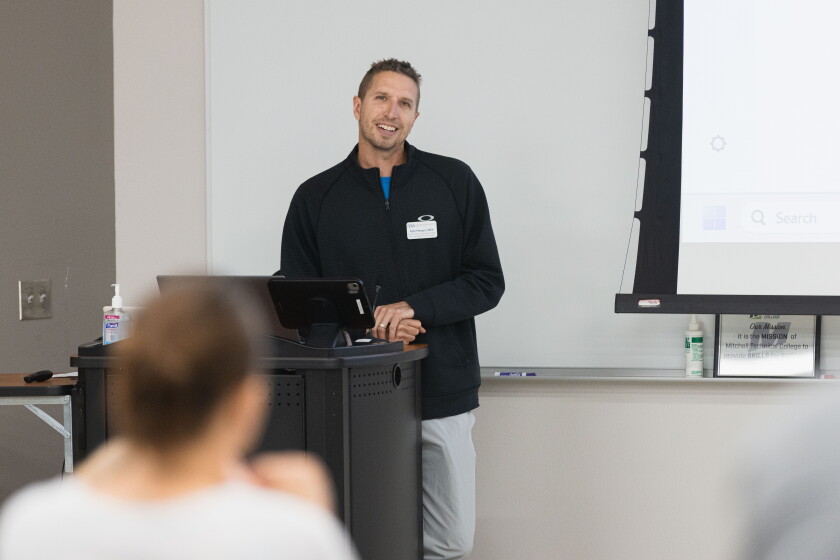
Huber was one of a handful of speakers to present at the Fall Workforce Summit at Mitchell Technical College. The event welcomed students, local organizations and business leaders to learn about how to collaborate with AI and use it to improve production and unlock new opportunities for growth and innovation.
Speakers at the event also included Kyle Herges, dean of arts and humanities at Dakota Wesleyan University; Devon Russell, program director and instructor at Mitchell Technical College; and Ryan Budmayr, president and CEO of South Dakota Chamber and Industry.

Adam Thury / Mitchell Republic
The group covered AI from the viewpoint of the classroom, practical applications in the business world and how AI will impact the future of job markets and other economic conditions. Throughout the morning’s presentations, the theme of AI being a tool, not an employee set to replace humans in the workforce, came up frequently.
Huber, in her role as an educator, has seen the proliferation of AI in industries across the board.
“Businesses and organizations are under pressure to do more with fewer resources. AI offers tools that can help us boost productivity, improve decision-making, and help employees focus on key terms here, that higher-value work,” Huber said. “It’s also becoming more accessible. What used to be really expensive and highly technical is now at our fingertips on these everyday platforms and different apps. We’re starting to talk about AI in so many different industries.”
Those industries include healthcare, finance, retail, agriculture, manufacturing and marketing. Studies show that a majority, if not all of those industries, have already considered or are using artificial intelligence in their workflow. Companies in those industries could be using Otter.ai to transcribe meeting notes, or using speaking.io, an AI that assists with public speaking presentation and practice.
Adam Thury / Mitchell Republic
Herges gave a rundown of how to effectively use prompts through popular AI services like Gemini and ChatGPT. He gave examples of generating promotional imagery for websites through Midjourney, such as he did with his own home gardening website Kota Greens. Using prompts — commands sent to the AI — effectively can help improve marketing efforts and customer interaction.
The audience, most of whom confirmed they had used AI before, posed questions throughout the presentations. How do you prevent the AI from catering to your preferences instead of providing neutral information? What kind of information should a user not ask an AI out of privacy concerns? What does AI get wrong?
Herges said that AI has come a long way, but it is not perfect. Responses should be monitored for obvious errors, and good user practice is important, both for obtaining accurate and useful results, but also to protect users in terms of privacy.
“I would not put customer information in there. I treat it like social media, honestly. So if I don’t want them to have my social security number, I’ll obviously not put that portion out there,” Herges said.
Russell gave a rundown of AI applications in various industries, such as manufacturing.
Automation in manufacturing has been a standard for years, but the integration of AI into the industry is allowing more efficient communication between those moving parts. For geospatial industries, which deal with gathering information on the surface of the earth, location-based statistics can allow AI to improve its accuracy in a number of different fields.
“In manufacturing, none of your equipment talks to each other. Today (AI) is transforming every piece to start to talk to each other. It’s a lot of data to go through, and AI can help us manage that data. AI being integrated into manufacturing is going to help us enhance our efficiency,” Russell said.
In agriculture,
automated tractors and sprayers are already starting to make their way into the fields.
Those are particularly useful in an industry that relies on hired labor to conduct business. That labor is in short supply in South Dakota, which logged a 1.9% unemployment rate as recently as July. When finding help is difficult, having a machine that can do the work if needed is more than helpful.
“Autonomous tractors – anyone see one driving around? We actually have some in Davison County that they’re testing out on the dealer side in case that’s their own. Everyone’s coming out with an autonomous tractor. Why? Because there’s a labor shortage on farm workers,” Russell said. “If I can sit in my cab and say I’m going planting or I’m harvesting, I can have my grain cart pull up right next to me and there’s no one in the cab.”
People can sometimes be hesitant to embrace change. Presenters noted the arrival of email in the 1990s was disruptive to workplace practices as employers wrestled with the best way to incorporate it. Computers in general were a technological marvel that could be difficult to embrace by older generations.
Mike Lauritsen, CEO of the Mitchell Chamber of Commerce and the Mitchell Area Development Corporation, said business owners of all generations are interested in improving their business efficiency and strengthening the backbone of their office. That’s why organizers for Thursday’s event selected artificial intelligence to focus on for the latest incarnation of the Fall Workforce Summit.
There will always be elements of the human worker that AI won’t be able to replace, and making employees more efficient and productive is a great way to make them invaluable to an employer.
“We’re talking about workforce summits because Mitchell has second-lowest unemployment in the state. South Dakota has the lowest unemployment rate in the nation. So we need to do something to help our businesses. When you use AI, you become more efficient. It doesn’t mean you’re getting rid of jobs,” Lauritsen said.
Budmayr, who was a last-minute replacement for South Dakota Secretary of Labor and Regulation Marcia Hultman, who was originally scheduled to speak at the event, said South Dakota has traditionally been a relatively slow adopter of new practices and techniques. That could be a factor in the role AI plays in South Dakota’s business future.
He said users in Rhode Island save 32 hours a month using AI, while South Dakota users save only 0.8 hours per month. With a low unemployment rate in South Dakota, one of the few ways to improve efficiency in the workplace is likely to be artificial intelligence.
The technology is there and ready to be used, he said, and South Dakota has a chance to wrap its arms around it now.
“I think in South Dakota, when you’ve got a 3% unemployment rate and a lot of people working multiple jobs, there’s just not the work. So how can you increase productivity — which would be phenomenal for our state and revenues and tax dollars?” Budmayr said. “It has to be through AI, in large part. There is workforce development, there’s recruitment and all that. But AI has to play a role. And I think that’s a big piece.”