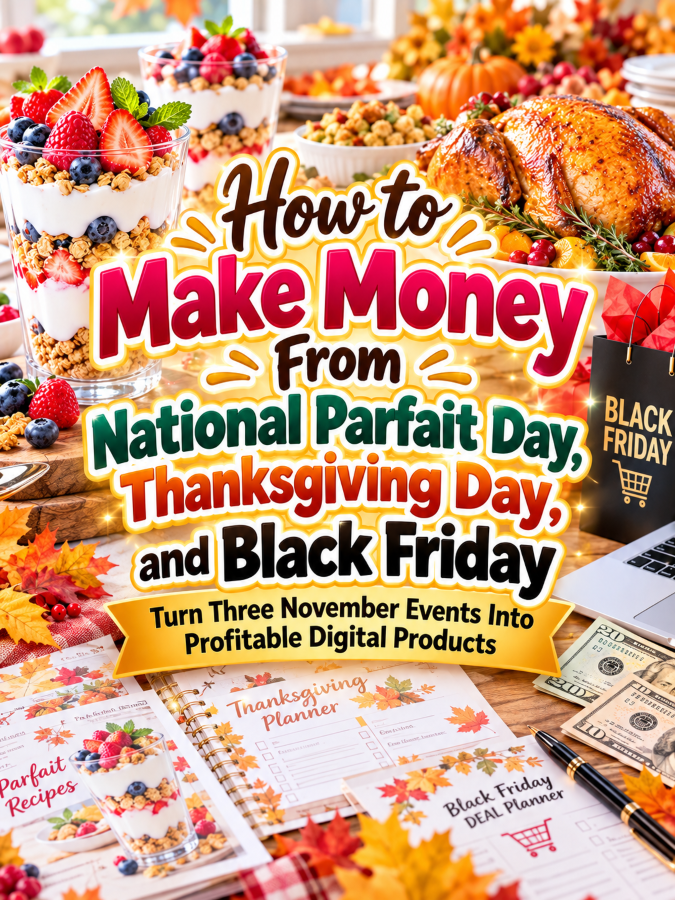
National Parfait Day – Turn a Simple Dessert Into a Profitable Printable Business (November 25, 2026)
Sometimes the best digital-product ideas are hiding in the most ordinary things.
Take the parfait.
Layers of ingredients in a glass. It looks fancy. It sounds fancy. And yet, at its core, it’s simply a fun way to put ingredients together.
National Parfait Day gives you a perfect excuse to enter the much larger market of desserts, recipes, food entertaining, holiday treats, and recipe organization.
And because Thanksgiving is arriving the very next day, the timing is even better.
You’re not trying to build a business around parfaits.
You’re using parfaits as the doorway into a bigger food-and-entertaining market.
National Parfait Day Is the Hook, Not the Business
This is one of the most important lessons in holiday-based digital marketing.
A holiday doesn’t have to support an entire business.
It simply needs to give you a timely reason to talk about a problem or interest that already exists.
People enjoy desserts.
People collect recipes.
People plan holiday meals.
People host family gatherings.
People create dessert tables.
People look for easy entertaining ideas.
And people love products that make those activities easier to organize.
That’s your opportunity.
Why the Dessert Niche Works
Food is naturally visual.
Recipes are easy to turn into cards, journals, planners, checklists, and collections.
And desserts are particularly useful for digital marketing because they photograph beautifully.
A pretty dessert can become a Pinterest pin.
A recipe can become a blog post.
A checklist can become a freebie.
A collection of recipes can become a paid product.
One idea can create several pieces of content.
That’s exactly what we want.
Research the Opportunity First
Before designing anything, find out what people are already searching for.
Search Google for National Parfait Day
Search Google for parfait recipe ideas
Search Google for dessert recipe printables
Search Google for holiday dessert planner printables
Then check Etsy, Pinterest, Canva, and Amazon.
Look for products people already understand.
You’re not trying to reinvent the recipe card.
You’re trying to find a useful angle that makes your version worth buying.
Three Ways to Make Money From National Parfait Day
1. Create Dessert Recipe Collections
This is the easiest starting point.
Create a collection of printable dessert recipe cards that customers can print, fill in, organize, or keep in a recipe binder.
Your product could include:
- Recipe cards
- Ingredient lists
- Preparation notes
- Serving-size fields
- Favorite recipe ratings
- Recipe variation notes
- Photo spaces
- Family favorite sections
- Seasonal dessert pages
- Recipe index pages
You could start with parfaits and then expand into cakes, cookies, pies, puddings, brownies, holiday desserts, and family favorites.
2. Create Holiday Dessert Planning Products
Here’s where National Parfait Day gets a Thanksgiving boost.
People aren’t only thinking about one dessert.
They’re planning entire holiday meals.
You could create a printable system that helps customers organize their dessert table, choose recipes, make shopping lists, and schedule preparation.
Possible pages include:
- Holiday dessert menu planner
- Dessert shopping list
- Baking schedule
- Recipe checklist
- Ingredient inventory
- Serving tracker
- Dessert table planner
- Holiday recipe organizer
- Guest preference notes
Now you’re solving a planning problem rather than simply selling a recipe.
3. Create Food-Themed Journals and Gift Products
Food journals can become keepsakes.
Create pages where customers can document favorite desserts, family recipes, special occasions, or recipes they want to try.
You can also turn these into giftable products.
- Family Dessert Recipe Journal
- Grandma’s Dessert Recipe Book
- Holiday Baking Journal
- Dessert Tasting Journal
- Recipe Memory Book
- Family Cookbook Planner
- Christmas Baking Journal
The more emotional the product becomes, the less it feels like “just another printable.”
Money-Making Tip #1: Sell the Dessert Experience
Here’s your first money-making lesson for this three-holiday series:
Don’t just sell the recipe. Sell what the customer wants to do with the recipe.
Someone might want to make desserts for Thanksgiving.
Someone else might want to organize Grandma’s recipes.
Another customer might want to create a dessert table for a party.
Another might want a holiday baking planner.
Another might want a beautiful recipe journal.
Same general food niche.
Different customer problems.
Different products.
That’s how you expand.
Your $7 to $77 Product Ladder
$7 – Parfait & Dessert Recipe Starter Pack
Create a simple collection of dessert recipe cards, ingredient pages, and recipe notes.
$12 – Dessert Recipe Journal
Add recipe tracking, ratings, favorite-dessert pages, photo spaces, and recipe index pages.
$17 – Holiday Dessert Planner
Build a planning system for selecting desserts, organizing ingredients, creating shopping lists, and scheduling preparation.
$27 – Holiday Baking & Dessert Kit
Add baking checklists, recipe cards, dessert-table planning, guest notes, shopping lists, and holiday activity pages.
$47 – Complete Dessert Lover’s Bundle
Combine your recipe cards, dessert journal, holiday planner, baking checklist, dessert-table planner, and family recipe pages.
$77 – Ultimate Holiday Baking & Recipe Collection
Expand the collection to cover Thanksgiving, Christmas, birthdays, family gatherings, baking projects, dessert recipes, and family recipe preservation.
Now the customer isn’t buying a parfait printable.
They’re buying an entire dessert organization system.
Who Could Buy These Products?
You’ve got several potential audiences.
- Home bakers
- Busy parents
- Holiday hosts
- Dessert lovers
- Food bloggers
- Recipe collectors
- Family cookbook creators
- Party planners
- Homemakers
- People who enjoy baking
- People looking for food-themed gifts
- Small home-based baking businesses
And each audience gives you another way to position the same underlying product.
Use Etsy to Study Dessert Products
Search Etsy for dessert recipe cards
Search Etsy for dessert recipe journals
Search Etsy for holiday baking planners
Search Etsy for Thanksgiving dessert planners
Pay attention to what customers appear to want.
Look for gaps.
Maybe sellers have lots of recipe cards but very few planning tools.
Maybe there are plenty of generic recipe journals but few products aimed at holiday hosts.
That’s where you can differentiate.
Use Canva to Create a Product Family
Canva makes it easy to create a consistent visual system for recipe cards, planners, journals, checklists, and food-related worksheets.
Create your core layouts once.
Then change the theme.
Your dessert journal could become:
- Thanksgiving Recipe Journal
- Christmas Baking Journal
- Cookie Recipe Journal
- Cake Decorating Journal
- Family Recipe Journal
- Pie Recipe Journal
- Chocolate Dessert Journal
- Holiday Baking Planner
One framework can become an entire collection.
Use Pinterest to Market the Visual Side
Pinterest is a natural fit for dessert and recipe content because the products are visual and highly searchable.
Create content around:
- “Holiday Dessert Planning Checklist”
- “How to Organize Your Baking Recipes”
- “Thanksgiving Dessert Ideas”
- “Holiday Baking Planner”
- “Printable Recipe Card Ideas”
- “Family Recipe Journal Ideas”
- “Dessert Table Planning Checklist”
Each piece of content can lead to a related product.
That’s how your content becomes a sales funnel instead of just another pretty picture.
Use Amazon for Product Research
Amazon can help you research the physical-product side of the market.
Look at recipe binders, baking books, dessert cookbooks, baking journals, kitchen organizers, and holiday entertaining products.
Then look for digital companions.
A recipe binder can inspire printable recipe pages.
A baking book can inspire a baking planner.
A dessert cookbook can inspire a tasting journal.
A holiday entertaining book can inspire a dessert-table planner.
You’re not copying the physical product.
You’re identifying the organization problem behind it.
Don’t Stop at Thanksgiving
Here’s where the timing becomes useful.
National Parfait Day is November 25.
Thanksgiving is November 26.
Christmas is right around the corner.
That gives you a natural transition from one seasonal product to another.
You can promote:
- Thanksgiving dessert planning
- Christmas baking
- Holiday cookie organization
- Family recipe preservation
- Holiday entertaining
- Giftable recipe journals
- New Year’s recipe organization
The product doesn’t have to disappear when the holiday does.
Create a Baking Business Version
There’s another audience hiding here: people who sell baked goods.
A home baker may need help organizing orders, recipes, content, promotions, and seasonal products.
That gives you another product line.
You could create:
- Home Baking Business Planner
- Custom Cake Order Tracker
- Holiday Baking Order Planner
- Recipe Costing Worksheet
- Bakery Content Planner
- Seasonal Baking Promotion Kit
Now you’re moving from consumer printables into business printables.
That can open another customer market without abandoning your original niche.
Your Simple Action Plan
- Research: Search Etsy, Pinterest, Google, Canva, and Amazon for dessert and baking products.
- Choose one audience: Start with home bakers, holiday hosts, or recipe collectors.
- Create the $7 product: Make a simple dessert recipe starter pack.
- Solve the next problem: Add recipe organization, baking schedules, or holiday planning.
- Build the ladder: Create $27, $47, and $77 bundles from related products.
- Repurpose: Turn the same system into Thanksgiving, Christmas, cookie, cake, pie, and family recipe products.
- Test a business version: Create a separate product for home bakers who sell their creations.
The Big Takeaway
National Parfait Day may look like a tiny opportunity.
But tiny holidays can open big doors.
Parfaits lead us into desserts.
Desserts lead us into recipes.
Recipes lead us into holiday planning.
Holiday planning leads us into entertaining.
And entertaining can lead us into an entire product catalog.
That’s the strategy.
Don’t sell the holiday. Sell the bigger experience behind the holiday.
Use the November 25 observance to get attention.
Use Thanksgiving to create urgency.
Use your product ladder to create additional offers.
And use evergreen recipe and baking products to keep the business working after the calendar moves on.
Thanksgiving Day – Turn a Major Holiday Into a Profitable Printable Product Business (November 26, 2026)
Now we’re moving from a quirky food holiday into one of the biggest opportunities on the November calendar.
Thanksgiving Day.
This is the kind of holiday that can support an entire collection of digital products because it naturally involves food, family, traditions, entertaining, activities, gratitude, gifts, memories, and planning.
And that’s exactly what we want.
We’re not trying to create one Thanksgiving printable and call it a business.
We’re building a product ecosystem around the many things people already need to organize before, during, and after Thanksgiving.
Thanksgiving Is the Hook, but the Customer Problem Is Bigger
Here’s the first thing to understand.
People don’t necessarily wake up thinking:
“I need a Thanksgiving PDF.”
They think:
“What am I cooking?”
“What do I need to buy?”
“Who’s coming?”
“Who’s bringing what?”
“How am I going to organize this kitchen?”
“What are the kids going to do?”
“How do I keep the family entertained?”
“How can we make this year memorable?”
Those are the real buying problems.
And every one of them can become a product opportunity.
Why Thanksgiving Is Such a Strong Digital-Product Niche
Thanksgiving combines several highly marketable categories:
- Meal planning
- Recipe organization
- Grocery planning
- Party planning
- Family activities
- Kids’ activities
- Games
- Gratitude journals
- Family memory keeping
- Holiday decorating
- Gift planning
- Entertaining
That means you aren’t trapped inside one product type.
You can create planners.
You can create journals.
You can create games.
You can create checklists.
You can create cards.
You can create activity packs.
You can create bundles.
That’s a very healthy environment for a digital-product business.
Research the Market Before Designing
Start by looking at what people are already searching for.
Search Google for Thanksgiving Day 2026
Search Google for Thanksgiving meal planner printables
Search Google for Thanksgiving kids’ activities
Search Google for Thanksgiving hosting checklists
Then research Etsy, Pinterest, Canva, and Amazon.
Don’t simply count how many products exist.
Look at what customers are actually trying to accomplish.
That’s where the product opportunity lives.
Three Ways to Make Money From Thanksgiving
1. Create Thanksgiving Planning Products
This is the most obvious starting point.
A Thanksgiving planner can help customers organize the entire event from beginning to end.
Pages could include:
- Guest list
- Menu planner
- Recipe checklist
- Grocery list
- Shopping tracker
- Cooking schedule
- Serving plan
- Table-setting checklist
- Guest notes
- Cleanup checklist
You’re selling organization.
And when someone is hosting a major family gathering, organization has value.
2. Create Family and Kids’ Thanksgiving Activities
Not everybody wants to spend the entire day talking about food.
Families also need activities.
This creates a great opportunity for printable entertainment.
You could create:
- Thanksgiving scavenger hunts
- Thanksgiving bingo
- Family conversation cards
- Thanksgiving coloring pages
- Kids’ activity packs
- Family trivia
- Thanksgiving games
- Gratitude activity sheets
- Table conversation cards
- Thanksgiving memory pages
These products can be particularly attractive to parents, grandparents, teachers, homeschool families, and party hosts.
3. Create Thanksgiving Memory and Gratitude Products
Here’s the emotional side of the market.
Thanksgiving is naturally connected with family, gratitude, traditions, and memories.
That gives you an opportunity to create keepsake products.
For example:
- Thanksgiving gratitude journals
- Family memory books
- Thanksgiving interview journals
- Family tradition planners
- Grandparent memory books
- Thanksgiving photo journals
- Annual Thanksgiving reflection books
- Family recipe and memory journals
These aren’t just planning tools.
They’re products people may keep and revisit.
Money-Making Tip #2: Sell the Memory, the Organization, or the Experience
Here’s your second money-making lesson:
Thanksgiving gives you three powerful product angles: make the day easier, make the day more fun, or help people remember the day.
Those three ideas can support completely different product lines.
Easier: planners, checklists, grocery lists, schedules.
More fun: games, activities, conversation cards, kids’ packs.
More memorable: journals, family interviews, gratitude books, recipe memory collections.
And because all three happen around the same holiday, you can cross-sell them.
Your $7 to $77 Product Ladder
$7 – Thanksgiving Activity & Planning Starter Pack
Create a simple collection containing a menu planner, grocery list, guest list, and a few family activity pages.
$12 – Thanksgiving Family Activity Pack
Add games, conversation cards, scavenger hunts, coloring pages, and gratitude activities.
$17 – Thanksgiving Planner & Memory Journal
Combine practical planning with memory-keeping pages for recording the day’s highlights, traditions, recipes, and family moments.
$27 – Complete Thanksgiving Hosting Kit
Add meal planning, grocery organization, cooking schedules, guest planning, activities, games, table planning, and cleanup checklists.
$47 – Complete Thanksgiving Family Bundle
Combine your planner, activity pack, gratitude resources, family memory journal, recipe pages, and hosting tools.
$77 – Ultimate Thanksgiving & Holiday Family Collection
Expand beyond Thanksgiving with Christmas planning, holiday activities, family recipe organization, gratitude resources, entertaining tools, and seasonal memory pages.
Now you’re not selling a Thanksgiving checklist.
You’re selling a complete holiday experience system.
Who Could Buy These Products?
The Thanksgiving market gives you a huge variety of possible buyers.
- Parents
- Grandparents
- Thanksgiving hosts
- Families
- Teachers
- Homeschool families
- Party planners
- Church groups
- Community organizations
- Family activity planners
- Food bloggers
- People preserving family traditions
You can create separate products for each audience without reinventing the entire concept.
Use Etsy to Research Thanksgiving Products
Search Etsy for Thanksgiving planners
Search Etsy for Thanksgiving activity printables
Search Etsy for Thanksgiving gratitude journals
Search Etsy for Thanksgiving family games
Look at the product categories.
Look at how sellers bundle pages.
Look at the audiences they target.
And pay attention to the words customers use in reviews and descriptions.
Those words can help you understand what people actually value.
Use Canva to Create Your Thanksgiving Product Family
Canva can help you build a reusable Thanksgiving design system.
Create a core collection of layouts for planners, cards, games, checklists, and journals.
Then adapt those layouts into other holidays.
Your Thanksgiving planner framework could become:
- Christmas Holiday Planner
- Easter Family Planner
- Mother’s Day Family Activity Kit
- Father’s Day Activity Pack
- Family Reunion Planner
- Birthday Party Planner
- Holiday Entertaining Planner
The goal is to build templates once and reuse the underlying structure.
Use Pinterest for Family-Focused Content
Pinterest gives you plenty of content opportunities.
Create pins around problems and ideas such as:
- “Thanksgiving Planning Checklist”
- “Thanksgiving Activities for Families”
- “Thanksgiving Games for Kids and Adults”
- “Thanksgiving Table Conversation Ideas”
- “How to Organize Thanksgiving Dinner”
- “Thanksgiving Gratitude Activity”
- “Family Thanksgiving Memory Book Ideas”
Each pin can lead to a relevant product or bundle.
And because Thanksgiving searches begin before the actual holiday, you can start marketing these products well in advance.
Create Products for Different Age Groups
One easy way to expand your catalog is to create age-specific versions.
For Young Kids
Coloring pages, simple puzzles, scavenger hunts, matching games, and gratitude activities.
For Older Kids
Trivia, family challenges, writing prompts, conversation cards, and memory activities.
For Adults
Meal planners, hosting checklists, conversation cards, gratitude journals, and family recipe journals.
For Grandparents
Family-history prompts, recipe memory books, interview journals, and annual family tradition journals.
One holiday can support multiple product lines simply by changing the audience.
Use Amazon for Product Research
Amazon can help you see what physical Thanksgiving-related products people already purchase.
Look for Thanksgiving activity books, recipe books, family games, journals, planners, table games, and holiday gift products.
Then think about digital companions.
A Thanksgiving activity book can inspire a printable activity pack.
A family cookbook can inspire a recipe-memory journal.
A party-planning book can inspire a hosting checklist.
A family game can inspire a Thanksgiving conversation-card product.
You’re identifying the problem and then creating a digital solution.
Don’t Forget the Business Market
Thanksgiving also creates opportunities for small businesses.
Restaurants, bakeries, caterers, event planners, photographers, community organizations, and local businesses may all need holiday marketing materials.
You could create:
- Thanksgiving social media templates
- Restaurant Thanksgiving promotion templates
- Holiday email planners
- Thanksgiving event checklists
- Catering order trackers
- Holiday promotion calendars
- Thanksgiving menu templates
- Small-business holiday content planners
This gives you another market with a completely different customer problem.
Make Thanksgiving Products Evergreen
Here’s the beautiful part.
You can reuse the underlying product framework for almost any family gathering.
Your Thanksgiving family activity planner can become a Christmas activity planner.
Your family recipe journal can become a year-round family cookbook.
Your hosting checklist can become a holiday entertaining planner.
Your gratitude journal can become a daily gratitude product.
Your family memory book can become a family-reunion journal.
You’re not starting over.
You’re repackaging a proven structure for another occasion.
Your Simple Action Plan
- Research: Study Thanksgiving planners, activity packs, journals, games, and hosting products on Etsy, Pinterest, Google, and Amazon.
- Choose one customer: Start with families, hosts, parents, or grandparents.
- Create the $7 product: Build a simple Thanksgiving planning or activity starter pack.
- Solve the next problem: Add meal planning, games, memories, or hosting resources.
- Build the ladder: Create $27, $47, and $77 bundles.
- Create audience versions: Develop kids’, family, adult, teacher, and grandparent versions.
- Repurpose: Turn the best-performing products into Christmas, Easter, family reunion, birthday, and holiday entertaining products.
The Big Takeaway
Thanksgiving isn’t just another holiday on the calendar.
It’s a collection of customer problems waiting to be organized.
People need help planning meals.
They need help entertaining guests.
They need activities for their families.
They want to preserve traditions.
They want to create memories.
And they want the day to feel special without turning preparation into a full-time job.
That’s your opportunity.
Don’t sell Thanksgiving. Sell a better Thanksgiving experience.
Use planners to make it easier.
Use activities to make it more fun.
Use journals to make it memorable.
Then bundle those solutions into a product ladder that can continue selling long after the turkey is gone.
And just when your customer thinks the holiday shopping is over…
Black Friday walks through the door.
Black Friday – Turn Holiday Shopping Chaos Into a Profitable Printable Business (November 27, 2026)
Black Friday is one of those days when people suddenly become very serious about shopping.
Some have a gift list.
Some have a budget.
Some have seventeen browser tabs open.
And some are wandering around thinking, “I know I need to buy something for somebody, but I have absolutely no idea what.”
That last group is your opportunity.
Black Friday isn’t just a shopping event.
It’s a giant collection of problems involving gift planning, budgeting, shopping organization, deal tracking, holiday preparation, and small-business marketing.
And those problems can become digital products.
Black Friday Is the Hook, Not the Business
Here’s the important distinction.
You don’t want to create a product that is only useful on Black Friday.
You want to create a product that solves a problem that becomes especially urgent on Black Friday.
For example:
“I need to organize my Christmas shopping.”
“I need to stay within my budget.”
“I need to remember who I’ve already bought gifts for.”
“I need to compare what I’m buying.”
“I need to plan my holiday shopping.”
“I need to promote my own business this weekend.”
Those are much bigger opportunities than simply creating a “Happy Black Friday” printable.
Why Black Friday Is a Strong Digital-Product Opportunity
Black Friday sits at the beginning of a major holiday shopping period.
That means customers are already thinking about purchases, gifts, budgets, lists, promotions, and deadlines.
Digital products work particularly well here because they can provide immediate organization.
A customer can download a shopping planner and start using it right away.
They don’t have to wait for shipping.
They don’t have to find a place to store it.
And if you create a well-designed system, they can reuse it throughout the holiday season.
Research the Black Friday Market
Start by researching what people are looking for.
Search Google for Black Friday 2026
Search Google for Black Friday shopping planner printables
Search Google for Christmas gift trackers
Search Google for holiday shopping budget planners
Then move to Etsy, Pinterest, Canva, and Amazon.
You’re looking for customer problems, not just holiday graphics.
Three Ways to Make Money From Black Friday
1. Create Holiday Shopping and Gift Planners
This is probably the easiest consumer product to create.
A holiday shopping planner can help customers keep track of everything they need to buy.
Include pages such as:
- Gift recipient list
- Gift ideas
- Budget per person
- Amount spent
- Purchase date
- Store or website
- Order number
- Shipping status
- Gift-wrapping status
- Notes
Now you’ve created something that can be used throughout November and December, not just on Black Friday.
2. Create Holiday Budget and Spending Trackers
Shopping can get messy when purchases happen across multiple stores, websites, and days.
A printable budget tracker can help customers organize their planned spending and actual purchases.
You could include:
- Total holiday budget
- Gift budget
- Food budget
- Travel budget
- Decorating budget
- Per-person spending limits
- Purchase tracker
- Running total
- Remaining budget
- Post-holiday spending review
Keep the product focused on organization rather than promising that customers will magically save a specific amount of money.
The printable is the tool.
The customer decides how to use it.
3. Create Black Friday Marketing Tools for Small Businesses
Now let’s flip the customer.
Instead of selling to shoppers, sell to businesses that want to attract shoppers.
This can be an excellent second market.
Small businesses may need help organizing their Black Friday promotions, content, offers, and follow-up.
You could create:
- Black Friday social media content planners
- Holiday promotion calendars
- Sale planning checklists
- Email campaign planners
- Product promotion trackers
- Offer planning worksheets
- Customer follow-up trackers
- Holiday content calendars
- Black Friday campaign planners
- Small-business holiday marketing kits
Now you have two separate markets: people shopping and businesses selling.
Money-Making Tip #3: Sell the Organization Behind the Shopping
Here’s your third money-making lesson:
Don’t sell Black Friday. Sell the system that helps someone survive Black Friday.
That’s the difference between a novelty printable and a useful product.
A customer may not need a Black Friday poster.
But they may absolutely need a way to track 15 gifts, three budgets, five orders, and twelve shipping deadlines.
That’s a real problem.
And real problems are what people pay to solve.
Your $7 to $77 Product Ladder
$7 – Black Friday Shopping Starter Pack
Create a simple shopping list, gift tracker, budget page, and purchase checklist.
$12 – Christmas Gift Tracker
Expand the system with recipient pages, gift ideas, spending trackers, purchase status, shipping status, and wrapping checklists.
$17 – Holiday Shopping & Budget Planner
Add a complete holiday budget, category trackers, spending logs, shopping schedules, and gift planning pages.
$27 – Complete Holiday Shopping Kit
Combine gift planning, shopping lists, budgets, order tracking, wrapping checklists, Christmas planning, and holiday deadlines.
$47 – Complete Holiday Organization Bundle
Add meal planning, gift planning, travel checklists, holiday activities, decorating plans, and family schedules.
$77 – Ultimate Holiday Planning Collection
Build a complete system covering Christmas shopping, budgeting, gifts, meals, parties, travel, family activities, decorating, and end-of-season organization.
Now Black Friday has become the front door to an entire holiday-management product line.
Who Could Buy These Products?
There are several strong customer groups.
- Busy parents
- Holiday shoppers
- Gift planners
- Budget-conscious families
- Grandparents
- People shopping for large families
- Holiday hosts
- Small-business owners
- Etsy sellers
- Content creators
- Local retailers
- Online shop owners
Each audience can receive a slightly different version of the product.
Use Etsy to Research Gift and Shopping Products
Search Etsy for Christmas gift trackers
Search Etsy for holiday shopping planners
Search Etsy for holiday budget planners
Search Etsy for Black Friday marketing templates
Look for the products that are easiest to understand from the thumbnail and title.
Then ask yourself:
“What would make this more useful?”
Maybe it needs better tracking.
Maybe it needs fewer pages.
Maybe it needs a family version.
Maybe it needs a small-business version.
Maybe it needs a bundle.
That’s how you find your angle.
Use Canva to Create Multiple Versions
Canva can help you create a consistent shopping-planner system.
Once your basic pages are created, you can make versions for different audiences.
For example:
- Family Christmas Shopping Planner
- Teacher Holiday Gift Planner
- Busy Mom Christmas Planner
- Secret Santa Gift Tracker
- Stocking Stuffer Planner
- Small Business Holiday Shopping Guide
- Black Friday Business Promotion Planner
Same underlying structure.
Different positioning.
Different customer.
Use Pinterest Before the Shopping Rush
Pinterest can help you attract people before they start shopping.
Create content around:
- “Christmas Gift Planning Checklist”
- “How to Organize Holiday Shopping”
- “Holiday Shopping Budget Template”
- “Black Friday Shopping Checklist”
- “Gift Tracker Printable”
- “Christmas Shopping Organization Ideas”
- “How to Plan Christmas Gifts on a Budget”
The goal is to get discovered while the customer is still planning.
That’s important because the person who finds your planner before shopping may use it throughout the entire holiday season.
Create a Separate Small-Business Product Line
The business side deserves special attention.
Black Friday creates a huge content and promotion opportunity for small businesses.
You could create a separate collection specifically for business owners.
$7 – Black Friday Content Starter Pack
Simple social media prompts, promotional checklist, and content planning pages.
$12 – Holiday Promotion Planner
Plan offers, posts, emails, deadlines, and promotional themes.
$17 – Black Friday Campaign Planner
Track products, offers, content, email campaigns, social posts, and follow-up.
$27 – Holiday Marketing Kit
Combine content planning, promotion calendars, campaign tracking, and customer follow-up.
$47 – Complete Holiday Marketing Bundle
Add Christmas content planning, promotional calendars, product-launch checklists, and campaign worksheets.
$77 – Ultimate Small-Business Holiday Marketing System
Build a larger planning system covering Black Friday, Cyber Monday, Christmas, holiday promotions, content, email, social media, and campaign tracking.
That’s a completely separate product ecosystem from the consumer shopping planner.
And that’s okay.
One holiday can serve multiple audiences.
Don’t Forget Cyber Monday
Black Friday doesn’t happen in isolation.
Cyber Monday follows shortly afterward, which gives you another marketing hook.
You can create a product that covers the entire shopping weekend.
For example:
Black Friday + Small Business Saturday + Cyber Monday Marketing Planner.
That product immediately has a longer useful life than a single-day printable.
You could also create a consumer version:
Black Friday to Cyber Monday Holiday Shopping Tracker.
Same basic problem.
Different customer.
Use Amazon for Shopping Research
Amazon can help you identify categories people are shopping heavily in during the holiday season.
Look at gift guides, stocking stuffers, toys, home products, kitchen products, electronics, books, and other popular gift categories.
Then turn those observations into content.
For example:
- Gift planning checklists
- Gift-category trackers
- Stocking-stuffer planners
- Family gift lists
- Gift comparison sheets
- Holiday wish-list organizers
You’re not trying to predict the perfect gift.
You’re helping the customer organize the shopping process.
Make Black Friday Products Evergreen
Black Friday happens once a year.
Shopping does not.
That’s your evergreen angle.
Your gift tracker can become a birthday gift tracker.
Your budget planner can become a general shopping budget.
Your holiday planner can become an event planner.
Your business campaign planner can become a seasonal promotion planner.
Your shopping checklist can become a moving or back-to-school shopping list.
One product framework can support multiple occasions.
Your Simple Action Plan
- Choose your customer: Decide whether you’re targeting shoppers or businesses first.
- Research: Study Etsy, Pinterest, Google, Canva, and Amazon for shopping and holiday-planning products.
- Create the $7 product: Build a simple shopping tracker or Black Friday planning pack.
- Solve the next problem: Add budgeting, gift tracking, order tracking, or holiday scheduling.
- Build the ladder: Expand into $27, $47, and $77 bundles.
- Extend the season: Connect Black Friday products to Cyber Monday, Christmas, and New Year’s planning.
- Repurpose: Turn the same framework into birthday, back-to-school, wedding, moving, and general shopping planners.
The Big Takeaway
Black Friday isn’t just about finding deals.
It’s about managing the chaos that comes with holiday shopping.
That’s where your digital-product opportunity lives.
Help shoppers organize their gifts.
Help families manage their budgets.
Help businesses plan their promotions.
Then turn those solutions into product ladders that continue into Christmas and beyond.
The holiday gets attention.
The planning system gets the sale.
And the evergreen version gives your product a life beyond one shopping day.
Turn Three November Events Into One Repeatable Product Strategy (November 25-27, 2026)
We’ve just covered three very different November opportunities.
National Parfait Day.
Thanksgiving Day.
Black Friday.
At first glance, they don’t seem to have much in common.
One is about dessert.
One is about family, food, gratitude, and gathering.
One is about shopping.
But from a make-money-online perspective, they’re connected by something much more important:
They all create moments when people need help making decisions and getting organized.
That’s where digital products come in.
The Holiday Is the Hook. The Problem Is the Product.
This is the biggest lesson from the entire three-day sequence.
Don’t build your business around the holiday itself.
Build it around the problem the holiday makes more visible.
For National Parfait Day, the bigger problem is dessert and recipe organization.
For Thanksgiving, it’s holiday planning, family activities, food, hosting, and memory keeping.
For Black Friday, it’s shopping, budgeting, gift organization, and holiday marketing.
That’s three markets.
And each market can support an entire product ladder.
Build Three Product Ecosystems
National Parfait Day Ecosystem
- $7 Parfait & Dessert Recipe Starter Pack
- $12 Dessert Recipe Journal
- $17 Holiday Dessert Planner
- $27 Holiday Baking & Dessert Kit
- $47 Complete Dessert Lover’s Bundle
- $77 Ultimate Holiday Baking & Recipe Collection
Thanksgiving Ecosystem
- $7 Thanksgiving Activity & Planning Starter Pack
- $12 Thanksgiving Family Activity Pack
- $17 Thanksgiving Planner & Memory Journal
- $27 Complete Thanksgiving Hosting Kit
- $47 Complete Thanksgiving Family Bundle
- $77 Ultimate Thanksgiving & Holiday Family Collection
Black Friday Ecosystem
- $7 Black Friday Shopping Starter Pack
- $12 Christmas Gift Tracker
- $17 Holiday Shopping & Budget Planner
- $27 Complete Holiday Shopping Kit
- $47 Complete Holiday Organization Bundle
- $77 Ultimate Holiday Planning Collection
Now you’ve got three separate product ladders instead of three random holiday printables.
Start With the $7 Product
Your $7 product should be simple.
It should solve one obvious problem.
And it should make the customer think:
“Yep. That’s exactly what I need.”
For example:
Parfait: a dessert recipe starter pack.
Thanksgiving: a simple planning and activity pack.
Black Friday: a shopping and gift tracker.
Don’t make the first product enormous.
Make it useful.
That’s the goal.
Then Sell the Next Problem
Once someone buys your $7 product, don’t immediately throw ten unrelated products at them.
Think logically.
What would they need next?
A dessert recipe customer may need a recipe journal.
A Thanksgiving planner customer may need a hosting kit.
A gift tracker customer may need a complete holiday budget planner.
Each new product should feel like the natural next step.
That’s how you build a ladder instead of a pile of PDFs.
Bundle the Right Things Together
Bundles work best when the products belong together.
For example, your Thanksgiving bundle could combine:
- Meal planner
- Grocery checklist
- Family activity pack
- Hosting checklist
- Gratitude pages
- Memory journal
Your Black Friday bundle could combine:
- Gift tracker
- Shopping planner
- Budget planner
- Order tracker
- Gift-wrapping checklist
- Holiday calendar
Your dessert bundle could combine:
- Recipe cards
- Dessert journal
- Baking planner
- Ingredient checklist
- Holiday dessert planner
- Recipe index
The customer should immediately understand why those products belong together.
Now Look for the Overlap
This is where the three holidays become even more useful.
Some products naturally cross over between categories.
For example:
- Holiday Recipe Journal
- Thanksgiving Dessert Planner
- Holiday Entertaining Planner
- Family Recipe & Memory Book
- Holiday Grocery Planner
- Gift & Recipe Planning Bundle
- Holiday Host Planner
- Christmas Baking Planner
These products aren’t tied to one observance.
They’re tied to the broader holiday season.
That’s exactly what you want.
Repurpose Instead of Starting From Scratch
Here’s one of the biggest time-saving tricks in a printable business.
Don’t redesign everything.
Create a strong underlying template and change the positioning.
Your Thanksgiving meal planner can become a Christmas meal planner.
Your dessert journal can become a cookie-baking journal.
Your gift tracker can become a birthday gift tracker.
Your holiday budget can become a general event budget.
Your hosting checklist can become a party-planning checklist.
Your family memory journal can become a family-reunion journal.
One good framework can create an entire product family.
Use the Three Holidays as a Marketing Sequence
Instead of treating November 25, 26, and 27 as three unrelated content days, connect them.
November 25 – Dessert
Talk about holiday desserts, recipes, baking, and food organization.
Lead customers toward your dessert products.
November 26 – Thanksgiving
Shift toward family gatherings, meal planning, hosting, activities, gratitude, and memories.
Lead customers toward your Thanksgiving products.
November 27 – Black Friday
Shift into shopping, gifts, budgets, deals, and holiday preparation.
Lead customers toward your shopping and planning products.
Now you’ve created a three-day content sequence that naturally moves from food → family → shopping.
That’s much stronger than posting three random holiday graphics.
Create a November-to-December Funnel
The timing is especially useful because Black Friday happens right before the main Christmas shopping period.
Your funnel can look like this:
National Parfait Day
Dessert content → recipe product → holiday baking bundle
Thanksgiving
Family content → hosting product → holiday organization bundle
Black Friday
Shopping content → gift tracker → Christmas planning bundle
Then December can continue the journey with:
- Christmas baking
- Gift wrapping
- Holiday parties
- Family activities
- Christmas meal planning
- New Year’s organization
You’re not starting a new business every week.
You’re moving the customer through the season.
Use Etsy to Find Product Opportunities
Etsy can help you research customer language, product categories, pricing structures, and bundle ideas.
Search for:
- Holiday planners
- Thanksgiving printables
- Christmas planners
- Recipe journals
- Gift trackers
- Shopping planners
- Holiday baking printables
Look for gaps.
If customers have lots of choices for one type of product but very few choices for a more specific audience, that may be your opening.
Use Canva as Your Production System
Canva can help you create a library of reusable components.
Build templates for:
- Recipe cards
- Planner pages
- Checklists
- Trackers
- Journals
- Activity cards
- Gift trackers
- Budget pages
- Calendars
Then combine those components differently for different products.
This is much faster than designing every product as if it were the first product you’ve ever created.
Use Pinterest to Build Evergreen Traffic
Pinterest can help you turn seasonal products into year-round traffic sources.
Create content around:
- Thanksgiving planning
- Holiday dessert ideas
- Christmas gift organization
- Holiday budgeting
- Family recipe organization
- Holiday hosting
- Christmas shopping checklists
- Holiday family activities
Then connect each topic to the product that solves the problem.
Useful content attracts attention.
Relevant products capture the demand.
Use Amazon to Discover What People Already Buy
Amazon can help you research physical products in the same markets.
Look for:
- Recipe binders
- Holiday planners
- Gift planners
- Meal-planning books
- Thanksgiving activity books
- Baking journals
- Kitchen organization products
- Gift-wrapping organizers
Then ask:
“What digital companion could make this product or activity easier?”
That’s where many printable ideas come from.
Build an Evergreen Product Calendar
Don’t let your products disappear when November ends.
Use the same product frameworks throughout the year.
- January: New-year organization, budgeting, meal planning
- February: Valentine’s gifts, family recipes, entertaining
- March: Spring organization and Easter planning
- April: Easter activities and spring entertaining
- May: Mother’s Day and family memory products
- June: Summer entertaining and family activities
- July: Picnics, barbecues, vacations, and family gatherings
- August: Back-to-school planning and family meal organization
- September: Fall recipes and holiday preparation
- October: Halloween, baking, parties, and seasonal activities
- November: Thanksgiving, Black Friday, holiday shopping
- December: Christmas, baking, gifts, family activities, and New Year’s preparation
Now you’re building a business around recurring customer needs instead of constantly chasing random holidays.
Track What Sells
Don’t guess what your customers want.
Watch what they actually do.
Track:
- Product views
- Clicks
- Favorites or saves
- Sales
- Conversion rate
- Average order value
- Bundle purchases
- Repeat customers
If the Thanksgiving planner gets attention, create more Thanksgiving planning products.
If the recipe journal performs well, expand the recipe category.
If the gift tracker sells, create birthday, wedding, baby-shower, and general gift-planning versions.
Your customers can tell you what to build next.
The Repeatable Formula
Here’s the strategy you can reuse with almost any holiday:
Holiday → Bigger Interest → Customer Problem → $7 Product → Next Problem → Bundle → Evergreen Product.
For National Parfait Day:
Parfait → desserts → recipe organization → recipe starter pack → baking planner → dessert bundle → evergreen recipe products.
For Thanksgiving:
Thanksgiving → family gathering → planning and entertaining → starter pack → hosting system → holiday bundle → evergreen family products.
For Black Friday:
Black Friday → holiday shopping → gift and budget organization → shopping tracker → holiday planner → shopping bundle → evergreen planning products.
Three Lessons From This Series
Lesson #1: Small Holidays Can Lead to Big Markets
Don’t judge a holiday by how famous it sounds.
Judge it by the bigger problem it can help you talk about.
Lesson #2: Build Around Problems, Not Dates
A holiday ends.
A customer problem often doesn’t.
That’s why your product should solve something useful beyond the specific date.
Lesson #3: Your Best Product May Be the Bundle
A $7 product gets someone through the door.
A $17 product solves a bigger problem.
A $27 product creates a system.
A $47 bundle creates convenience.
A $77 collection creates a complete solution.
That’s the product ladder.
Final Thoughts
National Parfait Day, Thanksgiving Day, and Black Friday may look like three completely different events.
But they give us a perfect example of how to think about holiday-based digital products.
Parfait gives you a doorway into desserts and recipes.
Thanksgiving gives you a doorway into family, food, activities, and memories.
Black Friday gives you a doorway into shopping, gifts, budgets, and business marketing.
And each doorway leads somewhere much bigger.
That’s the real trick.
Don’t chase the holiday. Follow the customer problem.
Find the problem.
Create the simple $7 solution.
Solve the next problem.
Bundle related solutions.
Repurpose what works.
And keep the best products useful long after the holiday has disappeared from the calendar.
That’s how you turn three little moments on the calendar into a repeatable digital-product business model.
And once you learn how to do that, the calendar starts looking less like a list of holidays…
and more like a list of product ideas.
Here’s what you uncovered today. If something made you pause, smile, or feel curious, follow that spark and start working toward it today. Momentum begins with one decision.
Enjoy!