Introduction
Let’s be honest, the words “book report” don’t exactly make every student jump out of bed with excitement. Some students love reading but freeze when they have to explain what they just read, while others stare at a blank page wondering how a 200-page book is supposed to become three paragraphs. That’s Not a Good Thing when the assignment is designed to show understanding but feels more like a punishment for enjoying books.
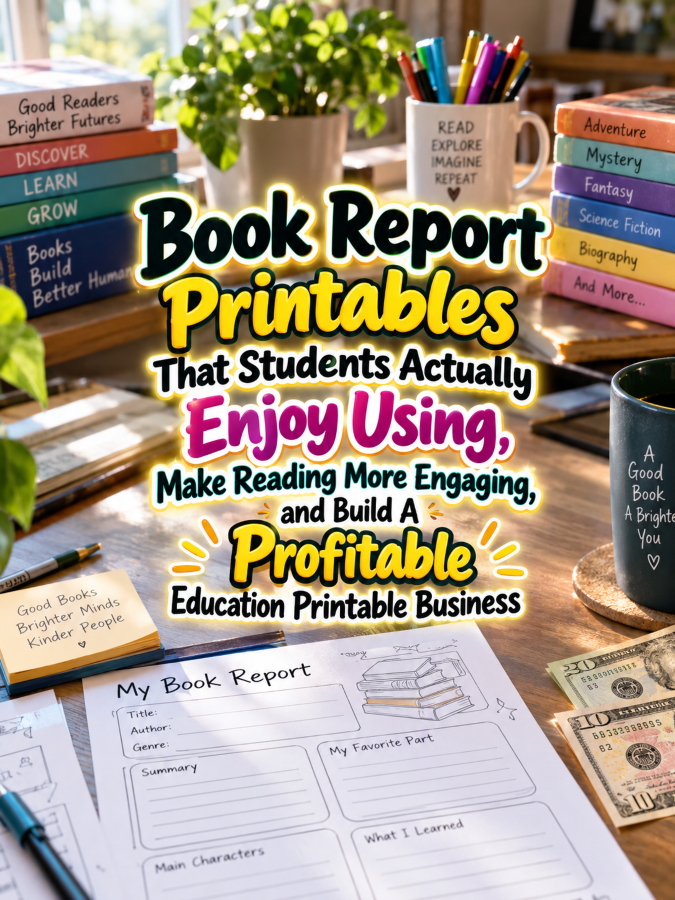
That’s where thoughtfully designed Book Report Printables can make a real difference. Instead of giving students one boring page with a giant blank box and the words “Write Your Report Here,” you can create structured worksheets that help them understand characters, setting, plot, themes, vocabulary, favorite moments, and personal reactions. The result is a product that makes the assignment feel more manageable while still giving students room to think independently.
Parents, teachers, homeschool families, tutors, and students all have reasons to use reading-response materials throughout the school year. That gives you multiple audiences and plenty of opportunities to create related products, from simple reading logs to complete literature study systems. The trick is making the pages useful and engaging without turning every worksheet into a carnival of clip art.
Quick Answer
Book Report Printables are structured worksheets that help students organize their thoughts about a book before, during, and after writing a report. Useful pages can cover book information, characters, setting, plot, conflict, themes, vocabulary, favorite passages, personal reactions, evidence, and final report planning. The strongest products guide students through the thinking process instead of simply asking them to fill in a blank page.
You can start with a $7 Book Report Starter Pack and expand it into a $17 Reading Response Workbook, $27 Complete Book Report System, $47 Literature Study Binder, and $77 Comprehensive Reading Printable Library. Companion products can focus on fiction, nonfiction, biographies, chapter books, book clubs, homeschool reading, and different age groups. That’s a Good Thing because education printables can grow naturally when each new product solves a specific classroom or reading problem.
Why This Niche Works
Reading assignments are a recurring need for students throughout the school year. Teachers assign books, parents encourage reading, homeschool families create literature activities, and tutors need structured materials that help students demonstrate comprehension. A well-designed printable can save adults preparation time while giving students a clear framework for responding to what they’ve read.
Book reports also involve many different skills at once. Students may need to remember details, identify characters, explain a sequence of events, understand vocabulary, find evidence, summarize ideas, and express an opinion. Breaking those skills into smaller worksheets can make a large assignment feel much more approachable.
The audience is broad enough to support multiple product lines. You can create simpler pages for elementary students, more detailed analysis sheets for middle school students, and deeper literature-response workbooks for older students. You can also create teacher versions, homeschool versions, book-club versions, and themed seasonal reading packs.
What You Can Put Inside Book Report Printables
1. Book Information Page
Start with a simple page where students record the basic information about the book. Include title, author, illustrator when appropriate, genre, publication information, number of pages, reading dates, and whether the book was fiction or nonfiction. Add a space for the student to write why they chose or were assigned the book.
You can include a small cover-sketch area where students draw the book cover from memory or create their own version. This gives younger readers a creative starting point while still recording useful information. Keep the page uncluttered so students can complete it quickly before moving into deeper reading activities.
2. Character Analysis Sheets
Character pages help students move beyond simply listing names. Create sections for the main character, supporting characters, personality traits, important actions, relationships, challenges, and changes throughout the story. Add a prompt asking students to provide evidence from the book for their observations.
You can also include a character comparison page where students compare two characters using traits, goals, choices, and relationships. For younger students, use simple prompts such as “What does this character like?” and “How does this character feel?” For older students, you can introduce motivation, conflict, development, and evidence.
3. Setting and Story World Pages
The setting can be more than simply writing down a location and time period. Give students space to describe where and when the story takes place and explain how the setting affects the characters or events. Add sections for important places, atmosphere, weather, culture, or historical context when appropriate.
You can make the page more engaging by including a setting sketch or map area. Students can draw the important location or create a simple map showing where major events happen. This gives visual learners another way to demonstrate understanding.
4. Plot and Story Sequence Maps
Many students understand a story but struggle to summarize it in the right order. Create a plot map with sections such as Beginning, Problem, Important Events, Turning Point, Climax, and Ending. For younger students, you can simplify the structure into Beginning, Middle, and End.
Add arrows or boxes that encourage students to connect events logically. You can also include a “Most Important Event” section that asks students to explain why that moment mattered. This helps students distinguish major story events from the dozens of tiny details that may not belong in a final report.
5. Conflict and Problem-Solving Pages
Conflict is an important part of many stories, but students may need help identifying exactly what the main problem is. Create sections for the central conflict, people or forces involved, attempts to solve the problem, obstacles, and final outcome. Include prompts that encourage students to explain how the conflict affected the story.
You can also introduce simple conflict categories such as Character vs. Character, Character vs. Self, Character vs. Nature, and Character vs. Society. Keep explanations short and student-friendly. The goal is to help students recognize patterns without turning a book report into a vocabulary test about literary terminology.
6. Vocabulary and Important Words Tracker
Reading assignments can introduce students to unfamiliar words, so include a vocabulary tracker. Give students space for the word, page or chapter, guessed meaning, actual meaning, and an original sentence. This can support both reading comprehension and vocabulary development.
You can also include an “Interesting Words” section where students record words they simply enjoy. Not every useful reading activity needs to feel like homework wearing glasses. A little room for curiosity can make the printable more enjoyable.
7. Evidence and Favorite Passage Pages
Students often struggle when teachers ask them to support an opinion with evidence from the book. Create a page where they can record an important passage, page reference, what it shows, and why it matters. For younger students, you can use prompts such as “This part shows…” or “I noticed…” to make the task easier.
Include a favorite moment section as well. Students can explain what happened, why they liked or disliked it, and what it revealed about the story or characters. This gives them a natural bridge from personal reaction to analytical thinking.
8. Final Book Report Planner
Finish the printable with a planning page that helps students organize the actual report. Include sections for introduction, book summary, main characters, important events, themes or lessons, personal response, evidence, and conclusion. The student can use their completed worksheets as reference material while writing.
Add a final checklist covering title and author, clear summary, supporting details, evidence, personal response, spelling, grammar, and required formatting. This turns the worksheets into a complete workflow from reading to finished assignment. That’s a Good Thing because the student doesn’t have to start the final report from a completely blank page.
Tools You’ll Need
Canva can help you create engaging book report worksheets with clean layouts, reading trackers, character maps, plot diagrams, checklists, and writing spaces. You can develop one consistent design system and adapt it for different grade levels and reading activities. Just remember that “engaging” doesn’t mean putting twelve cartoon books on every page.
Google Docs can help you draft worksheet prompts, teacher instructions, student directions, and report-writing frameworks before designing the final pages. It is also useful for organizing different versions by age group or reading level. Get the educational structure right first and make the pages pretty second.
AWeber can help you build an email audience around reading activities, homeschool resources, classroom printables, and student organization. You could offer a free character analysis sheet or book report planning page to attract parents and educators. Then follow up with useful reading tips and related printable resources.
GetResponse can support email campaigns and automated sequences for your education printable business. You could create a short series teaching parents or educators how to help students summarize books, analyze characters, organize evidence, and plan reports. Each lesson can naturally lead readers toward a related printable.
Gumroad can provide a simple storefront for selling downloadable book report worksheets and reading-response products. You can begin with a small starter pack and expand into grade-specific bundles or complete literature systems. This lets you test which reading problems your audience wants solved before building a giant catalog.
Teachable can become useful if you eventually want to teach reading comprehension, book-report writing, or literature study skills. You could pair lessons with printable worksheets that students use while learning. This creates another product format without abandoning the audience you’ve already built.
Amazon book report workbook research can help you study physical book report workbooks, reading journals, literature guides, and student activity books. Pay attention to the features educators and parents repeatedly mention in reviews. Those observations can help you design pages that are genuinely useful instead of simply adding more decorations.
Your 5-Step Action Plan
Step 1: Choose Your Student Age Group
Start by choosing the students your first product will serve. Elementary students may need simple visual prompts, middle school students may need stronger summary and evidence support, and older students may need deeper analysis and structured writing preparation. Trying to make one workbook perfect for every age group can make it confusing for everybody.
Pick one audience and use language, writing space, and page complexity that matches their needs. Once the first version works, you can adapt the framework for other age groups. That’s how you build a product family without creating a giant educational thingee that nobody knows how to use.
Step 2: Break The Report Into Thinking Steps
Don’t begin with the final report page. Think about everything a student needs to understand before they can write a strong report, including characters, setting, plot, conflict, important details, vocabulary, evidence, and personal response. Then create a page or activity that supports each major thinking step.
This makes the printable useful even before the student starts writing. Instead of staring at a blank document, the student gradually collects ideas and evidence while reading. By the time they reach the final report planner, much of the thinking work has already been completed.
Step 3: Make The Pages Feel Like Progress
Students should feel like they’re moving forward as they complete each section. Use clear labels, simple checkboxes, progress markers, and page titles that show what comes next. A student should be able to glance at the workbook and understand whether they’re collecting information, analyzing the book, or preparing to write.
You can also include small milestone sections such as Book Started, Halfway There, Book Finished, Notes Complete, and Report Ready. These little thingees can make a long assignment feel like a series of manageable victories. That’s a Good Thing because finishing five small steps feels much easier than confronting one giant assignment.
Step 4: Build A Product Ladder
Your $7 starter pack could include basic book information, character, setting, plot, and final report planning pages. A $17 expanded reading-response workbook could add vocabulary, evidence tracking, conflict analysis, theme pages, and creative response activities, while a $27 complete system could organize the entire reading-to-report workflow. A $47 literature study binder could include grade-specific resources, reading logs, book-club pages, and teacher-friendly organization, while a $77 comprehensive reading library could bundle multiple age groups and reading formats.
You can also create specialized companion products. Fiction Book Report Packs, Nonfiction Reading Response Worksheets, Biography Report Planners, Chapter Book Study Guides, Homeschool Literature Journals, and Book Club Discussion Packs can each become separate offers. Each product should have a clear purpose so customers understand exactly why they would want it.
Step 5: Market “No More Blank Page Panic”
Your strongest marketing message can focus on the moment students struggle with most: sitting down to write and not knowing where to begin. Show how your worksheets help students collect information, organize ideas, choose evidence, and create an outline before writing the final report. The product becomes a bridge between reading the book and completing the assignment.
Create before-and-after examples that show a blank report becoming an organized plan. Demonstrate how a character worksheet leads to a paragraph, how a plot map becomes a summary, and how an evidence tracker supports an opinion. You’re showing the transformation instead of simply announcing that your printable contains “lots of helpful pages.”
What Comes Next
Once your first Book Report Printable is working, you can expand into different grade levels, genres, and reading assignments. You can create versions for fiction, nonfiction, biographies, historical books, chapter books, graphic novels, and independent reading. You can also build products for book clubs, homeschool families, classroom reading centers, and summer reading programs.
The larger opportunity is to create a complete reading-response ecosystem. A student might start with a reading log, move into a book report workbook, use a vocabulary tracker, complete a character analysis, and eventually create a finished literature portfolio. That’s a Good Thing because your first printable can become the beginning of a much larger education product line.
The goal isn’t to make students love every book they are assigned. Sometimes the book is going to be wonderful, sometimes it will be merely okay, and sometimes the student will develop a passionate relationship with the clock while waiting for reading time to end. Your job is to make the thinking and writing process easier, clearer, and more engaging.
In Part 2, we’ll explore three ways to make your Book Report Printables stand out from the thundering herd, three nifty ways to find customers, three takeaways that can make the product more valuable, and three common mistakes to avoid. We’ll also look at how to scale one book-report product into a broader reading and education printable business.
3 Ways to Stand Out From The Thundering Herd!
Way 1: Make The Printable Feel Like A Reading Adventure
A book report doesn’t have to feel like a worksheet marathon. Add small creative activities that help students interact with the story, such as designing an alternate book cover, creating a character profile, drawing an important setting, or writing a different ending. These activities can make the reading process more enjoyable while still supporting useful comprehension skills.
You can organize the pages so students feel like they’re collecting clues as they read. One page might focus on characters, another on important events, and another on questions or predictions before everything comes together in the final report. That structure makes the printable feel more like a journey and less like a stack of school paperwork.
Way 2: Create “Easy Mode” And “Challenge Mode” Pages
Students don’t all need the same level of support, so give teachers and parents options. Your basic pages can use simple prompts such as “Who?”, “Where?”, “What happened?”, and “What did you think?”, while advanced pages can ask about motivation, symbolism, themes, evidence, and author choices. This lets one product serve different learners without forcing every student to complete every activity.
You can clearly label optional pages as “Challenge,” “Think Deeper,” or “Bonus Analysis.” That makes the workbook feel flexible rather than overwhelming. It also gives educators more control over which pages match a student’s reading level and assignment requirements.
Way 3: Turn The Finished Report Into A Portfolio
Instead of treating the book report as a one-time assignment, create a system that lets students keep a record of the books they’ve read. Add finished-book pages, reading milestones, favorite books, genre trackers, author lists, and personal recommendations. Over time, students can build a visual reading portfolio that shows how their interests develop.
A portfolio section can also include “Books I Want To Read,” “Books I Recommend,” and “Books That Changed My Thinking.” These pages add personality to the product while encouraging students to reflect on reading beyond the assignment itself. That’s a Good Thing because a printable that creates a lasting record has more value than one that gets thrown into a backpack after grading.
3 Nifty Ways to Find Customers
Way 1: Give Teachers A Free Mini Pack
Create a free three-page teacher resource containing a book information sheet, character analysis page, and simple plot map. Make the pages classroom-ready and easy to print so teachers can test them with students without a complicated setup. A useful free resource can introduce educators to your design quality and teaching approach.
Once teachers see that the pages actually work, offer the complete book report collection. You can also create email content around common classroom challenges such as helping students summarize, supporting reluctant writers, and teaching students to use evidence. The goal is to become a useful resource before asking teachers to buy more thingees.
Way 2: Target Parents And Homeschool Families
Parents often need ready-to-use activities that help children demonstrate reading comprehension without spending an hour designing worksheets themselves. Create content showing how a parent can use one book report page during a family reading session or homeschool lesson. Simple demonstrations can make your printable feel approachable rather than like another curriculum package requiring a master’s degree to understand.
You can also create bundles for different age groups. An elementary reading response pack could focus on characters, setting, sequence, vocabulary, and personal reactions, while a middle school pack could add themes, evidence, conflict, and deeper analysis. Specific bundles make it easier for parents to identify the product that fits their child.
Way 3: Create Seasonal Reading Challenges
Summer reading, holiday reading, school-break activities, and new-semester reading goals create natural opportunities for themed products. Build a Summer Reading Challenge Pack with reading logs, book reviews, creative response pages, and a simple reading goal tracker. Then create seasonal versions that encourage students to keep reading throughout the year.
These products can work as entry-level offers while introducing customers to your larger reading printable collection. A family might begin with a $7 summer reading pack and later purchase a complete reading-response workbook. That’s a Good Thing because the seasonal product becomes a doorway into your broader catalog instead of a standalone thingee.
3 Takeaways You Won’t Find Elsewhere!
Takeaway 1: Separate Comprehension From Writing
One reason students struggle with book reports is that they are often asked to understand a book and write about it at the same time. Your printable can make the process easier by separating those two stages. First, students collect and organize what they understand, and then they use those notes to build the final report.
This means your early pages should focus on noticing and recording. Character actions, important events, questions, vocabulary, evidence, and reactions can all be captured before the student worries about paragraphs. Once the information is organized, the writing stage becomes much less intimidating.
Takeaway 2: Ask Better Questions Instead Of Adding More Pages
You don’t need 80 worksheets to create a valuable reading product. A well-written prompt can produce much deeper thinking than several pages of repetitive questions. Instead of asking students to list five character traits, you might ask them to choose one trait and explain how the character’s actions prove it.
Focus on questions that encourage students to explain, compare, predict, connect, and support their ideas. These prompts make the printable more educational without making it unnecessarily long. Remember, more pages don’t automatically mean more value.
Takeaway 3: Give Students A Place To Have An Opinion
Reading comprehension doesn’t have to eliminate personal response. Give students space to explain what they liked, disliked, questioned, found surprising, or would change about the book. These responses can become useful material for the final report while making the activity feel more personal.
You can include prompts such as “Would you recommend this book?”, “Which character would you want to meet?”, “What would you change?”, and “What did this book make you think about?” These questions can make even reluctant readers more willing to participate. That’s a Good Thing because sometimes one genuine opinion is easier to write about than five forced sentences.
3 Common Mistakes to Avoid
Mistake 1: Making Every Page Look The Same
Consistency is useful, but repetition can quickly make a workbook boring. If every page contains the same boxes with slightly different questions, students may feel like they’re completing the same assignment over and over. Use different layouts for character work, plot mapping, vocabulary, creative responses, and final writing preparation.
Keep the overall typography and visual style consistent while allowing the page formats to change when the activity changes. A character map should look different from a vocabulary tracker because students are doing different kinds of thinking. That’s a simple design decision that can make the entire product feel more engaging.
Mistake 2: Making It Too Difficult For The Intended Age
A worksheet designed for a fourth grader shouldn’t read like a university literature seminar. Use age-appropriate vocabulary, writing space, instructions, and expectations. If the student has to ask an adult to explain every question, the worksheet isn’t doing enough of the teaching work itself.
Test your prompts against the age group you intend to serve. Read each instruction aloud and ask whether a student could understand it without additional explanation. If the answer is no, simplify the language before adding another decorative border.
Mistake 3: Forgetting The Teacher Or Parent
The student may be the person using the worksheet, but the teacher or parent is often the person buying it. Include a short instruction page that explains the purpose of the activities, suggested order, possible adaptations, and ways to use the pages for different books. This small addition can make the product much easier for adults to implement.
You can also include a simple answer-guidance or assessment checklist where appropriate. Don’t create rigid answers for open-ended questions, but give adults a framework for evaluating whether the student has supported their thinking. That’s a Good Thing because buyers want to know not only what the worksheet does but how to use it.
Scaling Your Results
Once your basic Book Report Printable gains traction, expand into specific reading needs. You can create Fiction Book Report Packs, Nonfiction Report Worksheets, Biography Study Packs, Character Analysis Workbooks, Reading Response Journals, Vocabulary Trackers, and Book Club Discussion Guides. Each product can solve a distinct problem while using the same overall design system.
Your $7 starter pack can contain the basic book information, character, setting, plot, and final report pages. A $17 Reading Response Workbook can add vocabulary, evidence, conflict, theme, creative response, and deeper-thinking activities, while a $27 Complete Book Report System can guide students from reading through final writing. A $47 Literature Study Binder can include grade-specific resources and reading portfolios, while a $77 Comprehensive Reading Library can bundle multiple grade levels, genres, and specialized activities.
You can also build products around the school calendar. A Back-to-School Reading Pack can help teachers and parents start the year, while a Summer Reading Challenge can create a seasonal offer. Midyear reading-response packs, holiday reading activities, and end-of-year reading portfolios can provide additional products without forcing you to invent an entirely new niche.
A collection containing 40 well-designed reading and book-report products could potentially generate an additional $700 to $2,200 per month through bundles, repeat customers, memberships, and complementary offers, although actual results will vary based on traffic, pricing, product quality, audience fit, and marketing. The important part is to create genuinely different solutions rather than 40 versions of the same worksheet with a different book icon. Your catalog should feel like a useful library, not a photocopier having a creative crisis.
Your Next Steps
Start with one age group and create a simple $7 Book Report Starter Pack. Include the essential thinking steps students need before writing, such as book information, characters, setting, plot, important evidence, personal response, and a final report outline. Keep the language clear and the pages enjoyable enough that students don’t immediately start negotiating with the nearest houseplant about completing the assignment.
Next, create a free character analysis sheet or plot map and use it to attract parents, teachers, homeschool families, and tutors. Create useful content demonstrating how one worksheet helps students move from reading to organized notes and eventually to a finished report. Your audience should be able to see that your product makes the assignment easier to understand.
Then expand based on real demand. If educators ask for nonfiction resources, create them, and if parents want elementary versions, build those, while if students need more writing support, create a report-planning workbook. Let customer questions become your product research because those questions often reveal the next useful thingee.
Final Thoughts
Book Report Printables have a simple job: help students understand what they read and organize their thoughts well enough to communicate those ideas. The best products don’t replace thinking, and they don’t write the report for the student. They simply provide enough structure to make the thinking process less overwhelming.
That makes this a strong printable niche because reading assignments happen repeatedly across the school year. Teachers need classroom resources, parents need ready-to-use activities, homeschool families need flexible materials, and students need clear guidance when a blank page starts looking like an enemy. A thoughtfully designed product can serve all of those needs while creating room for specialized versions.
The real magic is making the printable feel useful rather than boring. Give students creative choices, interesting questions, visual organizers, space for opinions, and a clear path toward the final assignment. When the student thinks, “Oh, I know what I’m supposed to do here,” you’ve solved the problem your product was created to solve.
That’s it. That’s your beginning! Start with one student age group, one reading problem, and one simple printable that turns a blank report page into a series of manageable thinking steps, then expand from there. If you were creating your first book report printable tomorrow morning, what would you help students organize first: characters, plot and events, vocabulary, evidence, or their final report outline?
Enjoy!