Introduction
Soap making can be a wonderfully creative hobby, but once you start making different recipes, testing scents, changing colors, recording ingredients, and trying to remember which batch turned out perfectly, things can get messy fast. Suddenly, your “simple little hobby” has notes on scraps of paper, ingredient lists on your phone, and a recipe card hiding underneath a pile of soap molds.
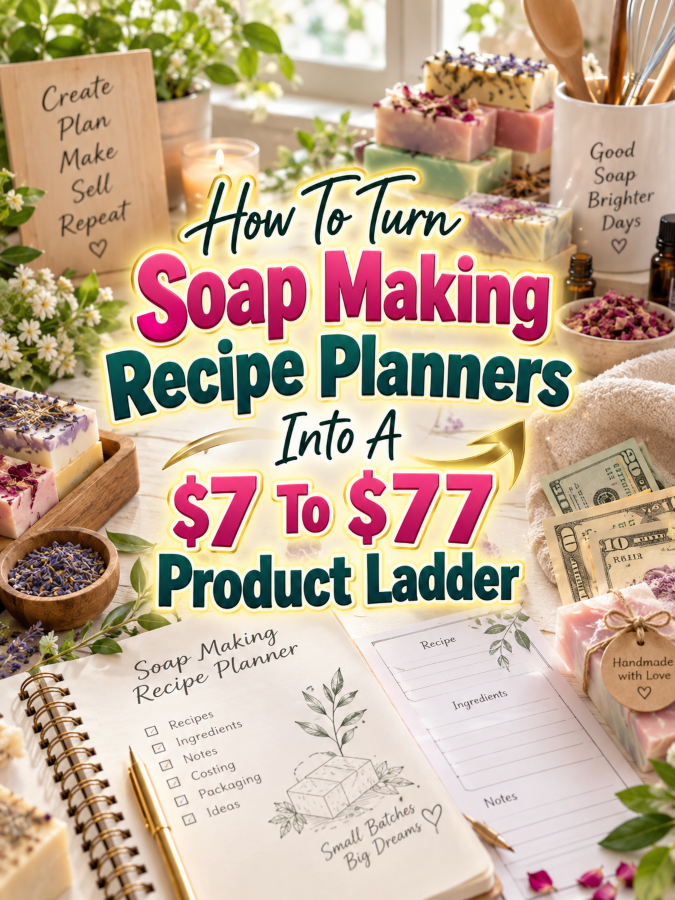
That’s where Soap Making Recipe Planners can become a useful digital product. Instead of creating one giant printable and hoping somebody wants all of it, you can build a product ladder that grows with the customer’s needs. Start with a simple $7 recipe planner, expand it into a recipe and batch tracking kit, turn that into a complete soap making management bundle, and then create a premium editable version.
The secret is making every level more useful. You aren’t charging more because you added another 40 pages of boxes. You’re charging more because the buyer gets a better way to organize recipes, batches, ingredients, testing, and future soap-making projects.
Quick Answer
A $7 to $77 Soap Making Recipe Planner ladder can start with a simple printable recipe sheet and grow into a complete soap making organization system. The $7 version can track a recipe, ingredients, scent, color, batch date, and notes. The $17 to $27 version can add multiple recipe pages, batch trackers, ingredient inventory, testing notes, and production checklists.
The $37 to $47 version can become a complete Soap Making Recipe and Batch Management Bundle with recipe organization, inventory, production planning, batch records, testing logs, and product planning. The $67 to $77 version can add editable Canva templates, digital versions, customization options, labels, promotional templates, and other time-saving assets. The price goes up because the usefulness goes up. That’s the whole game.
Let’s start with why soap makers have enough planning needs to support more than one product.
Why Soap Making Recipe Planners Work As A Product Ladder
Soap makers have plenty of details to keep track of. A recipe may include oils, butters, additives, fragrance or essential oils, colorants, water or other liquids, batch size, dates, and process notes. Depending on the type of soap and the maker’s method, there may also be curing, testing, packaging, and labeling information to remember.
A beginner may only need a clean recipe sheet. Someone with a growing recipe collection may want a recipe library. A frequent soap maker may need batch tracking and ingredient inventory. Someone selling finished soap may want production planning, packaging records, product labels, and content planning as well.
That gives you a natural product ladder because the buyer’s needs can grow. You don’t have to invent problems just to create another product. You can simply solve the next problem that appears as the maker becomes more organized and productive.
That brings us to the most important part: making sure each price level actually earns its price.
The Reasonable Pricing Rule
A $7 product should provide a quick win. A $17 to $27 product should give the buyer a more complete kit. A $37 to $47 product should feel like a working system. A $67 to $77 product should offer premium flexibility, such as editable templates, digital versions, customization, promotional assets, or other time-saving features.
For Soap Making Recipe Planners, the ladder can look like this:
- $7 is for a quick win. Give the buyer a simple recipe planner that helps document one soap recipe and batch.
- $17 to $27 is for a better kit. Add recipe library pages, batch records, ingredient inventory, testing notes, and production checklists.
- $37 to $47 is for a working bundle. Create a complete system for managing recipes, batches, ingredients, production, and finished products.
- $67 to $77 is for a premium editable system. Add editable Canva templates, digital versions, labels, customization instructions, promotional assets, and other practical resources.
The important thing is not to make every level bigger just for the sake of being bigger. The customer should be able to understand exactly why the next version costs more and what problem it solves.
Now let’s build the first offer.
The $7 Starter Product: Soap Making Recipe Planner
The $7 starter can be a clean, printable Soap Making Recipe Planner designed for someone who wants a reliable place to record their recipes. It should be simple enough for a beginner to understand without needing a 30-minute orientation session and a snack.
The main recipe page can include the recipe name, batch date, intended batch size, ingredient list, quantities, scent information, colorants, additives, notes, and results. Add space for the maker to record what they changed from a previous version and what they want to remember for next time.
A batch record can add even more usefulness. The buyer can record the batch number, date made, observations, cure or waiting notes where relevant, and final results. The planner can also include a simple “What I’d Change Next Time” section. That turns the product into a learning tool instead of just a pretty recipe card.
What To Include
- Soap recipe information page
- Ingredient and quantity section
- Scent and color notes
- Additive notes
- Batch date and batch number
- Process observations
- Results and notes
- “What I’d Change Next Time” section
- Simple batch completion checklist
At $7, resist the temptation to include everything. Save the inventory system, production planner, labels, and larger recipe library for the next level. The starter should feel focused and easy to use.
Once the buyer wants to manage more than one recipe, you’ve got a natural reason to introduce the expanded kit.
The $17 To $27 Expanded Kit: Soap Making Recipe & Batch Tracker Kit
The $17 to $27 version can turn the single recipe planner into a small soap making organization system. Instead of documenting one batch, the buyer can organize a growing collection of recipes and batches.
Add multiple recipe sheets and a master recipe index so makers can quickly find their favorite formulas. Include a batch tracker with batch numbers, dates, recipe names, results, and notes. An ingredient inventory page can help users record what they have on hand, what they need to replenish, and which ingredients they use most often.
You can also add scent and additive tracking, production checklists, and a recipe testing page. The goal is to help the maker move from “I made this once” to “I know exactly what I did and can find it again.” That’s a very useful upgrade.
Possible Expanded Kit Contents
- Everything in the $7 starter planner
- Recipe library pages
- Master recipe index
- Batch tracking sheets
- Ingredient inventory tracker
- Supply shopping list
- Scent and fragrance notes
- Color and additive tracker
- Recipe testing log
- Production checklist
- Batch results page
- Recipe revision notes
A price between $17 and $27 makes sense because the customer is getting a repeatable system rather than a single printable. They can use the pages again and again as their recipe collection grows.
Next, we can turn that kit into a complete working system for serious hobbyists and small soap businesses.
The $37 To $47 Working Bundle: Soap Making Recipe & Production Management Bundle
The $37 to $47 version should feel like the buyer’s main soap making command center. It can combine recipe management, batch tracking, inventory, production planning, and finished-product organization in one cohesive bundle.
Start with a master dashboard that helps the maker see their recipes and current batches at a glance. Add production planning pages for upcoming batches, ingredient preparation, packaging needs, and project priorities. A batch history section can make it easier to review previous recipes and see what worked well.
If your audience includes makers who sell finished soap, add optional business-use pages such as product planning, packaging checklists, product photo planning, and simple launch or restock planning. Keep these optional so the planner still works for hobbyists who simply enjoy making soap for themselves, family, or friends.
What Makes The Bundle Feel Complete?
- Master recipe dashboard
- Recipe library and index
- Detailed recipe sheets
- Batch history tracker
- Ingredient inventory
- Supply shopping list
- Recipe testing and revision log
- Production planning pages
- Batch preparation checklist
- Finished product tracker
- Packaging checklist
- Product photography planning page
- Optional gift planning page
- Optional small-business production planner
- QuickStart setup guide
This version should save time by putting related information together. The buyer shouldn’t have to search through six notebooks to figure out which recipe was used for a particular batch. That’s what makes the $47 level feel different from the $27 level.
And now we can add the premium features that make the top of the ladder genuinely different.
The $67 To $77 Premium Kit: Ultimate Soap Making Studio Command Center
The premium version can become the Ultimate Soap Making Studio Command Center. This is where you make the product flexible enough for different types of soap makers and useful enough to justify the higher price.
Editable Canva templates are a strong premium feature. Give buyers editable recipe pages, batch records, inventory sheets, labels, dashboards, and other templates they can customize. Include printable PDFs as ready-to-use versions and digital files where practical.
If you’re serving makers who sell finished products, you can also add promotional templates, simple product announcement graphics, social post templates, content prompts, product photography checklists, and packaging planning pages. If you offer commercial-use or resale rights, spell out exactly what those rights include. Clear terms are always better than vague “do whatever you want” language.
Premium Components
- Everything in the working bundle
- Editable Canva recipe templates
- Editable batch tracking templates
- Editable inventory templates
- Editable labels
- Printable PDF versions
- Digital versions where practical
- Customizable dashboards
- Recipe collection templates
- Production planning templates
- Packaging planning pages
- Product photography planning templates
- Social media promotional templates
- Simple promotional copy prompts
- Customization guide
- Setup checklist
- Clear license terms for any commercial-use rights offered
The $77 version isn’t more expensive because it has more paper. It’s more valuable because the buyer gets editable assets, flexible formats, and a system that can be adapted to their own workflow. That’s a much stronger reason to pay more.
Let’s put the ladder together so you can see how the value increases from one level to the next.
Example $7 To $77 Ladder For Soap Making Recipe Planners
| Price | Product | What It Includes | Primary Value |
|---|---|---|---|
| $7 | Soap Making Recipe Planner | Recipe pages, ingredients, scent and color notes, batch details, observations, results and revision notes | Quick recipe and batch organization |
| $17-$27 | Soap Making Recipe & Batch Tracker Kit | Recipe library, master index, batch tracker, inventory, testing log, shopping list and production checklists | Organizes multiple recipes and batches |
| $37-$47 | Soap Making Recipe & Production Management Bundle | Complete recipe, batch, inventory, production, packaging and finished-product management system | Manages soap projects from planning to completion |
| $67-$77 | Ultimate Soap Making Studio Command Center | Editable Canva files, PDFs, digital versions, labels, customization tools and promotional assets | Flexible, editable and time-saving premium system |
Each level solves a bigger problem. The $7 planner helps someone record a recipe. The $17 to $27 kit helps them manage a collection. The $37 to $47 bundle helps them manage production. The $67 to $77 version gives them editable tools they can customize for their own workflow or business.
That makes the ladder easier to explain and easier for buyers to understand. No mystery. No “premium because premium.” Just more useful help.
Next, let’s look at the tools that can make this product much easier to create.
Tools You Can Use To Create This Ladder
You can build this product line with a relatively simple tool stack. You don’t need expensive software or a room full of gadgets that blink at you.
- Canva: Create printable planners, recipe pages, dashboards, labels, covers, social graphics, and editable premium templates.
- Google Docs: Useful for setup guides, instructions, checklists, and editable text-based resources.
- Google Sheets: Helpful for digital inventory trackers, recipe indexes, and batch dashboards.
- ChatGPT: Use it for brainstorming planner sections, product names, checklists, content ideas, and draft copy.
- Etsy: Useful for researching how printable craft products are presented and for selling your own products if the marketplace fits your business.
- Creative Fabrica: Useful for design resources, provided you follow the license terms for any assets you use.
- Payhip: A simple option for selling and delivering digital products.
- Gumroad: Another option for selling and delivering downloadable products.
Start with Canva and a PDF. That’s enough for the $7 product. As you move up the ladder, you can add editable files, digital dashboards, and additional delivery options.
Remember, the goal is to make the product easier to create and easier to use. If your tool stack starts looking like the control panel of a spaceship, it’s time to simplify.
Before setting your prices, give each offer a quick reality check.
How To Know If Your Price Is Fair
Ask what the buyer is actually getting from each level. A $7 planner should save them time and give them a simple place to organize a recipe. A $27 kit should help them manage several recipes and batches. A $47 bundle should reduce the work involved in managing their soap-making workflow. A $77 premium system should offer flexibility and significant setup savings.
Don’t price based only on the number of pages. Think about usefulness. If ten pages solve a problem better than fifty pages, the ten-page product can be more valuable. Page count is not a personality test.
Use This Price Check
- Does the product solve a clear soap-making problem?
- Does it save the buyer time?
- Can the buyer use it repeatedly?
- Does it help organize recipes or batches?
- Does each higher level add meaningful value?
- Are instructions included where needed?
- Does the premium version provide genuinely editable files?
- Are commercial or resale rights clearly explained if offered?
- Would you feel comfortable buying the product at this price?
A higher price is easier to justify when the buyer can clearly see how the product saves time, reduces confusion, prevents lost information, or makes repeated tasks easier.
Now let’s turn the idea into five action steps.
5-Step Action Plan For Soap Making Recipe Planners
Step 1: Pick One Buyer Problem
Choose one problem such as “I keep losing track of my soap recipes” or “I need a better way to record my batches.” Don’t try to solve every soap-making problem at once. Your first product needs one clear job.
Step 2: Create The $7 Quick Win
Build a simple recipe and batch planner that solves that problem. Include recipe details, ingredients, dates, scent and color notes, observations, results, and a section for future changes. Keep it useful and easy to print.
Step 3: Expand It Into A Kit
Add multiple recipe pages, a recipe index, batch tracking, inventory, shopping lists, testing logs, and production checklists. Make the $17 to $27 version useful for someone managing a growing collection of recipes.
Step 4: Build The Premium Version
Create the complete working bundle and then add editable Canva files, digital versions, labels, customization tools, promotional assets, and clear licensing information where appropriate. Make sure the premium version saves real setup time.
Step 5: Test The Ladder
Compare every level and ask whether the next price provides a clear reason to upgrade. If two products feel too similar, improve the higher version or combine the offers. Customer questions and feedback can help you decide what to add next.
Before you publish, let’s cover the mistakes that can make a good product ladder look weaker than it really is.
Common Pricing Mistakes To Avoid
- Charging $77 for a thin PDF: A small recipe planner doesn’t become premium just because you put a premium price on it.
- Adding pages instead of usefulness: More blank recipe sheets aren’t enough to justify a major price increase.
- Making every version too similar: Each level should solve more of the buyer’s problem.
- Forgetting editable files: If customization is part of the premium promise, include actual editable files.
- Offering unclear rights: Spell out commercial-use or resale terms clearly if you offer them.
- Using fake income claims: A recipe planner can be useful without promising that buyers will make money.
- Making the ladder confusing: Keep the differences between each level obvious.
The fix is simple. Put yourself in the buyer’s shoes and compare the offers side by side. Could you explain in one sentence why someone would move from $7 to $27? Could you explain why they’d move from $47 to $77? If you can, you’re on the right track.
Now let’s give you some promotional ideas that don’t require shouting “LIMITED TIME!” at people every five minutes.
Simple Promo Angles For Soap Making Recipe Planners
- “Keep your soap recipes organized in one place.”
- “Stop losing track of which recipe made that amazing batch.”
- “Track your recipes, batches, ingredients, and results.”
- “Build your own organized soap recipe library.”
- “Keep your soap-making notes out of the scrap-paper pile.”
- “Plan your next batch before you forget what you used last time.”
- “Turn your soap-making notes into a system you can actually use.”
Show the planner in action whenever possible. A short video can show a recipe being recorded, a batch being added to the tracker, and the master dashboard being updated. That tells the story much faster than a wall of sales copy.
You can also offer a free sample recipe page or batch tracker as a lead magnet. Let potential customers see how the planner works before introducing the expanded kit or premium command center.
There are also natural affiliate opportunities around this niche.
Affiliate Opportunities Around Soap Making Organization
Soap makers often need supplies and organization tools, which creates natural opportunities for helpful affiliate content. Depending on your audience and the products available through your affiliate programs, you could discuss storage containers, ingredient storage, measuring tools, molds, cutters, labeling supplies, packaging materials, protective equipment, shelving, and craft-room organization.
The key is to make the content useful even without the affiliate link. An article such as “How To Organize A Small Soap Making Workspace” can recommend practical storage solutions while naturally mentioning your planner as the system used to keep recipes and supplies organized.
You can also create content around planning problems, such as organizing ingredients, tracking batches, setting up a recipe library, or preparing for a production day. The planner becomes part of the solution rather than an unrelated product being squeezed into the article.
Next, let’s build some internal links that can help turn one article into a larger content cluster.
Internal Link Ideas
If you’re building a larger website around craft printables, connect this article to related topics that help the reader solve the next problem.
- How To Organize Soap Making Recipes
- Soap Making Batch Record Printables
- Soap Making Inventory Trackers
- Soap Making Business Planners
- Craft Room Organization Printables
- How To Create Printable Recipe Planners
- How To Sell Soap Making Printables Online
- How To Create Editable Canva Printables
Use descriptive anchor text for these links. A phrase such as “soap making inventory tracker” is much more helpful than a generic “read more.”
And because soap making is a visual hobby, Pinterest gives you plenty of content angles.
Pinterest Ideas For Soap Making Recipe Planners
Create Pinterest pins that focus on specific problems instead of simply saying “Buy My Planner.” Show a clean recipe page, an organized batch tracker, or a before-and-after view of scattered notes becoming a simple system.
- “Soap Making Recipe Planner Printable”
- “Soap Making Batch Tracker Printable”
- “How To Organize Soap Making Recipes”
- “Soap Making Ingredient Inventory Printable”
- “Soap Making Production Planner”
- “Soap Recipe Testing Log Printable”
- “Soap Making Craft Room Organization”
- “Printable Planner For Soap Makers”
Create several pin designs for the same product. One can focus on recipes, another on inventory, another on batch tracking, and another on the premium editable system. One good product can give you many content angles. That’s a much nicer arrangement than constantly chasing the next shiny product idea.
Let’s answer a few questions potential buyers may have.
Frequently Asked Questions
What should a Soap Making Recipe Planner include?
A basic planner can include the recipe name, ingredients and quantities, batch date, batch size, scent and color notes, additives, observations, results, and notes for future changes. The exact fields can be adapted to the type of soap maker you’re serving.
Can I create a planner for both hobbyists and soap businesses?
Yes. Keep the core planner focused on recipes and batches, then add optional production, packaging, product planning, and content pages for makers who sell finished soap. This allows one product family to serve different customer needs.
Should I include specific soap formulas in the planner?
You can include example recipes or sample layouts if you have the appropriate knowledge and are comfortable providing them. However, a recipe planner doesn’t need to provide formulas to be useful. Its main job can be helping users document, organize, and review their own recipes.
What should I add to make a $27 version different from a $7 version?
Add tools that help manage multiple recipes and batches, such as a master recipe index, batch tracker, inventory pages, testing logs, shopping lists, and production checklists. The customer should gain a broader organization system.
What should go into the $47 bundle?
The $47 version can combine recipe management, batch history, inventory, production planning, packaging planning, finished-product tracking, and a QuickStart guide. It should feel like one complete system rather than several unrelated printables.
What makes the $77 version premium?
Editable Canva templates, digital versions, customizable dashboards, labels, promotional templates, specialty pages, and clear setup instructions can make the premium version substantially more flexible. If you offer commercial-use or resale rights, explain those rights clearly.
Do I need to build the $77 product first?
No. Start with the $7 version. Let customer feedback show you which features deserve to become part of the expanded kit and premium bundle. Building the smallest useful product first can save you a lot of time.
Now you have the product idea, the ladder, and the content strategy. Let’s turn it into a simple next move.
Your Next Steps
Create the $7 Soap Making Recipe Planner first. Give it a clear purpose and make sure every page helps the customer record or manage something useful. Don’t worry about making it enormous.
Once the starter product is solid, expand it into the $17 to $27 kit with recipe organization, batch tracking, inventory, testing, and production tools. Then turn those pieces into the $37 to $47 working bundle.
Finally, build the premium version with editable Canva files, digital options, labels, customization tools, and promotional assets. If you want to include commercial-use or resale rights, document them clearly before you put the product on sale.
Your first step can be as simple as opening Canva and designing one recipe page. One useful page can become a $7 product. That product can become a kit. That kit can become a complete product line.
You don’t need to boil the ocean. You’re making soap, not trying to manage the ocean’s inventory system.
Final Ladder Summary
| Level | Suggested Price | Core Offer | Value Added |
|---|---|---|---|
| Starter | $7 | Soap Making Recipe Planner | Quick recipe and batch organization |
| Expanded Kit | $17-$27 | Soap Making Recipe & Batch Tracker Kit | Recipe library, inventory, testing and production tracking |
| Working Bundle | $37-$47 | Soap Making Recipe & Production Management Bundle | Complete recipe, batch, inventory and production system |
| Premium | $67-$77 | Ultimate Soap Making Studio Command Center | Editable assets, digital versions, labels, customization and promotional tools |
The $7 version gives the buyer a quick win. The $17 to $27 version gives them a broader organization kit. The $37 to $47 version gives them a working system. The $67 to $77 version gives them editable assets and time-saving flexibility.
That’s what makes the ladder work. Each level adds usefulness instead of simply adding pages.
Conclusion
Soap Making Recipe Planners can become much more than a simple printable. They can grow into a complete organization product line for hobbyists, collectors, gift makers, and small soap businesses.
Start with the simple problem of keeping recipes organized. Then solve the next problem: tracking batches. Then inventory. Then production. Then customization and business support. Each step gives you another useful reason for the customer to move up the ladder.
You don’t need to create everything today. Create one excellent $7 planner first. Make it easy to use. Learn from the questions customers ask. Then build the next level based on what actually helps them.
That’s how you turn one practical printable into a product ladder without turning your craft business into a giant monster manual wearing a business hat.
So here’s what you discovered today. If something sparked your interest, take it as your sign to start moving toward that goal now. Even one small step counts.
Enjoy!