Introduction
Artists love to create, but that doesn’t mean they always know what to draw next. Sometimes the sketchbook is sitting right there, looking innocent and full of possibility, while the artist is staring at it as if it personally offended them. That creative hesitation is exactly where a well-designed sketchbook challenge workbook can become incredibly useful.
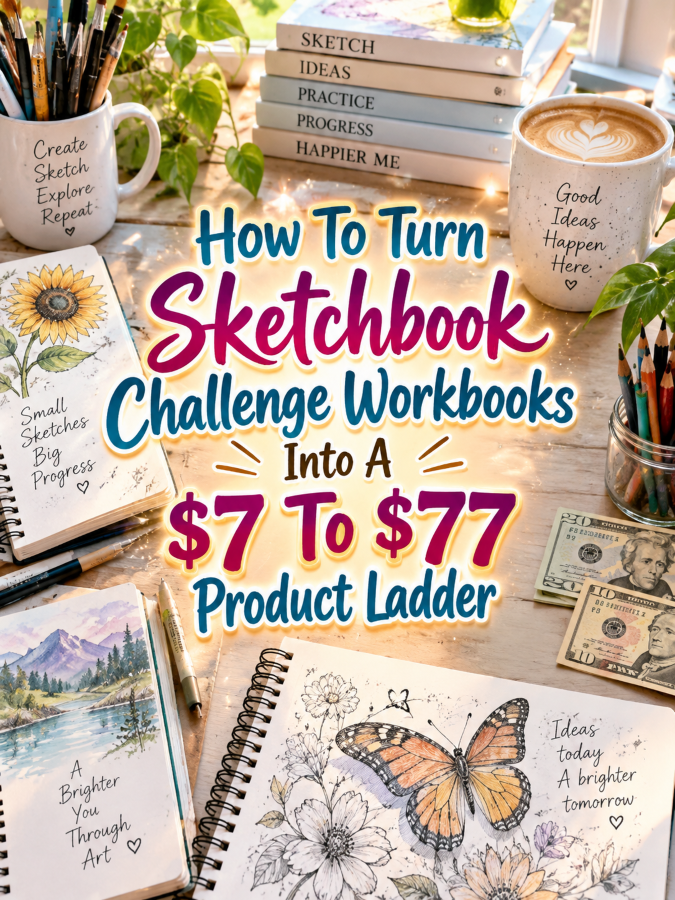
A sketchbook challenge workbook gives artists structure without taking away the fun of creating. It can provide prompts, progress trackers, creative exercises, reflection pages, project ideas, and gentle accountability that helps artists keep showing up. Better yet, those same components can be packaged into a product ladder that starts with an affordable $7 quick win and grows into a $77 premium creative system.
The goal isn’t to create one enormous workbook and slap a higher price on it. That’s Not a Good Thing. Instead, each level should solve a bigger problem, provide more flexibility, and give the buyer a stronger reason to move from one offer to the next.
Quick Answer
The easiest way to build a sketchbook challenge workbook product ladder is to begin with a focused $7 challenge, expand it into a $17–$27 creative toolkit, turn that into a $37–$47 complete challenge system, and finish with a $67–$77 premium editable bundle.
Your $7 product might contain a 30-day sketchbook challenge with daily prompts and simple progress tracking. Your middle offers can add themed prompts, creative exercises, trackers, idea banks, and reflection pages, while the premium version can include editable templates, multiple challenge lengths, specialty editions, bonus resources, and promotional materials.
This creates a natural progression from “Give me something to draw” to “Help me stay consistent” to “Give me an entire creative system.” That progression is what makes the ladder work.
Why Sketchbook Challenge Workbooks Work As A Product Ladder
Sketchbook challenges solve a very specific creative problem: getting started and continuing. Artists may have plenty of supplies, ideas, and good intentions, but consistency can be surprisingly difficult when every blank page requires a brand-new decision. A challenge workbook removes some of that decision fatigue by giving the artist a clear next step.
The niche also has excellent opportunities for specialization. You can create challenges for beginners, portrait artists, urban sketchers, nature artists, mixed-media creators, character designers, watercolorists, doodlers, journal artists, or people simply trying to rebuild a daily drawing habit. That means one basic product concept can become multiple focused editions instead of one giant everything-and-the-kitchen-sink workbook.
That’s always a Good Thing because niche variations can create additional products without requiring you to reinvent the entire business. You can reuse the underlying framework while changing prompts, examples, exercises, themes, and visual styling. The thundering herd of possibilities is suddenly much easier to manage.
The Reasonable Pricing Rule
Price your sketchbook challenge products according to the usefulness of the transformation, not the number of pages. A 20-page workbook that gets an artist drawing every day can be more valuable than a 100-page document that contains 80 pages of decorative filler. Nobody needs a creative planner that requires its own filing cabinet.
The $7 level should provide a quick and obvious win. The $17–$27 level should give buyers more variety and organization. The $37–$47 level should feel like a complete system for running a meaningful creative challenge, while the $67–$77 level should offer substantial flexibility, editability, specialization, and convenience.
Think of the ladder as increasing results, flexibility, and creative control. When buyers can clearly see why the next level would make their creative life easier, the price feels much more reasonable.
$7 Starter: 30-Day Sketchbook Challenge Workbook
Your $7 starter should be simple enough that someone can purchase it and begin using it almost immediately. A strong version could include 30 daily sketch prompts, a challenge calendar, a simple progress tracker, and a few reflection pages for recording favorite drawings and creative discoveries.
The key is to keep the challenge focused. Don’t try to teach every art technique known to humanity in a $7 workbook. Give the customer a clear creative mission and enough structure to make opening the sketchbook feel easy.
You could offer different themes such as 30 Days of Drawing Faces, 30 Days of Nature Sketching, 30 Days of Everyday Objects, or 30 Days of Creative Doodles. These focused editions can also become excellent follow-up offers once buyers finish their first challenge.
$17–$27 Expanded Kit: Sketchbook Challenge Toolkit
At the next level, give artists more choices and more ways to stay engaged. A $17–$27 toolkit could include several challenge calendars, themed prompt collections, warm-up exercises, idea generators, creative reflection pages, habit trackers, and “what should I draw today?” prompt cards.
This level should feel substantially more useful than the starter without simply being three times as many pages. Variety is valuable here because artists often enjoy switching between subjects and approaches when their creative energy changes. One day they may want a serious portrait exercise, and the next day they may want to draw a suspicious-looking houseplant.
You can also organize the toolkit around different challenge lengths, such as 7-day, 14-day, 30-day, and 60-day options. That gives customers flexibility while making the product feel like a reusable creative resource rather than a one-and-done download.
$37–$47 Working Bundle: Complete Sketchbook Challenge System
The $37–$47 bundle should help an artist run a complete creative challenge from beginning to end. Include challenge planning pages, goal-setting worksheets, prompt libraries, progress trackers, creative warm-ups, project planning sheets, review pages, and end-of-challenge reflection tools.
This is also a great place to introduce different challenge themes. You could include beginner drawing, creativity recovery, daily sketching, observational drawing, character development, nature journaling, and mixed-media challenges. The buyer isn’t merely purchasing prompts anymore; they’re purchasing a structured system for building a consistent creative practice.
Consider adding printable and digital-friendly versions where appropriate. A buyer who can print the workbook, use it on a tablet, or copy selected pages into their preferred digital note-taking system receives more flexibility without requiring you to create an entirely unrelated product.
$67–$77 Premium Editable Sketchbook Challenge Kit
The premium offer should focus on flexibility and creative control. This could include editable Canva templates, multiple complete challenge editions, customizable prompt pages, printable and digital formats, challenge calendars, promotional graphics, social-media content ideas, and bonus creative-planning resources.
You can also create versions for different audiences. For example, the premium bundle might contain beginner-friendly challenges, advanced artist challenges, themed seasonal challenges, and specialized prompt collections. Instead of forcing every customer through the same creative path, you’re giving them a toolbox they can adapt to their own style.
If you’re selling to other creators rather than only end-user artists, you can also include properly licensed commercial-use components where your licensing permits it. Be extremely clear about what customers may edit, sell, share, or redistribute. “Commercial use” should never be a mysterious thingee hiding in the fine print.
Example Product Ladder
| Price | Product | Core Value |
|---|---|---|
| $7 | 30-Day Sketchbook Challenge | Quick creative win |
| $17–$27 | Sketchbook Challenge Toolkit | More prompts, themes, and tracking tools |
| $37–$47 | Complete Sketchbook Challenge System | Full creative practice framework |
| $67–$77 | Premium Editable Challenge Kit | Maximum flexibility and customization |
The important part is that every level has a different job. The $7 offer gets the artist moving, the middle offer keeps the creative momentum going, the $37–$47 bundle creates a complete system, and the premium offer gives the customer control and customization.
That makes the upgrade path feel natural instead of pushy. A buyer who loves the first challenge can immediately understand why additional prompts, themes, planning tools, and editable resources would be useful.
Recommended Tools
Canva is an excellent choice for designing attractive challenge workbooks, prompt cards, calendars, trackers, and editable premium templates. Its flexibility also makes it easier to create multiple themed editions without rebuilding your entire layout from scratch.
ChatGPT can help brainstorm prompt categories, challenge themes, reflection questions, product descriptions, promotional copy, and variations for different skill levels. The important part is to review and refine generated ideas so the finished prompts actually feel creative rather than like a robot was locked inside a stationery shop.
For selling, platforms such as Etsy, Payhip, and Gumroad can give you different ways to reach buyers and package your digital products. You can also use Systeme.io if you want to build a broader sales funnel around your product ladder.
How To Know If Your Price Is Fair
Ask yourself what the buyer can accomplish with the product that would be harder without it. If the answer is simply “they receive 80 pages of prompts,” your value proposition needs work. If the answer is “they can follow a structured 30-day creative routine without spending every morning wondering what to draw,” you have a much stronger value story.
Compare the amount of decision-making you remove, the organization you provide, the flexibility you offer, and the time you save. A premium product can justify a higher price when it meaningfully reduces work for the buyer or gives them reusable resources they can return to repeatedly.
Most importantly, make sure every upgrade adds genuine value. If the $77 version is essentially the $7 version wearing a fancy hat, customers will notice.
5-Step Action Plan
- Create the $7 challenge first. Build one focused challenge with clear prompts, a tracker, and a simple completion goal.
- Expand the prompt library. Add themes, challenge lengths, warm-ups, and creative exercises for the $17–$27 level.
- Build the complete system. Add planning, tracking, reflection, and project-development tools for the $37–$47 bundle.
- Add premium flexibility. Create editable templates, multiple editions, digital versions, and promotional bonuses for the $67–$77 offer.
- Connect the ladder. Use your thank-you pages, product descriptions, email sequences, and social content to show buyers the logical next step.
Build the first level before trying to create the entire empire. You don’t need 300 prompts on day one. You need one useful product that solves one recognizable problem and gives you a foundation for the next offer.
Once the starter product is working, expansion becomes much easier. You’re building upward from something proven instead of wandering through the wilderness with a clipboard and no idea where the trail went.
Common Pricing Mistakes
One common mistake is pricing according to page count. More pages do not automatically equal more value, especially when many pages repeat the same concept with slightly different borders. Buyers want useful creative guidance, not a paper avalanche.
Another mistake is putting every feature into the $7 product. That makes upgrading difficult because the customer already received everything. Your ladder works better when each level answers a bigger need.
A third mistake is making the premium offer complicated instead of flexible. Premium should make the customer’s life easier, not give them a 47-step installation ceremony before they can draw a cat.
Where To Find Buyers
Artists naturally gather in communities where they share work, seek inspiration, participate in challenges, and look for ways to maintain creative habits. Pinterest is particularly useful because challenge ideas, drawing prompts, printable worksheets, and creative routines can all work well as visual search content.
Etsy can be useful for buyers already searching for printable art resources, while social platforms can help you demonstrate the product in action. Show the workbook being used rather than only displaying a pretty cover. A short video showing a prompt, the corresponding sketchbook page, and the finished drawing can communicate the product’s value quickly.
You can also create free mini-challenges as lead magnets. Give away a 5-day challenge, then introduce the $7 product as the natural next step. That’s a much warmer invitation than shouting “BUY MY WORKBOOK!” into the internet and hoping somebody brings snacks.
Affiliate Opportunities
Sketchbook challenge products can naturally connect with affiliate opportunities around art supplies, sketchbooks, drawing tools, storage products, digital tablets, creative software, and educational resources. The strongest affiliate content should complement the challenge instead of becoming a random shopping list.
For example, you could publish content around creating a daily sketching station, choosing a beginner sketchbook, organizing art supplies, or building a portable sketching kit. Your challenge workbook then becomes part of a larger ecosystem of helpful creative resources.
Keep affiliate recommendations genuinely useful and clearly disclosed. The goal is to become a trusted creative guide, not the internet’s most enthusiastic distributor of links.
Internal Links
Connect this article to related content about printable planners, creative workbooks, drawing resources, digital product creation, Etsy selling, printable product design, and other hobby-based product ladders. Internal links can help readers move from inspiration into related solutions while giving search engines a clearer understanding of your site’s content structure.
You can also build topic clusters around creative productivity. A sketchbook challenge article could naturally link to posts about art project planners, creative habit trackers, artist journals, printable art prompts, and digital product ideas for artists.
Pinterest Ideas
Create Pinterest graphics that focus on specific outcomes rather than simply announcing that a workbook exists. Strong angles include 30 Sketchbook Prompts To Beat Creative Blocks, How To Start A Daily Sketchbook Challenge, Printable Drawing Challenge Ideas, and How Artists Can Build A Consistent Sketching Habit.
Each pin can lead to a relevant article or product page. You can also create several visual treatments from the same core idea so that your promotion doesn’t look like the same pin wearing a slightly different sweater.
FAQ
What should a $7 sketchbook challenge include?
A focused $7 challenge can include daily prompts, a challenge calendar, a progress tracker, and a few reflection pages. Keep it simple enough that the customer can start immediately.
How many prompts should be in a premium workbook?
There isn’t one magic number. Focus on variety, usefulness, organization, and reuse rather than chasing an arbitrary page count.
Can sketchbook challenges be sold as printable products?
Yes. Printable challenges are a natural fit because artists can keep the workbook beside their sketchbook and physically mark their progress. Digital-friendly versions can provide additional convenience.
Can I create multiple sketchbook challenge products?
Absolutely. You can specialize challenges by subject, skill level, season, medium, or creative goal. This gives you multiple products while allowing you to reuse a proven framework.
What makes the $77 product different?
The premium offer should provide significantly more flexibility, customization, and convenience. Editable templates, multiple challenge editions, specialty resources, digital formats, and promotional assets can all contribute to premium value when they genuinely help the customer.
Promo Angles
Beat The Blank Page: Position the workbook as a simple way to know exactly what to draw next.
30 Days Of Creative Momentum: Focus on consistency and the satisfaction of completing a daily challenge.
Turn Creative Blocks Into Drawing Prompts: Emphasize the practical solution for artists who struggle with what to create.
Build Your Sketchbook Habit: Target artists who want to draw more consistently without turning creativity into another stressful obligation.
From One Challenge To A Complete Creative System: Highlight the progression from a simple prompt workbook to a comprehensive artist productivity toolkit.
Final Product Ladder Summary
The $7 Sketchbook Challenge provides a focused creative quick win. The $17–$27 Sketchbook Challenge Toolkit adds variety, themes, exercises, and tracking resources. The $37–$47 Complete Sketchbook Challenge System gives artists a more comprehensive framework for planning, completing, and reflecting on creative challenges.
The $67–$77 Premium Editable Sketchbook Challenge Kit adds customization, multiple editions, editable templates, digital options, and other high-value resources. Each level should feel like a meaningful improvement in usefulness rather than simply a larger pile of pages.
That is the secret to making the ladder feel good to buy. Every step should make the artist think, “Oh, that would make this easier.” When the upgrade feels like a helpful next step instead of a sales ambush, you’ve built the ladder correctly.
Conclusion
Sketchbook challenge workbooks are more than collections of drawing prompts. Done well, they give artists structure, momentum, accountability, and a reason to keep opening the sketchbook. Those benefits create plenty of room for a digital product ladder that serves customers at different levels of commitment.
Start with one focused $7 challenge. Expand it into a toolkit, develop a complete system, and then add premium flexibility through editable templates and specialized resources. You don’t need to create everything at once; you simply need to make each next offer more useful than the one before it.
And remember, the blank sketchbook isn’t the enemy. It’s just waiting for you to give it a job. Your workbook can be the friendly little boss that says, “Today we’re drawing something,” before creative procrastination has time to organize a committee meeting.
So here’s what you discovered today. If something sparked your interest, take it as your sign to start moving toward that goal now. Even one small step counts.
Enjoy!